
Description
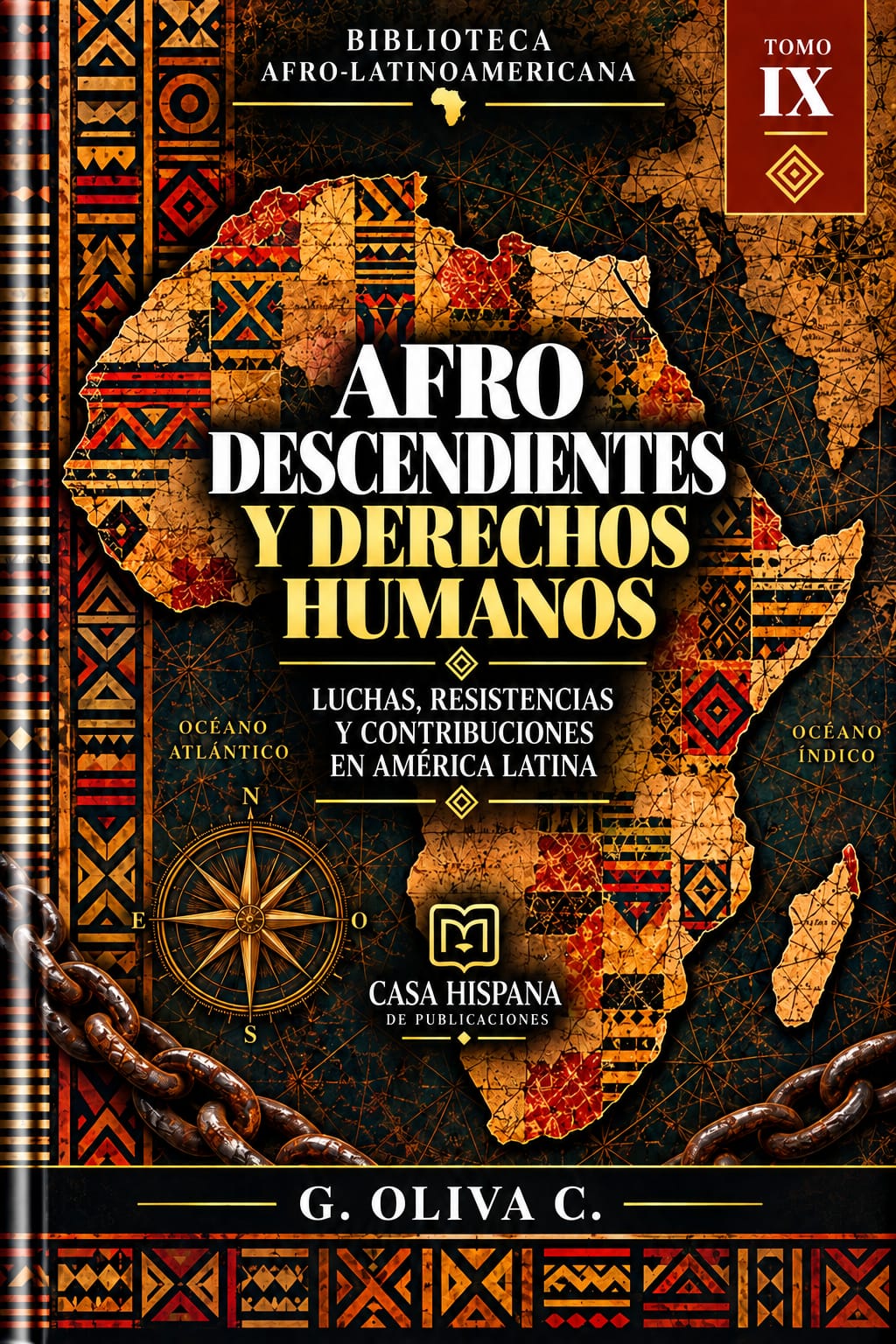
To speak of Afro-descendants and human rights in Latin America means placing at the centre of reflection a historical question that continues to run through contemporary societies: what happens when populations that took a decisive part in the economic, cultural, social and political construction of a region have had to travel a long road to attain not only legal freedom, but also full recognition as subjects of rights, citizens and communities bearing memory, identity and heritage. Latin American Afro-descendant history shows that the abolition of slavery was a fundamental legal transformation, but it did not automatically resolve inherited inequalities nor by itself guarantee equivalent access to education, property, political participation, justice, representation, work, housing, health or cultural recognition. Freedom legally eliminated the condition of property over the person. Citizenship opened a new framework of political belonging. Equality before the law established an indispensable principle. However, between the proclamation of a right and the effective possibility of exercising it there can be a considerable distance. Precisely in that distance lies a good part of the history of the human rights of Afro-descendant populations. Freedom - Citizenship - Equality - Recognition - Participation - Justice. This sequence makes it possible to understand that legal emancipation was a beginning and not the end of the historical construction of equality. From the perspective developed by the author, human rights offer a particularly important language for approaching this trajectory, because they place human dignity before any racial classification, economic condition, nationality, family origin or social position. Dignity does not arise when an institution recognises a person. Legal recognition protects a dignity the person already possesses. This distinction is fundamental. During slavery the law could declare that a human being was property. That declaration had real legal effects within the slaveholding order, but it did not morally turn the person into a thing. Unjust law could deny freedom. It could not ontologically transform humanity into merchandise. Similarly, the racial theories developed and spread during certain historical periods could classify populations through supposedly natural hierarchies, but no classification could alter the fundamental equality of the human condition. For this reason a reflection on Afro-descendance and human rights does not begin by asking what rights should be granted to a given population. It begins by affirming that no population needs to demonstrate historical, cultural, intellectual, economic or moral merit in order to possess fundamental rights. Dignity is not granted; it is recognised. Rights do not depend on colour. Humanity needs no certification. This principle protects the analysis against a frequent temptation: justifying equality by listing great Afro-descendant contributions. It is important to recover scientists, writers, workers, musicians, religious leaders, educators, entrepreneurs, artists, intellectuals and communities that took part in the construction of Latin America, but their achievements are not the reason why Afro-descendant people deserve rights. Rights also belong to the unknown, the poor, the anonymous worker, the child, the elderly, the one who will never hold public office and the one who will not appear in any book. Dignity precedes social recognition. This affirmation establishes a fundamental difference between heritage and rights. The previous volume could show the extraordinary African heritage present in religion, music, language, cuisine, identity and heritage. This volume must take one step further. A society can admire Afro-descendant music and continue to discriminate against certain Afro-descendant people. It can declare a celebration heritage and maintain barriers to access to opportunities. It can consume cuisine of African root and reproduce racial stereotypes. It can incorporate Black symbols in advertising and maintain scant Afro-descendant participation in certain decision-making spaces. For this reason cultural recognition and recognition of rights are related, but they are not equivalent. Heritage does not replace citizenship. Visibility does not replace equality. Cultural celebration does not replace rights. This triad is one of the keys of the present volume. Recognition has several dimensions. There is legal recognition when the law identifies rights and establishes mechanisms of protection. There is historical recognition when a society incorporates certain experiences into its public memory. There is cultural recognition when languages, religions, music, traditions, knowledge and heritage receive appreciation and protection. There is social recognition when people are treated in daily life as equally dignified members of the community. There is political recognition when they can take part in decisions that affect their lives through the mechanisms established by each democratic system. These dimensions can advance at different speeds. A country can have anti-discrimination legislation and continue to face discriminatory practices. It can recognise Afro-descendant heritage and maintain educational gaps. It can incorporate census categories and continue to debate how to interpret their results. It can develop specific policies and maintain legitimate controversies about design, scope and effectiveness. Serious study needs to distinguish norm, implementation and result. A law can be legally significant even if its application is imperfect. A statistical inequality may require additional research before attributing causality. An individual experience of discrimination can be real without automatically allowing generalisation about a whole institution. The defence of human rights gains strength when it uses precise evidence. This methodological concern runs through the research developed by the author. The purpose is neither to turn every social difference into automatic proof of racism nor to deny that certain structures can generate racially unequal results. The challenge consists in identifying mechanisms. Where does the barrier appear? In education? In hiring? In access to credit? In housing? In territorial recognition? In the administration of justice? In representation? In social treatment? What evidence exists? What period is analysed? What population? What territory? What additional variables intervene? Precision makes it possible to distinguish direct discrimination, historical inequality, socioeconomic exclusion, territorial differences and other processes that may interact. This distinction is indispensable because human rights should not become rhetorical language disconnected from verifiable facts. A right needs a subject, content, obligation and protection mechanism. A complaint needs context. A policy needs evaluation. A reparation needs to identify damage. An investigation needs sources. Justice without evidence can become a slogan. Evidence without dignity can become cold statistics. Human rights need both: rigour and humanity. History explains why this combination is necessary. African populations were forcibly displaced to the Americas within systems that transformed people into legal merchandise. Their descendants went through processes of resistance, manumission, emancipation and abolition. After abolition another stage began: building citizenship within societies that had for generations organised economic and social relations through categories of status, colour, origin and condition. Not all Latin American societies followed the same path. The chronologies of abolition were different. Demographic compositions varied. Racial categories had different meanings. Political systems changed. Regional economies followed diverse trajectories. For this reason there is no single Latin American Afro-descendant experience. Brazil, Colombia, Ecuador, Peru, Venezuela, Uruguay, Argentina, Cuba, the Dominican Republic, Mexico, Central American countries and other contexts must be studied according to their particular histories. Even within the same country there may be deep differences between coastal regions, cities, rural territories, traditional communities and migratory spaces. To speak of "Afro-descendants" as if they formed a homogeneous community would be to repeat a simplification that history itself refutes. There are differences of class, gender, religion, education, territory, nationality, generation, profession, political orientation, family experiences and forms of identification. Human rights protect precisely that diversity. Equality does not demand uniformity. Collective recognition should not erase individuality. This tension is fundamental. One person may identify intensely as Afro-descendant and take an active part in community organisations. Another may recognise African ancestry but give greater centrality to national, regional, religious or professional identity. Another may use a different racial category according to the conventions of their country. Statistical systems need categories to produce information, but no administrative category exhausts a person's identity. The census counts people. It does not completely define who they are. This distinction acquires special relevance when racial statistics are used. Data can reveal important patterns in income, schooling, health, housing, employment or representation. But categories may change between censuses and countries. Self-identification may increase through cultural transformations without an equivalent demographic change. International comparisons need methodological harmonisation. Figures must be interpreted within their classification system. This caution does not diminish their usefulness. It strengthens it. A data-based policy needs to understand how the data were produced. Human rights require statistical visibility when invisibility prevents the detection of problems, but they also require privacy, data protection and the prevention of discriminatory uses. Recording racial identity can help to identify inequalities. It also demands responsible governance. Sensitive information should not become a tool of surveillance or abusive classification. This tension will be increasingly important with artificial intelligence and large databases. Algorithms can reproduce biases present in historical data or produce unequal results through indirect variables. However, it should not automatically be assumed that any algorithmic difference constitutes racial discrimination. Auditing is needed: training data, variables, error rates, affected groups, decision context and consequences. Technology does not eliminate the need for human rights. It makes it more complex. The right not to be discriminated against enters into systems of credit, hiring, security, education and digital services. Twenty-first-century equality is also played out in databases. This contemporary dimension shows that Afro-descendant rights do not belong solely to the memory of slavery. They are the rights of current citizens within technological, urban and globalised societies. Reducing Afro-descendance to the past would be another form of invisibility. Territory is an especially important dimension of the subtitle, but it needs to be treated with precision. Not every Afro-descendant population maintains the same legal or cultural relationship with a specific territory. There are rural, coastal and traditional communities whose collective history may be deeply linked to certain spaces. There are also urban populations whose identity developed over generations in neighbourhoods and cities. There are highly mobile people and contemporary diasporas. For this reason territory must not…
Category
- AFRO-DESCENDANTS
- HUMAN RIGHTS
- HUMAN DIGNITY
- RECOGNITION
- SOCIAL JUSTICE
- RACIAL JUSTICE
- RACIAL EQUALITY
- RACIAL DISCRIMINATION
- STRUCTURAL RACISM
- COLLECTIVE RIGHTS
- CIVIL RIGHTS
- AFRO-DESCENDANT CITIZENSHIP
- TERRITORY
- TERRITORIAL RIGHTS
- AFRO-DESCENDANT IDENTITY
- CULTURAL HERITAGE
- SOCIAL PARTICIPATION
- SOCIAL INCLUSION
- HISTORICAL MEMORY
- AFRO-LATIN AMERICAN HISTORY
Rights for this book
We turn publishing rights into international growth, connecting authors and publishers with new markets, new readers and new partners around the world.
Technical details
- Title
- Afrodescendientes y derechos humanos
- Author
- G. Oliva C.
- Imprint
- Grupo Editorial casa Hispana
- Size
- 15x23cms
- Edition
- 1st edition, 2026
- Published in
- Chile
- Year of publication
- 2026
- Available languages
- Spanish, English, German, Portuguese
- Binding
- Paperback with flaps
- Pages
- 587