Description
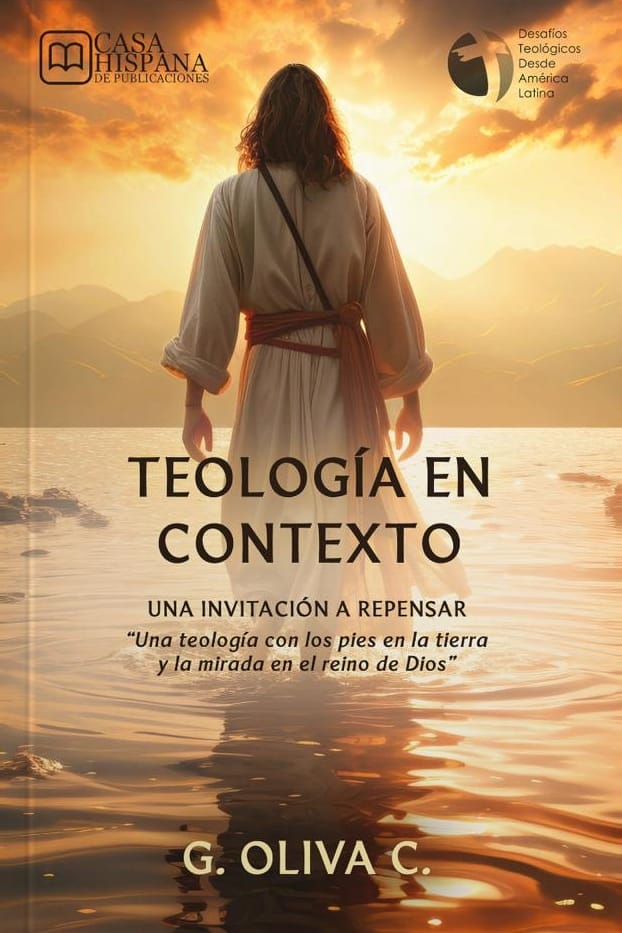
Theology in Context is a theological project aimed at recovering the indispensable relationship between biblical revelation, historical reality and the concrete experience of Christian communities. Its approach starts from a fundamental conviction: theology cannot be developed in isolation from the questions, sufferings, cultures, hopes and transformations that run through peoples. To think theologically means listening to Scripture with rigour and, at the same time, responsibly understanding the world in which the Church has been called to live, serve and proclaim the Gospel. The work is the result of the author's disciplined, systematic and interdisciplinary labour, developed out of theological research, biblical reflection, pastoral and missionary experience and the observation of the social and cultural realities of Latin America. This process seeks to articulate doctrine and life, faith and culture, Church and society, mission and human transformation, avoiding both a theology reduced to abstract formulations and a reading of the context detached from the foundation of the Scriptures. From this perspective, contextual theology does not seek to replace the biblical message or to adapt the Gospel arbitrarily to the trends of each age. Its purpose is to understand how Christian truth can be interpreted, communicated and lived responsibly within specific historical and cultural contexts, maintaining a critical relationship between text, tradition, community and reality. The context thus becomes not the ultimate source of theology, but the human and historical space where theological questions acquire a face, urgency and meaning. The particular importance of this project for the Latin American Church lies in recognising that Latin America possesses historical, cultural and spiritual experiences that demand a theological reflection capable of dialoguing with its own reality. Poverty and inequality, migration, cultural diversity, indigenous peoples, urbanisation, environmental crisis, violence, exclusion, the transformation of families, secularisation, religious plurality and new social configurations form part of the scenario in which Christian communities currently carry out their mission. For this reason, Theology in Context proposes a Church that does not contemplate reality from a distance, but learns to discern the presence and action of God in the midst of history. Christian mission then acquires a deeply incarnational dimension: proclaiming Jesus Christ, forming disciples, accompanying human beings, defending their dignity, building community, promoting reconciliation and responsibly taking up the care of creation. A significant contribution of the work also consists in recognising the plurality of expressions of the Church. The worldwide Christian community is not a culturally uniform reality. It is expressed in urban and rural churches, indigenous communities, migrant congregations, historic and evangelical churches, missionary movements, communities on the periphery and multiple Christian traditions. Theology needs to develop the capacity to listen to these voices without giving up critical dialogue, academic rigour or the centrality of biblical revelation. In this sense, although the project is born of a deep Latin American sensibility, its horizon transcends Latin America. The processes of globalisation, human mobility, interculturality, ecological crisis and religious transformation have made contextualisation a relevant question for the worldwide Church. Africa, Asia, Europe, Latin America, the Caribbean and the Christian communities of the diaspora face the common challenge of communicating a historic faith within societies that are changing at speed. The interdisciplinary dimension is therefore essential. Theology enters into conversation with history, anthropology, sociology, missiology, cultural studies, human rights and environmental problems, not to dilute its identity, but to understand more deeply the people and communities to whom it directs its reflection and service. This openness makes it possible to build a theology that is intellectually rigorous and, at the same time, pastorally close. At the centre of Theology in Context remains Jesus Christ. Contextualisation finds in the incarnation a decisive paradigm: God enters human history, dwells among people and communicates his grace within concrete historical circumstances. For this reason, a truly contextual theology must also be biblical, Christ-centred, communal, missionary, critical and deeply human. The project thus represents…
Category
- BIBLICAL THEOLOGY
- SYSTEMATIC THEOLOGY
- CONTEXTUAL HERMENEUTICS
- CONTEXTUAL CHRISTOLOGY
- ECCLESIOLOGY
- MISSIOLOGY
- INTERCULTURAL THEOLOGY
- INTEGRAL MISSION
- CHURCH AND SOCIETY
- CHRISTIAN ETHICS
- ECOTHEOLOGY
- INDIGENOUS PEOPLES AND THEOLOGY
- HUMAN RIGHTS AND THEOLOGY
Rights for this book
We turn publishing rights into international growth, connecting authors and publishers with new markets, new readers and new partners around the world.
Technical details
- Title
- Teología en Contexto
- Author
- G. Oliva C.
- Imprint
- Grupo Editorial casa Hispana
- Size
- 15x23cms
- Edition
- 1st edition, 2025
- Published in
- Chile
- Year of publication
- 2026
- Available languages
- Spanish, English, German, Portuguese
- Binding
- Paperback with flaps
- Pages
- 575