
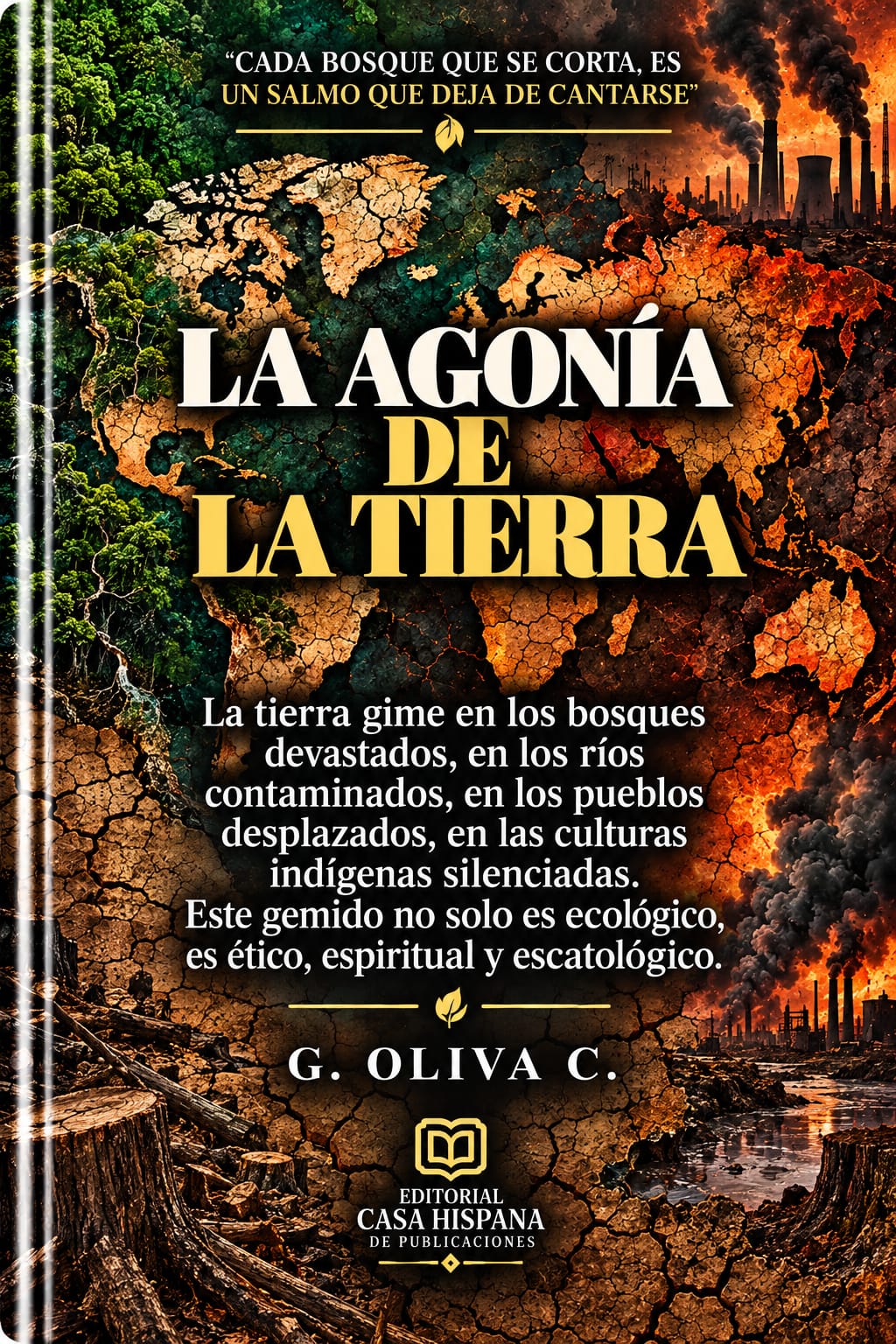
Description
The expression the agony of the Earth constitutes a deeply meaningful metaphor for describing the progressive deterioration experienced by numerous natural systems as a consequence of the interaction between climate change, loss of biodiversity, pollution, degradation of ecosystems, overexploitation of resources, urban expansion, transformation of territories and models of production and consumption that exert growing pressure on the planet's regenerative capacities; to speak of an Earth in agony does not mean literally affirming that the planet is dying like an organism, but using an image capable of expressing the gravity of an ecological crisis that affects the environmental conditions needed to sustain the extraordinary diversity of life and the wellbeing of human societies; this precision is fundamental because the Earth as a planet will continue to exist regardless of many of the transformations produced by our civilisation; what is really under threat is the stability of certain ecosystems, biodiversity, the availability of essential resources and the conditions that allow human communities and other forms of life to develop within healthy and relatively stable environments. From the author's perspective the agony of the Earth also represents a crisis in our relationship with nature; for much of modern history economic development was accompanied by an extraordinary expansion of the human capacity to transform territories, extract resources, produce energy, transport goods, modify ecosystems and increase productivity; these transformations allowed important material, scientific, technological, sanitary and social advances, but they also generated environmental externalities whose cumulative magnitude has become increasingly evident; the problem is not simply that humanity uses natural resources; every society needs water, food, energy, minerals, timber, soil and territory to sustain life; the challenge appears when the speed and scale of extraction, pollution and transformation exceed the capacity of ecosystems to regenerate, absorb impacts or maintain their essential functions. The contemporary environmental crisis must therefore be understood as a multidimensional phenomenon; there is not a single agony but multiple ecological processes that interact with one another; climate change can intensify droughts, modify precipitation, alter ocean temperatures and increase certain extreme risks; loss of biodiversity can diminish ecological resilience; deforestation can modify water cycles and reduce carbon storage; soil degradation can affect food production; pollution can deteriorate water, air and ecosystems; and overexploitation can reduce species populations or locally exhaust resources; when these processes converge within the same territory their consequences can be amplified. One of the concerns running through this work consists precisely in avoiding a fragmented understanding of the environmental crisis; a forest cannot be analysed only as a collection of trees, because it takes part in cycles of water, carbon, nutrients, biodiversity and territorial regulation; a river is not merely a volume of water available for consumption, because it sustains ecosystems, connects territories, transports nutrients, supports economic activities and may hold cultural meanings; an ocean is not simply a fishing reserve, because it plays a decisive part in climate regulation and sustains extraordinarily complex ecological networks; the Earth functions through interdependent systems, and this interdependence obliges us to think ecologically. Climate change constitutes one of the most important expressions of this crisis, because the accumulation of greenhouse gases coming mainly from human activities has altered the energy balance of the climate system, producing a global warming that manifests itself in different ways according to regions and ecosystems; its consequences cannot be reduced solely to the average rise in temperature, because they affect oceans, ice, precipitation, climate extremes, ecological cycles, agriculture, infrastructure and water availability. The warming of the oceans constitutes an especially important dimension, because it can modify the distribution of species, marine ecosystems and coastal dynamics, while sea-level rise represents a growing challenge for certain cities, islands, wetlands and coastal communities. The retreat of glaciers and transformations of the cryosphere can modify water systems and mountain landscapes, affecting territories where water from snow and ice performs relevant functions. Heatwaves can increase health risks, especially for older people, children, exposed workers and populations with less access to adequate housing, while prolonged droughts can affect agriculture, ecosystems and water security. However, the author considers it necessary to avoid an environmental narrative based exclusively on catastrophes; scientific knowledge about climate change should not be used to produce hopelessness but to guide prevention, adaptation, mitigation and responsible transformation; the gravity of a problem does not eliminate the human capacity to respond, and history shows that societies, institutions, science and technology can profoundly change their practices when they recognise sufficiently important risks. The loss of biodiversity constitutes another fundamental component of the environmental agony; species, populations and habitats face multiple pressures associated with territorial transformation, direct exploitation, pollution, invasive species and climate change; biodiversity does not have only an instrumental value related to the benefits it provides to people; it also constitutes the expression of millions of years of evolutionary history and forms part of ecological systems whose complexity we still only partially understand. The disappearance of a species can alter relationships with other species, and certain cumulative losses can modify ecosystem functions, although the specific impact varies considerably according to organism and ecosystem; for this reason conservation needs to be based on rigorous research and not only on emotional criteria. Forests represent one of the spaces where this tension becomes particularly visible; they provide habitat, store carbon, take part in water cycles, protect soils and sustain communities, but they also constitute sources of timber, food, medicines, employment and productive territory; the solution does not necessarily consist in prohibiting all use but in distinguishing between sustainable management and irreversible destruction. Deforestation can respond to multiple causes: agriculture, livestock, infrastructure, urban expansion, timber extraction, fires and other processes; for this reason solutions need to adapt to each context; restoration, responsible forest management, protected areas, land-use planning, economic incentives and community participation can form part of complementary strategies…
Category
- ENVIRONMENT
- ENVIRONMENTAL CRISIS
- ECOLOGICAL CRISIS
- CLIMATE CHANGE
- BIODIVERSITY
- ENVIRONMENTAL DEGRADATION
- POLLUTION
- NATURAL RESOURCES
- ECOSYSTEMS
- ENVIRONMENTAL CONSERVATION
- ECOLOGICAL RESTORATION
- ENVIRONMENTAL JUSTICE
- CLIMATE JUSTICE
- SUSTAINABLE DEVELOPMENT
- SUSTAINABILITY
- INTEGRAL ECOLOGY
- ECOTHEOLOGY
- CARE OF CREATION
- ENVIRONMENTAL RESPONSIBILITY
- INTERGENERATIONAL RESPONSIBILITY
Rights for this book
We turn publishing rights into international growth, connecting authors and publishers with new markets, new readers and new partners around the world.
Technical details
- Title
- La agonía de la tierra
- Author
- G. Oliva C.
- Imprint
- Grupo Editorial casa Hispana
- Size
- 15x23cms
- Edition
- 1st edition, 2025
- Published in
- Chile
- Year of publication
- 2026
- Available languages
- Spanish, English, German, Portuguese
- Binding
- Paperback with flaps
- Pages
- 455