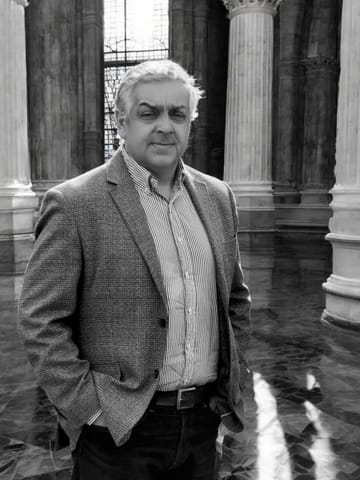
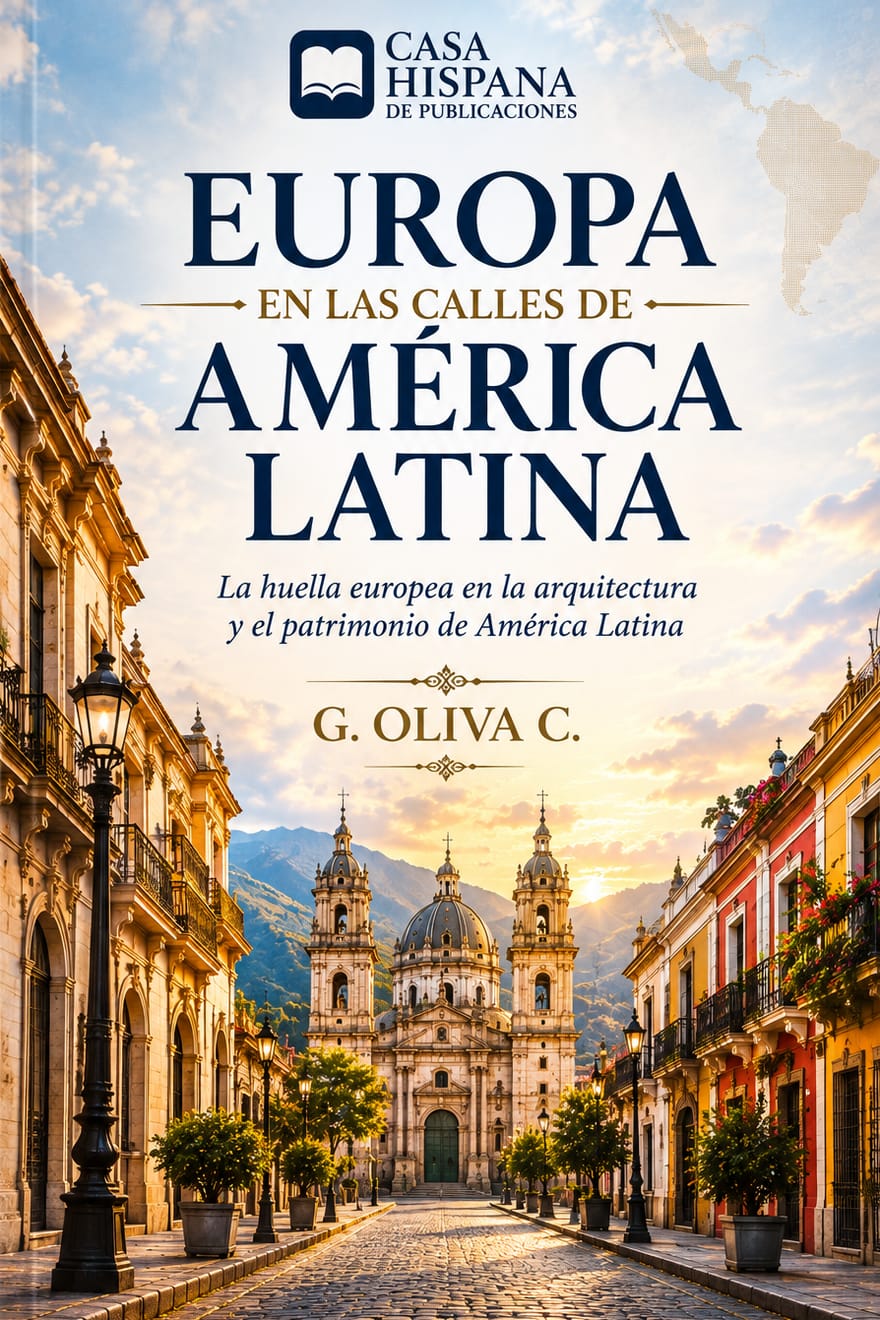
Description
Europa en las calles de Latinoamérica offers a historical, urban and cultural reading of the traces that the European presence left on the shaping of Latin American cities. The work starts from a reality that is easy to observe but historically complex: to walk through many of Latin America's historic centres is to move through spaces where colonial layouts, squares, churches, railway stations, markets, public palaces, theatres, avenues, residential districts, monuments and buildings coexist, their architecture bearing witness to centuries of cultural exchange, appropriation, imposition, adaptation and reinterpretation. The book's central thesis holds that the Latin American city cannot be understood solely as a reproduction of European models, nor exclusively as a break with them. Its urban identity arose from far more complex processes involving Indigenous peoples, African and Afro-descendant populations, European colonisers, later migrants and local communities who constantly transformed the spaces they inhabited. Consequently, the presence of Europe in Latin American streets must be interpreted critically. Europe is present in numerous names, institutions, buildings, architectural styles and conceptions of urban planning; but those expressions were implanted, negotiated and ultimately given new meaning within societies profoundly different from those that originally produced them. Europe arrived as power, but also as culture; as empire, but also as migration; as an urban model, but also as an influence that Latin America ended up transforming. From this perspective, the street becomes the work's principal analytical setting. The street is not merely infrastructure. It is an archive. In it remain successive layers of history. A colonial building may stand beside a republican construction; a railway station of British influence may coexist with a palace inspired by French models; a church raised according to Iberian traditions may occupy a space that previously held another territorial significance; a district formed by Italian, German, Croatian, Portuguese or Spanish immigrants may later be absorbed into a culturally mestizo metropolis. The city thus functions as an urban palimpsest: each generation writes over what it received, but never manages to erase the earlier inscriptions completely. The first major period studied corresponds to the Iberian expansion that began at the end of the fifteenth century. The Spanish and Portuguese conquest produced profound territorial transformations. The founding and reorganisation of cities was a decisive instrument for administering territories, organising populations, establishing authorities and linking economic networks. Squares, administrative buildings, churches, streets and commercial spaces formed part of a new organisation of the territory. Urban planning was not, therefore, an exclusively aesthetic matter. To Order Space Was Also A Way Of Exercising Power. This statement makes it possible to connect urban history with political history. Whoever defines where the centre lies, who occupies particular spaces, where institutions are installed and how the different sectors of a city are distributed also takes part in organising social relations. However, Latin American urban construction never took place on culturally empty territory. Before the European arrival there were important Indigenous forms of spatial organisation, from great urban centres to settlements adapted to specific environmental and cultural conditions. For that reason, to speak of European foundation requires precision. In some cases new settlements were created; in others, colonial structures were established over spaces previously inhabited and organised. The work insists that Latin American urban history begins before the colonial city. Before the colonial square there was territory. Before the European name there was memory. Before the imperial map there were peoples who already inhabited the space. This perspective prevents Latin America from being presented as a passive stage on which Europe unilaterally built an urban civilisation. The colonial city was also a space of encounter, conflict and transformation. Indigenous people, Europeans, Africans and mestizo populations took part in different ways in its material and social construction. Craftsmen, masons, labourers, traders, clergy, officials, enslaved people and local communities helped to raise and maintain those spaces. For that reason, a building of European inspiration constructed in Latin America is not necessarily an exclusively European work. Its design may derive from a particular architectural tradition, while its materials, workers, techniques, climatic adaptations and social uses belong to another reality. Here appears one of the central concepts of Europa en las calles de Latinoamérica: the cultural appropriation of space. Imported forms change when they are inhabited. A square designed according to a given model may acquire unexpected social functions. A European architecture must adapt to the tropical, Andean or southern climate. The available materials transform building techniques. Local traditions modify ornamentation and uses. The inhabitants end up appropriating spaces that originally answered to other projects. In this way, Latin America did not confine itself to copying Europe. It received it, adapted it, argued with it and transformed it. The nineteenth century represents a second fundamental period. After the independences, the new republics faced the challenge of building national identities while retaining numerous cultural structures inherited from the colonial period. Paradoxically, breaking politically with the European empires did not mean abandoning Europe culturally. The republican elites continued to look to European models of education, law, architecture, science, fashion and urban planning. France acquired a particularly important influence in certain intellectual and urban circles, while Great Britain exercised a significant economic and technological presence linked, among other processes, to trade and railway development. Italian, German, Portuguese and other European influences also acquired relevance depending on each country and region. The result was a new Latin American paradox: the republics sought to build their political independence while part of their elites continued to look towards Europe as a benchmark of modernity. This tension became visible in the city. Avenues, theatres, stations, parks, government buildings, public promenades and residential districts were frequently conceived in architectural languages associated with the modern aspirations of the republican elites. Architecture then became a political statement. To construct certain buildings did not mean only meeting functional needs. It meant communicating order, progress, civilisation, stability and membership of a particular international imaginary. For that reason, the book proposes reading architecture as a historical document. A façade may express social aspirations. A monument may reveal who were regarded as heroes. The name of an avenue may show which memory the State wished to institutionalise. A railway station may reveal economic connections. A district may preserve the memory of a migration. A square may bear witness to political transformations. The whole city can be interpreted as an archive. Streets speak. Buildings preserve memory. Monuments construct narratives. The names of public space reveal which history a society decided to remember. The book gives particular weight to the European migrations of the nineteenth and twentieth centuries. Italians, Spaniards, Portuguese, Germans, Britons, French, Croats and other groups took part in various migratory processes towards Latin America. The characteristics and scale of these movements varied profoundly between countries. Argentina, Brazil, Uruguay, Chile and other societies experienced differentiated migratory processes that altered districts, economies, institutions, cuisines, associations, educational systems and cultural expressions. This second Europe was different from the conquering Europe. Not every European arrived as the representative of an empire. Many arrived as migrants, workers, craftsmen, traders, professionals or families seeking new opportunities. This distinction is indispensable if an excessively uniform narrative is to be avoided. Conquest and migration are not synonyms. Coloniser and migrant are not one and the same historical category. Indeed, one of the conceptual strengths of Europa en las calles de Latinoamérica lies in recognising the different Europes that reached the continent. There was an imperial Europe. A missionary Europe. A commercial Europe. An intellectual Europe. A migrant Europe. An industrial Europe. An architectural Europe. And all of them were received differently by Latin American societies that were equally diverse. The European presence can also be observed in infrastructure. Railway, port and industrial development radically altered numerous cities during the nineteenth and twentieth centuries. Stations, bridges, markets, factories and working-class districts introduced new forms of territorial organisation. Modernisation altered the relationship between city and time. The railway shortened distances. The port connected economies. Industry reorganised districts. Avenues transformed journeys. Public lighting changed the experience of the night. New means of transport progressively extended the urban frontiers. But modernisation did not necessarily mean equality. This is another of the book's central arguments. Latin American cities could display monumental buildings and, at the same time, contain deep social contrasts. The architecture of progress could coexist with poverty, precarious housing and segregation. Urban modernity did not reach all the city's inhabitants in the same way. This observation makes it possible to introduce the social dimension of space. Cities distribute opportunities and inequalities geographically. Certain sectors concentrate services, infrastructure, heritage and economic power, while others may remain historically marginalised. Urban geography is also social geography. For that reason, Europa en las calles de Latinoamérica does not set out to be simply a catalogue of European buildings. Its purpose is to understand the relations between architecture, power, memory, identity and society. This perspective leads inevitably to heritage. Which buildings should be preserved? Which memories do they represent? To whom does heritage belong? Can a construction associated with a period of domination later become shared heritage? Does preserving mean celebrating? The work maintains that to conserve is not necessarily to glorify. A society may preserve a colonial building precisely because it makes it possible to understand its history critically. Heritage need not function as an uncritical monument. It can become a space of historical education. This consideration is especially important in contemporary debates about monuments, street names and symbols associated with colonial processes. Eliminating every uncomfortable trace of the past can impoverish memory. Maintaining it without contextualisation can also reproduce partial narratives. Between the two extremes there is a more rigorous possibility: to conserve, investigate, contextualise and explain. The city can thus be turned into a public classroom. The author's research pays equal attention to what monumental narratives tend to conceal: the people who physically built the cities. Behind great works there were workers. Behind European façades there were Indigenous, African, Afro-descendant, mestizo, migrant and working-class hands. Behind projects designed by renowned architects there were masons, carpenters, stonecutters, blacksmiths and craftsmen whose names often disappeared from the official accounts. This observation introduces a profoundly human dimension: The History Of Architecture Is Not Only The History Of Those Who Design; It Is Also The History Of Those Who Build. The book therefore proposes broadening the notion of heritage. Heritage is not only palaces, cathedrals and government buildings. It is also markets, stations, working-class districts, traditional dwellings, workshops, cemeteries, community spaces and cultural landscapes. Urban memory dwells as much in the monumental as in the everyday. The work also addresses the problem of Latin American identity. If so many cities bear European influences, does this mean that their identity is European? The answer proposed is no. Influence does not amount to total identity. Latin America arose precisely from historical processes of encounter, conflict, mixture, imposition, resistance and creation. Its cities have European components, but also Indigenous, African and Afro-descendant ones, and many later contributions. That is why the author proposes speaking of culturally stratified cities. Each era adds a layer. Indigenous Territory – Colonial City – Republican City – Migrant City – Industrial City – Contemporary Metropolis. These layers do not succeed one another cleanly. They overlap. A Latin American historic centre may contain at once the traces of five centuries. From this springs one of the work's fundamental ideas: Europe is in the streets of Latin America, but those streets are no longer European. They are Latin American. This statement sums up the process of historical appropriation. An architectural form may have been born in Europe, but after generations of being integrated into Santiago, Buenos Aires, Montevideo, Lima, Mexico City, Bogotá, Havana, São Paulo, Rio de Janeiro or any other city of the continent, it acquires new associations, uses and memories. Heritage changes meaning when the community that inhabits it changes. The work also establishes a dialogue between urban memory and decolonisation. To decolonise the interpretation of the city does not necessarily mean destroying everything of European origin. It means abandoning the idea that Europe is the sole subject of Latin American urban history. A decolonised gaze also asks about Indigenous people, Afro-descendants, workers, women, migrants and the working classes. It asks who designed. But also who built. Who paid. Who worked. Who was displaced. Who was able to live in certain sectors. And who remained outside them. In this sense, urban space becomes the setting of a struggle over memory. Whoever names the streets, raises the monuments and decides which buildings deserve to be preserved also takes part in the construction of collective memory. For the author, this discussion should not lead to a simplistic opposition between Europe and Latin America. Five centuries of history have produced relations too deep to be interpreted through binary categories. Europe forms part of Latin American history. But it is not the whole of that history. To acknowledge European influence does not require denying colonial violence. To acknowledge colonial violence does not require denying all the cultural exchanges that followed. To value a building does not imply justifying the political system within which it was built. To vindicate Indigenous and Afro-descendant memories does not require erasing the contributions of migrant communities. Historical maturity consists precisely in holding these complexities together. The work's conceptual sequence may be summarised thus: Territory – Conquest – City – Colony – Architecture – Power – Independence – Modernity – Migration – Transformation – Heritage – Memory – Identity. From this perspective, Europa en las calles de Latinoamérica stands at the intersection of urban history, cultural geography, architecture, heritage, migration studies, memory and Latin American identity. Its contribution lies in teaching us to look at the city in another way. A street ceases to be merely a thoroughfare. A façade ceases to be only an old construction. A station ceases to be simply infrastructure. A monument ceases to be a statue. All of them can become documents. The whole city can be read. And when we learn to read it we discover that Latin America preserves in its streets the traces of conquests and resistances, imperial projects and independences, migrations and mixtures, elites and workers, architects and craftsmen, official memories and forgotten memories. That is why the title carries a meaning that goes beyond architecture. Europa en las calles de Latinoamérica does not mean that Latin America is still Europe. It means that history left traces. Some were imposed. Others were imported. Others arrived with migrants. They were adapted. And almost all of them ended up being transformed. The work's great conclusion lies precisely there: Latin American cities are not imperfect copies of European cities; they are historical constructions in their own right, which drew on European, Indigenous, African and later global elements to produce original urban spaces. To walk through their streets is, then, to walk upon layers of history. Europe is present in many of their façades; the Indigenous peoples remain in the territory and in memory; Africa dwells in their culture; the migrations transformed their districts; and Latin America, after centuries of encounters and conflicts, turned all those traces into an urban geography that finally belongs to it…
Category
- URBAN HISTORY
- LATIN AMERICAN ARCHITECTURE
- EUROPEAN INFLUENCE
- CULTURAL HERITAGE
- URBAN MEMORY
- LATIN AMERICA
Rights for this book
We turn publishing rights into international growth, connecting authors and publishers with new markets, new readers and new partners around the world.
Technical details
- Title
- Europa en las calles de América Latina
- Author
- G. Oliva C.
- Imprint
- Grupo Editorial casa Hispana
- Size
- 15x23cms
- Edition
- 1st edition, 2024
- Published in
- Chile
- Year of publication
- 2024
- Available languages
- Spanish, English, German, Portuguese
- Binding
- Paperback with flaps
- Pages
- 497