Description
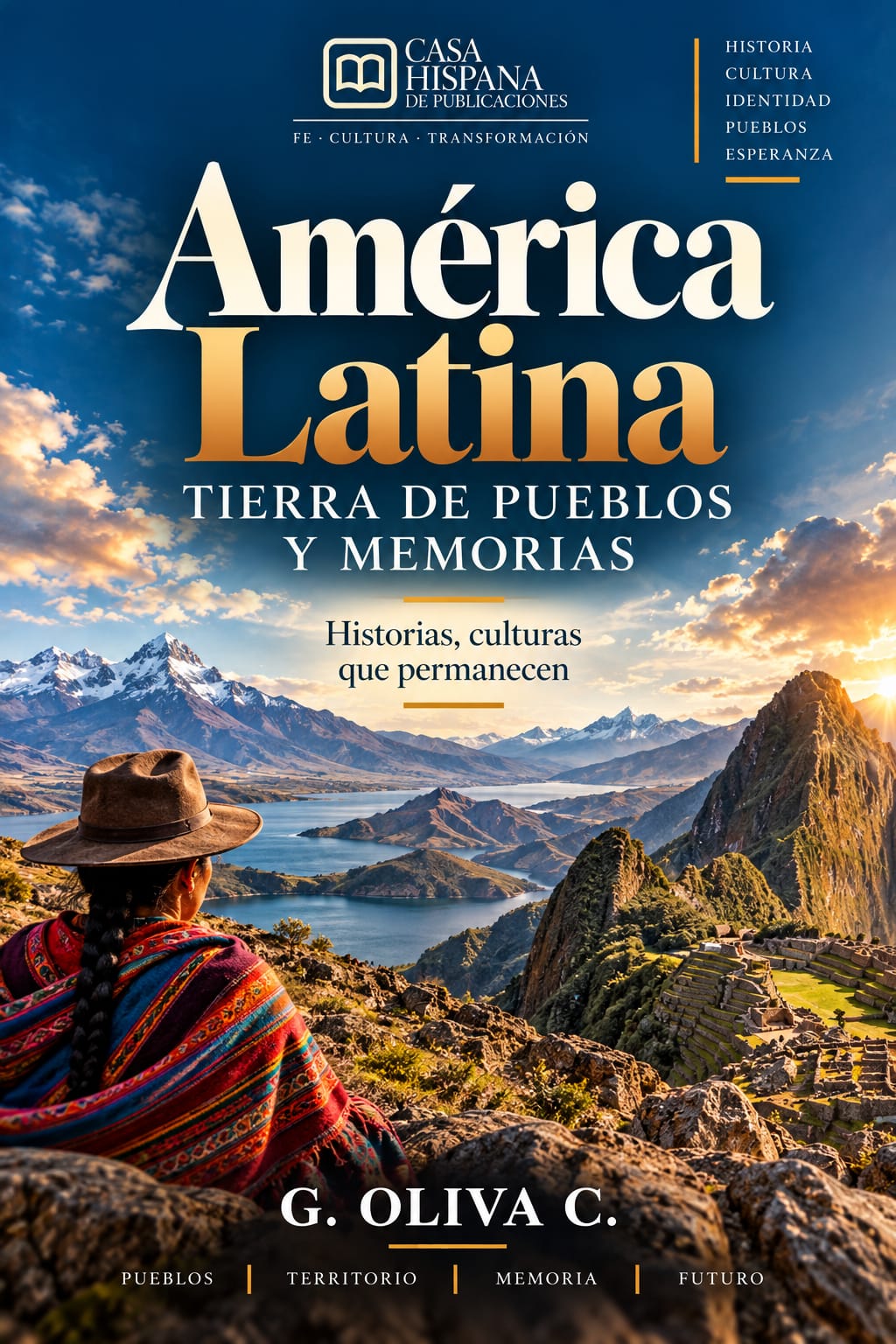
América Latina: tierra de pueblos y memorias offers a historical, cultural and social reading of the Latin American continent from a fundamental premise: Latin America is not a homogeneous reality, but a space built by many peoples, territories, languages, memories and historical experiences. Understanding it requires going beyond the narratives that reduce its history exclusively to the European conquest, to the formation of the nation states or to the generalised idea of mestizaje. Long before the contemporary political configuration there were societies with their own forms of organisation, territoriality, spirituality, economy, knowledge and memory. The work places at the centre of its analysis three closely related categories: Peoples – Territories – Memories. Peoples build relationships with particular spaces; territories preserve traces of those relationships; and memory makes it possible to transmit meanings, experiences and identities between generations. From this perspective, Latin America appears as a historical geography permanently under construction. The starting point necessarily lies with the Indigenous peoples. Before the continent was called America, and long before the political and cultural category of Latin America emerged, there were countless Indigenous societies. Some developed great political structures and urban centres; others organised their life through territorial communities, agricultural systems, trading networks and forms of mobility adapted to specific ecosystems. The Andes, Amazonia, Mesoamerica, the Caribbean, Patagonia, the Chaco and many other regions were spaces of intense human diversity. This observation leads to a central affirmation: Latin America does not begin with the arrival of Europe. The conquest represents a decisive transformation of its history, but it is not its point of origin. Recognising this wider time frame makes it possible to recover the historical depth of peoples whose memories predate contemporary national borders. The Mapuche, Aymara, Quechua, Maya and Guaraní, and many Amazonian, Andean and Mesoamerican peoples and peoples of other regions, have particular trajectories that cannot be reduced to a single category simply labelled “Indigenous”. Diversity is therefore one of the interpretative keys of the book. There is no single Latin American Indigenous people, just as there is no single way of being Afro-descendant, mestizo, migrant or Latin American. The European conquest radically altered these human geographies. Territorial occupation, wars, epidemics, the reorganisation of populations, evangelisation and the incorporation of the American territories into imperial structures produced demographic, economic and cultural transformations of enormous depth. However, América Latina: tierra de pueblos y memorias avoids building a narrative in which the Indigenous peoples appear solely as motionless victims of external forces. The conquest produced domination and the breakdown of structures, but it also met with resistance, negotiation, adaptation and continuity. The peoples survived. Their cultures changed, as all cultures change, but they did not simply disappear before the colonial advance. Here one of the fundamental concepts of the work emerges: historical persistence. To persist does not mean to remain identical. A culture that changes does not necessarily disappear. A language that takes in new words is still a language. A community that adopts contemporary technologies does not automatically lose its identity. An Indigenous people that takes part in universities, political institutions, cities or digital networks does not thereby cease to belong to its collective history. Identity does not mean immobility. Tradition does not mean absence of change. Memory does not mean living in the past. This understanding is indispensable for avoiding a folklorising view of Indigenous peoples. The work then moves on to another fundamental component of the making of Latin America: Africa. Millions of African people were forcibly transported to the Americas during the centuries of the transatlantic slave trade. Their incorporation into the continent took place within slave systems that sought to turn human beings into labour power and economic property. But the African presence in Latin America cannot be reduced to slavery. The people who arrived by force had histories that predated the chains. They came from diverse societies, spoke languages, practised religions, possessed knowledge, developed techniques and belonged to family and community networks. The condition of being enslaved was imposed. Human identity existed before it. Africa came to America under the violence of the slave trade, but its presence on the continent proved to be far deeper than the system that tried to reduce it to slavery. Afro-descendant cultures took an active part in the making of Latin America. Music, cuisine, forms of religiosity, languages, community practices, knowledge, ways of inhabiting the body and many cultural expressions preserve and transform African legacies. However, the work avoids presenting these contributions as decorative elements within a supposedly central culture. Afro-descendants did not merely “contribute” to Latin America. They are a constitutive part of Latin America. The difference is fundamental. The construction of Latin America was also deeply marked by Europe. Spain and Portugal had a decisive initial influence, but later other European migrations — Italian, German, French, British, Croatian and of various origins — took part in the economic, cultural and urban transformation of many countries. Europe remains in the predominant languages, in legal institutions, religious traditions, political structures, architectures, educational systems and many cultural practices. But Latin America was never simply Europe transplanted to the other side of the Atlantic. European forms were transformed by the territory and by their encounter with Indigenous, African and mestizo populations and, later, with migrations from different regions of the world. The work interprets this process through a fundamental category, mestizaje, but uses the concept critically. Mestizaje is an undeniable historical reality, although it must not become a discourse designed to erase differences. During certain periods, the idea of a mestizo nation was used to build a common identity, but it may also have helped to render invisible the persistence of Indigenous peoples and Afro-descendant communities. For this reason, recognising mixture does not mean denying diversity. Latin America is mestizo, but it is not only mestizo. It is also Indigenous, Afro-descendant, European, migrant, rural, urban, Caribbean, Andean, Amazonian, Mesoamerican, Atlantic and Pacific. This plurality is one of its greatest historical complexities. Territory occupies a central place within the research. Memory does not exist only in books or archives. It also remains inscribed in mountains, rivers, roads, cemeteries, neighbourhoods, churches, markets, stations, ports, communities and landscapes. A territory can preserve different memories simultaneously. The same space can be ancestral territory for an Indigenous community, legally registered property for another person, an economic resource for a company and an administrative area for the State. These different ways of understanding space can coexist, complement one another or come into conflict. For this reason: territory is not only geography. It is also history, power, identity and memory. This affirmation makes it possible to understand many Latin American conflicts. Territorial disputes are not always reducible to surface area or ownership. They may involve belonging, ancestral memory, natural resources, autonomy, development and recognition. The formation of the nation states during the nineteenth century represents another decisive moment. The new republics had to build symbols, borders, institutions and narratives capable of producing national identity. Flags, anthems, monuments, heroes, educational systems and historical accounts all took part in this process. The nation also needed to build memory. But every national memory selects. It decides which events to highlight. Which figures to turn into heroes. Which episodes to remember. And which to leave on the margins. The work therefore proposes a critical examination of national narratives. Who wrote history? Who appears in it? Who remained outside the account? These questions make it possible to recover local, Indigenous, Afro-descendant, peasant, working-class, women's and popular histories that for long periods occupied secondary positions within certain official historiographies. However, recovering historically marginalised voices does not mean replacing one history with another that is equally exclusionary. The purpose must be to build a broader narrative, capable of integrating diverse perspectives and confronting them critically with the available sources. Here the distinction between history and memory appears. They are not identical concepts. Memory is lived, transmitted, selected and given new meaning by communities. History, as a discipline, seeks to analyse the past critically through sources, methods and interpretative debate. The two can enter into dialogue. Memory can reveal questions that the official archives ignored. Historical research can test, contextualise and extend the recollections that have been handed down. Memory without research can idealise; history without memory can forget those whom the archives of power did not consider important. Oral tradition consequently acquires particular significance. In many peoples and communities, historical knowledge, genealogies, territorial accounts and collective memories have been transmitted orally. Recognising its value does not mean abandoning critical analysis. It means widening the documentary universe. Written archives, archaeology, linguistics, anthropology, cartography, testimonies, photographs, material heritage and oral tradition can together contribute to a fuller understanding of the past. The work likewise devotes attention to memories of violence. Conquest, slavery, wars, displacements, dictatorships, political persecution, territorial conflicts and human rights violations have left deep marks on different Latin American societies. Remembering them raises a difficult question: how can memory be built without turning it into a prison? For the author, to remember does not mean to remain indefinitely trapped in the conflict. It means acknowledging what happened in order to prevent silence from taking the place of history. A democratic society needs memory, but it also needs the capacity for dialogue. Truth – Memory – Justice – Recognition – Reconciliation form a complex process that cannot be reduced to slogans. Memory can also become heritage. Languages, ceremonies, music, stories, trades, traditional knowledge, architecture, cultural landscapes and popular expressions form part of Latin American heritage. But heritage does not mean only conserving old objects. It means recognising what a community considers significant for transmitting its identity. This definition introduces a fundamental question: who decides what deserves to be preserved? When only the central institutions determine what counts as heritage, there is a risk of privileging monuments associated with elites and relegating community memories. The democratisation of heritage requires participation. Peoples must not appear solely as objects studied by specialists. They are also producers of knowledge about their own history. This perspective is especially relevant for Indigenous peoples and Afro-descendant communities. Contemporary research needs to move from models in which the outside researcher unilaterally interprets a community towards relationships of greater dialogue, participation and responsibility. It is not enough to speak about peoples. It is also necessary to learn to listen to how peoples speak about themselves. This affirmation is one of the methodological axes of the work. Nor can Latin American memory be confined to the rural past. The city is today one of its principal settings. Internal migrations profoundly transformed societies during the twentieth and twenty-first centuries. Millions of people moved from rural areas to cities. Indigenous communities established an urban presence. Afro-descendant populations took an active part in metropolises and social movements. International migrations created new diasporas. Identity ceased to be linked exclusively to a territory of origin. A person can simultaneously belong to an ancestral community, live in a large city, take part in a global economy and maintain family relationships through digital technologies. This multiplicity obliges us to abandon rigid conceptions of culture. Culture is alive because it changes. Memory endures because it can be reinterpreted. Identity continues because it can adapt. Another central axis concerns nature. For many Latin American peoples, territory and environment are not separate domains. Water, forest, mountain, land and biodiversity take part in economic, cultural and symbolic systems. The contemporary environmental crisis turns these relationships into matters of growing importance. Climate change, deforestation, pollution, extractive pressure, loss of biodiversity and conflicts over water affect different territories and communities unequally. In this way, territorial memory and environmental justice begin to meet. Protecting a territory can also mean protecting a memory. The research developed by the author therefore proposes an integrated understanding of Latin America. It is not enough to study political events. It is necessary to relate history, territory, culture, economy, society, ecology and memory. The conceptual sequence running through the work can be summarised as follows: Peoples – Territories – Conquest – Resistance – Africa – Diaspora – Mestizaje – Migrations – Nations – Memories – Identities – Heritage – Diversity – Future. But the work does not set out to build an idealised Latin America. The continent has deep contradictions. It is extraordinarily rich in cultural diversity and has simultaneously experienced discrimination. It possesses abundant natural resources and, at the same time, deep inequalities. It built republics on ideals of citizenship while many groups remained for long periods in subordinate positions. It celebrates mestizaje, but does not always recognise with equal intensity those who chose to maintain distinct identities. It speaks of heritage while allowing some languages and memories to disappear. These contradictions form part of its history. For the author, recognising them does not mean denying Latin America. It means understanding it in greater depth. Latin American identity does not need to be built on a perfect history. It can be built on a known history. This distinction is decisive. A mature society is not one that has no contradictions in its past, but one that is capable of examining them without fear and learning from them. América Latina: tierra de pueblos y memorias finally proposes a look towards the future. Memory does not exist only to preserve what happened. It also makes it possible to decide what deserves to continue. The new generations receive languages, stories, territories, heritages and experiences that did not begin with them. But they are not obliged simply to repeat them. They can reinterpret them and pass them on. For that reason, memory has an intergenerational side. Each generation receives. Each generation transforms. Each generation transmits. The fundamental question is what we shall transmit. A history built only from the standpoint of victors and elites? Or a history capable of recognising the plurality of those who built the continent? An identity that demands homogeneity? Or a common citizenship capable of living with cultural differences? A modernisation that regards traditional memories as obstacles? Or a development capable of entering into dialogue with heritage, territory and diversity? These questions make the book something more than a historical interpretation. They turn it into a reflection on the kind of Latin America that can be built from knowledge of its past. The final thesis of the work can be expressed through a fundamental affirmation: Latin America is not a single memory. It is a community of memories. Indigenous memory. Afro-descendant memory. European memory. Mestizo memory. Migrant memory. Peasant memory. Urban memory. Popular memory. Religious memory. Women's memory. Workers' memory. Memory of displacements and returns. Memory of violence. Memory of resistance. Memory of creation. None of them, in isolation, explains the continent. Together they build a profoundly plural reality. For that reason, América Latina: tierra de pueblos y memorias invites us to abandon the search for a pure and definitive Latin American identity. Such an identity never existed. What exists is a history of encounters, conflicts, impositions, resistances, displacements, mixtures, continuities and new constructions. Latin America is Indigenous without being only Indigenous; it is Afro-descendant without being only Afro-descendant; it has a deep European inheritance without being Europe; it is mestizo without mestizaje exhausting its diversity; and it is contemporary without having ceased to carry the memories of its past. It is precisely there that its historical richness lies. The continent does not need to choose a single root. It has many. It does not need to build a single memory. It possesses countless memories that enter into dialogue, compete, meet and are transformed. And it does not need to erase its differences in order to build a shared future. The proposal running through this work consists precisely in recognising that Latin American unity should arise not from the elimination of diversity, but from the capacity of different peoples to recognise one another as participants in a common history without renouncing their own memories. Because before it is a political abstraction, Latin America is lived territory. Before it is a geographical category, it is historical experience. And before it is a uniform identity, it is a vast human community formed by peoples who, after centuries of conquests, displacements, resistances, migrations, mixtures and transformations, go on doing what they have done for generations: inhabiting the territory, preserving memory, rebuilding identity and continuing to make history…
Category
- LATIN AMERICAN STUDIES
- IDENTITY AND TERRITORY
- CULTURAL DIVERSITY
- HISTORICAL MEMORY
- PEOPLES OF LATIN AMERICA
- CULTURAL HERITAGE
Rights for this book
We turn publishing rights into international growth, connecting authors and publishers with new markets, new readers and new partners around the world.
Technical details
- Title
- América Latina: tierra de pueblos y memorias
- Author
- G. Oliva C.
- Imprint
- Grupo Editorial casa Hispana
- Size
- 15x23cms
- Edition
- 1st edition, 2025
- Published in
- Chile
- Year of publication
- 2025
- Available languages
- Spanish, English, German, Portuguese
- Binding
- Paperback with flaps
- Pages
- 521