Description
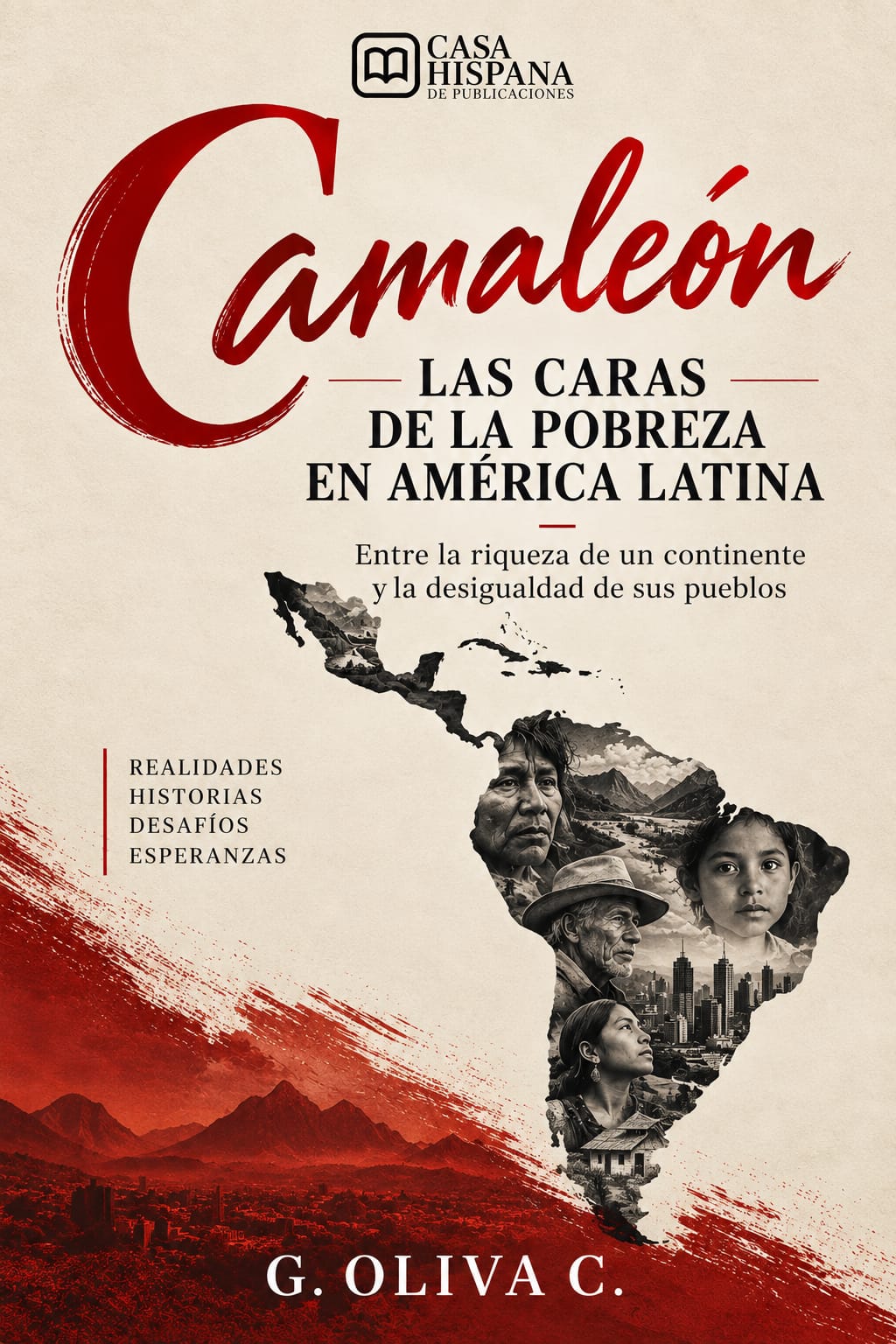
Poverty in Latin America has a deeply chameleon-like character: it changes face, territory, language, intensity and mechanisms of reproduction according to the historical, cultural, social and economic conditions of each people. To speak of the "chameleon effect" makes it possible to understand that poverty is not a static reality nor does it take a single recognisable form. Just as the chameleon changes its appearance in response to its surroundings, poverty adapts to the changes of Latin American societies and can remain hidden behind new expressions of modernisation, urban growth, consumption, employment, connectivity or economic expansion. A person may not be destitute and yet live under conditions of extreme fragility; a family may have housing, a mobile phone, internet access and certain consumer goods, but lack savings, job security, social protection or the capacity to face an illness, the loss of a job or an emergency. The chameleon effect of poverty consists precisely in its capacity to change appearance without the conditions of vulnerability that sustain it necessarily disappearing. From the anthropological perspective, this effect acquires a particularly important dimension because poverty never occurs in a cultural vacuum. People interpret need, wellbeing, work, property, family, solidarity and territory from specific cultural universes. Latin America is not a culturally homogeneous society, but a space formed by indigenous peoples, Afro-descendant populations, mestizo societies, peasant communities, migrants and multiple urban and regional identities. For this reason, an exclusively monetary definition may prove insufficient for understanding how deprivation is experienced. In certain rural or indigenous territories, for example, wealth may also be related to access to land, water, family networks, productive autonomy, cultural continuity and community belonging. A family may have relatively low monetary income and preserve certain community resources, while another with higher income may experience isolation, indebtedness, housing insecurity and the loss of support networks. This does not mean romanticising poverty or claiming that culture replaces rights, services or income. It means recognising that wellbeing, deprivation and quality of life must also be interpreted within the social and cultural context in which people live. From this anthropological viewpoint, the chameleon effect appears when external categories describe a community only by what it apparently lacks and not by the totality of its relationships, capacities and resources. An indigenous community should not be regarded as poor simply because it preserves economic forms different from urban ones, just as maintaining community traditions does not automatically eliminate real situations of deprivation. The analysis needs to distinguish Culture - Deprivation - Inequality - Territory - Autonomy - Wellbeing. Confusing these dimensions can produce mistaken diagnoses and policies that, in trying to combat poverty, end up weakening legitimate forms of community organisation. For the author, here appears a first deep expression of the chameleon effect: poverty may change according to territory, but the way a society defines, interprets and confronts it may also change. The social dimension reveals another face. Latin America experienced during the twentieth and twenty-first centuries enormous processes of urbanisation. Millions of people left rural areas and moved to cities in search of work, education, health and opportunities. But moving from an impoverished rural area to a city did not necessarily mean leaving poverty behind; it often meant transforming its expression. The old rural precariousness could turn into urban overcrowding, informal labour, long commutes, residential segregation, insecurity and dependence on monetary income. The chameleon changed its setting. Rural poverty did not always disappear: in many cases it became urban. Where exclusion could previously be expressed through geographical distance, it began to manifest itself through social distance. Two families may live in the same city and find themselves separated by completely different worlds of opportunity. One has quality schools, efficient transport, security, professional networks and family wealth; the other may live a few kilometres away but face deficient services, informal employment and scant networks capable of facilitating social mobility. Inequality then has a geography. The postcode can become a variable that conditions opportunities. The city physically gathers rich and poor without necessarily integrating them socially. In this way, the chameleon effect makes it possible to understand a characteristic paradox of Latin American modernisation: poverty can coexist with shopping centres, smartphones, cars, universities, large infrastructure and advanced technologies. Owning some consumer goods does not mean having overcome vulnerability. Contemporary poverty may use a mobile phone, travel daily on public transport, consume digital content and take part in social media, while continuing to depend on unstable income. From the economic perspective, this transformation is especially visible in the labour market. For a long time, the classic image of poverty was associated with the absence of employment. Today it is necessary to recognise another reality: people who work and continue to be poor or vulnerable. Precarious, informal, temporary or low-productivity employment can generate income without providing sufficient stability. Working does not always mean having escaped poverty. Here the chameleon effect takes on the face of the working poor: someone economically active who produces, sells, transports, cares, builds, cleans or provides services and yet retains a limited capacity to save or withstand a crisis. Informality can offer survival strategies and economic opportunities, but it can also leave millions of workers exposed to income fluctuations and insufficient coverage. Poverty then ceases to appear exclusively as an absence of economic activity and begins to hide within productive activity itself. Another economic face is indebtedness. Access to credit can broaden opportunities when it makes it possible to finance housing, education, enterprise or investment, but it can become a factor of vulnerability when households use debt recurrently to cover ordinary needs. A family may outwardly project an image of economic integration while a large part of its future income is already committed. Income is not wealth. Consumption is not economic security. Credit is not riches. These distinctions are fundamental for understanding contemporary chameleon-like poverty. There are households that do not appear within statistical poverty at a given moment, but are one illness, one job loss or one emergency away from falling into it. They are vulnerable sectors whose social position can change rapidly. The economic chameleon thus moves between poverty - vulnerability - precariousness - indebtedness - recovery - social mobility. The historical perspective makes it possible to understand why these transformations have deep roots. Latin America was shaped by conquest, colonisation, slavery, land concentration, extractive economies and hierarchical structures that distributed resources and power unequally. After independence, legal citizenship did not immediately produce material equality. Later came industrialisation, internal migrations, urbanisation, social reforms, educational expansion and economic modernisation. Each transformation changed living conditions, but also produced new inequalities. The chameleon effect therefore has a historical dimension: poverty changes when society changes. The agrarian poverty of the nineteenth century is not identical to the industrial poverty of the twentieth century nor to the urban, digital and labour vulnerability of the twenty-first century. However, there are continuities related to the unequal distribution of opportunities. That is why history must explain processes without becoming determinism. The past conditions, but it does not completely write the future. Societies can transform institutions, broaden capacities and change the mechanisms that reproduce inequality. The anthropological dimension of the chameleon effect also obliges us to observe the strategies developed by people themselves. The poor do not constitute a homogeneous human category nor passive subjects waiting for intervention. Families and communities create networks of reciprocity, family economies, informal trade, territorial organisations, care systems and collective survival mechanisms. In working-class neighbourhoods, peasant communities and indigenous territories there may be forms of cooperation that reduce certain impacts of precariousness. These practices should not be romanticised nor used as an excuse to withdraw institutional responsibilities, but they should be recognised as an expression of human agency. The person in a situation of poverty is not only someone who lacks; they are also someone who thinks, decides, works, creates, resists, organises and plans. From a social perspective, this affirmation radically changes the way responses are designed. Combating poverty does not only mean handing resources downwards from institutions that supposedly have all the answers. It also means understanding existing capacities and removing the obstacles that prevent their development. Education is one of those mechanisms, but once again the chameleon effect appears. In another era, the great problem could be not having access to school. When educational coverage increases, inequality can shift towards the quality of teaching. Everyone may be enrolled and yet not receive the same opportunities. The problem changes shape: Access - Retention - Quality - Learning - Continuity - Labour Insertion. Something similar happens with health. Formally having the right to care does not necessarily mean accessing it with equal opportunity, proximity and quality. Poverty learns to hide within averages. A favourable national statistic can coexist with persistently lagging territories. That is why averages must be complemented with territorial, age, labour and socioeconomic analysis. The chameleon effect also appears in the digital revolution. The first problem was not having internet; then differences arose in speed, devices, digital literacy and the capacity to turn connectivity into educational or economic opportunities. A connected person may continue to be digitally excluded if they lack the competencies to use technology productively. Digital access is not automatically digital inclusion. In the future, the expansion of artificial intelligence may generate a new frontier of inequality between those who have the capacities to use advanced tools and those who remain limited to elementary forms of technological consumption. Poverty changes because the requirements needed to take full part in society also change. The cultural dimension of the phenomenon demands special care regarding indigenous and Afro-descendant peoples. Their identities must not become statistical synonyms of poverty. A Mapuche, Quechua, Aymara, Maya, Garifuna or Afro-descendant person is not poor because of belonging to their people. Where socioeconomic gaps exist, specific mechanisms must be studied: territory, infrastructure, education, discrimination, access to the labour market, historical conditions, public policies and geographical location. Identity is not poverty. Culture is not backwardness. Difference is not deprivation. But nor should cultural respect be used to hide real deprivation. A community has the right simultaneously to preserve its identity and to access education, health, infrastructure, connectivity and economic opportunities. The challenge consists in avoiding both assimilation and paternalism. The chameleon effect also acquires a generational face. Poverty experienced during childhood can affect nutrition, learning and future opportunities; in youth it can be expressed through difficulties in accessing higher education, housing or stable employment; in adulthood through labour precariousness and family responsibilities; and in old age through insufficient pensions, dependence or isolation. It is the same social problem changing its face throughout the life cycle. It also acquires a female face when care responsibilities, single-parent households or certain labour barriers increase economic vulnerability. It acquires a migrant face when a person loses family networks, recognition of credentials or stable access to work. It acquires an environmental face when droughts, floods, fires or other events especially affect those with less capacity for recovery. In this way, the chameleon does not represent a mere literary metaphor, but an interpretive tool that makes it possible to analyse how the same structure of vulnerability can be transformed as it interacts with culture - territory - age - gender - work - education - migration - technology - environment. For the author, understanding this effect also obliges us to review anti-poverty policies. If the phenomenon changes, responses must learn to recognise its new manifestations. A cash transfer can resolve an emergency without changing the causes that generate precariousness. A job can generate income without guaranteeing stability. A dwelling can provide a roof and remain territorially isolated from opportunities. A school can guarantee enrolment without ensuring learning. The internet can provide connection without developing competencies. For this reason a comprehensive policy needs to distinguish relief - protection - training - mobility - autonomy. Assistance is necessary in the face of certain emergencies, but a long-term strategy must broaden people's capacity to build their own projects. This requires economic growth, productive employment, effective institutions, quality education, infrastructure, sustainable social protection, legal certainty, innovation and policies capable of being evaluated by results. Latin America holds one of the great historical paradoxes of the contemporary world: enormous natural and cultural wealth coexists with persistent inequalities. Minerals, agriculture, biodiversity, water, energy and human capital constitute extraordinary potential, but natural resources do not automatically produce collective wellbeing. A continent can be rich in resources and continue to be unequal in opportunities. True transformation occurs when potential wealth is turned into productivity, knowledge, dignified work, infrastructure, education and possibilities of mobility. There, finally, lies the deep meaning of the chameleon effect: it obliges us to look beyond appearances. A society can modernise without fully integrating; grow without distributing sufficient opportunities; consume without accumulating wealth; connect without including; school without equalising learning; urbanise without overcoming segregation. Chameleon: The faces of poverty in Latin America proposes precisely to recognise these mutations from an anthropological, social, historical and economic perspective. There is no single Latin American poverty, but multiple experiences of poverty and vulnerability crossed by different histories, cultures and territories. Understanding them requires listening to people, studying mechanisms, comparing evidence and avoiding single explanations. The chameleon effect reminds us that poverty does not always disappear when it stops looking like poverty. Sometimes it changes territory. Sometimes it changes generation. Sometimes it changes trade. Sometimes it hides behind consumption, credit, informality or modernity. That is why the challenge consists not only in combating the poverty we see, but in learning to recognise the poverty that has changed colour to adapt to a new social reality…
Category
- SOCIAL SCIENCES
- SOCIOLOGY
- LATIN AMERICAN STUDIES
- POVERTY AND SOCIAL INEQUALITY
- SOCIOECONOMIC EXCLUSION AND VULNERABILITY
- HUMAN RIGHTS
- SOCIAL JUSTICE
- PUBLIC POLICY
- HUMAN DEVELOPMENT AND SOCIAL TRANSFORMATION
Rights for this book
We turn publishing rights into international growth, connecting authors and publishers with new markets, new readers and new partners around the world.
Technical details
- Title
- Camaleón
- Author
- G. Oliva C.
- Imprint
- Grupo Editorial casa Hispana
- Size
- 15x23cms
- Edition
- 1st edition, 2024
- Published in
- Chile
- Year of publication
- 2025
- Available languages
- Spanish, English, German, Portuguese
- Binding
- Paperback with flaps
- Pages
- 517