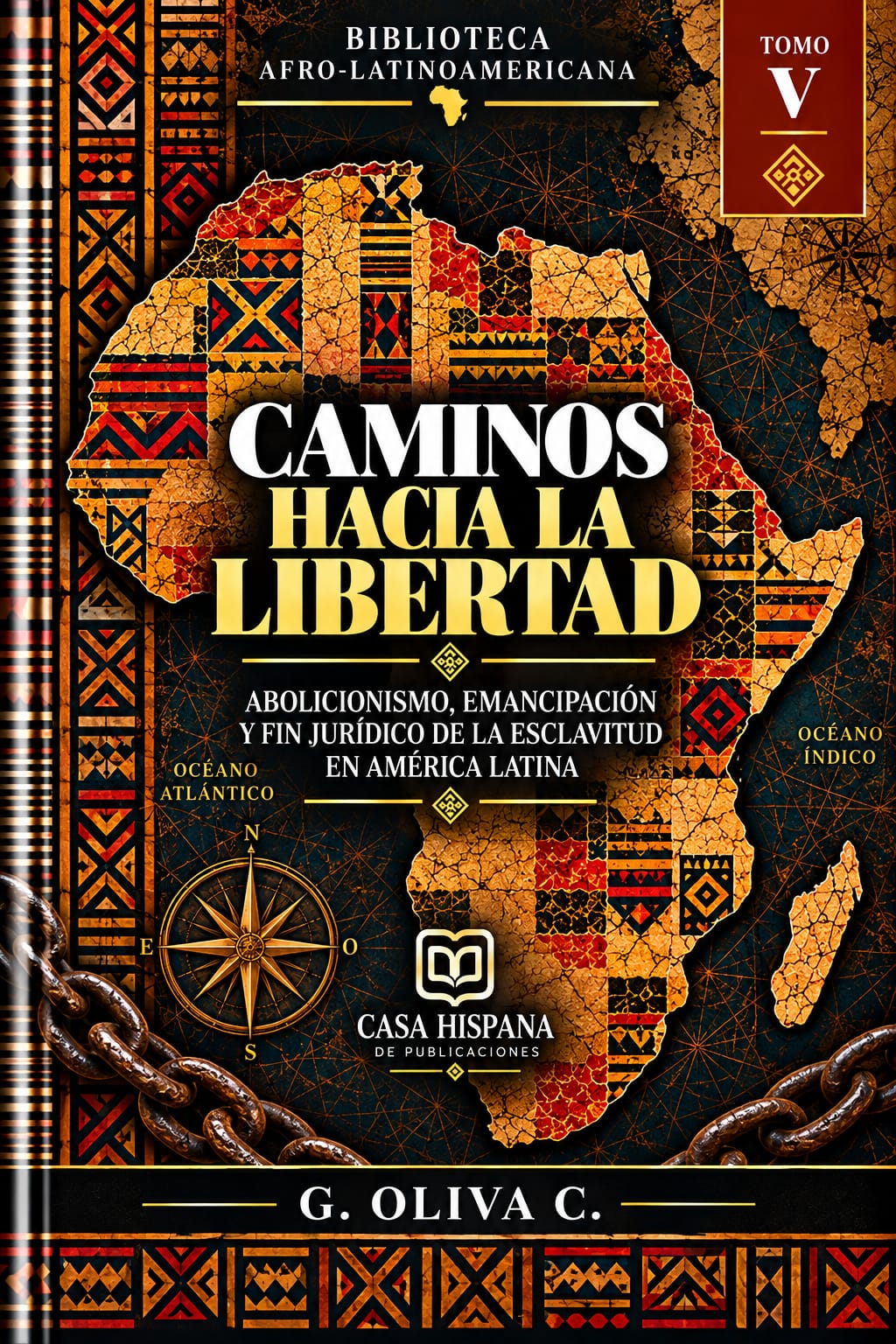
Description
The abolition of slavery in Latin America was not a single event nor a sudden concession of freedom made by enlightened governments, but a prolonged, conflictive, uneven and deeply complex historical process in which the resistance of the enslaved people themselves, marronage, rebellions, escapes, manumissions, economic transformations, wars of independence, abolitionist movements, legal debates, religious convictions, political changes, international pressures and new conceptions of citizenship, freedom, equality and human dignity converged, and for this reason to speak of Paths to Freedom necessarily means speaking in the plural, because there was no single path, no single date and no single actor capable of explaining the legal end of an institution that had remained for centuries integrated into the economic, social and political structures of the continent. Freedom was won through different and at times contradictory trajectories. Some people attained freedom individually long before their countries abolished slavery. Others were born free as a consequence of gradual legislation. Some obtained manumission. Others escaped. Some gained freedom through military participation. Others remained enslaved until a general law legally ended the institution. This diversity is the fundamental starting point for understanding Latin American emancipation. Abolition was collective as a legal transformation, but freedom had been experienced individually and communally long before States recognised it universally. The history of emancipation therefore begins within slavery itself. Every escape anticipated a freedom still denied by law. Every quilombo and every palenque showed that communities could exist outside slaveholding domination. Every manumission showed that the enslaved condition could end for a concrete person. Every lawsuit for freedom questioned the legal limits of human property. Every rebellion revealed the absence of consent. Every family that gathered resources to free one of its members turned freedom into a collective project. Later abolitionism did not appear on an empty stage. It found generations of resistance that had already materially questioned the legitimacy of the system. This continuity between resistance and abolition is one of the author's central concerns, because it makes it possible to correct a historical narrative in which enslaved people appear passively waiting for others to grant them freedom. Freedom did not begin in parliament. Nor did it begin with the decree. It had begun long before as desire, decision, escape, organisation, negotiation and resistance. The law came afterwards. This sequence is essential for understanding the deep meaning of emancipation. The legal end of slavery represents a decisive moment because it transforms what for centuries had been permitted by law. A property relationship recognised by the State ceases to be legally valid. The owner loses the legal power to claim dominion over another person. The enslaved person ceases to exist as a legitimate legal category. But this extraordinary change needs to be distinguished from other related processes. Prohibiting the trade was not the same as abolishing slavery. Declaring free birth did not necessarily mean immediate freedom for all enslaved people. Facilitating manumissions was not equivalent to eliminating the institution. Declaring abolition did not automatically guarantee material equality either. These conceptual differences are indispensable for correctly studying Latin American chronologies. Trade - Slavery - Manumission - Emancipation - Abolition - Citizenship - Equality are related but different processes. A State could prohibit new imports of enslaved people while allowing those already subjected to remain in slavery. It could establish that certain children were born under new legal conditions while their parents remained enslaved. It could recognise mechanisms for purchasing freedom without questioning human property as an institution. Finally, it could legally abolish slavery without immediately providing land, education, housing, employment or protection against discrimination to those who were freed. This sequence shows that legal freedom is of enormous importance, but does not by itself resolve all the dimensions of an inequality built over generations. From the perspective developed by the author it is fundamental to avoid two opposite errors. The first consists in minimising abolition because it did not produce immediate equality. The second consists in presenting abolition as the complete solution to the problem. Abolition was an indispensable legal transformation. Without it slavery would have continued to be legal. Its importance must not be relativised. But precisely because freedom has social, economic, cultural and political dimensions, we must study what happened after the legal declaration. Legal freedom opens a door. It does not automatically determine the conditions existing on the other side. Abolitionism arose within this long transformation as a diverse set of movements, discourses, organisations, people and initiatives aimed at questioning the trade, slavery or both, and it cannot be understood as a completely homogeneous current either. There were religious, philosophical, legal, economic, political, humanitarian and strategic arguments. Some people defended immediate abolition. Others promoted gradual processes. Some questioned the institution for moral reasons. Others considered that certain economic changes made it convenient to transform the labour system. Some defended racial equality. Others could oppose slavery and continue to hold racial prejudices. This last distinction is especially important, because abolitionism and anti-racism were not automatically equivalent. A person could consider the ownership of human beings morally wrong and at the same time preserve hierarchical ideas about African and Afro-descendant populations. Abolishing slavery did not necessarily mean abolishing racialisation. Precisely this contradiction helps to understand why post-abolition societies could continue reproducing discrimination after eliminating human property. The law changed before many mentalities. And in certain cases mentalities changed before certain institutions. Historical processes rarely advance in a synchronised way. Moral, legal, economic and cultural transformation have different rhythms. This difference is one of the keys to understanding the Latin American nineteenth century. The ideas of freedom and equality acquired growing importance within the Atlantic world, and political revolutions profoundly transformed the languages of legitimacy. Speaking of rights, citizenship, sovereignty and representation produced inevitable questions within societies that maintained slavery. If all human beings possessed certain rights, how could it be justified that some were property? If the new republics proclaimed freedom, how could they keep people enslaved? If colonial sovereignty was denounced as oppression, how could the absolute dominion of one person over another simultaneously be legitimised? These contradictions did not automatically resolve slavery, but they provided new languages for questioning it. The history of Latin American independence is crossed by this tension. Political freedom for the nation did not necessarily mean immediate personal freedom for all its inhabitants. Colonial emancipation and slave emancipation were different processes, although at certain moments they were closely related. This distinction is indispensable. A colony could become independent and maintain slavery. A republic could proclaim legal equality while preserving exclusionary categories and practices. Independence responded to the relationship between territory and empire. Abolition responded to the relationship between person and property. Both could use the language of freedom, but they spoke of different freedoms. The wars of independence nevertheless opened important opportunities for enslaved people, because different armies resorted to recruitment and…
Category
- ABOLITIONISM
- EMANCIPATION
- ABOLITION OF SLAVERY
- LEGAL FREEDOM
- END OF SLAVERY
- MANUMISSION
- FREE WOMB LAW
- ANTI-SLAVERY RESISTANCE
- BLACK RESISTANCE
- ENSLAVED PEOPLE
- AFRO-DESCENDANTS
- AFRICAN DIASPORA
- ABOLITIONIST MOVEMENTS
- ABOLITIONIST LEGISLATION
- CITIZENSHIP
- LEGAL EQUALITY
- HUMAN RIGHTS
- RACIAL JUSTICE
- HISTORICAL MEMORY
- AFRO-LATIN AMERICAN HISTORY
Rights for this book
We turn publishing rights into international growth, connecting authors and publishers with new markets, new readers and new partners around the world.
Technical details
- Title
- Caminos hacia la libertad
- Author
- G. Oliva C.
- Imprint
- Grupo Editorial casa Hispana
- Size
- 15x23cms
- Edition
- 1st edition, 2026
- Published in
- Chile
- Year of publication
- 2026
- Available languages
- Spanish, English, German, Portuguese
- Binding
- Paperback with flaps
- Pages
- 478