Description
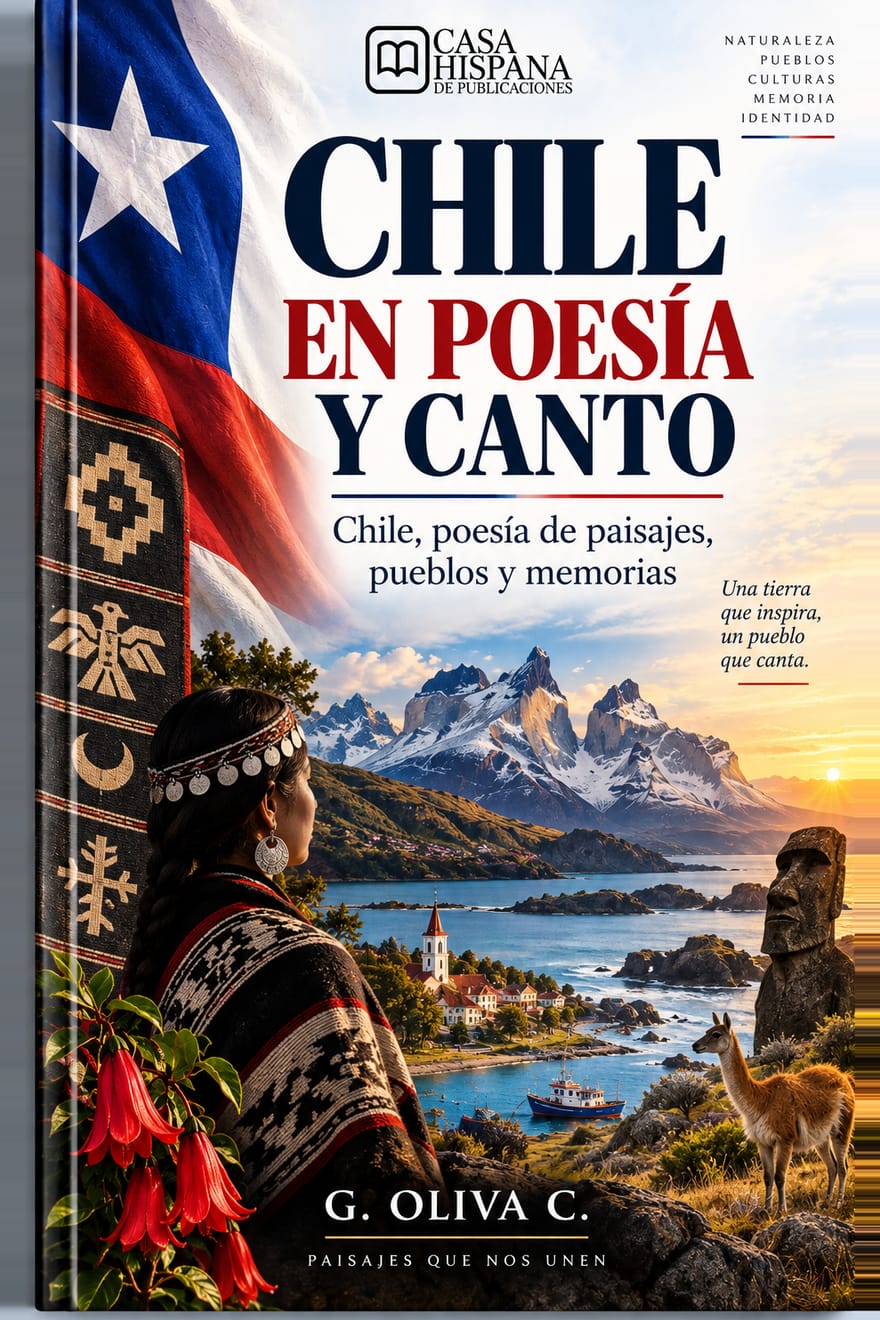
Chile en poesía y canto is a literary and cultural work that proposes travelling the country through the poetic word, collective memory and the many expressions of an identity built among territories, peoples and generations. More than a collection of images of Chile, the book seeks to interpret a vast and diverse land through what makes it profoundly human: its inhabited landscapes, its voices, its recollections, its sorrows, its celebrations and the everyday experiences of those who have built its history. Chile appears in these pages not only as a geographical demarcation lying between the Andes mountain range and the Pacific Ocean, but as an emotional and cultural territory. Desert, high plateau, valleys, cities, fields, mountains, forests, rivers, lakes, archipelagos, volcanoes, coasts and southern territories make up an extraordinarily diverse geography that has deeply influenced the ways of living, working, imagining and narrating the country. Chile is territory, but it is also memory. It is landscape, but it is also a people. It is history, but it is also a voice that goes on singing. From this perspective, poetry becomes a form of knowledge. The poem does not replace history, geography or the social sciences, but it makes it possible to approach dimensions of human experience that statistics and chronologies do not always manage to express. Where history records events, poetry can recover emotions; where geography describes territories, song can reveal bonds of belonging; where documents record facts, memory preserves meanings. The journey begins, inevitably, with the land. Chile's particular territorial configuration has helped to produce distinct regional identities. To live in the north does not mean experiencing the territory in the same way as living in the centre, in the Araucanía, in Chiloé, in Patagonia or in the large cities. Each region has its own rhythms, landscapes, traditions and memories. The north presents the immensity of the desert, mining, the ancient roads and the Andean cultures. There, the apparent austerity of the landscape contrasts with the historical depth of communities that learned over generations to live in territories where water is an essential good. The central zone brings together farmland, mountain ranges, cities and spaces where an important part of the country's political and demographic history has unfolded. Santiago appears as the capital and a great urban concentration, but the book tries to prevent the view of Chile from being reduced to its administrative centre. Chile is far larger than its capital. Towards the south, rain alters the landscape. Forests, rivers, lakes and volcanoes build another experience of territory. The Araucanía acquires a particular significance here. It does not represent merely an administrative region: it is a space deeply marked by the historical presence of the Mapuche people, by intercultural encounters, territorial conflicts, family memories and social transformations. The author's gaze approaches this land recognising that landscape is never wholly separate from those who inhabit it. A mountain can be geography and memory. A river can be a natural resource and community heritage. A forest can be an ecosystem, an economic space and a cultural territory. A road can connect cities and, at the same time, preserve the traces of earlier generations. For that reason, Chile en poesía y canto develops a poetics of territory. Landscape does not serve simply as literary decoration. It is a protagonist. The land is not the backdrop against which history takes place. The land also takes part in it. This sensitivity to territory leads inevitably to the Indigenous peoples. Chilean memory predates the formation of the State. Various peoples inhabited these territories before the European arrival and the drawing of the contemporary national borders. Their presences, transformations and continuities form part of the country's deep history. The work pays particular attention to the Mapuche people and to the persistence of their memory in the south of Chile. Mapudungun, territory, orality, community and transmission between generations appear as dimensions of an identity that does not belong exclusively to the past. But the book avoids turning what is Indigenous into a romantic or folkloric image. Indigenous peoples are contemporary. They live in communities and cities. They take part in universities, institutions, professions and organisations. They preserve traditions while also producing new forms of identity. Culture lives precisely because it is able to endure and to change at the same time. Alongside Indigenous memory appear the European inheritance, the migrations, the rural world, popular culture, urban life and the many influences that progressively took part in the making of contemporary Chile. The book does not look for a supposed pure Chilean identity. It looks for precisely the opposite: to recognise that national identity is the result of historical encounters. Indigenous peoples, Hispanic colonisation, mestizaje, European and later Latin American and global migrations have contributed, from different positions and circumstances, to transforming the country. Poetry makes it possible to gather these experiences without forcing them to become a single voice. Because Chile has many voices. That of the fisherman. That of the peasant farmer. That of the miner. That of the urban worker. That of the Indigenous people. That of the migrant. That of the woman who quietly holds a family together. That of the child discovering their territory. That of the old man who keeps memories that no photograph managed to record. That of the poet who turns what he observes into words. And that of the singer who gives those words back to the people. From this arises the work's second great concept: song. In Chile, poetry and music have historically maintained a particularly fruitful relationship. The written word has found in song a way of circulating beyond the book, while popular music has turned social, territorial and emotional experiences into shared heritage. Song can celebrate. It can remember. It can denounce. It can accompany. It can tell a story. It can preserve the name of a place. It can turn a personal experience into collective memory. When a people sings, it is also telling who it is. Popular culture therefore acquires a fundamental position. Chile en poesía y canto does not draw a rigid frontier between academic culture and popular culture. Both form part of the national experience and can be found in literature, music, oral tradition and community practices. Poetry does not belong only to universities, libraries or literary circles. It also dwells in a family conversation. A décima. A song. A guitar. A community festival. A story handed down by grandparents. An expression spoken in the countryside. A memory of childhood. An old name given to a place. In that everyday life, heritage is also built. Oral tradition is one of the great repositories of Chilean cultural memory. Before being written down, countless forms of knowledge, tales, songs, legends and experiences were passed from person to person. This orality acquires particular significance in rural communities and among Indigenous peoples, but it does not belong exclusively to them. Every family keeps small oral traditions: stories about ancestors, migrations, hardships, places and events that enable the new generations to understand where they come from. The author finds there one of the most intimate forms of heritage. A society does not preserve its memory only in archives. It also preserves it in the stories that one generation decides to tell the next. The work likewise incorporates the historical dimension of pain. Chile is not made up solely of beautiful landscapes and cultural celebrations. Its history contains conflicts, inequalities, natural disasters, earthquakes, displacements, political violence, family losses and periods of deep social division. A poetry that sought to speak of the country without acknowledging its wounds would offer an incomplete representation. But neither would it be enough to build a national identity exclusively out of suffering. Memory requires balance. To remember what hurt. To acknowledge what divided. But also to preserve what made it possible to go on. Solidarity. Work. Community. Hope. Reconstruction. Because Chile also has a long memory of reconstruction. Earthquakes, fires, floods and other disasters have repeatedly obliged its inhabitants to rebuild material and communal spaces. This experience has helped to form a particular awareness of territorial fragility. The land that offers beauty is also a constant reminder that it is alive. Mountain range, volcanoes, ocean and earth tremors form part of the country's everyday and symbolic experience. For that reason, nature occupies in the book a position that goes beyond aesthetic contemplation. The poetry of landscape also becomes an ethics of care. If the land forms part of our memory, to destroy it is also to damage a part of what we shall hand on. Forests, wetlands, rivers, glaciers, coasts and ecosystems are not merely resources available for the present. They are heritage for future generations. Here, Chile en poesía y canto builds a bridge between cultural memory and ecological awareness. We cannot sing to the land and, at the same time, remain indifferent to its degradation. This statement brings a contemporary dimension into the work. The Chile that sings is not only the one preserved in old photographs. It is also the country facing accelerated urbanisation, environmental transformation, migrations, technological change and new forms of coexistence. Cities therefore occupy an important place. Urban experience has profoundly transformed Chilean identity. Neighbourhoods, squares, markets, stations, public transport, peripheries and historic centres are new territories of memory. Poetry also exists among buildings. Santiago, Valparaíso, Concepción, Temuco and the country's many cities have emotional geographies built through everyday encounters. A street corner can hold a story. An old house can preserve a family memory. A station can recall a farewell. A port can speak of migrations. A square may have witnessed celebrations and conflicts. The City Also Has Memory. The book then proposes broadening the idea of Chilean heritage. Heritage is not only what has been officially declared a monument. It is also what communities consider significant. A trade. A recipe. A song. A word. A ceremony. A photograph. A dwelling. A way of farming. A boat. A local history. A way of naming the landscape. A language. A family memory. This everyday heritage makes it possible to understand that national identity is built from below, through millions of small experiences. From the author's perspective, writing about Chile necessarily involves writing from an affective relationship with the territory, but that relationship must not hinder the critical gaze. To love a land does not mean idealising it. It also means recognising its contradictions. One can love Chile and ask about its inequalities. One can celebrate its history and acknowledge its wounds. One can value its unity without denying the diversity of the peoples who inhabit it. This tension between belonging and critique gives the work depth. The country appears at once as reality and aspiration. As what we have received and what we are still building. National identity is not presented as a closed definition. Each generation adds new experiences. Contemporary migrations are an obvious example. New inhabitants arrive with languages, music, foods, memories and traditions. Their children will grow up within Chilean territory and will also take part in the future construction of what we call Chile. Identity, therefore, continues to be written. Hence the concept of song takes on a still greater meaning. Each generation adds a verse. It receives a song that began before its birth and hands it on, transformed, to those who come after. The work's conceptual sequence may be summarised thus: land – landscape – peoples – territory – poetry – song – memory – identity – heritage – diversity – nature – history – belonging. These concepts make it possible to understand that Chile en poesía y canto does not set out to be merely a descriptive collection of poems or a cultural inventory. It presents itself as a work of poetic memory of the territory. The author's research, observation and sensibility converge on a simple and profound question: what does it mean to belong to a land? To belong does not mean to possess it. It means recognising that our own history is bound up with it. That others were here before. That others will come after. That we are temporarily responsible for what we have received. From this perspective, the Chilean landscape ceases to be a postcard and becomes an inheritance. The Araucanía is not only forest and volcano: it is inhabited territory and memory. The north is not only desert: it is human history written in extreme conditions. The coast is not only ocean: it is work, fishing, port, voyage and farewell. The countryside is not only production: it is accumulated knowledge, family and tradition. Patagonia is not only immensity: it is also human experience in the face of a nature that compels us to recognise our limits. And the city is not only concrete: it is encounter, contradiction and everyday memory. The contribution the author seeks to make lies in bringing these dimensions together within a single gaze without eliminating their differences. A country is not only its territory. It is the relationship between that territory and the people who have inhabited, named, worked, sung, defended, transformed and remembered it. For that reason, Chile en poesía y canto is also an invitation to look again at what habit renders invisible. To look at the mountains as if for the first time. To listen again to the sound of rain over the south. To recognise the silence of the desert. To pause before the ocean. To listen to the words of those who still remember old stories. To ask about the origin of the names of our towns and cities. To listen once more to the songs that accompanied earlier generations. And to understand that behind each one there lies a part of the national memory. The work ultimately finds its meaning in the relationship between poetry and belonging. The poet does not need to describe the whole country in order to speak of Chile. Sometimes a tree is enough. A street. A fall of rain. A station. A mother. A peasant farmer. A word in Mapudungun. A guitar. A port. A mountain. A house. A memory. Because great identities are also built through small memories. In that sense, Chile en poesía y canto proposes a geography different from the one that appears on maps. An affective geography made up of places that acquire meaning because someone remembers them. Chile is a land long in its geography, but deeper still in its memories. From the desert to the southern territories, from the mountains to the Pacific, from the Indigenous peoples to the new generations, the work travels a country whose identity has never ceased to change. And perhaps there lies its deepest affirmation: Chile Is Not Only Inhabited. It Is Also Remembered. It is remembered in its landscapes. It is remembered in its peoples. It is remembered in its families. It is remembered in its words. It is remembered in those who left and went on carrying with them an image of their land. It is remembered in those who stayed. It is remembered in the old names. It is remembered in poetry. And, above all, it is remembered in song. Because as long as a people can name its land, preserve its memory and turn its experience into words, its history will remain alive. Chile en poesía y canto is precisely that: a song to the diversity of a land, a memory of its peoples and a poetic invitation to recognise that Chile is made up not only of what we see, but also of everything that whole generations have loved, suffered, built, remembered and sung…
Category
- CHILEAN LITERATURE
- POETRY AND SONG
- IDENTITY AND TERRITORY
- CULTURAL MEMORY
- HERITAGE OF CHILE
Rights for this book
We turn publishing rights into international growth, connecting authors and publishers with new markets, new readers and new partners around the world.
Technical details
- Title
- Chile en poesía y canto
- Author
- G. Oliva C.
- Imprint
- Grupo Editorial casa Hispana
- Size
- 15x23cms
- Edition
- 1st edition, 2026
- Published in
- Chile
- Year of publication
- 2026
- Available languages
- Spanish, English, German, Portuguese
- Binding
- Paperback with flaps
- Pages
- 464