Description
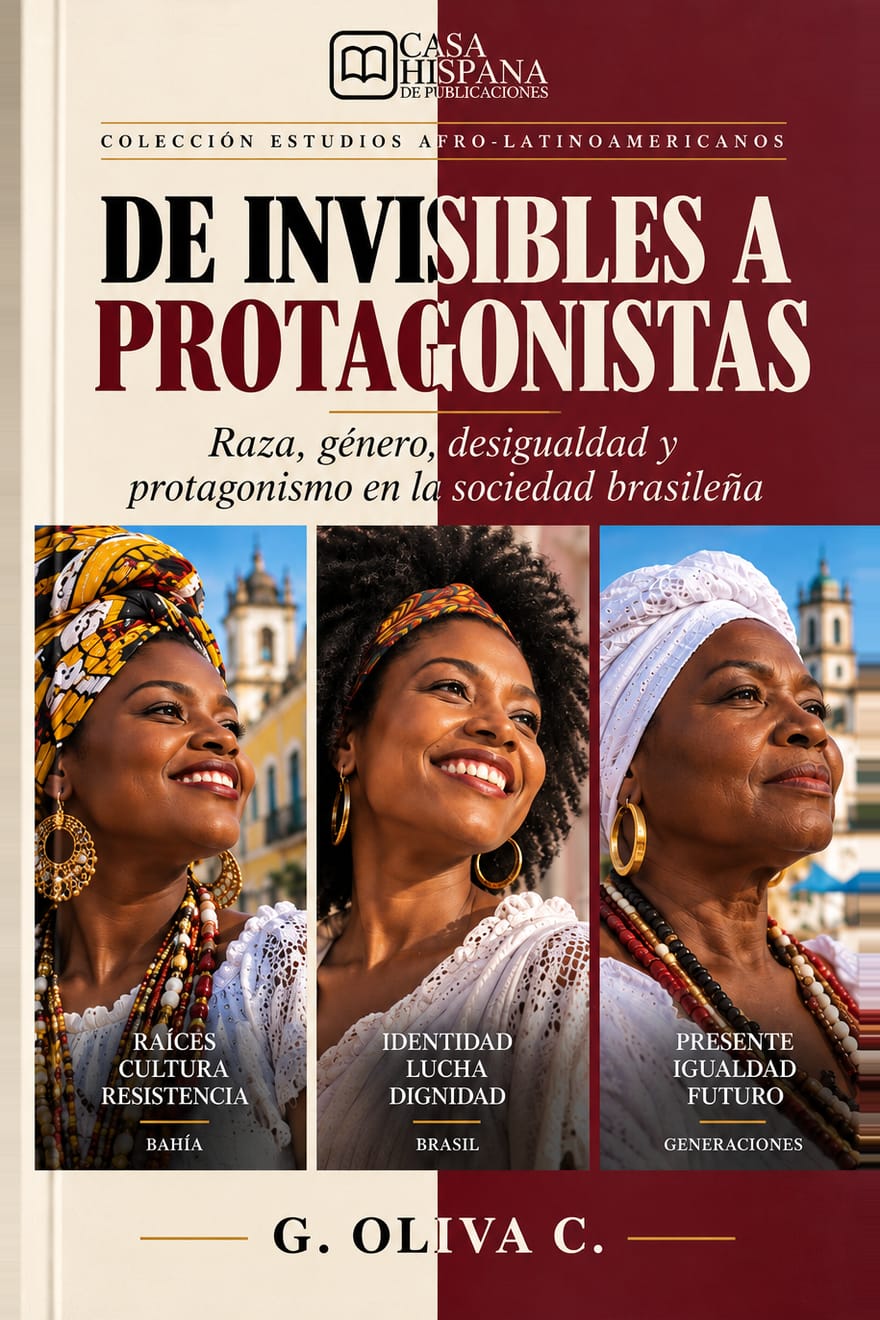
Brazilian social history cannot be understood in all its complexity without considering the presence, work, resistance, cultural production, community participation and protagonism of Black women. For centuries, however, much of this presence remained fragmented in the historical records or subordinated to narratives that favoured certain social and political groups. To speak of a passage "from invisible to protagonists" does not mean affirming that these women were literally invisible, nor that they only recently began to take part in the construction of Brazil. On the contrary: it means recognising that they were present from the formative processes of Brazilian society, although their agency did not always receive recognition proportional to its historical importance. Invisibility does not mean absence. It often means presence without recognition, work without memory and contribution without protagonism in the official narrative. The perspective proposed in this work therefore starts from a fundamental distinction between historical presence and historical recognition. Enslaved African women, free Black women, freedwomen, urban workers, traders, farmers, domestic workers, mothers, religious leaders, educators, intellectuals, artists, activists, professionals and entrepreneurs took part in different stages of Brazilian social formation. Their experiences, however, were profoundly diverse. There is no single experience of the Black woman in Brazil. Region, historical period, legal condition, social class, schooling, occupation, religion, territory, age and family relationships produced different trajectories. For this reason, an academically rigorous approach needs to avoid both generalisation and romanticisation. Black women do not constitute a homogeneous historical category. They share experiences that may be marked by processes of racialisation and inequality, but they have diverse histories, identities, choices and life projects. Slavery is inevitably one of the great starting points for understanding these trajectories, but it cannot become the only possible framework. During the slave period, African women and their descendants were subjected to different forms of exploitation, violence and control. They worked in domestic, agricultural, commercial and urban activities, among many other functions. However, even within an order that sought to reduce people to the legal condition of property, there were strategies of survival, negotiation, preservation of ties, formation of networks, obtaining freedom, economic practices and different forms of resistance. Recognising this agency does not diminish the violence of slavery; on the contrary, it makes it possible to understand that the enslaved person must never be reduced to the system that oppressed her. The condition of being enslaved was imposed. It did not exhaust the identity of the person. This distinction has important historiographical consequences. The Black woman needs to appear in history not only as someone upon whom certain structures acted, but also as a subject who made decisions within the limits and possibilities of her context. The legal abolition of slavery in 1888 represented a decisive transformation, but legal freedom and social equality are not equivalent categories. The end of legal ownership of human beings did not automatically eliminate accumulated inequalities, prejudices, educational difficulties, differences in wealth or barriers to economic insertion. Legal Freedom - Citizenship - Equality - Recognition - Participation constitute related but not simultaneous processes. In the period after abolition, Black women continued to take an intense part in the labour market and in community life, frequently in socially undervalued and economically vulnerable occupations. Domestic work acquired special importance in Brazilian history and reveals continuities, transformations and tensions between race, gender and class. However, it would be historically inadequate to reduce the trajectory of Black women to domestic service. They were and are present in trade, agriculture, education, the arts, religions, health, intellectual production, universities, companies, public administration, politics, entrepreneurship and numerous other activities. A more complete social history needs to shift its gaze from what was attributed to Black women towards what they actually did, built, negotiated and transformed. It is at this point that race, gender and inequality need to be analysed relationally. "Race", in the context of the contemporary social sciences, should not be understood as a rigid biological division of humanity, but as a historical and social category of classification that produced concrete consequences. Colour, appearance and racial belonging were interpreted in specific ways in Brazilian society and interacted with class, gender and territory. This does not mean that every difference observed between groups necessarily has a single racial cause. Rigour requires identifying mechanisms, periods, institutions and evidence. Difference is not automatically discrimination. Inequality does not necessarily have a single cause. But the absence of a single cause does not authorise ignoring racial mechanisms when they can be demonstrated historically and empirically. Gender adds another analytical dimension. Brazilian women, regardless of their racial classification, historically faced specific restrictions on political participation, economic autonomy, education and access to certain professions. However, these experiences did not occur identically among all women. The combination of gender, race and socioeconomic position helps to understand why certain women could simultaneously experience different barriers. Intersectional analysis can be useful precisely when it is not used as an automatic formula, but as an instrument for investigating how different social dimensions interact in concrete situations. Race - Gender - Class - Territory - Education - Work - Generation should not be treated as opposing explanations, but as variables capable of combining in different ways. For the author, one of the main challenges consists in preventing the analysis of inequality from producing a new form of invisibility: the one that contemplates the Black woman exclusively as a victim. If the old historiography frequently minimised her presence, a contemporary narrative centred solely on suffering may recognise oppression and, paradoxically, continue to hide agency. Protagonism demands another question. Not only: what happened to Black women? But also: what did Black women do in the face of the history they had to confront? This methodological change makes it possible to observe work, family organisation, economic strategies, associations, religiosity, artistic production, education, social movements, intellectual thought, political participation and entrepreneurship. History then ceases to be exclusively a narrative of structures acting upon people and comes to incorporate people acting within, against and beyond those structures. Protagonism does not mean the absence of barriers. It means the capacity to act even when barriers exist. The family is another fundamental space. Black women historically performed decisive functions in the economic and emotional sustenance of numerous family units. However, this role should not be romanticised as if overload were naturally a feminine virtue. Recognising strength does not mean normalising inequality in the distribution of responsibilities. Motherhood, care, paid work and community participation can overlap and produce long working days. Therefore, social analysis needs to distinguish between valuing care and naturalising overload. Caring is work. Sustaining a family is work. Organising community networks is work. However, recognising these activities does not mean limiting feminine identity to care. Education and knowledge represent another central dimension of the passage towards greater social visibility. The progressive access of Black women to schooling and higher education broadened professional, academic and institutional possibilities. This transformation has a meaning that goes beyond individual mobility: it changes who produces knowledge, who occupies specialised spaces and which questions enter academic debate. However, numerical presence and equality of opportunity are not synonyms. Research needs to observe entry, retention, training, professional progression and socioeconomic conditions, avoiding conclusions based solely on visual representativeness. The same principle applies to the labour market. The professional rise of Black women shows social transformation and individual and collective capacity, but it does not automatically eliminate broader differences in income, occupation or access to decision-making positions. At the same time, aggregate statistics must not become individual destiny. Averages describe groups; they do not define people. This distinction is essential to prevent research on inequality from ending up imprisoning individuals within the very categories used to understand them. Contemporary protagonism also appears in entrepreneurship. For some women, starting a business represents opportunity, autonomy and the creation of wealth; for others, it may arise as a response to difficulties in entering formal employment. For this reason, entrepreneurship by necessity and entrepreneurship by opportunity must be analytically differentiated. Not every independent activity represents prosperity, just as not every formal job represents mobility. Income - stability - productivity - wealth - autonomy constitute different dimensions of economic participation. Culture represents another indispensable field. Music, literature, dance, aesthetics, cuisine, religiosity and artistic production constituted spaces in which Black women produced memory and identity. However, cultural recognition does not replace citizenship. A society can celebrate symbols of African origin and continue to present concrete inequalities. Heritage does not replace rights. Visibility does not replace opportunities. Representation does not replace legal and social equality. On the other hand, reducing Afro-Brazilian cultural production to an instrument of denunciation would also be limiting. Black women have the right to produce art about racism and ancestry, but also about love, science, daily life, spirituality, humour, the future or any other dimension of human experience. Full protagonism begins when a person can be recognised for her identity without being confined to it. In the public sphere, the growing presence of Black women in universities, institutions, social organisations, companies, the media and political spaces makes visible important changes in Brazilian society. However, protagonism does not mean ideological homogeneity. Black women do not constitute a single political bloc and should not be assumed to hold the same opinions by reason of race or gender. Recognising identity does not mean denying individuality. Representation does not mean uniformity of thought. This observation is especially important for an approach committed to human rights: dignity also includes freedom of conscience, divergence and plurality. Brazilian society in the twenty-first century therefore presents a reality profoundly different from that of the colonial, imperial or early republican periods, although certain historical inequalities may continue to produce effects. Responsible research needs to work simultaneously with continuity and change. The past explains part of the present, but it cannot be used as an automatic answer for every contemporary reality. History explains processes. Sociology analyses relationships. Economics examines incentives, resources and results. Anthropology interprets experiences and meanings. Human rights establish a horizon of dignity. The combination of these perspectives makes it possible to better understand the path from relative invisibility towards growing protagonism without replacing research with slogans. FROM INVISIBLE TO PROTAGONISTS: race, gender, inequality and protagonism in Brazilian society thus proposes a historical and social reading in which Black women appear as complete subjects: people who suffered injustices, but also built families; faced barriers, but produced knowledge; worked in undervalued positions, but also won professional spaces; preserved memories, but equally created modernities; demanded rights, but also produced culture, economy, thought and future. The passage from invisibility to protagonism should not be understood as a concluded trajectory nor as a linear movement. It is a historical process marked by advances, permanences, conflicts and new possibilities. The final aim should not be simply to replace one invisibility with an identity permanently defined by suffering, but to build a society in which no person has her possibilities determined in advance by the colour of her skin, her gender or her social origin. The Black woman did not enter the history of Brazil recently; she was always in it. What is changing is the place from which her history is told. From object of representation to subject of her own narrative; from silenced presence to recognised voice; from work without memory to historical contribution; from social invisibility to protagonism. To understand this trajectory is to understand an indispensable part of Brazil itself…
Category
- BLACK WOMEN
- AFRO-BRAZILIAN WOMEN
- AFRO-DESCENDANTS
- RACE
- GENDER
- RACIAL INEQUALITY
- GENDER INEQUALITY
- FEMALE PROTAGONISM
- BLACK PROTAGONISM
- RACIALISATION
- INTERSECTIONALITY
- AFRO-BRAZILIAN IDENTITY
- CITIZENSHIP
- HUMAN RIGHTS
- SOCIAL JUSTICE
- RACIAL JUSTICE
- BLACK RESISTANCE
- HISTORICAL MEMORY
- AFRO-BRAZILIAN CULTURE
- BRAZILIAN SOCIAL HISTORY
Rights for this book
We turn publishing rights into international growth, connecting authors and publishers with new markets, new readers and new partners around the world.
Technical details
- Title
- De invisibles a protagonistas
- Author
- G. Oliva C.
- Imprint
- Grupo Editorial casa Hispana
- Size
- 15x23cms
- Edition
- 1st edition 2022
- Published in
- Chile
- Year of publication
- 2023
- Available languages
- Spanish, English, German, Portuguese
- Binding
- Paperback with flaps
- Pages
- 554