
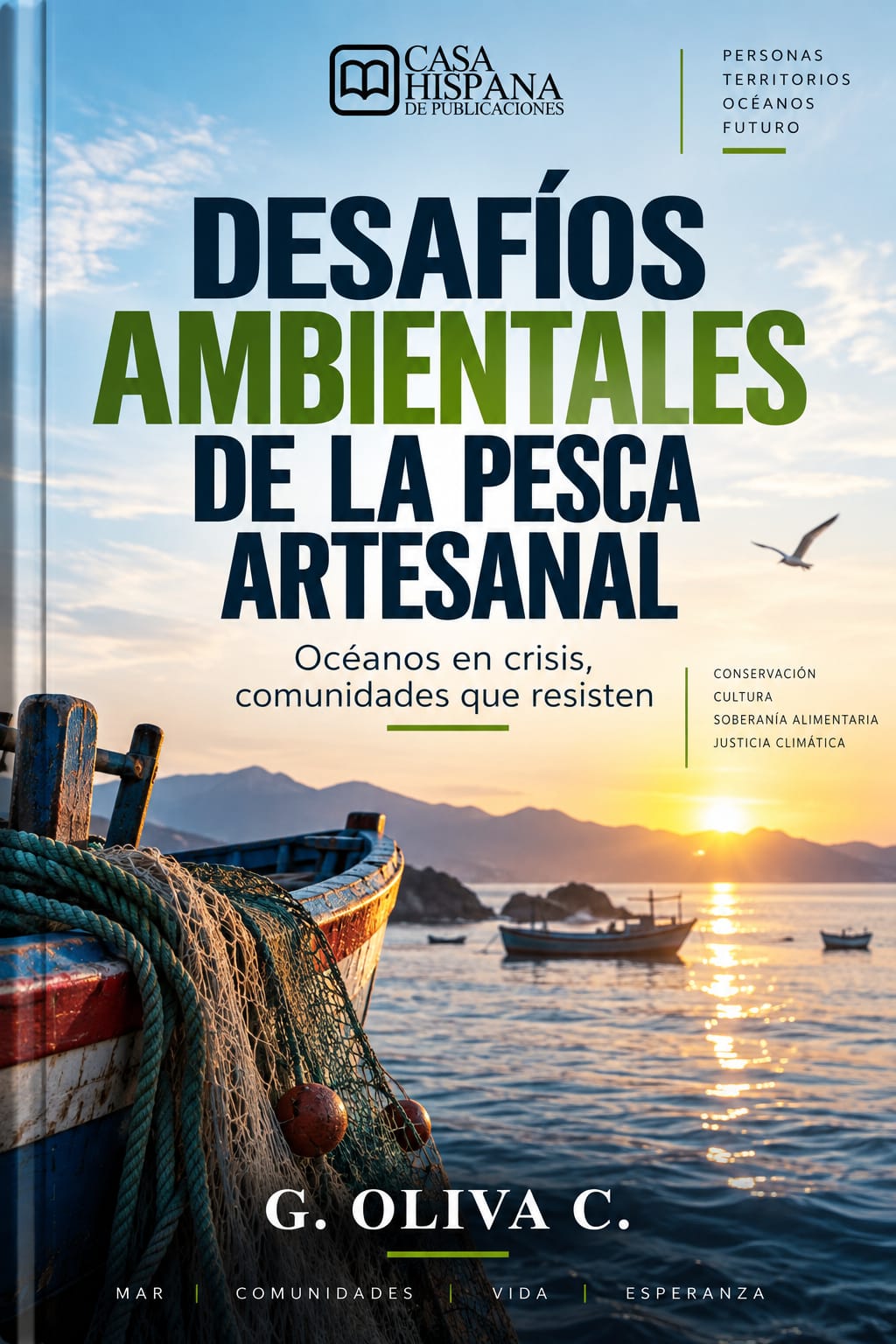
Description
Artisanal fishing in the face of environmental challenges: sustainability, territory, communities and the future of marine ecosystems. Artisanal fishing constitutes much more than an activity aimed at extracting marine resources; it represents a historical form of relationship between coastal communities and the sea, a fundamental source of work, food, local economy, territorial identity, traditional knowledge and cultural continuity for thousands of families who for generations have built their lives around oceans, coasts, coves, estuaries, rivers, lakes and other aquatic ecosystems; for this reason analysing the environmental challenges of artisanal fishing requires going beyond an exclusively productive view and understanding that when a marine ecosystem deteriorates, not only does a given commercial species decline, but jobs, family economies, production chains, food security, traditional knowledge, cultural practices and community forms of organisation that depend directly on the health of the aquatic environment may also be affected. One of the central concerns running through this reflection consists precisely in understanding artisanal fishing as an activity situated within deeply interdependent ecological and social systems; the fisher does not work on an unlimited resource but within a complex ecosystem in which fish, molluscs, crustaceans, algae, birds, marine mammals, microorganisms, ocean floors, currents, temperature, nutrients and climatic conditions maintain multiple relationships with one another; any significant alteration of these components can produce consequences for the commercially harvested species and ultimately for the human communities that depend on them. This perspective makes it possible to understand that fishing sustainability does not consist simply in continuing to extract resources for many years; it means maintaining ecological conditions that allow the reproduction, renewal and diversity of marine populations while preserving economic and social opportunities for present and future fishing communities; sustainability therefore has biological, economic, social, cultural and territorial dimensions. Overfishing represents one of the best-known challenges within this scenario and occurs when extraction pressure exceeds the capacity of certain populations to reproduce and maintain biologically sustainable levels; when over prolonged periods more individuals are extracted than a population can replace through reproduction and growth, abundance may progressively decline until it affects the productivity of the fishery. The problem becomes particularly serious when juvenile individuals are caught before reaching reproductive maturity, because each specimen removed prematurely represents not only a present catch but also a potential reduction of future generations; for this reason measures such as minimum sizes, closed seasons, reproductive periods, quotas, selective gear and protection of certain areas can play important roles within a conservation strategy. However, it would be methodologically incorrect to attribute overfishing automatically to artisanal fishing as if all actors exerted the same pressure on ecosystems; the intensity of the impact depends on the number of vessels, technological capacity, fishing effort, target species, gear used, regulatory conditions and the simultaneous presence of other extractive sectors; serious research needs to distinguish scales, modalities and responsibilities. Artisanal fishing can develop highly selective and territorially adapted practices, but it can also generate impacts when fishing effort increases excessively, unselective gear is used, juveniles are caught, closed seasons are not respected or populations whose abundance is already reduced are exploited; recognising these situations does not mean holding the artisanal fisher exclusively responsible, but understanding that sustainability requires commitments from all actors linked to the fishing system. Pressure on resources may also increase when communities have few economic alternatives; a family whose subsistence depends almost completely on daily catches may face a complex dilemma between conserving a resource for the future and obtaining sufficient income to cover immediate needs; this reality shows that conservation policies cannot be designed exclusively from biological criteria; they also need to incorporate the economic and social conditions of those who will have to comply with them. Conservation that ignores poverty can fail in the same way that a productive policy that ignores ecological limits can destroy the economic base it seeks to develop; for this reason environmental sustainability and social justice need to remain related. Marine ecosystems have biological limits that no economic policy can eliminate; a species needs a certain time to grow, reach maturity, reproduce and recover its population; if the rate of extraction persistently exceeds those natural processes, future availability declines; this apparently simple principle constitutes one of the foundations of sustainable fisheries management. But a fishery never depends exclusively on a single species; food chains connect predators, prey, producers and decomposing organisms, so that important changes in the abundance of certain populations can alter broader ecological relationships; excessively removing one species may favour the increase of another, reduce the food available for certain predators or modify ecosystem dynamics. Research developed around these challenges therefore needs to adopt an ecosystem approach; the question can no longer be limited to how many tonnes of a species can be caught, but must consider what function that species performs within the ecosystem, which other species interact with it, what its reproductive habitats are and what additional environmental pressures it faces. Marine habitats constitute precisely another fundamental component; rocky bottoms, kelp forests, coastal wetlands, estuaries, seagrass meadows, reefs, intertidal zones and other environments can function as areas of reproduction, feeding, refuge and growth; when these spaces degrade, fish populations may decline even if catch effort remains relatively stable. This reality makes it possible to understand an essential question: protecting artisanal fishing requires protecting the ecosystems that sustain fishing; there can be no truly sustainable fishing policy while the habitats where species are born, grow and reproduce continue to deteriorate. The use of certain fishing gear can generate impacts on these habitats depending on their characteristics and the place where they are used; unselective gear can produce incidental catches of species that are not the main target, while certain techniques that interact intensely with the seabed can alter sensitive benthic habitats. Once again it is worth differentiating fishing modalities, because not all gear has the same impact, nor can all forms of artisanal fishing be equated with large-scale industrial operations; evaluating environmental effects requires considering gear type, depth, target species, seabed characteristics, intensity of use, selectivity and the ecosystem's capacity for recovery. Selectivity therefore constitutes one of the most important principles of responsible fishing; the greater the capacity to catch the species and size sought while reducing juveniles, protected species and bycatch, the smaller the ecological impact associated with a given operation may be. Technological innovation can contribute significantly in this area; modifications to hooks, mesh sizes, escape devices, positioning systems, monitoring and new gear characteristics can reduce unwanted catches without necessarily destroying the economic viability of the activity. This relationship between technology and traditional knowledge is especially promising; artisanal fishers possess knowledge accumulated through daily observation of the sea; they know seasons, seabeds, currents, species behaviour, changes in abundance and environmental signals that can complement scientific information. One of the contributions this research seeks to highlight consists precisely in recognising the artisanal fisher not only as a user of resources but also as a bearer of territorial knowledge; their experience does not replace oceanographic or biological research, but it can provide valuable information, especially in areas where scientific monitoring systems have limited coverage. Cooperation between scientists, authorities and fishing communities can significantly improve the diagnosis of ecosystems; when scientific data dialogue with decades of local observation, possibilities appear for building more complete and legitimate management models. Climate change introduces an additional difficulty, because it modifies the environmental conditions on which many traditional fishing practices were built; ocean warming, changes in marine currents, acidification, decreasing oxygen in certain zones, changes in productivity patterns and the increase of some extreme events can alter the distribution, reproduction, growth and availability of species. This means that a fisher may continue using the same techniques in the same territory and yet find different results because the ecosystem itself is changing; certain species may move towards other latitudes or depths, while others may experience changes in their reproductive cycles. For communities whose infrastructure, vessels and knowledge are adapted to certain species and traditional areas, these shifts can represent a considerable economic challenge; following a species into more distant waters may require greater range, fuel, technology, safety and operating costs that small vessels cannot always bear. The climate vulnerability of artisanal fishing is therefore related both to environmental exposure and to the economic capacity for adaptation; two communities subjected to the same oceanographic change may experience very different consequences if one has access to information, financing, infrastructure, productive diversification, insurance and technology while the other depends almost exclusively on daily catches. Adaptation to climate change therefore needs to form part of fishing policies and not be limited to general environmental documents; early warning systems, accessible oceanographic information, diversification of activities, resilient coastal infrastructure, training and participatory monitoring can strengthen the capacity of communities to respond to changing scenarios. Ocean acidification constitutes another relevant process, because the increase in carbon dioxide absorbed by the waters modifies their chemistry; certain species, particularly those that form calcareous structures, may experience difficulties under certain conditions, and these alterations can have repercussions on ecological chains and economic activities linked to molluscs and other organisms…
Category
- ENVIRONMENT
- SUSTAINABLE DEVELOPMENT
- MARINE CONSERVATION AND SUSTAINABLE FISHING
- ARTISANAL FISHING
- MARINE ECOSYSTEMS AND COASTAL COMMUNITIES
- FISHERIES SUSTAINABILITY AND SOCIO-ENVIRONMENTAL MANAGEMENT
- CLIMATE CHANGE, MARINE BIODIVERSITY, ENVIRONMENTAL JUSTICE AND RESILIENCE OF COASTAL COMMUNITIES
- MARITIME ANTHROPOLOGY
- FISHERIES ECONOMY
- SOCIAL AND ENVIRONMENTAL STUDIES
- MARINE RESOURCES
Rights for this book
We turn publishing rights into international growth, connecting authors and publishers with new markets, new readers and new partners around the world.
Technical details
- Title
- Desafíos ambientales de la pesca artesanal
- Author
- G. Oliva C.
- Imprint
- Grupo Editorial casa Hispana
- Size
- 15x23cms
- Edition
- 1st edition, 2024
- Published in
- Chile
- Year of publication
- 2024
- Available languages
- Spanish, English, German, Portuguese
- Binding
- Paperback with flaps
- Pages
- 472