Description
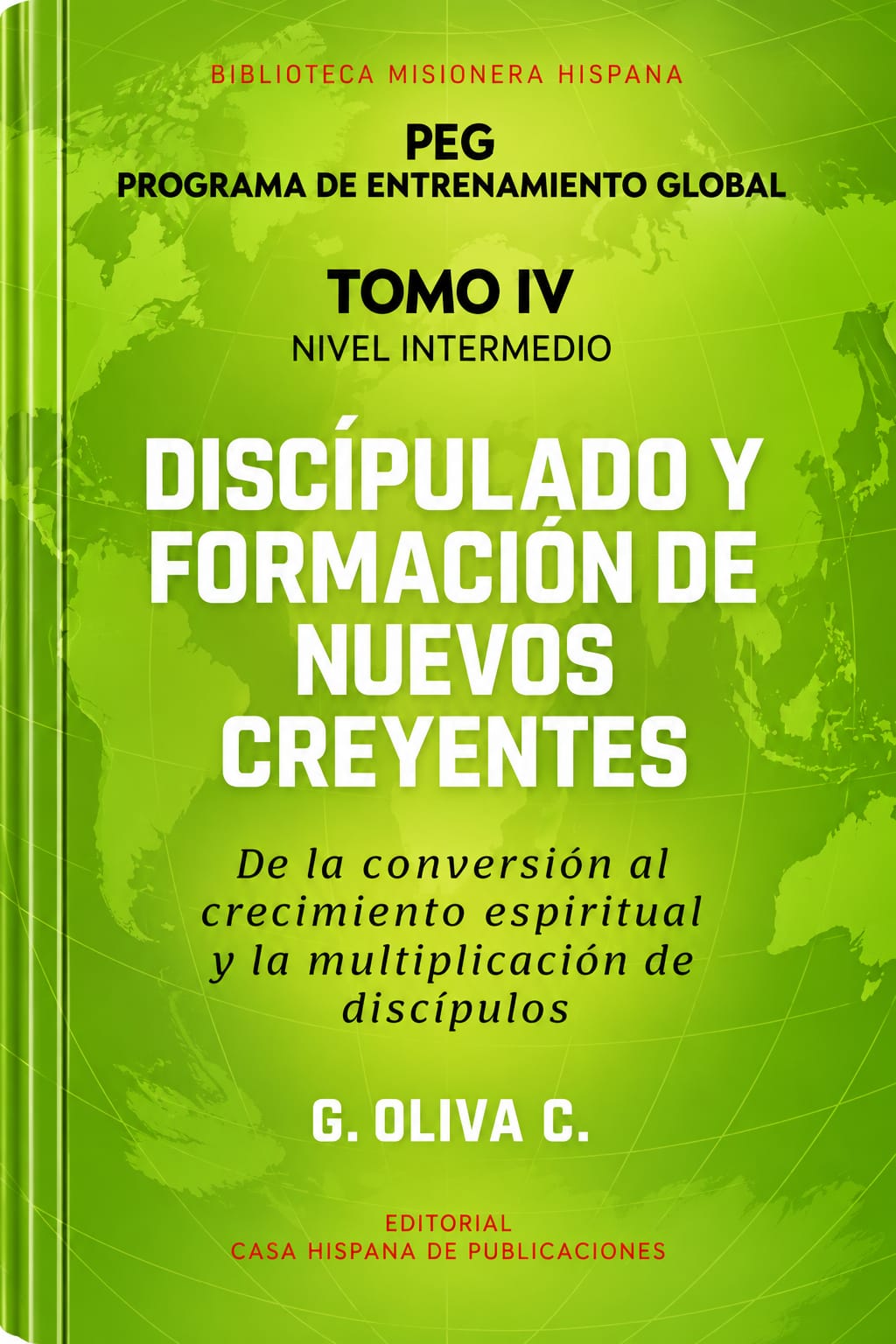
Discipleship as the foundation of formation and of the continuity of Christian mission. Discipleship is one of the fundamental dimensions of the identity, spirituality and mission of the Christian Church. From its origins, Christianity has understood following Jesus Christ not merely as an initial adherence to certain religious convictions, but as a continuous process of personal transformation, communal learning, spiritual maturity and responsible participation in the mission of God. It is in this context that Discipulado y formación de nuevos creyentes: De la conversión al crecimiento espiritual y la multiplicación de discípulos, the fourth volume of the Hispanic Missionary Library, by G. Oliva C., takes its place: a programme of theological, pedagogical and missiological formation that examines the foundations and processes through which people who are beginning their Christian life can develop a mature faith, biblically grounded and committed to the life of the church community. The work addresses a central problem for the contemporary Church: the need to move beyond evangelistic models that concentrate their efforts exclusively on the initial proclamation of the Gospel without establishing systematic processes of accompaniment, teaching and formation for new disciples. From a biblical perspective, Christian conversion represents the beginning of a new relationship with God, but it is not the culmination of the formative process. The Christian life involves growth, learning, transformation of character, participation in community and the progressive development of spiritual responsibilities. Discipleship must consequently be understood as an integral journey that brings together biblical knowledge, spirituality, Christian ethics, pastoral accompaniment, community relationships and formation for service. The central argument of the work can be summed up in a single statement: the mission of the Church consists not only in proclaiming the Gospel, but also in forming disciples capable of living it, teaching it and passing it on responsibly to new generations. Biblical and theological foundations of Christian discipleship Discipleship finds its principal foundation in the life, teaching and ministry of Jesus Christ. The Gospel accounts present following Jesus as an experience that involves learning, a transformation of personal priorities, participation in community and commitment to the values of the Kingdom of God. The call addressed to the first disciples did not consist merely in accepting a set of doctrinal statements. It meant accompanying Jesus, listening to his teaching, observing his conduct and gradually taking part in his ministry. This relational dimension allows discipleship to be understood as a formative experience that integrates teaching and practice. In Matthew 28:18-20, the Great Commission establishes a direct relationship between the mission of the Church and the forming of disciples. The command to make disciples of all nations includes baptism and teaching aimed at obedience to the commandments of Jesus Christ. From a missiological perspective, this passage provides an essential foundation for understanding that evangelisation and discipleship are complementary dimensions of Christian mission. Proclamation of the Gospel can give rise to new experiences of faith, while discipleship seeks to accompany the development of a mature Christian life. Other New Testament texts help to deepen this understanding. Ephesians 4:11-16 relates the ministries of the Church to the equipping of believers and their growth towards maturity in Christ. Likewise, 2 Timothy 2:2 sets out a principle for passing on Christian teaching through people equipped to instruct others. These foundations allow discipleship to be understood as a continuous, communal and multiplying process. Christian conversion as the beginning of a process of transformation. Conversion holds a significant place in Christian experience, especially because of its relationship to faith, repentance and reconciliation with God. The formation of new believers, however, requires a distinction between the initial event of conversion and the subsequent development of the spiritual life. In Christian theology, conversion can be understood as a response of faith to the Gospel, accompanied by a new orientation of life towards God. Personal experiences of conversion may nonetheless take diverse forms. Some people identify specific moments of spiritual transformation, while others describe gradual processes of understanding, drawing closer to faith and taking part in community. Pastoral formation needs to recognise this diversity and avoid imposing uniform models of religious experience. The accompaniment of new believers should seek to ensure that initial faith finds the right conditions to develop, through biblical teaching, prayer, integration into the community and reflection on the practical implications of following Jesus Christ. Conversion does not automatically remove the personal, family or social difficulties a person may be experiencing. Discipleship must therefore unfold through realistic, respectful and gradual processes that are able to recognise the particularities of each spiritual journey. Spiritual growth and the formation of Christian character Spiritual growth is a central dimension of discipleship. Christian maturity cannot be reduced to the accumulation of doctrinal knowledge, length of congregational membership or frequent participation in religious activities. From a biblical perspective, it involves the progressive development of a life guided by the teachings of Jesus Christ and marked by the fruit of the Holy Spirit. Galatians 5:22-23 presents virtues such as love, patience, kindness, faithfulness, gentleness and self-control, which offer relevant criteria for reflecting on the transformation of Christian character. These dispositions find concrete expression in family relationships, community life, professional practice and social responsibility. The formation of new believers therefore needs to integrate doctrinal teaching with the development of habits, attitudes and competences that foster a coherent Christian life. Spiritual growth also requires recognising that processes of maturing do not always unfold in a linear way. People may go through periods of enthusiasm, difficulty, doubt and conflict, and through stages of learning that call for pastoral accompaniment and understanding from the community. Responsible discipleship must avoid simplistic interpretations that associate every personal difficulty with a supposed lack of faith or insufficient spiritual maturity. Christian formation needs to promote a spirituality that integrates trust in God, personal responsibility, critical reflection and the capacity to face the complexities of human existence. Biblical teaching as the foundation of disciple formation Knowledge of the Scriptures is one of the essential components of Christian discipleship. New believers need to develop tools that enable them to understand the biblical message, recognise its principal teachings and relate them responsibly to their everyday lives. Initial biblical formation can include content relating to the person and work of Jesus Christ, salvation, prayer, the life of the Church, Christian ethics and eschatological hope. Learning, however, ought not to be limited to memorising verses or doctrinal statements. Formation needs to develop basic competences in reading, interpreting and understanding the Scriptures in context. From a pedagogical perspective, it is important to organise content in a progressive sequence that takes into account each participant's prior knowledge, questions and learning abilities. Biblical teaching also requires spaces for dialogue in which new believers can voice their concerns and examine their own interpretations. Discipleship must promote a responsible relationship with the biblical text, avoiding both total dependence on the interpretations of others and the isolated reading of passages without regard to their context. Basic theological education is therefore a tool for strengthening the believer's autonomy in studying the Scriptures and his or her conscious participation in the Christian community. Pastoral accompaniment and Christian mentoring Discipleship has a profoundly relational dimension. The formation of new believers cannot be understood solely as participation in courses or teaching programmes, since it also involves relationships of trust, accompaniment and shared learning. Christian mentoring is a form of formation through which people with more experience can guide those who are beginning their journey of faith. This accompaniment may include conversations, Bible study, prayer, reflection on personal experiences and guidance in becoming part of the community. The relationship between mentor and disciple, however, needs to rest on principles of respect, transparency and responsibility. Spiritual authority must not be used to control personal decisions, create emotional dependence or restrict freedom of conscience. Pastoral accompaniment requires recognising the limits of ministerial competence and referring, in good time, those situations that call for specialised professional care. The forming of disciples should foster the development of people able to think, discern, decide and take on responsibilities progressively. Christian mentoring therefore becomes more valuable when it contributes to the growth of spiritual autonomy rather than to the permanent subordination of the new believer to a figure of authority. The Christian community as a space for integral formation The local church is one of the principal settings for the formation of new believers. Community life provides opportunities to learn, share experiences, build relationships and take part in different expressions of Christian service. The book of Acts describes practices of the first communities relating to apostolic teaching, fellowship, prayer and solidarity. These experiences show that Christian formation does not take place solely through individual processes, but also through participation in a community of faith. Integration into a congregation is a significant stage for those who are beginning their Christian life. Incorporation into a community, however, must be carried out through practices of welcome, respect and accompaniment that recognise the dignity of each person…
Category
- RELIGION AND SPIRITUALITY
- CHRISTIANITY
- THEOLOGY
- PRACTICAL THEOLOGY
- MISSIOLOGY
- CHRISTIAN DISCIPLESHIP
- FORMATION OF NEW BELIEVERS
- CHRISTIAN EDUCATION
- SPIRITUAL GROWTH
- MULTIPLICATION OF DISCIPLES
Rights for this book
We turn publishing rights into international growth, connecting authors and publishers with new markets, new readers and new partners around the world.
Technical details
- Title
- Discipulado y formación de nuevos creyentes
- Author
- G. Oliva C.
- Imprint
- Grupo Editorial casa Hispana
- Size
- 15x23cms
- Edition
- 1st edition, 2026
- Published in
- Chile
- Year of publication
- 2026
- Available languages
- Spanish, English, German, Portuguese
- Binding
- Paperback with flaps
- Pages
- 475