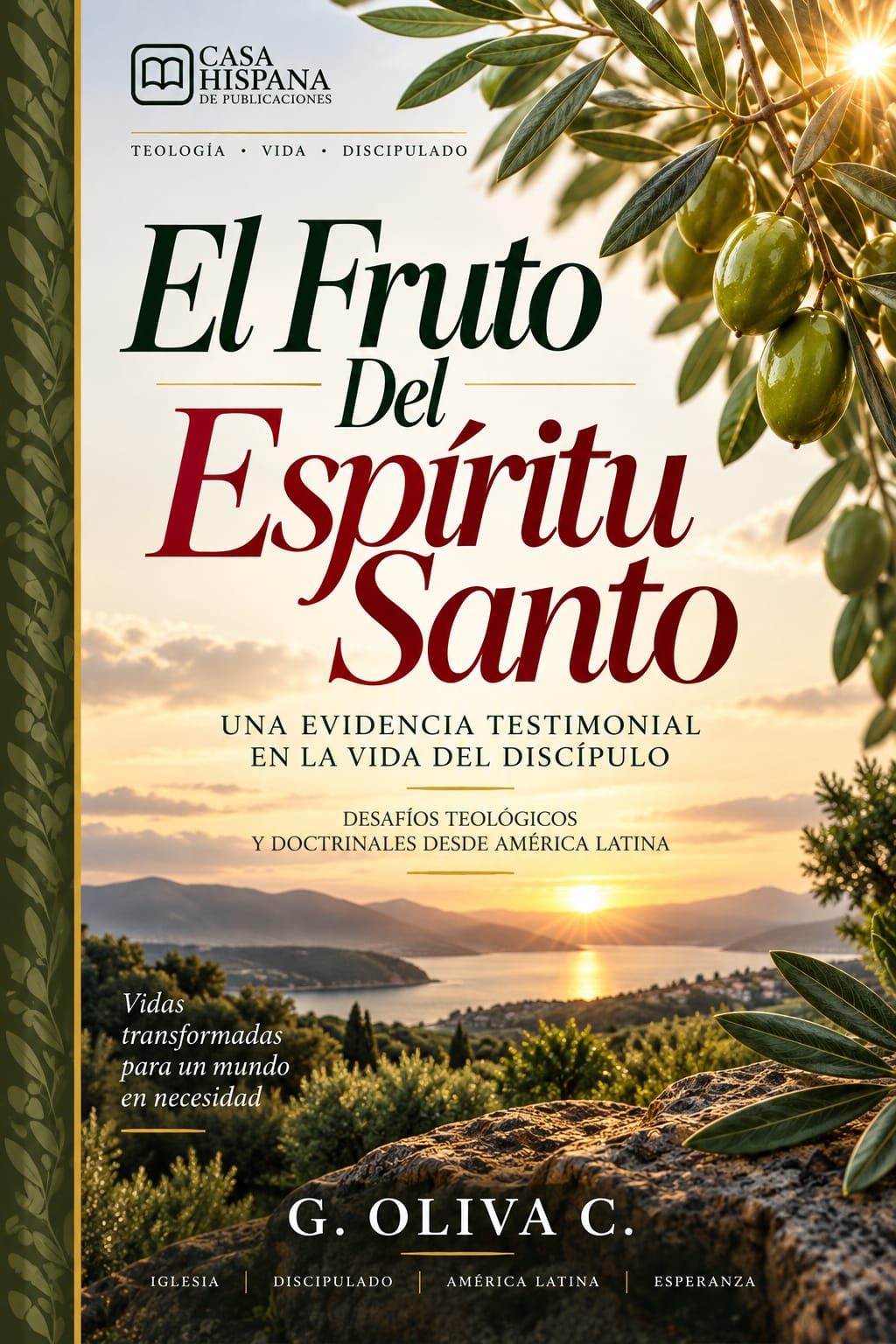
Description
The fruit of the Holy Spirit is one of the deepest expressions of Christian transformation, because it reveals that the Spirit's work is not confined to extraordinary experiences, charismatic manifestations, ministerial abilities or particular moments of intense spirituality, but progressively reaches the believer's character, decisions, relationships, thoughts, attitudes and everyday conduct, so that the presence of the Spirit begins to become visible in a life that reflects the character of Jesus Christ with ever greater clarity. This understanding occupies a central place in the pneumatology of the New Testament, because it makes it possible to recognise that an authentic spiritual life cannot be assessed exclusively by what a person claims to experience, but also by what that person is becoming. It is precisely for this reason that Paul, after describing the conflict between the flesh and the Spirit, declares in Galatians 5:22-23 that “the fruit of the Spirit is love, joy, peace, patience, kindness, goodness, faithfulness, gentleness, self-control”, establishing a direct relationship between the action of the Holy Spirit and the ethical and spiritual transformation of the believer. One important observation about the text is that Paul uses the word “fruit” in the singular, and does not simply offer a collection of independent fruits, which makes it possible to understand these virtues as related aspects of one and the same life transformed by the Spirit. Love cannot be wholly separated from patience, peace needs gentleness, goodness requires self-control, and faithfulness finds concrete expression in relationships marked by love and truth. From the author's perspective, this unity is of enormous pastoral significance, because it prevents us from selecting only those virtues that happen to suit our personal temperament while ignoring other areas of Christian character. The Spirit seeks to form the believer as a whole, and not simply to strengthen the qualities he or she already possesses by nature. The immediate context of Galatians 5 is indispensable for understanding this teaching, because Paul draws a contrast between the “works of the flesh” and the “fruit of the Spirit”, and is therefore not simply developing a general catalogue of moral virtues but describing two different orientations of existence. The flesh, in this context, should not be reduced exclusively to the physical body; it designates human existence oriented against God and marked by desires, behaviours and relationships that destroy communion, whereas walking by the Spirit represents a life submitted to the transforming action of God. For this reason Paul exhorts, “Walk in the Spirit, and do not gratify the desires of the flesh”, in Galatians 5:16, and later affirms, “If we live by the Spirit, let us also walk by the Spirit”, in Galatians 5:25, showing that the spiritual life is dynamic, practical and a matter of every day. The fruit, therefore, does not appear as the automatic result of a moral discipline independent of God, nor as the exclusive product of human willpower. Although the will, discipline, obedience and personal decisions play an important part in the Christian life, the fundamental origin of the fruit is the Holy Spirit. This affirmation establishes a decisive difference between Christian transformation and the mere external modification of behaviour. A person may learn certain rules, temporarily control some forms of conduct or project a respectable religious image without necessarily experiencing a deep transformation of the heart, whereas the work of the Spirit seeks to reach the motivations, desires, priorities and relationships from which a renewed conduct subsequently emerges. The research carried out by the author regards it as particularly important to recover this relationship between pneumatology and the formation of character, because in certain Christian contexts the study of the Holy Spirit has been concentrated almost exclusively on gifts, experiences, supernatural manifestations or charismatic controversies, whereas Galatians reminds us that one of the fundamental evidences of his action is precisely a personality progressively shaped after Christ. To speak of the Holy Spirit without speaking of holiness, love, self-control, faithfulness, gentleness and ethical transformation yields an incomplete pneumatology; in the same way, to speak of Christian character without recognising the indispensable action of the Spirit may end by turning sanctification into religious moralism. The first characteristic mentioned by Paul is love, ágape, and its place at the head of the list is theologically significant, because love occupies a central position within Christian ethics. Jesus sums up the law in love of God and of neighbour, and Paul declares in 1 Corinthians 13 that even the most impressive spiritual manifestations lose their true meaning when they lack love. Christian ágape should not be defined solely as a feeling of affection, because it includes decision, commitment, service, self-giving, the pursuit of the other's good, mercy, truth and the capacity to act responsibly even when the emotions are difficult. The love produced by the Spirit finds its supreme model in Christ, who not only taught about love but embodied it through service, compassion, forgiveness, closeness to marginalised people, self-giving and sacrifice. To grow in love therefore means progressively abandoning an existence centred exclusively on one's own interest in order to learn to recognise the dignity, the needs and the well-being of one's neighbour. Yet neither should this love be confused with permissiveness, because to love does not mean approving of all behaviour, avoiding all confrontation or giving up the truth. Christian love can correct, set limits, denounce injustices and confront whatever destroys, precisely because it genuinely seeks the good. This clarification is of particular pastoral relevance, because certain mistaken interpretations of Christian love have led people to tolerate abuse, manipulation, violence or destructive relationships on the assumption that to forgive means to allow the harm to continue indefinitely. The fruit of the Spirit should never be used to legitimise abusive subjection. Christian love and gentleness do not do away with dignity, justice, responsibility or healthy boundaries. Joy, chará, represents another fundamental aspect of life in the Spirit, and neither should it be confused with permanent enthusiasm, superficial optimism or the absence of sadness. The New Testament presents believers who are able to experience joy in the midst of difficulties precisely because their hope is rooted in God and not exclusively in favourable circumstances. Paul can exhort, “Rejoice in the Lord always”, while writing from adverse circumstances, because the foundation of Christian joy does not consist in denying suffering but in recognising that no circumstance holds absolute authority over the hope that comes from God. From this perspective, Christian joy can coexist with tears, mourning, worry and pain. Jesus himself experienced anguish and wept; a spirituality that obliges the believer to project constant happiness may therefore end by denying human emotional reality. The fruit of the Spirit does not eliminate difficult emotions but introduces a deeper hope within them. The believer can lament and go on hoping, can pass through loss and go on trusting, can acknowledge pain without turning it into final despair. Peace, eirēnē, likewise has a depth that goes beyond mere emotional calm. Its biblical background is bound up with a comprehensive understanding of well-being, reconciliation, order and communion with God and with others. The peace that the Spirit produces begins in reconciliation with God and extends into human relationships, and for that reason it cannot be limited to an inner sensation. A person truly formed by peace will also seek to become an agent of reconciliation, refusing to feed conflicts, rumours, divisions, resentments and hostility unnecessarily. Nor is Christian peace the same as an artificial absence of conflict. Some situations call for responsible confrontation, especially in the face of injustice, abuse, falsehood or corruption. To seek peace does not mean concealing problems but facing them in a way that pursues truth, justice, reconciliation and restoration wherever these are possible. This is fundamental for the church, because a congregation may have intense religious activity and at the same time be deeply fragmented by personal rivalries, ministerial competition, power struggles or a lack of forgiveness. The fruit of the Spirit directly calls those contradictions into question. Patience, makrothymía, expresses the capacity to persevere in the face of provocations, difficulties and prolonged processes without responding at once with anger, vengeance, despair or abandonment. Christian patience recognises that people need time to grow, that conflicts require processes and that many of God's answers do not arrive according to our personal calendars. Yet neither does patience mean irresponsible passivity: to bear a difficulty patiently does not imply accepting indefinitely what can and must be transformed. In human relationships patience acquires extraordinary importance, because living together means constantly coming up against differences, mistakes, limitations, different rhythms and frustrated expectations. A church where there is little patience can quickly become a community of judgement, whereas a community where patience is combined with truth and responsibility creates space for growth, restoration and learning…
Category
- THEOLOGY
- SYSTEMATIC THEOLOGY
- CONTEXTUAL THEOLOGY
- LATIN AMERICAN THEOLOGY
- CHRISTIAN EDUCATION
- DISCIPLESHIP
Rights for this book
We turn publishing rights into international growth, connecting authors and publishers with new markets, new readers and new partners around the world.
Technical details
- Title
- El fruto del Espíritu Santo
- Author
- G. Oliva C.
- Imprint
- Grupo Editorial casa Hispana
- Size
- 15x23cms
- Edition
- 1st edition, 2024
- Published in
- Chile
- Year of publication
- 2024
- Available languages
- Spanish, English, German, Portuguese
- Binding
- Paperback with flaps
- Pages
- 495