Description
The message of the cross is the heart of the Christian faith, because in it converge some of the fundamental truths of the Gospel: redemption, salvation, forgiveness, reconciliation, the love of God, victory over sin and death, and the call to a life of discipleship centred on Jesus Christ. The cross should not be understood merely as a tragic event at the end of Jesus's earthly life, nor solely as a religious symbol historically associated with Christianity, but as the redemptive event through which God decisively reveals his grace, his righteousness and his love towards a humanity in need of reconciliation. From this perspective, to understand the cross is to approach the very centre of Christology and of the Christian doctrine of salvation, because the identity and mission of Jesus Christ find their culminating expression in his death and resurrection. The death of Jesus must be interpreted within the whole of his person and mission. The Christ who dies on the cross is the same Christ who announced the Kingdom of God, called people to repentance, proclaimed good news, showed compassion towards those who suffered, confronted sin, formed disciples and declared that he had come to serve and to give his life for many. For this reason, the cross does not appear as an event disconnected from Jesus's ministry, but as the culmination of a life marked by obedience, self-giving and faithfulness to God's purpose. One of the fundamental aspects of the message of the cross is redemption. First John 2:2 links Jesus Christ with atonement for sin, while Romans 3:25-26 presents the work of Christ within the revelation of God's righteousness. These statements show that the cross answers the deep problem of human sin, and that Christian forgiveness should not be understood as mere divine indifference towards evil: the grace of God takes the reality of sin seriously and provides in Christ the foundation for reconciliation. Atonement therefore occupies a central place in the theology of the cross, although throughout Christian history different traditions have used various categories to explain the richness of Christ's work. Terms such as sacrifice, substitution, reconciliation, redemption, victory and ransom attempt to express complementary aspects of an event whose depth cannot be exhausted by any single biblical image. The cross reveals at once the gravity of sin and the greatness of grace, because it shows that the rupture between God and humanity calls for a work of reconciliation that God himself carries out through Jesus Christ. To speak of atoning sacrifice is to recognise that Jesus willingly gives his life on behalf of others. The cross does not simply present a man accidentally caught up in the political and religious circumstances of his time. Although, historically, his crucifixion took place within concrete structures of power and violence, the New Testament interprets his death theologically as a redemptive self-offering bound up with God's purpose. This understanding allows us to affirm that what looked like defeat from a human perspective becomes, within the divine purpose, an instrument of salvation. Romans 3:24-26 further links justification with grace and with the redemption that is in Christ Jesus. Believers cannot build their own reconciliation with God by accumulating religious merit, because salvation is received as grace. This profoundly challenges any spirituality based on moral self-sufficiency, because it places all human beings before a common need: the need to receive what they cannot fully produce by themselves. The cross can also be understood through the category of ransom. Colossians 1:13-14 describes believers as transferred from the dominion of darkness into the Kingdom of the beloved Son, in whom there is redemption and forgiveness. This image conveys liberation, because the work of Christ not only forgives past guilt but brings the believer into a new spiritual reality. The Gospel proclaims freedom from the dominion of sin and a new possibility of living under the lordship of Christ. This freedom needs to be rightly understood, because liberation from sin does not simply mean independence to live according to any desire whatever, but a renewed capacity to live oriented towards God. The grace that sets free is also the grace that transforms. Titus 2:11-14 links saving grace precisely with a life marked by new moral and spiritual priorities. In this way, redemption and sanctification remain deeply intertwined. The love of God is another inseparable aspect of the cross. John 3:16 presents the giving of the Son as an expression of God's love for the world, while Romans 5:8 declares that God demonstrates his love in that, while we were still sinners, Christ died for us. This truth is fundamental because it establishes that the initiative of salvation comes from God: human beings do not first persuade God to love them; rather, divine love precedes and underpins the work of redemption. The cross thus reveals a love that does not depend on the merit of the one who receives it. God loves within a humanity marked by sin, frailty, contradiction and estrangement. This gives Christian grace a particular depth, because it means that the Gospel begins not with the human capacity to reach God but with the divine initiative that comes out to meet humanity through Christ. Yet the love revealed on the cross must not be reduced to sentimentality. It is a love that gives itself, that bears a cost and that actively seeks the good of the other. Romans 5 presents this love within the death of Christ for people who were still in a state of sin. The cross thus redefines the Christian meaning of love, because it shows that to love may involve self-giving, renunciation, service, patience, forgiveness and a willingness to seek the well-being of others even when this demands personal sacrifice. This understanding has profound consequences for the Christian life, because whoever claims to follow the crucified Christ is called to learn a similar way of relating to others. Christian love cannot be confined to religious declarations; it must become a concrete readiness to serve, forgive, accompany, share and recognise the dignity of one's neighbour. The cross therefore challenges a spirituality centred exclusively on individual benefit and directs the believer towards a life marked by self-giving. Reconciliation is another essential aspect of the message of the cross. Second Corinthians 5:18-19 presents God reconciling the world to himself in Christ. This makes it possible to understand salvation as the restoration of a relationship broken by sin. Christian reconciliation does not consist merely in cancelling a moral debt, but in opening once again the possibility of communion with God. In this way, the cross is the place where the enmity produced by sin is confronted and where a path towards peace is opened. Romans 5:1 links justification by faith with peace with God through Jesus Christ. This peace does not simply mean emotional calm, but a new relational standing: the believer can come to God not as someone who must build a path to acceptance on their own, but as a person reconciled through Christ. Ephesians 2:14-16 significantly broadens this perspective, because it links Christ's reconciling work not only with the relationship between God and humanity but also with the overcoming of hostility between human groups, in the specific context of Jews and Gentiles. This shows that the cross has ecclesiological and communal consequences: those who have been reconciled to God are also called to learn to live as a reconciled community…
Category
- THEOLOGY
- SYSTEMATIC THEOLOGY
- CHRISTOLOGY
- CONTEXTUAL THEOLOGY
- LATIN AMERICAN THEOLOGY
- CHRISTIAN EDUCATION
- SPIRITUALITY
Rights for this book
We turn publishing rights into international growth, connecting authors and publishers with new markets, new readers and new partners around the world.
Technical details
- Title
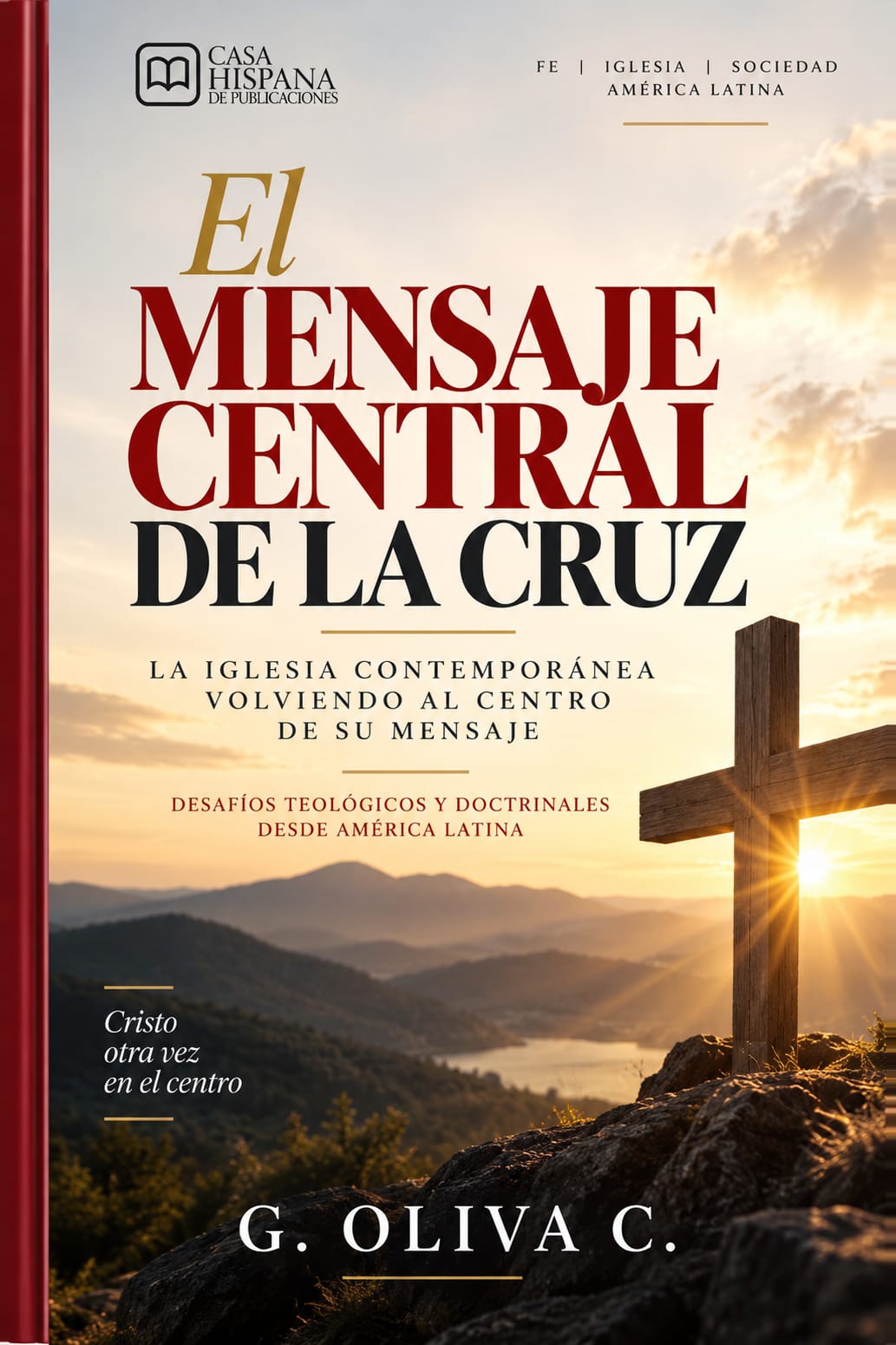
- El mensaje central de la cruz
- Author
- G. Oliva C.
- Imprint
- Grupo Editorial casa Hispana
- Size
- 15x23cms
- Edition
- 1st edition, 2023
- Published in
- Chile
- Year of publication
- 2024
- Available languages
- Spanish, English, German, Portuguese
- Binding
- Paperback with flaps
- Pages
- 485