Description
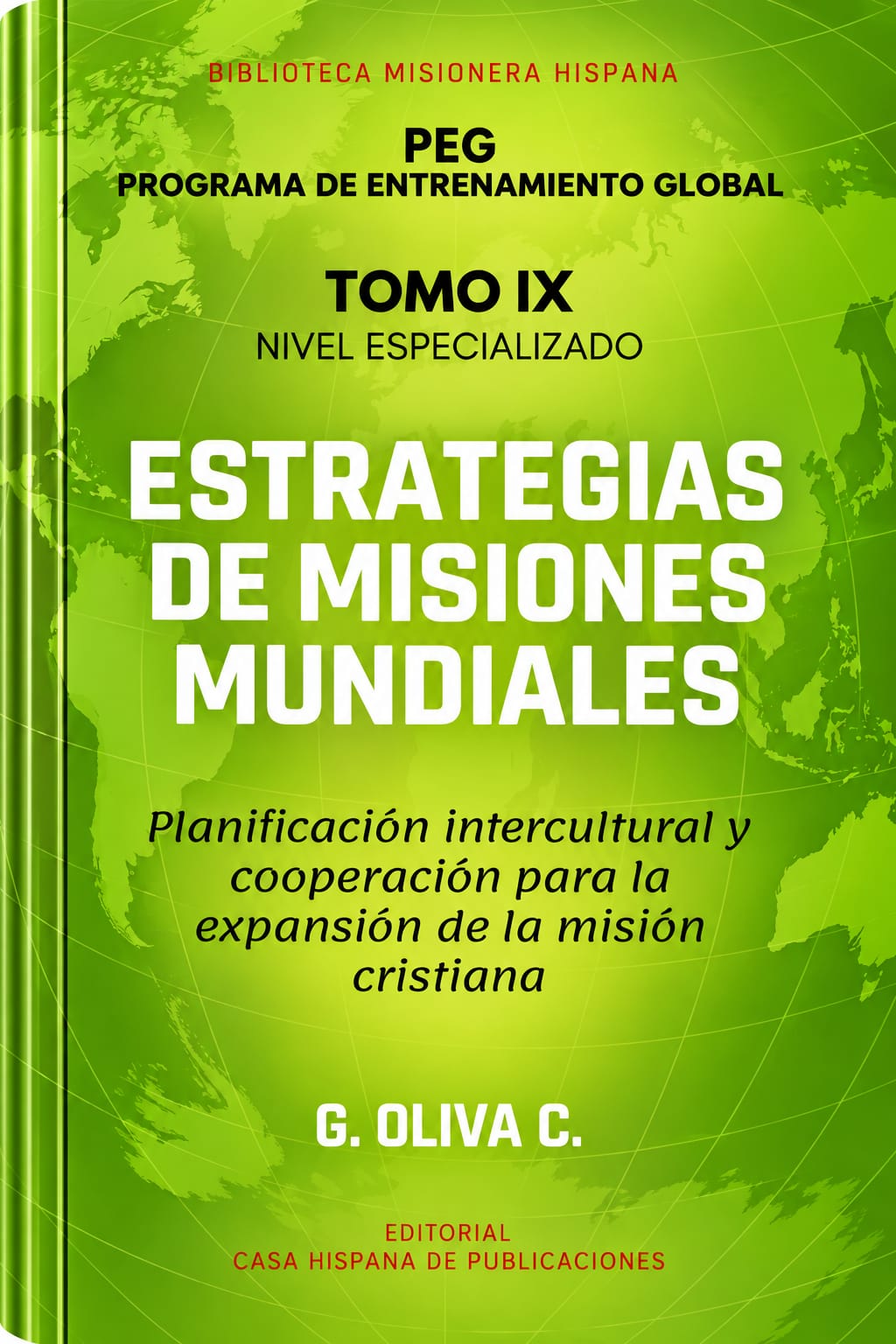
World missions are one of the most significant expressions of the universal vocation of the Christian church and represent a field of study that brings together biblical foundations, theological reflection, sociocultural research, strategic planning and international cooperation. In a world marked by profound political, economic, cultural and religious change, Christian mission faces the challenge of developing strategies capable of responding to diverse realities through responsible processes of evangelisation, disciple-making, community service and the strengthening of local churches. It is from this perspective that estrategias de misiones mundiales: planificación intercultural y cooperación internacional para la expansión de la misión cristiana, by G. Oliva C., is presented: an academic and missiological proposal aimed at examining the principles, models and tools that make it possible to organise international missionary initiatives on the basis of an integral understanding of the mission of God. The work argues for the need to move beyond reductionist conceptions that identify world missions exclusively with the geographical relocation of evangelists or with the institutional expansion of particular religious organisations. Instead, it proposes a horizon of reflection in which mission is understood as a responsibility shared among churches, Christian communities, training centres, mission agencies and international networks committed to the contextualised communication of the gospel. The biblical foundation of this perspective finds essential points of reference in the Great Commission of Matthew 28:18-20, in the mandate to bear witness expressed in Acts 1:8 and in the missionary experience of the first Christian communities. These passages make it possible to recognise that the mission of the church has a universal dimension that transcends national and cultural borders, calling believers to take part in making disciples among diverse peoples. Contemporary theological reflection has developed the concept of the Missio Dei to underline that mission originates in the divine initiative and that the church takes part in it through its witness, its community life and its service. This understanding makes it possible to place missionary planning within a theological framework that recognises the centrality of Jesus Christ, the work of the Holy Spirit and the responsibility of Christian communities in the face of human realities. The expansion of Christian mission, consequently, should not be assessed solely through indicators of numerical growth or territorial presence, but should also take into account the maturity of communities, the formation of local leadership, the quality of intercultural relationships and the ethical responsibility of the processes undertaken. One of the fundamental pillars of world mission strategy is knowledge of the geographical, demographic and religious realities of the international scene. Missionary research needs to consider the distribution of populations, urban change, migratory movements, socioeconomic conditions and the cultural characteristics of territories. Analysing these factors makes it possible to identify needs, understand opportunities for cooperation and set priorities grounded in verifiable information. Missionary geography is, in this sense, an interpretive tool that relates territory to the historical, cultural and religious processes of societies. The identification of areas of work, however, must not reduce peoples to statistical categories or treat religious differences as automatic indicators of human deficiency. Communities have their own histories, knowledge, institutions and forms of organisation, which must be recognised in any missionary approach. International strategic planning therefore requires the integration of documentary research, sociocultural analysis, dialogue with local actors and an assessment of the legal and political conditions of each country. The formulation of missionary projects needs to set clear objectives, define responsibilities, identify available resources and develop monitoring mechanisms that make it possible to evaluate results. These tools help to reduce improvisation and favour institutional continuity, especially when initiatives involve organisations located in different countries. Planning must nonetheless remain flexible enough to adapt to political changes, social transformations and lessons learnt through contact with communities. Missionary strategies cannot be transferred mechanically from one territory to another, since each context has particular characteristics that shape its forms of communication, participation and community organisation. The intercultural dimension is another decisive component. World mission involves encounters between people who have different languages, traditions, worldviews and historical experiences. For this reason, the preparation of international teams must incorporate knowledge of cultural anthropology, intercultural communication, the history of religions and the analysis of social relationships. Language learning, active listening and cultural sensitivity help to build relationships of trust and to avoid ethnocentric interpretations. The contextualisation of the gospel is a theological responsibility that seeks to communicate the Christian message in a way that is understandable and relevant within each cultural reality, without automatically identifying the faith with the customs of the sending churches. This process demands distinguishing between the biblical foundations of Christianity and the particular historical expressions through which communities have organised their religious life. World mission needs to recognise that cultural diversity is not necessarily a difficulty to be overcome, but a fundamental dimension of human experience that calls for respect, learning and discernment. International cooperation occupies a central place in the development of contemporary missionary strategies. Local churches, sending organisations, training centres and Christian networks can strengthen their capacities through partnerships grounded in shared objectives, transparency and co-responsibility. Inter-church cooperation makes it possible to exchange knowledge, share educational resources, develop joint programmes and establish mechanisms of accompaniment for cross-cultural projects. These relationships, however, require clear agreements on financial administration, institutional authority, pastoral responsibilities and the participation of receiving communities. Cooperation should not reproduce structures of permanent dependence or concentrate strategic decisions in the organisations that have the greatest economic resources. On the contrary, it needs to foster balanced relationships and to recognise the capacity of local churches to set priorities, develop leadership and manage their own processes. The formation of locally rooted leaders is a fundamental condition for the sustainability of international initiatives. Christian communities need to develop theological, organisational and ministerial autonomy, so that their continuity does not depend indefinitely on the presence of foreign agents. From this perspective, disciple-making, leadership training and institutional strengthening acquire an importance equal to that of opening new mission fields. The expansion of Christian mission does not consist merely in increasing the number of places where the church is present, but in contributing to the development of communities capable of sustaining their spiritual life, forming new generations and taking a responsible part in their societies. Another significant aspect is the preparation and mobilisation of human resources. World missions require people with theological, spiritual, intercultural, administrative and communication skills. The selection and training of candidates must take into account personal maturity, adaptability, family responsibilities and the particular demands of the contexts of service. Responsible sending requires establishing processes of orientation, pastoral accompaniment, risk prevention and holistic care for missionaries. Sending organisations need to recognise that their responsibility does not end once participants have been deployed, but continues throughout their service and through the subsequent processes of return and reintegration. Physical, emotional and family well-being is an essential dimension of missionary sustainability. International teams likewise require preparation to work collaboratively, resolve conflicts and recognise the cultural differences among their own members. Financial administration is another strategic dimension. International missionary projects need realistic budgets, accountability mechanisms and transparent procedures for transferring and using resources. Economic sustainability must rest on responsible criteria and avoid funding models that create dependence, religious pressure or unrealistic expectations. Diversifying sources of support, planning for contingencies and periodically reviewing expenditure help to strengthen the stability of programmes. International cooperation also requires attention to the tax, labour, immigration and administrative regulations that apply in each territory. Compliance with legal provisions is an institutional responsibility that protects both missionary teams and the communities involved. In contexts marked by religious restrictions, political conflict or insecurity, planning must give priority to the safety of people and to respect for the legal order. Christian mission cannot justify practices that needlessly expose vulnerable populations or disregard their freedom of conscience. Missionary ethics is therefore a cross-cutting pillar of every international strategy. The proclamation of the gospel must take place through free and respectful relationships, without emotional manipulation, economic coercion or making social assistance conditional on the acceptance of religious beliefs. This responsibility takes on particular relevance in societies where there are historical inequalities, inter-religious tensions or a legacy of colonial intervention. Missiological reflection needs to acknowledge critically the relationships between Christianity, political power and cultural expansion, and to avoid reproducing models of religious or civilisational superiority. In Latin America, the diversity of Indigenous peoples, Afro-descendant communities and migrant populations demands strategies that take into account collective rights, cultural identity, historical memory and forms of community organisation. Christian mission must seek relationships of cooperation that recognise human dignity and the autonomy of peoples. On the global stage, international migration and diasporas have transformed the traditional conditions of missionary activity. Large cities bring together communities from different countries, languages and religious traditions, creating opportunities for intercultural encounter that do not depend solely on sending people to distant territories. This reality requires churches to develop strategies of hospitality, community accompaniment and intercultural communication in their own urban contexts. Migrant communities must not be regarded merely as the targets of evangelistic initiatives, but also as active agents of mission, able to contribute experience, knowledge and leadership. Transnational networks of believers can help to develop new forms of cooperation and missionary training. Digital technologies have also changed the possibilities for international coordination. Virtual platforms make it possible to run training programmes, share educational resources, organise teams and maintain communication between organisations located on different continents. The use of these tools, however, requires policies on data protection, digital security and responsible communication. The availability of technology does not replace the need to build human relationships, nor does it in itself guarantee the cultural relevance of projects. Strategic planning must integrate digital resources as complementary instruments within broader formative and community processes. The evaluation of world missions is another essential dimension. International projects need mechanisms that make it possible to recognise progress, identify difficulties and modify strategies when circumstances so require. Indicators relating to leadership formation, the continuity of communities, local participation, financial sustainability and the quality of accompaniment can contribute to a more integral evaluation. Spiritual and communal outcomes, however, cannot be entirely reduced to quantitative measurement. Responsible evaluation must incorporate qualitative information, the testimonies of participants and the perspectives of receiving communities, so that institutional demands for growth do not artificially condition the interpretation of results. Cooperation between organisations also requires processes of shared learning that make it possible to review methodologies and strengthen good practice. From an academic standpoint, estrategias de misiones mundiales stands at the convergence of missiology, practical theology, intercultural anthropology, strategic planning, international relations and the administration of missionary projects. Its thematic orientation makes it possible to understand that contemporary world mission demands specialised formation capable of relating theological convictions to competences in research, management and cooperation. As the ninth volume of the Hispanic Missionary Library, part of the Global Missionary Training Programme, it represents a stage of deeper study aimed at preparing leaders, coordinators, researchers and those responsible for international missionary initiatives. Its proposal extends the material on cross-cultural evangelisation, church planting and the sending of missionaries towards a strategic understanding of the movements and networks that take part in Christian mission on a global scale. The relevance of this orientation lies in recognising that contemporary challenges require collaboration between communities and organisations with different experiences, capacities and resources. No institution can take on the complexity of world mission by itself, and responsible cooperation is therefore an important condition for developing sustainable initiatives. The expansion of Christian mission needs to be understood as a process of shared participation that brings together biblical formation, cultural sensitivity, local leadership, transparent administration and ethical commitment. In short, estrategias de misiones mundiales: planificación intercultural y cooperación internacional para la expansión de la misión cristiana, by G. Oliva C., stands as an academic and ministerial proposal addressed to pastors, missionaries, theology students, agency directors, international coordinators, trainers and organisations committed to the development of global missionary initiatives. Its approach stresses that world mission cannot depend solely on isolated efforts or on institutional strategies detached from human realities. It requires research, theological discernment, planning, cooperation and the capacity to adapt to changing circumstances. A responsible missionary strategy recognises that the universality of the gospel must be expressed through respectful relationships with cultural diversity, the active participation of local communities and formative processes capable of being sustained over the long term. In this way, world missions are understood as a collective responsibility of the church that demands specialised preparation, an international vision and an abiding commitment to the dignity of people, the making of disciples and the development of contextualised Christian communities…
Category
- RELIGION AND SPIRITUALITY
- CHRISTIANITY
- THEOLOGY
- PRACTICAL THEOLOGY
- MISSIOLOGY
- WORLD MISSIONS
- STRATEGIC MISSION PLANNING
- INTERNATIONAL COOPERATION
- CROSS-CULTURAL MISSION
- EXPANSION OF THE CHRISTIAN MISSION
Rights for this book
We turn publishing rights into international growth, connecting authors and publishers with new markets, new readers and new partners around the world.
Technical details
- Title
- Estrategias de misiones mundiales
- Author
- G. Oliva C.
- Imprint
- Grupo Editorial casa Hispana
- Size
- 15x23cms
- Edition
- 1st edition, 2026
- Published in
- Chile
- Year of publication
- 2026
- Available languages
- Spanish, English, German, Portuguese
- Binding
- Paperback with flaps
- Pages
- 468