Description
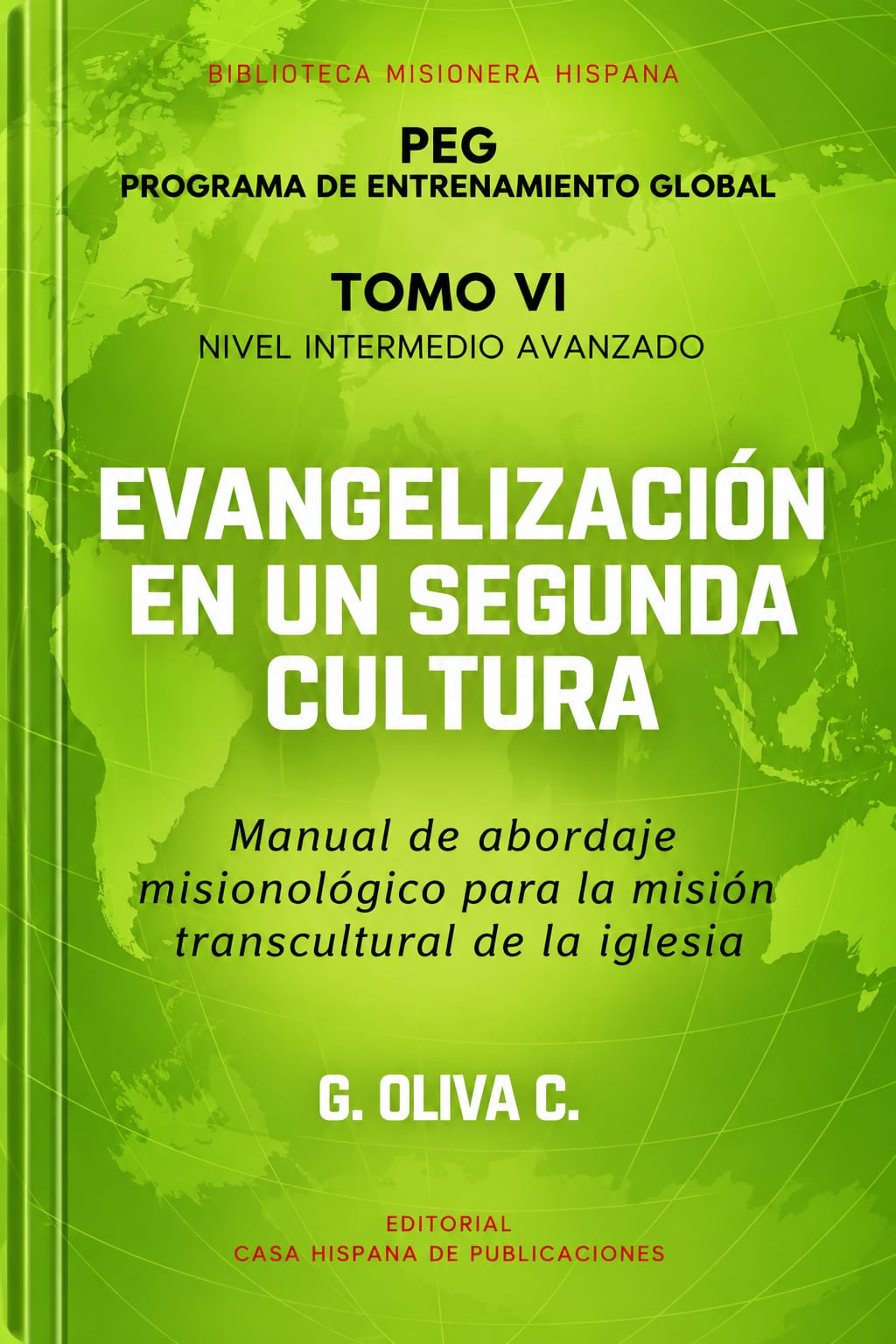
Evangelisation in a second culture is one of the most complex and significant challenges facing contemporary Christian mission, because it involves an encounter between people, communities, traditions, languages, worldviews and value systems that do not always share the same ways of understanding reality, spirituality and human relationships. In this setting, proclaiming the gospel requires far more than transmitting a religious message, for it demands theological preparation, anthropological understanding, intercultural sensitivity and a genuine willingness to engage in respectful dialogue with the receiving communities. It is from this perspective that evangelización en una segunda cultura: manual de abordaje misionológico para la misión transcultural de la iglesia, by G. Oliva C., is presented: an academic and formative proposal aimed at examining the biblical, theological, anthropological and methodological foundations that ought to guide the church's participation in cultural contexts other than its own. The work argues for the need to understand cross-cultural mission as a process of human encounter and of communicating the gospel, one that requires recognising the dignity, identity and history of peoples and avoids reproducing models of evangelism associated with cultural imposition, religious paternalism or the subordination of local communities. Christian mission finds its foundation in the initiative of God and in the universal character of the message of Jesus Christ, whose reach towards all nations is an essential dimension of the Great Commission. The mandate expressed in Matthew 28:18-20, together with the vision of Acts 1:8, makes it possible to understand that the mission of the church transcends geographical and cultural boundaries, calling believers to take part in making disciples among diverse peoples. This universality, however, must not be confused with cultural uniformity, since the spread of Christianity has historically unfolded through complex encounters between different religious traditions, social structures and cultural experiences. The event of Pentecost, narrated in Acts 2, offers a significant point of reference for reflecting on the communication of the Christian message in different languages, while the experience of the apostle Paul at the Areopagus in Athens, presented in Acts 17, makes it possible to examine the importance of recognising the cultural and religious reference points of one's interlocutors. Both accounts help us to understand that the intercultural communication of the gospel requires knowledge of the context, interpretive skill and a willingness to build bridges of understanding. One of the fundamental pillars of the cross-cultural missiological approach is the study of culture as a system of meanings, practices, symbols, values and relationships through which communities interpret their existence. From the standpoint of cultural anthropology, no society can be adequately understood through superficial observations or generalisations that ignore its internal diversity. For this reason, the preparation of the cross-cultural evangelist needs to incorporate tools of social research, participant observation, active listening and contextual analysis that make it possible to recognise the particular features of each community. Understanding family structures, traditional authorities, spiritual expressions, mechanisms of collective organisation and local forms of communication is indispensable for establishing respectful relationships. In this sense, missionary anthropology is a relevant auxiliary discipline in the formation of those called to serve in a second culture, since it provides conceptual tools for interpreting cultural differences without reducing them to categories of superiority or inferiority. Worldview represents another decisive dimension of cross-cultural work, since it encompasses the conceptions through which individuals and communities explain the origin of life, nature, illness, death, spirituality, time and social relationships. These interpretations directly influence the way in which people receive, understand or question the Christian message. For this reason, contextualised evangelisation requires recognising that theological concepts do not always have immediate equivalents across different languages and traditions. Terms such as salvation, sin, reconciliation, grace and the kingdom of God may need careful explanation that takes account of the cultural frameworks of one's interlocutors. Linguistic translation alone does not guarantee that the message is understood, because communication also depends on symbolic meanings, historical experiences and relationships of trust. Learning the local language is, consequently, an important responsibility for those who take part in cross-cultural missionary processes. Knowing a community's language fosters communication, makes it possible to grasp cultural nuances and expresses a concrete willingness to recognise people's identity. It also helps to reduce asymmetrical relationships in which receiving communities must constantly adapt to the foreign missionary's ways of expressing himself or herself. Intercultural communication demands the development of skills in listening, observation, interpretation and dialogue, recognising that gestures, silences, expressions of courtesy and forms of participation may take on different meanings depending on the context. Another fundamental aspect is the theological contextualisation of the gospel. This process seeks to communicate and express the Christian faith in a way that is understandable and meaningful within a given culture, while striving to maintain a responsible relationship with the biblical witness. Contextualisation must not be confused with a superficial adaptation of evangelistic methods or with the automatic reproduction of foreign church models. It involves an exercise of theological discernment that recognises the capacity of local communities to reflect on the Scriptures from their own historical and cultural experiences. This perspective makes it possible to call into question missionary practices that have identified particular Western cultural expressions with the universal essence of Christianity. The distinction between gospel and culture is a necessary condition for preventing evangelisation from becoming an instrument of cultural homogenisation. In Latin America, this reflection takes on particular relevance in light of the history of Indigenous peoples, Afro-descendant communities and other groups that have experienced processes of colonisation, territorial displacement, discrimination and the transformation of their traditions. Contemporary cross-cultural mission needs to acknowledge critically the historical relationships between religious expansion, political power and cultural domination, and to avoid presenting the missionary experience as an activity detached from its social consequences. Respect for Indigenous peoples requires understanding their forms of organisation, their collective memories, their ties to their territory and their cultural rights. It likewise requires recognising freedom of conscience and the autonomy of communities in the face of religious proposals coming from outside. From an ethical perspective, evangelisation must be carried out through free and responsible dialogue, without resorting to economic pressure, emotional manipulation or the conditioning of social benefits. Human dignity is a principle that no missionary practice aspiring to express Christian love coherently can renounce. The preparation of the cross-cultural missionary also involves processes of personal transformation. Entering a second culture can give rise to experiences of disorientation, frustration, isolation, linguistic difficulty and conflicting interpretations. These situations, frequently linked to processes of cultural adaptation, call for emotional preparation, flexibility, humility and a capacity to learn. Missionaries need to recognise that their own customs, interpretations and expectations are not necessarily universal models. A willingness to learn from other people is an essential competence for developing healthy intercultural relationships. Within this framework, cross-cultural formation must integrate spirituality, biblical knowledge, anthropology, communication, conflict resolution and the holistic care of those who take part in mission. Institutional support is equally important, since difficulties in adapting should not automatically be interpreted as spiritual shortcomings or a lack of vocational commitment. The sending church has a responsibility to establish mechanisms of preparation, orientation, supervision and support that foster the sustainability of missionary service. The communal dimension is another significant component of the cross-cultural approach. Mission should not be organised solely around the figure of the foreign missionary, but should promote relationships of cooperation with local believers, leaders and organisations. The formation of locally rooted leadership makes it possible to strengthen the autonomy of Christian communities and to reduce their dependence on external resources, structures and decisions. From this perspective, the planting and development of contextualised churches require recognising local capacities to interpret the Scriptures, organise community life and develop their own expressions of spirituality and service. Missionary accompaniment must be directed towards processes of institutional strengthening and the formation of disciples capable of taking on responsibilities within their own contexts. Intercultural cooperation also requires transparency in the management of resources and clarity regarding shared objectives, commitments and responsibilities. Contemporary cross-cultural mission, moreover, unfolds in a setting marked by international migration, urbanisation, religious pluralism, technological change and new forms of social interaction. Cultural boundaries no longer necessarily coincide with the territorial borders of states, since many cities bring together communities of diverse linguistic, religious and ethnic origins. This reality broadens the possibilities for intercultural encounter and demands that local churches develop the capacity to relate respectfully to people from other traditions. Mission among migrant communities, diasporas and multicultural populations requires an understanding of the experiences of human mobility, the difficulties of integration and the conditions of vulnerability that may affect particular groups. In these settings, Christian service needs to express hospitality, solidarity and respect, and to avoid exploiting people's needs as a means of religious recruitment. Missionary planning is a complementary tool for developing responsible cross-cultural initiatives. Sociocultural assessment, territorial research, the setting of objectives, the identification of partners and periodic evaluation make it possible to organise work processes consistent with the characteristics of each context. Planning methods, however, must remain flexible enough to incorporate lessons drawn from experience and from dialogue with communities. The evaluation of projects should not depend solely on numerical indicators relating to conversions, attendance or institutional expansion, but should also consider the quality of relationships, cultural relevance, the formation of local leadership and the sustainability of initiatives. From an academic standpoint, evangelización en una segunda cultura stands at the convergence of missiology, practical theology, cultural anthropology, intercultural communication and missionary education. Its thematic orientation makes it possible to relate the biblical foundations of mission to the competences needed to take part in different social and cultural settings. As the sixth volume of the Hispanic Missionary Library, part of the Global Missionary Training Programme, it represents a stage of deeper formation that extends the horizon of personal and community evangelisation towards preparing the church for cross-cultural encounter. The relevance of this proposal lies in its recognition that Christian mission requires both theological convictions and the human capacity to listen, learn, interpret and live alongside diversity. Rigorous missiological formation should help to overcome ethnocentric attitudes, strengthen intercultural respect and promote evangelistic practices that recognise the freedom and dignity of peoples. In short, evangelización en una segunda cultura: manual de abordaje misionológico para la misión transcultural de la iglesia, by G. Oliva C., stands as an academic and ministerial proposal addressed to theology students, missionaries, pastors, evangelists, congregational leaders and organisations committed to cross-cultural formation. Its approach stresses that proclaiming the gospel in a different culture does not mean mechanically transferring one's own structures, customs or interpretations, but developing a process of encounter characterised by learning, theological discernment and respect for communities. Cross-cultural mission attains an expression more consistent with its Christian foundation when it recognises that serving among other peoples also means learning from them, valuing their identity and building relationships of trust. In this way, evangelisation in a second culture is understood as a theological, human and ethical responsibility that demands comprehensive preparation, historical sensitivity and a commitment to communicating the gospel in a way that is respectful, contextualised and faithful to the universal vocation of the church…
Category
- RELIGION AND SPIRITUALITY
- CHRISTIANITY
- THEOLOGY
- PRACTICAL THEOLOGY
- ECCLESIOLOGY
- MISSIOLOGY
- MISSION OF THE CHURCH
- CHURCH ORGANISATION
- MISSIONARY MOBILISATION
- CHRISTIAN LEADERSHIP
- CONGREGATIONAL DEVELOPMENT
Rights for this book
We turn publishing rights into international growth, connecting authors and publishers with new markets, new readers and new partners around the world.
Technical details
- Title
- Evangelización en una segunda cultura
- Author
- G. Oliva C.
- Imprint
- Grupo Editorial casa Hispana
- Size
- 15x23cms
- Edition
- 1st edition, 2026
- Published in
- Chile
- Year of publication
- 2026
- Available languages
- Spanish, English, German, Portuguese
- Binding
- Paperback with flaps
- Pages
- 492