Description
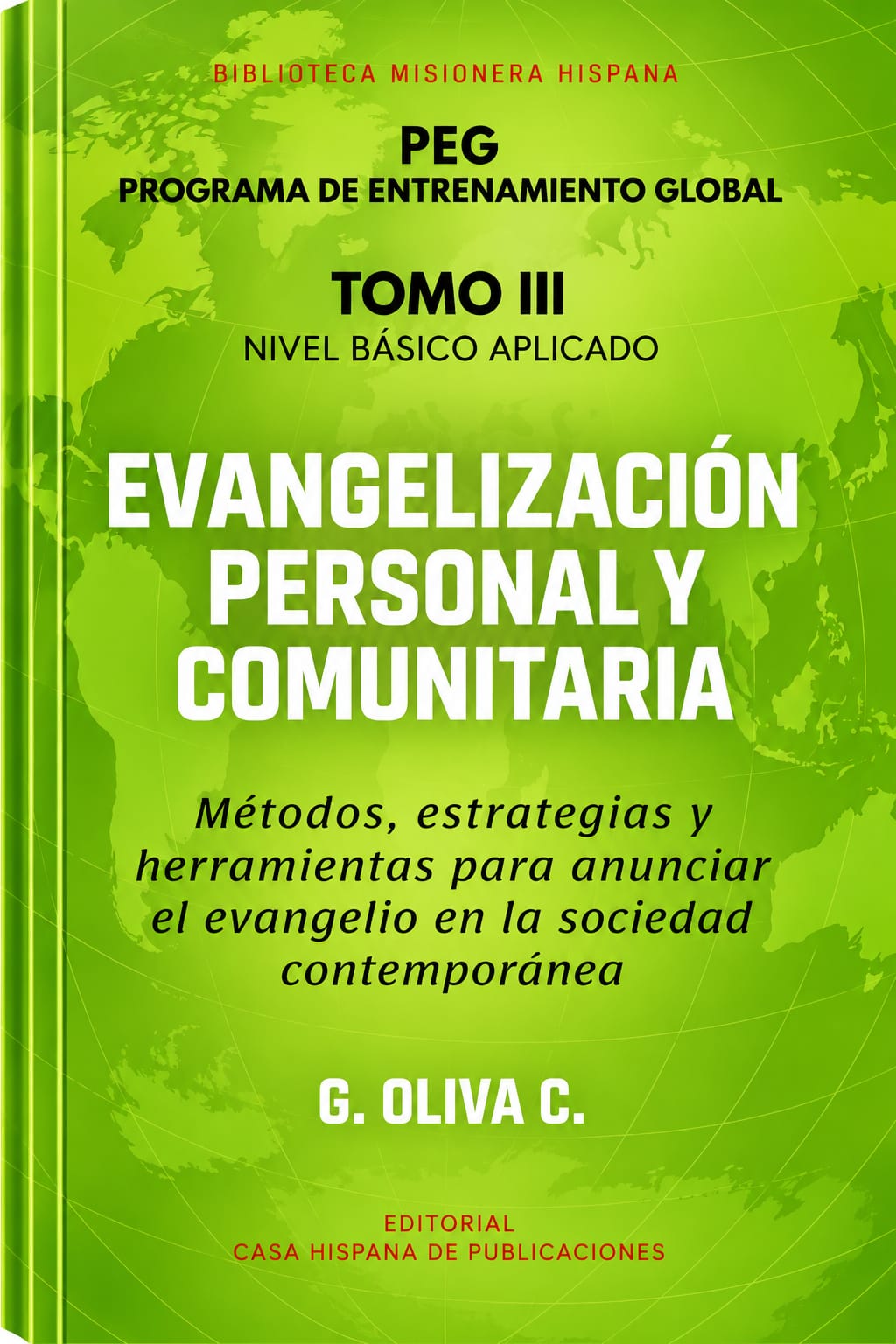
Evangelisation as an expression of the integral mission of the Church. Evangelisation is an essential dimension of the identity, vocation and historical responsibility of the Christian Church. From their origins, communities of faith have understood the proclamation of the Gospel as an expression of obedience to the command of Jesus Christ and as an active participation in God's mission in the world. Yet the profound cultural, social, technological and religious changes of the present age pose new challenges for the communication of the Christian message, especially in societies marked by pluralism, a diversity of worldviews, changing human relationships and the rapid development of digital media. It is in this setting that Evangelización personal y comunitaria: Métodos, estrategias y herramientas para anunciar el Evangelio en la sociedad contemporánea, the third volume of the Hispanic Missionary Library, by G. Oliva C., takes its place: a programme of theological and missiological formation designed to link the biblical foundations of evangelisation with their practical application in individual, congregational and community life. The work is intended as a training tool for believers, evangelists, pastors, leaders and ministry teams seeking to develop evangelistic processes that are contextualised, responsible and sustainable. Its thematic orientation recognises that evangelisation cannot be reduced to the use of techniques of religious persuasion or to the occasional organisation of public events, but requires an integral understanding of the people, communities and cultural realities in which the Gospel is communicated. The proposal starts from a fundamental premise: Christian evangelisation must bring together biblical faithfulness, human sensitivity, ethical responsibility and contextual relevance. From this perspective, the proclamation of the Gospel is not an activity isolated from the Church's mission, but a practice bound up with personal witness, the forming of disciples, community service and the Church's responsible participation in society. Biblical and theological foundations of personal evangelisation Personal evangelisation finds its foundations in the ministry of Jesus Christ and in the experiences of the first Christian communities. The Gospels present many encounters in which Jesus enters into direct relationships with people from different social, cultural and religious backgrounds. The dialogue with Nicodemus, narrated in John 3, invites reflection on the personal dimension of faith and the need for spiritual transformation. The encounter with the Samaritan woman, described in John 4, offers relevant insights into communicating the Christian message in contexts shaped by cultural, religious and social differences. Likewise, the Gospel accounts show that Jesus did not use a single mode of communication. His teaching drew on questions, parables, conversations, public discourses and personal encounters, attentive to the particular circumstances of those he spoke with. These experiences provide foundations for an evangelisation that recognises the importance of human relationship and the variety of situations in which the proclamation of the Gospel can take place. In the book of Acts, the experience of Philip and the Ethiopian official (Acts 8:26-40) is another significant reference point for personal evangelisation. The account brings out the relationship between biblical interpretation, openness to dialogue and the accompaniment of a person seeking to understand the Scriptures. From a missiological perspective, these passages help to show that personal evangelisation requires more than passing on previously organised content: it demands listening, understanding questions, explaining the biblical message and respecting each person's own process. The formation of the evangelist must therefore take into account the ability to build authentic relationships and to communicate one's convictions with clarity and sensitivity. Methods and strategies of personal evangelisation One of the main threads of the proposal is the study of the methods and strategies that can facilitate the interpersonal communication of the Gospel. Personal evangelisation encompasses various forms, including spontaneous conversations, individual testimony, Bible-study meetings, dialogue within the family, friendships and initiatives of spiritual accompaniment. Each of these forms has its own characteristics and requires specific competences. Personal conversations demand skills in active listening, asking questions, clarity of argument and recognition of the needs of those taking part in the dialogue. Individual testimony, for its part, makes it possible to relate Christian experience to concrete events in life, provided it is communicated authentically and without replacing the central content of the Gospel with a purely subjective narrative. Personal Bible studies can provide spaces for systematic reflection, fostering a progressive understanding of the Scriptures and the opportunity to ask questions in an atmosphere of respect. From a pedagogical perspective, evangelistic methods must be assessed in terms of their biblical foundation, cultural relevance, communicative clarity and ethical implications. The effectiveness of a strategy cannot be determined solely by the number of people contacted or the quantity of immediate responses obtained. The quality of the relationships established, the understanding of the message, freedom of decision and the continuity of accompaniment must also be taken into account. Personal evangelisation consequently requires a flexible methodology, capable of adapting to different circumstances without turning Christian communication into a mechanical or depersonalised practice. Community evangelisation and the responsibility of the local church The communal dimension of evangelisation is a fundamental component of Christian mission. The local church is not merely an institution responsible for organising religious activities, but a community of believers called to express its faith through relationships, service, teaching, hospitality and public witness. Community evangelisation can be carried out through congregational programmes, family activities, educational initiatives, social-service projects, cultural events, small groups and spaces for dialogue open to the wider community. These practices require planning that takes into account the characteristics of the territory, the needs of the population and the human resources available. From a missiological perspective, the Christian community needs to develop the capacity to understand its surroundings and to build relationships of trust with the people who live there. Community evangelisation ought not to rest solely on inviting people to activities held within church premises. It also needs to recognise the importance of Christian presence in the places where everyday life unfolds. Neighbourhood relationships, educational institutions, workplaces and community organisations are all settings in which opportunities for dialogue and witness can arise. Congregational planning requires identifying objectives, forming teams, allocating responsibilities and establishing evaluation mechanisms. Organisation, however, must not take the place of the human dimension of mission. The evangelising community needs to understand that its public credibility is tied to the coherence between its teaching, its internal practices and its conduct towards society. Family evangelisation and close relationships The family is one of the most important settings for passing on values, convictions and religious experiences. Evangelisation within the family requires particular sensitivity, since relationships among its members are shaped by emotional bonds, shared histories and differing degrees of personal autonomy. Communicating the faith within the family must take place through witness, dialogue, respect and a willingness to understand the questions of its members. In this context, religious imposition or the use of emotional pressure can create conflict and damage relationships. Responsible evangelistic formation needs to recognise that the expression of Christian convictions must coexist with respect for each person's freedom of conscience. Family life offers opportunities to communicate the faith through solidarity, reconciliation, care and everyday coherence. These expressions do not replace the verbal proclamation of the Gospel, but they help to situate it within concrete human relationships. Urban evangelisation and the transformations of contemporary society. Cities are particularly complex settings for Christian mission. Population density, labour mobility, socio-economic inequality, cultural diversity and the fragmentation of community relationships directly influence forms of religious interaction. Urban evangelisation requires an understanding of these transformations and the development of strategies suited to different territorial contexts. Latin America's large cities present contrasting realities: areas of high economic concentration, peripheral neighbourhoods, migrant communities, university settings, shopping centres and territories marked by difficulties in accessing essential services…
Category
- RELIGION AND SPIRITUALITY
- CHRISTIANITY
- THEOLOGY
- PRACTICAL THEOLOGY
- MISSIOLOGY
- EVANGELISATION
- EVANGELISTIC METHODS AND STRATEGIES
- PERSONAL AND COMMUNITY EVANGELISATION
Rights for this book
We turn publishing rights into international growth, connecting authors and publishers with new markets, new readers and new partners around the world.
Technical details
- Title
- Evangelización personal y comunitaria
- Author
- G. Oliva C.
- Imprint
- Grupo Editorial casa Hispana
- Size
- 15x23cms
- Edition
- 1st edition, 2026
- Published in
- Chile
- Year of publication
- 2026
- Available languages
- Spanish, English, German, Portuguese
- Binding
- Paperback with flaps
- Pages
- 455