Description
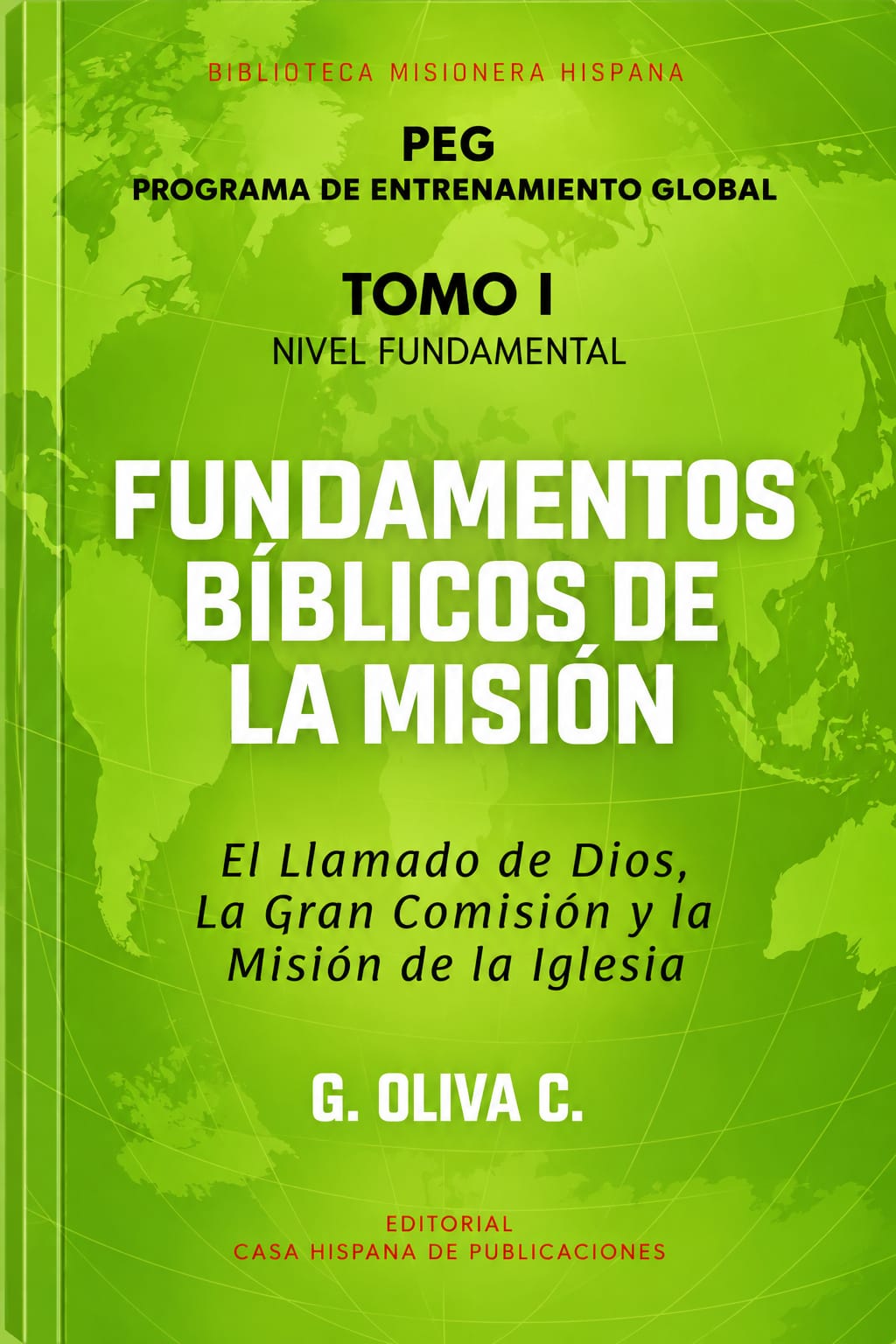
Evangelisation is one of the fundamental aspects of the identity, vocation and historical responsibility of the Christian Church. From the earliest witness of the Scriptures to the spread of Christianity among different peoples and cultures, the proclamation of the good news has held a central place in the understanding of the relationship between God, humanity and his purpose of redemption. Yet to evangelise does not simply mean passing on a set of religious teachings, encouraging people to join an ecclesiastical institution or running activities aimed at the numerical growth of a congregation. Evangelisation, understood in the light of its biblical foundations, is an expression of God's saving initiative, made manifest in Jesus Christ and entrusted to the Church through the work of the Holy Spirit. Fundamentos bíblicos de la evangelización: El llamado de Dios, la Gran Comisión y la misión de la Iglesia is presented as a programme of theological and missiological formation intended to recover the biblical understanding of evangelisation, to examine its doctrinal foundations and to equip believers with the essential tools to take a responsible part in the Christian mission. As the first volume of the Hispanic Missionary Library, part of the PEG – Global Missionary Training Programme, this work marks the starting point of a progressive course of training in evangelisation and world missions. Its fundamental aim is to provide a solid biblical foundation on which the spiritual, communicative, pastoral, intercultural and strategic competences required for missionary service can subsequently be built. In the author's view, evangelisation should not be understood as an ancillary activity of the Church, nor as a responsibility belonging exclusively to pastors, preachers or professional missionaries. It is an inseparable part of Christian existence and of the communal vocation of those who have been called to follow Jesus Christ. Evangelisation is not an activity the church carries out to justify its existence; it is an expression of the mission that defines its identity and its presence in the world. One of the main theological threads of this proposal is the understanding of mission as an initiative that originates in God. Before it takes shape as an ecclesiastical programme, an evangelistic strategy or a religious movement, mission belongs to the divine purpose of reconciling and restoring humanity. This perspective makes it possible to place evangelisation within the whole sweep of the biblical story, avoiding interpretations that reduce it exclusively to certain passages of the New Testament. From creation, the fall and the promises of redemption to the election of Israel, the ministry of Jesus Christ and the birth of the Church, the Scriptures present a narrative in which God relates to humanity and progressively reveals his saving purpose. The Genesis account is an indispensable starting point. The creation of human beings in the image of God establishes the basis of their dignity and of their responsibility before the Creator. The rupture brought about by sin affects the relationship between God and humanity, as well as human relationships and the order of creation. In this context, the biblical history of redemption allows evangelisation to be understood as the proclamation of God's response to a human condition marked by sin, separation and the need for reconciliation. The promise made to Abraham, through which all the families of the earth would be blessed, introduces a universal horizon that is fundamental to the theology of mission. The election of a particular people does not erase the horizon of the nations; rather, it belongs within a purpose that transcends ethnic and territorial boundaries. This universal dimension continues in various expressions of the Old Testament. The Psalms summon the nations to acknowledge the glory of God, while the prophets announce horizons of justice, restoration and knowledge of the Lord that reach beyond Israel. Christian evangelisation, therefore, does not arise as an initiative cut off from the history of salvation. It rests on an understanding of divine action that runs through the Scriptures and finds its centre in the person and work of Jesus Christ. Christology accordingly holds a decisive place in evangelistic formation. There is no Christian evangelisation properly so called without an understanding of the significance of Jesus Christ, his incarnation, ministry, death, resurrection and lordship. The proclamation of the Gospel cannot be reduced to a generic invitation to improve one's conduct, attain emotional well-being or take part in religious activities. Its fundamental content lies in the good news of Jesus Christ and in the reconciliation with God that is proclaimed through his redemptive work. The Gospel narratives present Jesus announcing the Kingdom of God, calling people to repentance, inviting them to faith and showing, through his words and deeds, the mercy, justice and restoring power of God. His ministry shows that the proclamation of the good news went hand in hand with personal encounters, teaching, compassion and care for those who experienced exclusion, suffering or marginalisation. From this perspective, evangelisation must maintain a consistent relationship between the message proclaimed and the conduct of those who communicate it. The gospel is not merely a proposal for moral change; it is the proclamation of Jesus Christ and of God's saving action on behalf of humanity. The work also places at the centre of its reflection the Great Commission, understood as one of the principal foundations of the Church's missionary mandate. The Gospel according to Matthew presents the risen Jesus Christ sending his disciples to make disciples of all nations, baptising them and teaching them to observe his commandments (Matthew 28:18-20). This passage shows that Christian mission is not limited to an initial communication of a message, but encompasses a process of forming and accompanying people who learn to live according to the teachings of Jesus. The Great Commission therefore has an evangelistic, disciple-making, communal and pedagogical dimension. Evangelising and making disciples are neither opposing responsibilities nor activities that can be entirely separated. The proclamation of the Gospel opens the way to a response of faith, while discipleship seeks to accompany spiritual growth and responsible incorporation into the life of the Christian community. The command to teach takes on particular importance because it reminds us that mission does not end when a person shows interest in the Christian message. Biblical formation, spiritual maturity, community life and the development of a conscious faith are all part of the Church's evangelistic responsibility. The Gospel according to Mark, in its presentation of the command to proclaim the good news, underlines the public and expansive character of evangelisation. Luke, for his part, links the proclamation of repentance and the forgiveness of sins with a witness that begins in Jerusalem and reaches out towards the nations. In the Gospel according to John, the sending of the disciples is understood in the light of the relationship between the mission of Jesus and the mission of those who follow him. These perspectives make it possible to build a broad understanding of Christian sending, in which authority, witness, teaching, reconciliation and service converge. The book likewise sets out to examine the meaning of Acts 1:8, where Christian witness is explicitly linked to the power of the Holy Spirit and to a geographical expansion that reaches from Jerusalem to the ends of the earth. This passage is an especially relevant foundation for understanding the relationship between pneumatology and missiology. Mission does not depend solely on human abilities, institutional structures or material resources. The narrative of the Acts of the Apostles presents the Holy Spirit as the protagonist of the spread of Christian witness and of the formation of communities of faith. Pentecost represents a decisive event in this story. The proclamation of the works of God in different languages displays the expansive character of the Christian message and anticipates the cultural diversity that would accompany the growth of the Church. The presence of different peoples and languages shows that the Gospel is destined to be communicated in diverse human contexts, without being confined to a single cultural expression. The Great Commission does not consist solely in going to the nations, but in making disciples, teaching the word and sharing in the witness to Jesus Christ through the power of the Holy Spirit. Another fundamental aspect of the work is its reflection on the nature of the Gospel and its relationship to salvation. The formation of evangelists requires an understanding of doctrinal concepts such as sin, grace, faith, repentance, reconciliation, redemption, justification, regeneration and new life. These categories make it possible to present the Christian message with biblical depth and to avoid simplifications that distort its content. Salvation, from the standpoint of evangelical theology, cannot be reduced to a superficial change in personal circumstances or to intellectual assent to certain religious statements. It involves the relationship of human beings with God and the response of faith to the proclamation of Jesus Christ. Grace holds a central place in this understanding. The Gospel proclaims God's initiative of salvation, not a system by which human beings might obtain God's favour solely through their own merits. The relationship between grace and faith, developed especially in the Pauline epistles, provides an indispensable doctrinal basis for the responsible communication of the Christian message. Evangelisation also requires an understanding of repentance as a response that involves a new orientation of life. It is not merely a passing emotion, but a transformation that finds expression in one's relationship with God, with other people and with the Christian community. Reflection on conversion leads naturally to the subject of discipleship. A biblical understanding of evangelisation must recognise that the initial response of faith is the beginning of a process of learning, growth and maturity. In this sense, the evangelist is called not merely to pass on religious information, but to take a responsible part in a task that demands accompaniment, teaching, witness and connection with the community. The local church holds an indispensable place in this process. The New Testament presents Christian communities as settings for apostolic teaching, fellowship, prayer, service and witness. The account in Acts 2:42-47 brings out the relationship between the inner life of the community and its public presence. Evangelisation ought not to be carried out as an activity disconnected from the identity and conduct of the Church. A community that proclaims reconciliation but constantly reproduces relationships of hostility weakens the coherence of its witness. Likewise, a Church that proclaims human dignity but ignores people's suffering faces a contradiction between its discourse and its practice. The editorial proposal seeks to highlight that Christian witness has both personal and communal dimensions. The believer's life, family relationships, social responsibility and everyday conduct are all part of the context in which other people interpret the message proclaimed. The credibility of Christian witness depends not only on the clarity of its preaching, but also on the coherence between the faith professed and the life lived. This understanding leads to an examination of the evangelistic responsibility of all believers. The Church is made up of people with different gifts, functions, abilities and responsibilities. Not everyone carries out the same ministerial tasks or takes part in public proclamation in the same way. Nevertheless, the Christian community as a whole shares the responsibility of bearing witness to Jesus Christ. The priesthood of all believers, within the Protestant and evangelical tradition, is an important basis for recognising the active participation of the community in mission. This does not mean disregarding the ministries of teaching, leadership or evangelisation, but understanding that Christian mission cannot be monopolised by a small group of specialists. Evangelisation can find expression in public preaching, personal conversations, Bible teaching, family witness, pastoral accompaniment, community relationships and other forms of communication consistent with the nature of the Christian message. The foundational formation of the evangelist needs to develop a balanced understanding of these possibilities, avoiding both congregational passivity and indiscriminate pressure on people. Religious persuasion must not be confused with emotional manipulation, coercion or the exploitation of people's vulnerability. The Christian message must be communicated clearly, responsibly and respectfully, recognising that each person's response cannot be replaced by the will of the evangelist. At this point, Christian ethics and missiology meet in a particularly important way. Evangelisation needs to examine not only what message is communicated, but also how, why and under what conditions it is proclaimed. Using methods incompatible with human dignity may produce results that look favourable from a statistical point of view, yet contradict the ethical content of the message proclaimed. For this reason, the biblical formation of the evangelist must be accompanied by reflection on his or her motivations, attitudes and responsibilities. Another of the thematic contributions of this work is to situate evangelisation within the diversity of social and cultural contexts in which the contemporary Church lives. The command to proclaim the Gospel is universal in scope, but its communication always takes place in concrete historical circumstances. Linguistic, cultural, economic, generational and religious differences influence the way in which people receive, interpret and respond to messages. For this reason, foundational training in evangelisation needs to introduce the believer to the importance of knowing the people they are speaking with, understanding their questions and developing relevant forms of communication. Contextualisation does not mean arbitrarily altering the content of the Gospel to make it fit any social expectation. It consists in seeking to ensure that the message is properly understood within the cultural and linguistic frameworks of those who hear it. This distinction is particularly important for a library of missionary formation that, in its later volumes, goes more deeply into cross-cultural evangelisation, discipleship, the mobilisation of the local church and world missions. Biblically grounded evangelisation must learn to distinguish between the central content of the Christian faith and the particular customs that have historically accompanied its transmission. In Latin America, this reflection takes on particular relevance because of the diversity of peoples, traditions, languages, religious experiences and historical processes that have shaped the continent. The formation of Latin American evangelists requires recognising that social reality is not homogeneous. Indigenous communities, Afro-descendant populations, rural sectors, urban spaces, migrant communities and the younger generations bring different experiences and questions. Responsible evangelisation needs to approach these realities without prejudice, recognising their dignity, their history and their particular forms of social organisation. The proclamation of the Gospel must avoid being confused with the imposition of an external culture. The historical experience of the spread of Christianity shows the need to distinguish between the witness of faith and the relationships of political, economic or cultural domination that, in certain periods, accompanied processes of evangelisation. Contemporary missiological reflection must critically examine this history in order to promote practices grounded in humility, freedom, dialogue and respect. The universality of the gospel does not demand the uniformity of cultures; it demands that its message can be understood and lived amid human diversity. The book also invites reflection on the relationship between evangelisation and integral mission. The verbal proclamation of the Gospel holds a central place in the evangelical tradition, but it cannot be entirely detached from the biblical call to love of neighbour, mercy, justice and service. The ministry of Jesus Christ shows a significant relationship between teaching, the proclamation of the Kingdom and attention to human needs. This relationship does not imply that all social activities are equivalent to evangelistic proclamation, nor that material aid should be used as an instrument of religious pressure. It means recognising that the Christian life has a public and ethical dimension that must accompany its witness. The Church is called to show coherence between its preaching and its actions, especially in the face of poverty, exclusion, violence and suffering. From this perspective, evangelisation ought not to be reduced to a technique for increasing institutional membership. Its purpose has to do with communicating the Gospel, forming disciples and the Church's participation in the mission of God. Congregational growth may be a consequence of evangelisation, but it must not become the sole criterion for assessing its faithfulness. The quality of discipleship, spiritual maturity, community integrity and pastoral responsibility are equally relevant measures. Foundational formation therefore needs to examine critically those evangelistic models that privilege only the number of religious decisions, the spectacle of events or the efficiency of particular methodologies. Strategies can be useful, but no technique replaces the content of the Gospel, the work of the Holy Spirit or the ethical responsibility of those who take part in its proclamation. When evangelisation is reduced to a strategy for institutional growth, it runs the risk of losing sight of its foundation: Jesus Christ and the redemptive mission of God. The work finds another of its central threads in the spiritual formation of the evangelist. Doctrinal understanding, though indispensable, needs to be bound up with a life of prayer, Bible study, obedience, service and growth in Christian character. The history of Christianity offers numerous examples of people who built their witness through a combination of theological conviction, perseverance and commitment to the community. Spiritual formation, however, must not be confused with an idealised image of personal perfection. The evangelist remains a person who needs to learn, acknowledge his or her limitations, correct mistakes and receive pastoral support. Humility is therefore an essential disposition. Whoever proclaims the Gospel needs to develop the capacity to listen to difficult questions, recognise legitimate differences and respond with respect when his or her convictions are challenged. Preparation also requires cultivating patience. Processes of religious understanding, personal transformation and the forming of disciples do not always follow predictable rhythms. The responsible evangelist must avoid interpreting every difficulty as failure or every immediate response as definitive evidence of spiritual maturity. This perspective allows evangelisation to be understood as a task that demands faithfulness and perseverance, but also prudence, sensitivity and discernment. The relationship between evangelisation and teaching is another essential component of the formative journey. The proclamation of the Gospel requires conceptual clarity. The believer needs to understand the meaning of the fundamental doctrines of the faith and learn to express them accessibly without sacrificing their content. Communicating the Christian message also demands the ability to relate biblical teaching to people's real questions. Evangelistic training can help to develop the skills needed to structure a biblical exposition, share a personal testimony, sustain respectful conversations and answer questions about the faith. These practical competences, however, must rest on a sound understanding of the Scriptures. Evangelisation without a biblical foundation runs the risk of becoming a discourse dominated by personal opinions, subjective experiences or institutional interests. By contrast, solid theological preparation provides criteria for examining teachings, recognising problematic interpretations and communicating the Christian message more responsibly. In this respect, biblical hermeneutics holds an important place. The texts of Scripture need to be interpreted with due regard to their literary, historical and theological context. Using isolated verses to justify any evangelistic method can lead to conclusions that do not adequately represent the meaning of the passages…
Category
- THEOLOGY
- BIBLICAL THEOLOGY
- MISSIOLOGY
- CHRISTIAN EVANGELISATION
- THE GREAT COMMISSION
- MISSION OF GOD
- MISSION OF THE CHURCH
- CHRISTOLOGY
- SOTERIOLOGY
- PNEUMATOLOGY
- ECCLESIOLOGY
- DISCIPLESHIP
- SPIRITUAL FORMATION
- BIBLICAL PREACHING
- EVANGELISTIC TRAINING
- THEOLOGICAL EDUCATION
- CHRISTIAN MINISTRY
- THE MISSIONARY CHURCH
- CHRISTIAN MISSIONS
- WORLD MISSIONS
Rights for this book
We turn publishing rights into international growth, connecting authors and publishers with new markets, new readers and new partners around the world.
Technical details
- Title
- Fundamentos bíblicos de la misión
- Author
- G. Oliva C.
- Imprint
- Grupo Editorial casa Hispana
- Size
- 15x23cms
- Edition
- 1st edition, 2026
- Published in
- Chile
- Year of publication
- 2026
- Available languages
- Spanish, English, German, Portuguese
- Binding
- Paperback with flaps
- Pages
- 455