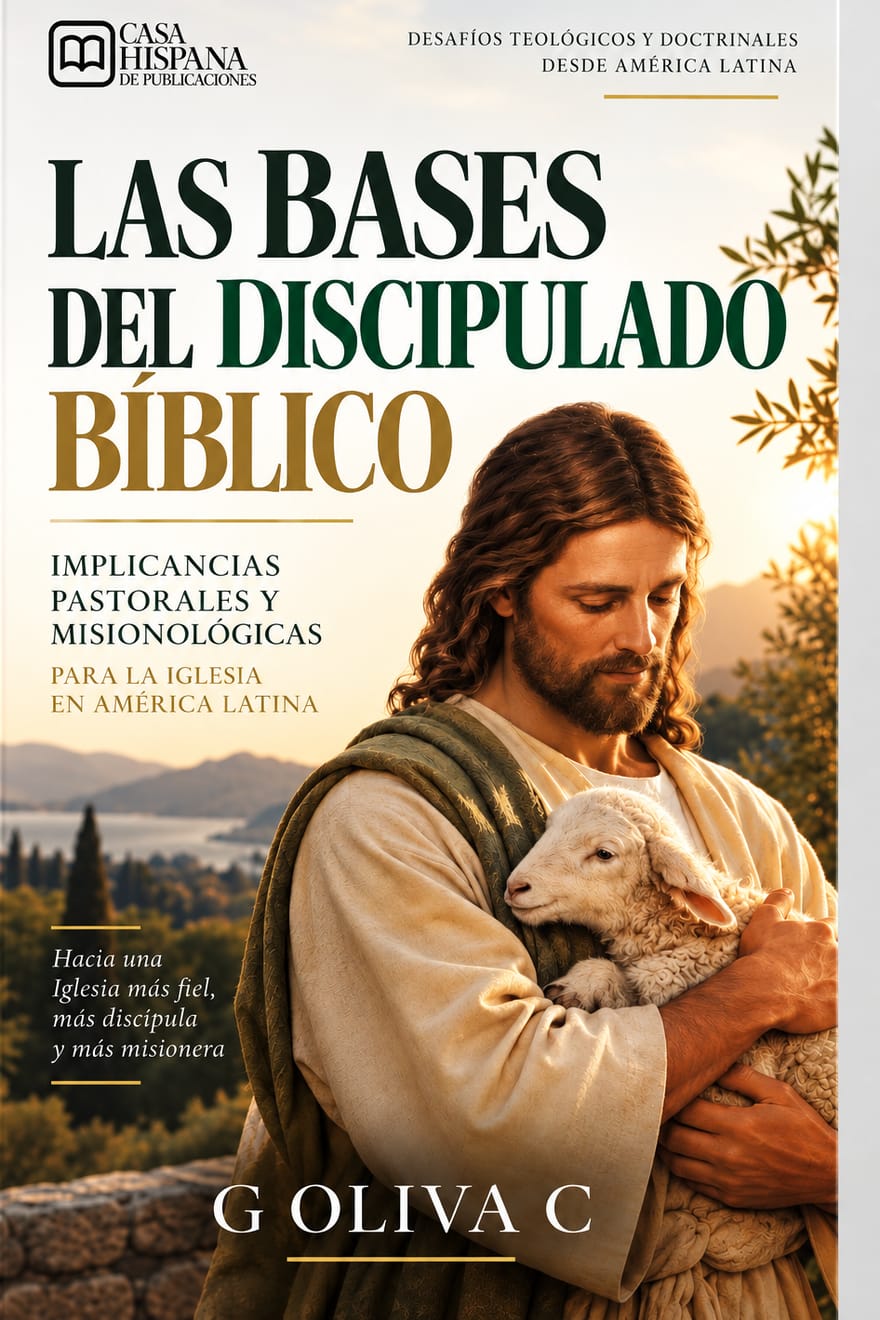
Description
Biblical discipleship is one of the essential foundations of the Christian life, because the call of Jesus Christ was never limited to producing nominal believers, religious attenders or people who simply accepted certain doctrines, but aimed to form men and women capable of following him, learning from him, obeying his Word, reproducing his character and taking a responsible part in his mission. When Jesus called his first disciples, his invitation was deeply relational: "Follow me" (Matthew 4:19). Before sending them out, he called them to be with him; before entrusting them with responsibilities, he formed them; before making them messengers, he began to transform their lives. This sequence is fundamental to understanding the nature of discipleship: Call - Following - Formation - Transformation - Service - Mission. The disciple is not merely someone who knows teachings about Christ, but someone who progressively organises their existence around Christ. For this reason, discipleship begins with grace and continues through a conscious response of faith, obedience and perseverance. Jesus did not hide what following him would involve. In Luke 9:23 he declared that whoever wished to follow him must deny himself, take up his cross daily and follow him. Biblical discipleship, therefore, cannot be reduced to a church methodology, a course lasting a few weeks or a stage immediately after conversion. It is an integral process of formation that reaches thought, conduct, relationships, priorities, decisions, vocation, spirituality and mission. For the author, one of the difficulties of the contemporary Church arises precisely when biblical information is mistaken for Christian formation. A person may accumulate theological knowledge and yet show little maturity of character. They may know doctrines, master religious terminology and even develop ministerial abilities without having allowed the Gospel to transform deeply their relationships, their motives and the ways in which they exercise authority. Hence discipleship needs to recover an elementary truth: knowing the Word must lead to living the Word. Jesus directly linked discipleship with abiding in his teaching when he said: "If ye continue in my word, then are ye my disciples indeed" (John 8:31). To abide implies continuity. It describes not momentary enthusiasm, but a life that learns to submit progressively to revealed truth. Scripture thus occupies a central place in the formation of the disciple, because it provides content, direction, correction and discernment. Yet the purpose of Bible study is not merely to know more, but to learn to think, decide and live under the lordship of Christ. Word - Obedience - Character - Maturity - Mission are inseparable dimensions of one and the same formation. Nor can this transformation be understood as a mere outward modification of behaviour. The New Testament presents the Christian life as a profound renewal. Paul urges believers to be transformed by the renewing of their mind (Romans 12:2), while describing God's purpose as conformity to the image of his Son (Romans 8:29). The horizon of discipleship is, consequently, Christological: to become progressively more like Christ. This does not mean outwardly reproducing the historical circumstances of Jesus, but allowing his love, humility, truth, obedience, mercy, holiness and readiness to serve to shape the way we live. The disciple matures when Christ ceases to be merely the object of their confession and becomes the model for their character. From this perspective, the fruit of the Spirit described in Galatians 5:22-23 takes on decisive importance. Love, joy, peace, patience, kindness, goodness, faithfulness, gentleness and self-control show that the work of the Spirit reaches character. That is why a community that emphasises gifts, leadership or ministry results but neglects character runs the risk of producing people who are capable but immature. Gifting does not replace character. Ability does not replace holiness. Popularity does not replace maturity. Influence does not replace integrity. Discipleship needs to recover this connection between spirituality and character, because genuine Christian formation must also be visible in the way one speaks, listens, manages resources, resolves conflicts, treats one's family, exercises authority, asks for forgiveness, keeps commitments and relates to those who think differently. In this sense, discipleship takes place as much in formally religious settings as in everyday life. The home, the workplace, the university, the neighbourhood, social relationships and economic decisions are also settings for Christian formation. There is no biblical spirituality that can be kept entirely separate from daily life. The Sermon on the Mount demonstrates precisely this breadth by relating the Kingdom of God to inner attitudes, reconciliation, truthfulness, love of neighbour, prayer, the use of possessions and human priorities. To be a disciple means learning to live the Gospel where life actually unfolds. Another indispensable foundation is community. Jesus did not form isolated disciples. He called them to walk with him and also with one another. The early Church continued steadfastly in the apostles' doctrine, fellowship, the breaking of bread and prayers (Acts 2:42). Biblical discipleship therefore has a communal dimension. We need to learn from others, receive correction, offer accompaniment, share burdens, develop gifts and take part in a community where faith can be seen and practised. Individualism weakens discipleship because it turns spirituality into an exclusively private experience. The Church, by contrast, must become a formative community. Preaching - Teaching - Accompanying - Modelling - Correcting - Restoring - Sending are responsibilities that ought to be part of its culture. This also means rethinking the concept of leadership. The Christian leader is not called to create dependence around their own person, but to contribute to the maturity of others. Paul expresses this principle in Ephesians 4:11-13 when he links the ministries with equipping the saints and building up the body of Christ until it reaches maturity. Healthy discipleship asks not only how many people follow a leader, but how many are learning to follow Christ responsibly. Spiritual authority must foster responsible freedom, discernment and maturity, never manipulation or personal dependence. The model of Jesus is once again decisive: he taught, corrected, allowed questions, delegated responsibilities, sent out his disciples and later prepared them to continue the mission without his physical presence. To make disciples means preparing people who can walk with Christ without depending permanently on whoever formed them. This vision leads directly to mission. Matthew 28:19-20 does not present the Great Commission simply as an order to obtain conversions, but as a mandate to make disciples, to baptise and to teach them to observe all that Christ had commanded. Evangelisation opens the way; discipleship accompanies growth; community provides belonging; formation develops maturity; and mission turns the formed disciple into a participant in the sending. Evangelisation without discipleship can produce decisions without roots. Discipleship without mission can produce knowledge without movement. Mission without formation can produce activism without depth. That is why the biblical process can be expressed as a continuous dynamic: Receive The Gospel - Follow Christ - Learn His Word - Transform Character - Serve Others - Make Disciples - Take Part In The Mission. The mature disciple begins to understand that they were not formed solely for their own growth. What has been received must become service. Paul expresses this logic of multiplication when he instructs Timothy to pass on what he has learnt to faithful people who will in turn be able to teach others (2 Timothy 2:2). There we find several spiritual generations within a single principle: someone receives and passes on, another learns and later teaches in turn. Biblical discipleship is reproductive because the formation received generates responsibility towards others. But multiplying disciples does not mean reproducing cultural clones, identical personalities or uniform ministry styles. It means helping different people to grow in faithfulness to Christ within their own contexts. This consideration is particularly important for cross-cultural mission. When discipleship crosses cultures, the Gospel must be distinguished from the particular customs of the messenger. Discipling Is Not Colonising Culturally. Contextualising Is Not Diluting Theologically. The Church needs to teach biblical truth and, at the same time, learn to distinguish between Gospel - Doctrine - Biblical Principle - Method - Cultural Custom. In Indigenous, migrant, urban or multicultural contexts, this distinction makes it possible to accompany journeys of faith without needlessly requiring people to abandon their language, memory, identity or cultural expressions simply because they differ from those of the missionary. Every culture needs discernment in the light of the Gospel, including the culture of the one who evangelises. Cross-cultural discipleship therefore requires listening before concluding, learning before imposing and understanding before correcting. The disciple who seeks to form others must also keep the identity of a learner. No one reaches a point at which they no longer need formation. This humility protects leadership from authoritarianism and mission from cultural superiority. Likewise, discipleship needs to incorporate service, compassion and responsibility towards one's neighbour. Jesus taught and at the same time drew near to the sick, the excluded, the poor and those who were socially despised. The disciple learns that loving God has consequences for the way we look at other human beings. Christian service, however, must remain free of manipulation. Helping is not buying conversions. Serving is not controlling. Loving our neighbour does not depend on our neighbour accepting our convictions. Integral mission finds precisely here one of its foundations: proclaiming Christ clearly and serving with dignity, while preserving the integrity of both responsibilities. Discipleship also needs to learn perseverance. Christian formation does not happen instantly. Peter was called, formed, corrected, confronted, restored and sent. His mistakes did not automatically invalidate the process; under the grace and correction of Christ, they became occasions for learning. This makes it possible to understand that maturity does not mean the complete absence of failure, but a growing capacity to recognise it, repent, receive correction and keep walking. Grace does not remove responsibility, and responsibility does not remove grace. Both have their part in a mature spirituality. From the author's perspective, a Church that wishes to recover the foundations of biblical discipleship needs to move from a culture of attendance to a culture of formation; from religious consumers to disciples; from spectators to servants; from the accumulation of information to transformation; from ministerial dependence to maturity; and from a faith shut up inside the church building to a faith sent out into the world. This requires intentional processes, healthy relationships, sound biblical teaching, prayer, community life, pastoral accompaniment, character formation, real opportunities for service and missionary participation. Not every disciple will exercise the same ministry, nor will all be sent cross-culturally, but all are called to live under the lordship of Christ and to take part, according to their gifts and vocations, in bearing witness to the Gospel. The goal is not simply to fill discipleship programmes, but to form people capable of following Jesus when no one is watching, making decisions in accordance with Scripture, loving when it is difficult, serving without seeking recognition, remaining faithful in adversity and accompanying others towards maturity. Ultimately, the foundations of biblical discipleship always return to Christ. He calls, teaches, transforms, corrects, restores and sends. The Church accompanies that process under the action of the Holy Spirit and the authority of the Word. That is why discipleship does not end when a person completes a course, receives a certificate or takes on a ministry responsibility. It continues as long as there is anything in our lives that still needs to be conformed to Christ. Call - Word - Communion - Obedience - Character - Service - Mission - Multiplication thus form a permanent dynamic of the Christian life. The disciple is called to follow Christ, formed to become like Christ and sent to bear witness to Christ. When these three dimensions remain united, discipleship ceases to be merely a church programme and recovers its true nature: a whole life in the process of being transformed into the image of Jesus and placed at the service of his mission…
Category
- BIBLICAL DISCIPLESHIP
- CHRISTIAN DISCIPLESHIP
- THEOLOGY OF DISCIPLESHIP
- CHRISTIAN FORMATION
- SPIRITUAL FORMATION
- FOLLOWING CHRIST
- CHRISTIAN CHARACTER
- SPIRITUAL TRANSFORMATION
- SPIRITUAL MATURITY
- SANCTIFICATION
- CHRISTIAN OBEDIENCE
- WORD OF GOD
- HOLY SPIRIT
- EVANGELISATION
- CHRISTIAN MISSION
- THE GREAT COMMISSION
- FORMATION OF DISCIPLES
- MULTIPLICATION OF DISCIPLES
- DISCIPLE-MAKING CHURCH
- MISSIOLOGY
Rights for this book
We turn publishing rights into international growth, connecting authors and publishers with new markets, new readers and new partners around the world.
Technical details
- Title
- Las bases del discipulado bíblico
- Author
- G. Oliva C.
- Imprint
- Grupo Editorial casa Hispana
- Size
- 15x23cms
- Edition
- 1st edition, 2023
- Published in
- Chile
- Year of publication
- 2025
- Available languages
- Spanish, English, German, Portuguese
- Binding
- Paperback with flaps
- Pages
- 557