Description
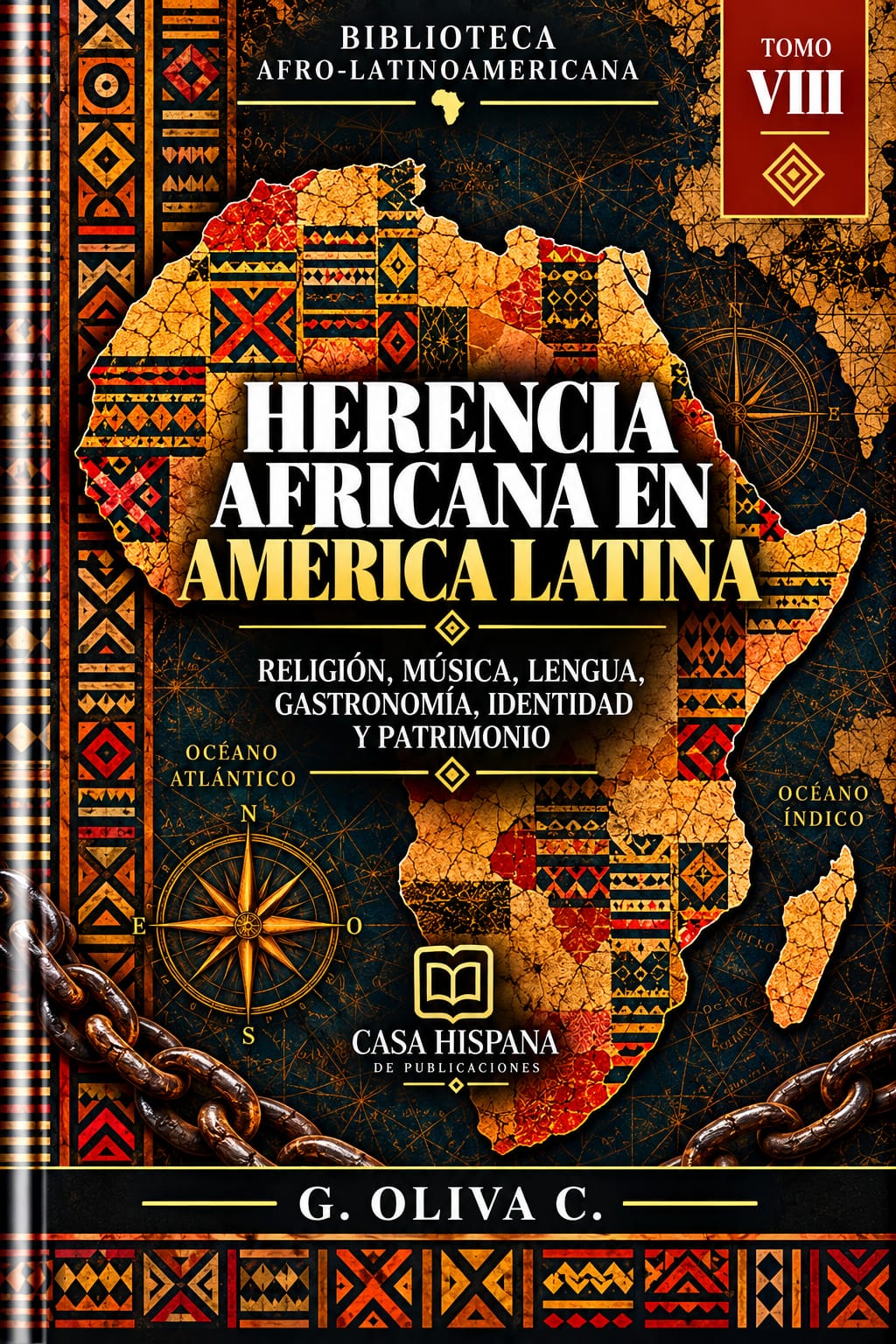
To speak of the African heritage in Latin America means recognising one of the fundamental dimensions of the historical, cultural, social, religious, linguistic, artistic and human formation of the continent, because the African presence cannot be reduced to the history of slavery nor interpreted solely from the suffering produced by the transatlantic trade, but must also be understood from the extraordinary capacity of millions of Africans and their descendants to preserve, transform, recreate and pass on knowledge, practices, memories, spiritualities, languages, musical expressions, forms of sociability, culinary traditions, aesthetic sensibilities and ways of understanding community that ended up taking a deep part in the construction of numerous Latin American societies; and for this reason to speak of African heritage does not mean describing a set of external elements later added to a previously constituted Latin American culture, but recognising that in many territories Latin American culture itself was born through encounters, tensions, conflicts, exchanges, impositions, adaptations and creative processes in which indigenous, European, African and later other populations took part in different and unequal ways. This distinction is the starting point of the reflection developed by the author. Africa did not only influence Latin America. Africa forms part of the constitutive history of Latin America through the millions of people who arrived forcibly on the continent and the generations later born on American soil. Those people did not disembark culturally empty. They brought languages, family memories, kinship systems, agricultural techniques, medicinal knowledge, craft skills, religious conceptions, musical repertoires, rhythms, ways of preparing food, forms of organisation and multiple experiences accumulated within diverse African societies. However, this affirmation immediately needs a second precision. There was no single African culture transferred to the Americas. Africa was and continues to be a continent of enormous diversity. The displaced people came from different regions, peoples, languages, religious traditions and political organisations. West Africa, West-Central Africa, East Africa and other regions connected to the Atlantic trade possessed different cultural worlds. For this reason the expression African heritage must be used in the plural whenever the context requires it. African Heritages. African Memories. African Languages. African Spiritualities. African Traditions. The unity of the diasporic experience never completely eliminated the diversity of its origins. This diversity is fundamental in order to avoid a homogeneous representation of the continent. Simply saying "Africans believed" or "African culture did" is usually historically insufficient. The rigorous question must always be which population, which region, which period, which tradition and what evidence allows continuity to be established. This methodology is particularly important when studying heritage, because many popular claims automatically attribute certain words, foods, rhythms, symbols or practices to Africa without demonstrating specific historical routes. Recognising the depth of the African heritage does not require inventing connections. Documented evidence has sufficient force. The aim of this work is not to artificially Africanise everything that exists in Latin America, but to recover what historical, linguistic, anthropological, musicological, religious, culinary, archaeological and community research allows us to link responsibly with African and Afro-descendant experiences. The dignity of a memory is strengthened through precision. This rule runs through the whole Afro-Latin American Library and acquires special importance in this volume because, after having studied slavery, resistance, abolition, inequality and structural racism, the narrative deliberately changes its centre. Now the main question is no longer only what the structures of domination did to Afro-descendants but what Afro-descendants did with history. What they preserved. What they transformed. What they created. What they passed on. What they incorporated into Latin American societies. This conceptual shift is fundamental, because an Afro-descendant history narrated solely from oppression paradoxically ends up granting the oppressor the leading role in the whole narrative. If every chapter begins and ends with slavery, the slave system continues symbolically to define those it tried to reduce. The African heritage obliges us to change our gaze. Before being enslaved they were bearers of culture. During slavery they continued to produce culture. After abolition they broadened their cultural participation. In contemporary societies their descendants continue to create new expressions. This continuity can be summed up in a fundamental sequence. Origin - Displacement - Memory - Adaptation - Creation - Transmission - Heritage - Identity. Each word represents a dimension of the diasporic process. Origin refers to concrete African societies. Displacement introduces rupture. Memory preserves fragments. Adaptation responds to the new context. Creation produces new expressions. Transmission connects generations. Heritage recognises what a community regards as significant. Identity uses that memory to understand present belonging. This sequence avoids a static conception of culture. Heritage is not a motionless archaeological piece. It is what a generation receives, interprets, transforms and passes on. That is why a Latin American practice of African root does not need to be identical to its African antecedent in order to preserve a historical relationship with it. Transformation does not necessarily eliminate continuity. It may be precisely the way in which a tradition survives. This principle is indispensable for understanding the diaspora. The displaced people arrived in territories where they did not always find members of their own linguistic or cultural community. Slavery separated families, mixed origins, imposed European languages, introduced Christianity within colonial relationships and subjected populations to new economies and legal structures. In those conditions literal cultural preservation was difficult. But human beings have an enormous capacity to rebuild meaning. Elements of different African traditions could meet one another and later interact with European, indigenous and creole traditions. From these encounters arose expressions that did not exist in exactly the same way in Africa, in Europe or in indigenous America. They were new. This creative capacity is one of the central phenomena of Afro-Latin American culture. The diaspora was not only loss. It was also recomposition. This does not mean romanticising forced displacement. Creativity arose in spite of the violence and not morally thanks to it. This distinction must always be maintained. It would be deeply problematic to claim that slavery was positive because it produced extraordinary music, cuisines or religions. No cultural product justifies the dehumanisation that accompanied its historical formation. People created beauty within unjust conditions. The beauty belongs to the people. The injustice belongs to the system. Culture was born in spite of the violence, not morally thanks to it. This affirmation is an interpretive key of the volume. Religion represents one of the fields where this capacity for preservation, transformation and creation can be observed with special depth. The African populations displaced to the Americas did not possess a single religion. There were different religious systems, cosmologies, ancestral cults, ritual practices, spiritual authorities and traditions that varied according to region and people. Moreover, some people came from societies where Islam had a significant presence and others from regions that had already had contact with Christianity before arrival in the Americas. This diversity needs to form part of any serious study. The idea that every African person transferred to the continent practised the same traditional religion is historically incorrect. Afro-Latin American religions arose through specific processes of transmission, recomposition, adaptation and encounter. Brazil offers particularly important examples with traditions such as Candomblé and other Afro-Brazilian expressions that have diverse internal histories and should not be reduced to a single matrix. Cuba developed its own configurations such as the Regla de Ocha or Santería and other traditions. Haiti, although culturally and historically Caribbean, has Vodou within a particular trajectory. Other territories developed different practices. To use these traditions as if they were equivalent would be a mistake. They share certain diasporic processes, but they have their own genealogies. Each one must be studied from its communities, ritual texts, histories and contexts. The concept of syncretism has been widely used to describe encounters between African and Christian elements, but it needs to be handled with care, because it can suggest a simple mechanical mixture of clearly separate elements when the historical processes were more complex. Communities reinterpreted symbols, saints, rituals, calendars, music and concepts from new experiences. In some cases the identification between African entities and Christian figures may have functioned as a strategy of continuity within contexts where certain practices were persecuted. In other cases genuine religious syntheses arose, taken up by later generations as systems of their own. The interpretation depends on the case. Religion shows that a tradition can change profoundly without losing memory. It also shows that religious imposition never guarantees passive reception. People interpret what they receive. The Christianity introduced by Europeans could later become a faith appropriated and transformed by Afro-descendant communities that developed Christian expressions of their own. This reality is especially important for the author's theological and missiological perspective, because it obliges us to distinguish between Christianity as Gospel and Christianity as European cultural form. They are not identical. Missionary history shows that the Christian faith can cross cultures and acquire diverse expressions without necessarily losing its doctrinal core. But it also shows that Christian institutions took part in slaveholding and racialised societies. This ambivalence needs to be recognised. There were religious actors who justified slavery. Others questioned it. There were communities that reproduced racial hierarchies. Others offered spaces of organisation, education, leadership and dignity. Afro-Latin American religious history cannot be reduced to church against African religions or African religions against Christianity. The relationships were much more complex. Afro-descendant people could take part in Catholic confraternities, preserve practices of African ancestry, develop new religious expressions or later embrace Protestant, evangelical, Pentecostal and other movements. Afro-descendant religious identity has never been uniform. This diversity must be respected. Being Afro-descendant does not imply belonging to a specific Afro-descendant religion. Nor does being Christian automatically eliminate an African or Afro-Latin American cultural identity. Culture, religion and ancestry intersect, but they are not equivalent. This distinction is especially important in order to avoid contemporary essentialisms. An Afro-descendant person has the right to practise a religion of African matrix, to be Catholic, evangelical, Muslim, to adhere to another tradition or to profess no religion. Cultural heritage does not prescribe conscience. Religious freedom is part of citizenship. This perspective makes it possible to value religious heritage without imposing it as identity. From a Christian perspective the study of these religions requires respect and discernment at the same time. Respect, because their practitioners possess dignity and freedom of conscience. Discernment, because a Christian theology does not need to affirm that all religious doctrines are equivalent in order to defend coexistence. Mature interreligious dialogue recognises real differences without turning them into hostility. This stance is especially relevant in societies where Afro-descendant religions have suffered stigmatisation. Religious freedom must be protected regardless of the theological evaluation one tradition makes of another. A church can hold doctrinal convictions and at the same time oppose discrimination, violence or persecution against other religious communities. This distinction between theological disagreement and the denial of rights is an important application of human dignity. Afro-descendant religious heritage can also be studied as a cultural archive, because rituals, songs, vocabularies, objects and memories may preserve historical elements that other sources did not record…
Category
- AFRICAN LEGACY
- AFRO-DESCENDANTS
- AFRICAN DIASPORA
- AFRO-LATIN AMERICAN CULTURE
- AFRO-DESCENDANT IDENTITY
- CULTURAL HERITAGE
- AFRICAN MEMORY
- AFRO-LATIN AMERICAN RELIGIONS
- AFRO-LATIN AMERICAN MUSIC
- AFRICAN LANGUAGES
- AFRO-LATIN AMERICAN CUISINE
- ORAL TRADITION
- AFRICAN ANCESTRY
- INTANGIBLE HERITAGE
- CULTURAL DIVERSITY
- INTERGENERATIONAL TRANSMISSION
- CULTURAL RESISTANCE
- AFRO-DESCENDANT COMMUNITIES
- HISTORICAL MEMORY
- AFRO-LATIN AMERICAN HISTORY
Rights for this book
We turn publishing rights into international growth, connecting authors and publishers with new markets, new readers and new partners around the world.
Technical details
- Title
- Herencia africana en América Latina
- Author
- G. Oliva C.
- Imprint
- Grupo Editorial casa Hispana
- Size
- 15x23cms
- Edition
- 1st edition, 2026
- Published in
- Chile
- Year of publication
- 2026
- Available languages
- Spanish, English, German, Portuguese
- Binding
- Paperback with flaps
- Pages
- 475