Description
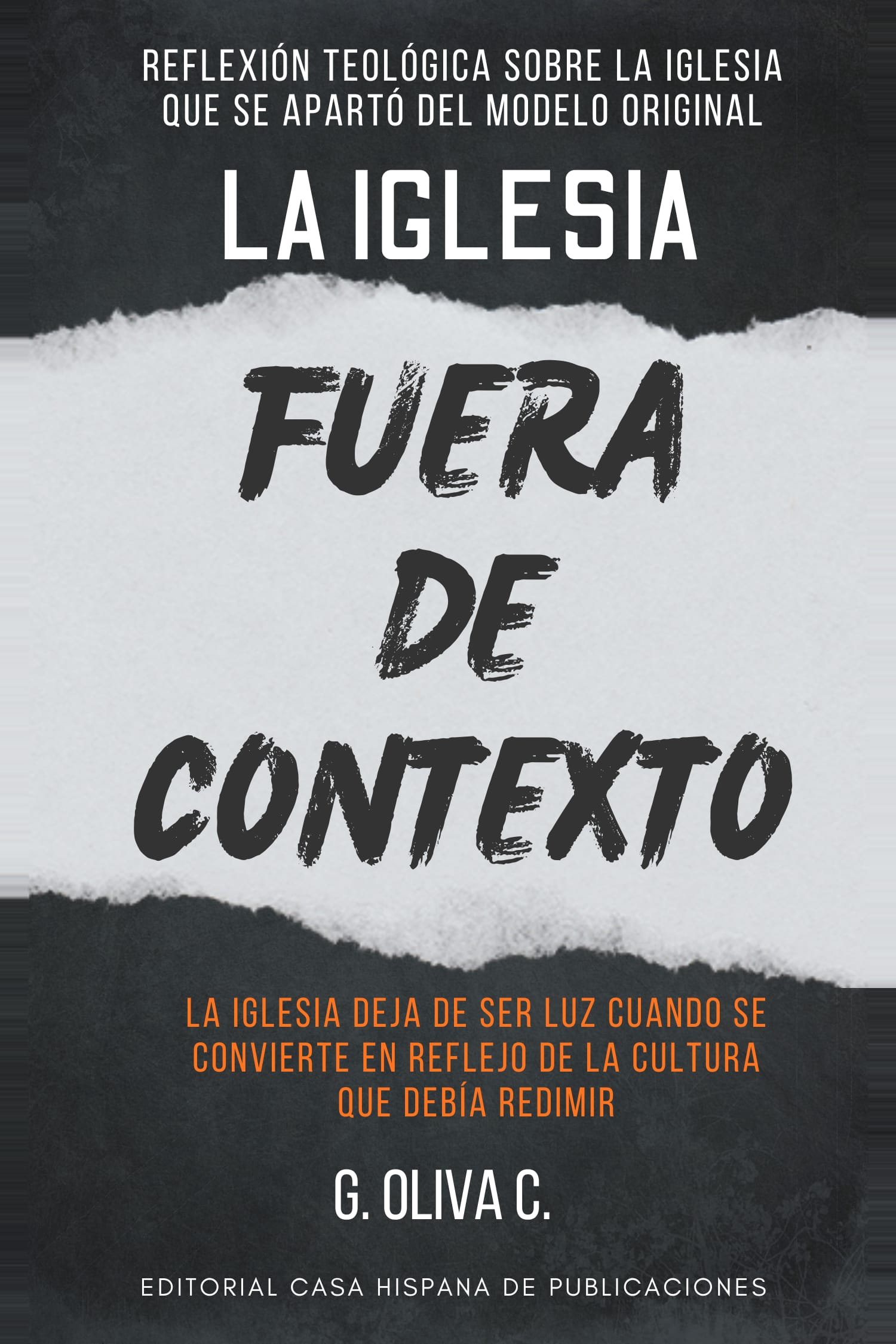
The Church Out of Context is a critical, biblical, theological and pastoral reflection on one of the most sensitive problems in contemporary ecclesiology: the distance that can open up between the Church confessed in the Scriptures and certain historical, institutional and cultural expressions of the present-day Church. The work examines what happens when a Christian community keeps its structures, its language, its activities and its religious symbols, yet gradually loses sight of the purpose that grounds its existence. The phrase out of context carries a twofold meaning here. On the one hand it describes a Church that may have become disconnected from the biblical context that determines its identity; on the other, a Church that may have lost the capacity to understand the human, cultural and social context within which it is called to carry out its mission. The question, then, is not merely whether the Church continues to exist as an institution. The fundamental issue lies deeper: Is it still, in its life, its mission, its priorities and its relationships, what it has biblically been called to be? This question is the axis of the work. The biblical model as a point of reference. The author starts from a fundamental methodological premise: the Church cannot be defined solely on the basis of what it has historically become. Its identity must be examined in the light of the biblical witness. The New Testament presents the Church through a plurality of images: the body of Christ, the people of God, the family of faith, the temple of the Spirit, the bride of Christ, a community of disciples and a people sent out in mission. These images differ from one another, but they converge on one fundamental conviction: the Church belongs to God and finds its identity in Jesus Christ. The biblical design should not, therefore, be understood as a rigid organisational chart to be reproduced mechanically in every historical period. The New Testament sets out fundamental ecclesiological principles that need to be embodied responsibly in different cultures and different historical moments. The distinction is decisive. Biblical faithfulness does not mean cultural immobility. It means holding on to what belongs to the essence of the Church while its ministerial forms engage responsibly with changing contexts. When Christ no longer occupies the centre. The first great deviation examined is the practical loss of the centrality of Jesus Christ. A community may go on using Christian language and yet gradually organise its existence around other centres: the personality of the leader, institutional growth, power, prestige, financial resources, political influence, religious spectacle or the preservation of structures. When this happens, Christ remains nominally present but is functionally displaced. Christology then becomes an ecclesiological test: a genuinely Christian Church must be able to show that Jesus Christ determines not only what it preaches but also the way it exercises authority, administers resources, carries out mission and treats people. From a community of disciples to a religious institution. One of the deepest implications of standing outside the biblical design appears when the Church stops understanding itself first of all as a community of disciples and begins to define itself fundamentally as an institution. Institutionality is not intrinsically negative. Every community that grows needs organisation, administration, leadership and structures. The problem appears when what was created to serve the mission ends up becoming the object of the mission. The Church then begins to pour enormous energy into preserving itself. Maintaining buildings, structures, posts, programmes and systems can come to absorb more attention than evangelising, discipling, training, serving and sending. The institution stops serving the mission. The mission begins to serve the institution. From discipleship to religious attendance. The model of Jesus is bound up closely with the formation of disciples. A Church out of context, however, may gradually replace discipleship with attendance. People learn to attend meetings, take part in activities and consume religious content, but do not necessarily develop biblical maturity, Christian character, a capacity for service or missionary responsibility. This shift has profound consequences. It produces religious consumers rather than disciples. Success begins to be measured by attendance and not necessarily by transformation. The question stops being: what kind of disciples are we forming? and becomes: how many people came? Numbers have pastoral value, but they cannot become the definitive measure of ecclesial faithfulness. From fellowship to anonymity. Acts 2:42 presents a community marked by teaching, fellowship, prayer and shared life. When the Church becomes excessively institutionalised, a paradox can arise: crowds gathered together and people profoundly alone. Biblical fellowship is not simply a matter of sharing a physical space during a service. It involves relationships, accompaniment, mutual accountability, care and belonging. A Church can grow numerically while shrinking relationally. The loss of community is therefore one of the clearest signs of ecclesiological decontextualisation. From pastors to figures of power The biblical understanding of leadership finds one of its central paradigms in service. Jesus Christ confronts models of authority built on domination and proposes a leadership marked by self-giving. When this paradigm is lost, leadership can turn into a concentration of power. Structures emerge in which questioning the leader amounts in practice to questioning God. This creates the conditions for authoritarianism, spiritual abuse, manipulation and an absence of accountability. The problem does not lie in pastoral authority. The Church needs leadership. The question is what kind of authority that leadership reproduces. The biblical model does not abolish authority. It redefines it from within service. From stewardship to corporate logic Another deviation appears when legitimate business categories begin to determine the identity of the Church. Planning, administration, communication, technology and management can all be useful tools. But a Church is not simply a religious company. The Gospel is not a product. Believers are not customers. Pastors are not corporate celebrities. And the growth of the Kingdom cannot be reduced to market indicators. The difficulty arises when ministerial success and business success begin to be used as equivalent concepts. One community may command great resources and be spiritually weak. Another may have limited resources and show an extraordinary missionary faithfulness. From worship to spectacle. The contemporary culture of entertainment introduces a further challenge. Technology, music and visual communication can legitimately enrich the life of a community. The problem appears when worship begins to be organised fundamentally around the logic of spectacle. Participants stop understanding themselves as members of a worshipping community and begin to behave as religious spectators. Technical excellence can then quietly displace spiritual depth. The pastoral question is not whether modern technology should be used. It is a matter of establishing who serves whom: does technology serve worship, or does worship end up serving spectacle? From proclamation to marketing. Communicating the Gospel requires comprehensible language. The problem arises when contextualisation and marketing are confused. To contextualise means to communicate the Gospel faithfully within a culture. Religious marketing may end up altering the message to make it more attractive to the consumer. The difference is fundamental. Contextualisation transforms the language without altering the Gospel. Commodification can alter the Gospel in order to satisfy expectations. When that happens, subjects such as repentance, the cross, suffering, holiness, justice and discipleship may lose ground to a discourse oriented exclusively towards success, prosperity or individual well-being. From mission to maintenance. A biblical Church is a Church that is sent. The Great Commission provides a missionary horizon that prevents the community from existing solely for itself. When mission weakens, most of the resources begin to be directed towards those who already belong to the community. Programmes for members. Activities for members. Budget for members. Infrastructure for members. The Church can remain extremely busy and, at the same time, cease to be genuinely in mission. This is one of the paradoxes the work seeks to draw out: ecclesial activity does not necessarily mean missionary faithfulness. From the peripheries to the centre of power. Jesus showed a constant capacity to draw near to those who found themselves at the margins. A Church out of context can develop the opposite movement. It can come to feel progressively more at ease among influential people, structures of power and socially recognised sectors. The consequence is a loss of sensitivity towards the poor, migrants, Indigenous peoples, prisoners, the sick, the lonely and communities on the periphery. The Church can speak about them without walking with them. Social distance ends up becoming pastoral distance as well. From the prophetic voice to convenient silence. When a Church depends excessively on economic, political or institutional power, its prophetic voice can weaken. It begins to select carefully what it denounces. It can be forceful about sins that do not threaten its interests and silent about injustices that would compromise its alliances. The prophetic function demands independence. The Church must be able to confront abuse whoever commits it. When it loses that freedom, its public word loses credibility. From unity to fragmentation. The New Testament presents unity as a fundamental characteristic of the Christian community. The history of the Church, however, shows many divisions produced by doctrinal, cultural, personal and institutional differences. Not every difference means unfaithfulness. There are legitimate doctrinal convictions. But when competition, personality cult, denominational prestige or struggles for power produce permanent fragmentation, the Church contradicts what it proclaims about reconciliation. A community incapable of practising reconciliation internally will hardly be able to announce it convincingly to the world. From biblical formation to superficiality. Another grave consequence is the loss of biblical and theological depth. When teaching is reduced to motivational messages, isolated phrases or instant answers, the community loses the tools it needs to discern. Believers with little biblical formation can become particularly vulnerable to manipulation, incoherent doctrine and authoritarian leadership. Recovering the biblical design requires recovering the theological formation of the whole community as well, and not of its leaders alone. A Church disconnected from its social context. There is, however, a second way of being out of context. A Church can be doctrinally conservative and, at the same time, wholly ignorant of the society in which it carries out its mission. It can answer questions nobody is asking and stay silent before the questions millions of people actually have. Migration, technology, the environmental crisis, inequality, loneliness, the changing family, Indigenous peoples, new generations, globalisation and secularisation are all realities that need to be understood pastorally. To contextualise does not mean to relativise the truth. It means understanding one's interlocutor well enough to communicate it responsibly. The Latin American Church in the face of this challenge. This reflection takes on particular relevance in Latin America and the Caribbean. The growth and historical presence of Christianity cannot be assessed by the number of church buildings, institutions or believers alone. The more demanding theological question is this: what kind of society are we helping to shape? If there is a strong Christian presence and yet corruption, violence, abuse, inequality, discrimination and indifference persist, the Church needs to ask itself about the depth of its discipleship. Not because it is solely responsible for society's problems. But because a community that proclaims transformation must examine honestly how much of that transformation is taking place in those who belong to it. Pastoral implications. A Church outside the biblical design produces profound pastoral consequences. It can produce dependent believers rather than mature ones. Followers of leaders rather than disciples of Christ. Attenders rather than servants. Consumers rather than missionaries. Crowds without community. Activity without purpose. Growth without depth. Preaching without transformation. Religion without mission. And, perhaps most serious of all, a Church that goes on using the name of Christ while its practices reflect the character of Christ less and less. Recovering direction- The purpose of this work, however, should not be read simply as an indictment of the contemporary Church. Its fundamental orientation is restorative. Theological criticism makes sense when it leads to repentance, discernment and renewal. Regaining that direction means asking again: Who is Christ? What is the Church? Why does it exist? Whom does it serve? What does it mean to make disciples? How should it exercise authority? What place do the poor and the vulnerable occupy? What does it mean to live in fellowship? What does it mean to be sent into the world? These questions lead back once again to the Scriptures. An ecclesiology of return. The central proposal may be defined in precisely those terms. It does not mean going back romantically to the first century, nor mechanically copying every cultural form of the early Church. It means recovering its fundamental principles: Christ at the centre. Scripture as foundation. The Holy Spirit as presence and power. Discipleship as process. Fellowship as a way of life. Service as the model of leadership. Mission as the reason for being sent. Holiness as witness. Mercy as practice. Justice as responsibility. Hope as horizon. The forms may change. The foundation does not. The academic and theological contribution of the work. The value of The Church Out of Context lies in developing an ecclesiological critique that does not set out to destroy the institution but to confront it with its own foundation. The author draws together ecclesiology, Christology, pneumatology, missiology, pastoral theology, Christian ethics, contextual theology and eschatology in order to examine the distance between confessed identity and ecclesial practice. The fundamental methodological question might be put like this: to what extent can our present-day structures, practices and priorities be justified from the nature and mission of the Church as the New Testament presents it? The question demands rigour. Not all innovation is deviation. Not all tradition is faithfulness. Not all growth is health. Not every crisis means failure. Discernment must therefore be carried out through exegesis, theological reflection, historical analysis and pastoral assessment. A final consideration. The Church Out of Context is, in the end, a call to reform, to renewal and to the recovery of purpose. Its concern is not simply to assert that the contemporary Church has gone wrong. It seeks to put a considerably more constructive question: how can it become once more what Christ called it to be? The answer begins when the Church has humility enough to confront its own practices with the Gospel. When it acknowledges that institutional success does not always mean faithfulness. When it understands that having crowds does not necessarily mean forming disciples. When it remembers that leadership means service. When it stops measuring its greatness solely by buildings, budgets, platforms or influence. When it listens once again to the vulnerable. When it recovers its prophetic freedom. When it goes out again in mission. When it replaces spectacle with worship, consumption with discipleship, power with service, and self-preservation with sending. The most dangerous crisis for the Church does not necessarily come when its numbers fall. It comes when it loses its identity and does not notice. It can keep the church building. It can keep the name. It can keep the structure. It can keep the activities. It can even keep the crowds. And still have gradually lost its purpose. For that reason, the closing question of this work should not be addressed to other churches alone. It must be addressed to every Christian community: are we still the Church that Jesus Christ called us to be, or have we simply learned to keep running the thing we have become? In this question lies the academic, pastoral and prophetic character of the study. Because returning to the biblical design does not mean going back to the past; it means recovering the foundation, so as to be faithful to Christ in the present and relevant to the mission in the future…
Category
- Christian Theology
- Biblical Theology
- Pastoral Theology
- Social Theology
- Contextual Theology
- Latin American Theology
- Ecclesiology
- Missiology
- Integral Mission
- Kingdom of God
- Church and Society
- Social Justice
- Human Dignity
- Social Exclusion
- Human Rights
Rights for this book
We turn publishing rights into international growth, connecting authors and publishers with new markets, new readers and new partners around the world.
Technical details
- Title
- La Iglesia fuera de contexto
- Author
- G. Oliva C.
- Imprint
- Grupo Editorial casa Hispana
- Size
- 15x23cms
- Edition
- 1st edition, 2026
- Published in
- Chile
- Year of publication
- 2026
- Available languages
- Spanish, English, German, Portuguese
- Binding
- Paperback with flaps
- Pages
- 587