
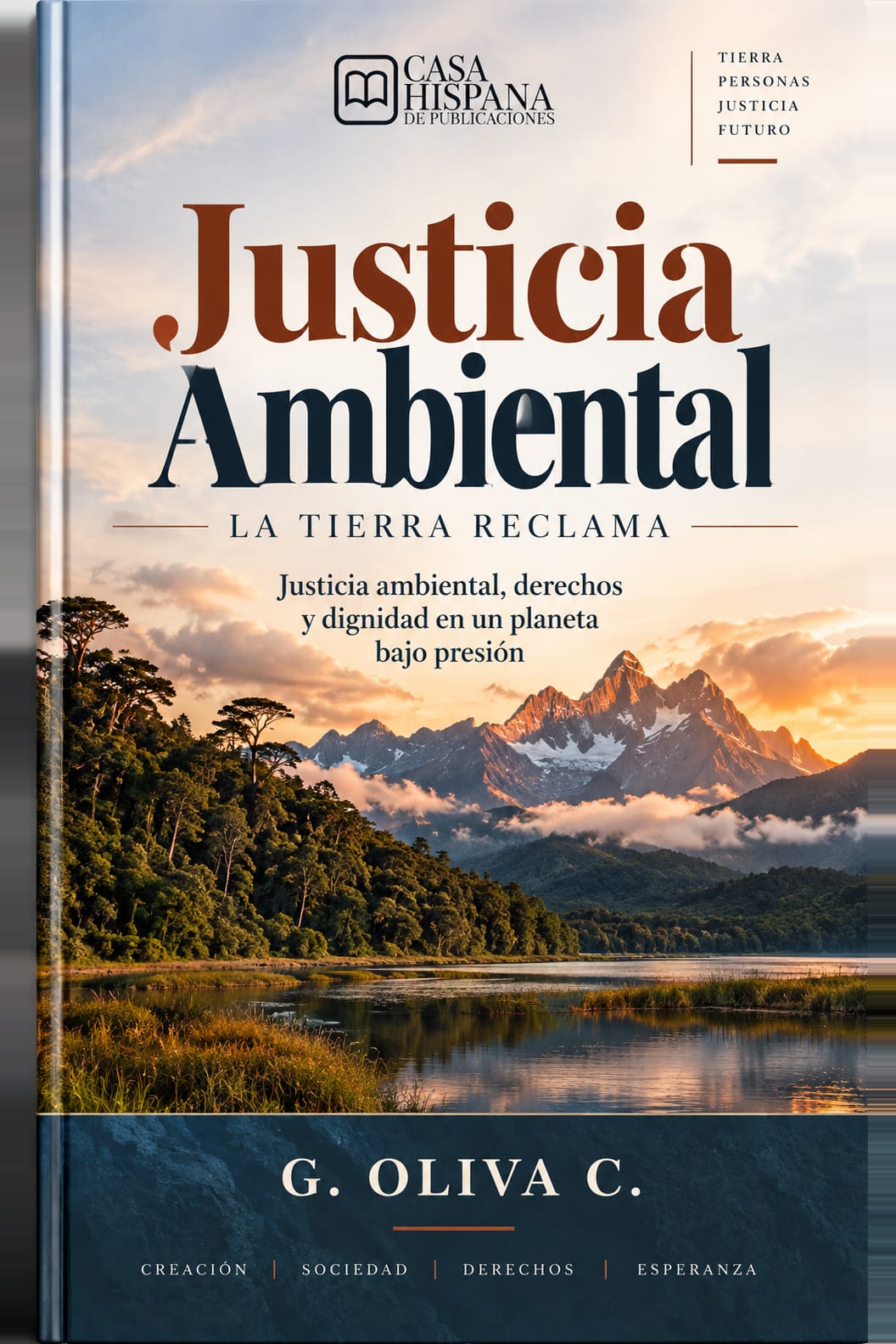
Description
Environmental justice constitutes an ethical, social, legal and political perspective that analyses the way in which the benefits derived from natural resources and the burdens produced by pollution, the degradation of ecosystems and environmental risks are distributed among different people, communities and territories; its fundamental concern starts from a widely recognisable observation: environmental problems do not necessarily affect all people in the same way, nor do all possess equal economic, social, institutional or territorial capacities to protect themselves against them; for this reason, to speak of the environment also means asking who receives the benefits of development, who bears its impacts, who takes part in decisions, who has access to sufficient information, who can legally defend their rights and who has the resources to adapt when environmental conditions deteriorate. From this perspective environmental justice considerably broadens the traditional understanding of the protection of nature, because it is not limited to conserving species, forests, rivers, oceans or landscapes, but also studies the relationships between environment, human dignity, inequality, territory, economy, health, participation and rights; an environmental policy may produce positive results according to a given ecological indicator and nevertheless generate unequal social consequences if its costs fall disproportionately on communities that have less capacity to take part in decisions or to adapt to their effects. One of the central concerns running through this reflection consists precisely in recovering the human dimension of the ecological crisis; behind a polluted river there is an affected ecosystem, but there may also be families who use its waters, farmers who depend on irrigation, fishers who need its resources, indigenous communities that maintain territorial ties with that space and populations whose health or economy may be directly related to environmental quality; for this reason the degradation of nature should never be analysed exclusively through physical indicators when its consequences simultaneously reach social life. Equity constitutes one of the fundamental principles of environmental justice and holds that people should have reasonable conditions for accessing essential environmental goods and should not systematically bear a disproportionate share of the costs of activities that mainly benefit other sectors; this does not mean that every environmental impact must be distributed mathematically in an identical way, but that decisions need to consider who is affected, what their level of vulnerability is, what benefits they receive and what mechanisms exist to prevent, mitigate, compensate or repair the damage. Access to water constitutes one of the clearest examples of this relationship, because water simultaneously has ecological, social, economic, cultural and sanitary dimensions; a community that lacks sufficient access to safe water experiences consequences for food, hygiene, health, work, education and quality of life, while other activities may require large quantities of the same resource; environmental justice then asks how priorities are set, how scarcity is distributed, what criteria guide decisions and how affected communities take part. Land represents another fundamental sphere; its quality determines agricultural, housing, ecological and cultural possibilities; soil contamination, erosion, desertification, loss of fertility or certain territorial transformations can profoundly change the living conditions of those who depend directly on it. For rural, peasant and indigenous communities this relationship can acquire an even greater depth, because territory does not mean only productive property; it also constitutes memory, identity, kinship, local knowledge, cultural practices and intergenerational continuity; profoundly altering a territory can mean simultaneously changing a way of life. Environmental justice therefore has a distributive dimension, because it examines how environmental benefits and burdens are distributed, but this is only one of its dimensions; there is also a procedural justice related to the way decisions are made; it is not enough to ask what the final result was; it is necessary to ask who took part, who was heard, what information the community received, how much time it had to analyse it and what real capacity it had to influence the decision. Participation consequently represents an essential principle; communities affected by industrial, energy, mining, forestry, urban, port or infrastructure projects need to have adequate mechanisms to express concerns, present information, formulate observations and learn the reasons by which the authorities adopt certain decisions. A merely formal participation may fulfil administrative procedures without producing true dialogue; if the information arrives too late, is expressed exclusively in incomprehensible technical language or the main decisions have already been taken, the community's capacity to participate is significantly reduced. For this reason access to information constitutes another foundation of environmental justice; people need to know the risks related to activities carried out near their territories: water quality, atmospheric emissions, characteristics of waste, impacts on biodiversity, mitigation measures, monitoring systems and the procedures available for lodging complaints. Environmental transparency fulfils a double function: it allows communities to make informed decisions and strengthens the accountability of public and private institutions; when environmental information remains inaccessible or excessively fragmented, the asymmetry increases between those who have the technical capacity to interpret the data and those who directly bear the territorial consequences. This informational inequality can become an additional form of vulnerability; a community with few economic resources may lack specialists, lawyers, scientists or consultants capable of interpreting complex technical documents, while a company or institution may have complete professional teams; guaranteeing effective participation requires recognising these differences in capacity. Environmental justice is thus deeply related to the principle of non-discrimination; no community should be systematically selected to receive polluting or hazardous activities simply because it has less economic, social or political power…
Category
- ENVIRONMENT AND SUSTAINABLE DEVELOPMENT
- ENVIRONMENTAL JUSTICE
- CLIMATE JUSTICE
- ECOLOGICAL JUSTICE
- HUMAN RIGHTS AND THE ENVIRONMENT
- ENVIRONMENTAL EQUITY
- SOCIO-ENVIRONMENTAL INEQUALITY
- SOCIO-ENVIRONMENTAL CONFLICTS
- TERRITORY AND ENVIRONMENTAL JUSTICE
- ENVIRONMENTAL GOVERNANCE
- ENVIRONMENTAL PUBLIC POLICIES
- CITIZEN AND COMMUNITY PARTICIPATION
- RIGHTS OF INDIGENOUS PEOPLES
- INDIGENOUS TERRITORIES AND NATURAL RESOURCES
- INTERCULTURALITY AND THE ENVIRONMENT
- CLIMATE CHANGE AND VULNERABLE COMMUNITIES
- CLIMATE ADAPTATION AND RESILIENCE
- JUST TRANSITION
- ENERGY TRANSITION
- POLLUTION AND ENVIRONMENTAL HEALTH
- WATER AND WATER JUSTICE
- BIODIVERSITY AND CONSERVATION
- PROTECTION OF ECOSYSTEMS
- ECOLOGICAL RESTORATION
- NATURAL RESOURCES AND SUSTAINABILITY
- CORPORATE ENVIRONMENTAL RESPONSIBILITY
- ENVIRONMENTAL RESPONSIBILITY AND REPARATION
- TERRITORIAL PLANNING AND DEVELOPMENT
- LOCAL COMMUNITIES AND THE ENVIRONMENT
- ECOTHEOLOGY THEOLOGY OF CREATION
- CARE OF CREATION
- INTEGRAL ECOLOGY
Rights for this book
We turn publishing rights into international growth, connecting authors and publishers with new markets, new readers and new partners around the world.
Technical details
- Title
- Justicia ambiental
- Author
- G. Oliva C.
- Imprint
- Grupo Editorial casa Hispana
- Size
- 15x23cms
- Edition
- 1st edition, 2024
- Published in
- Chile
- Year of publication
- 2025
- Available languages
- Spanish, English, German, Portuguese
- Binding
- Paperback with flaps
- Pages
- 502