Description
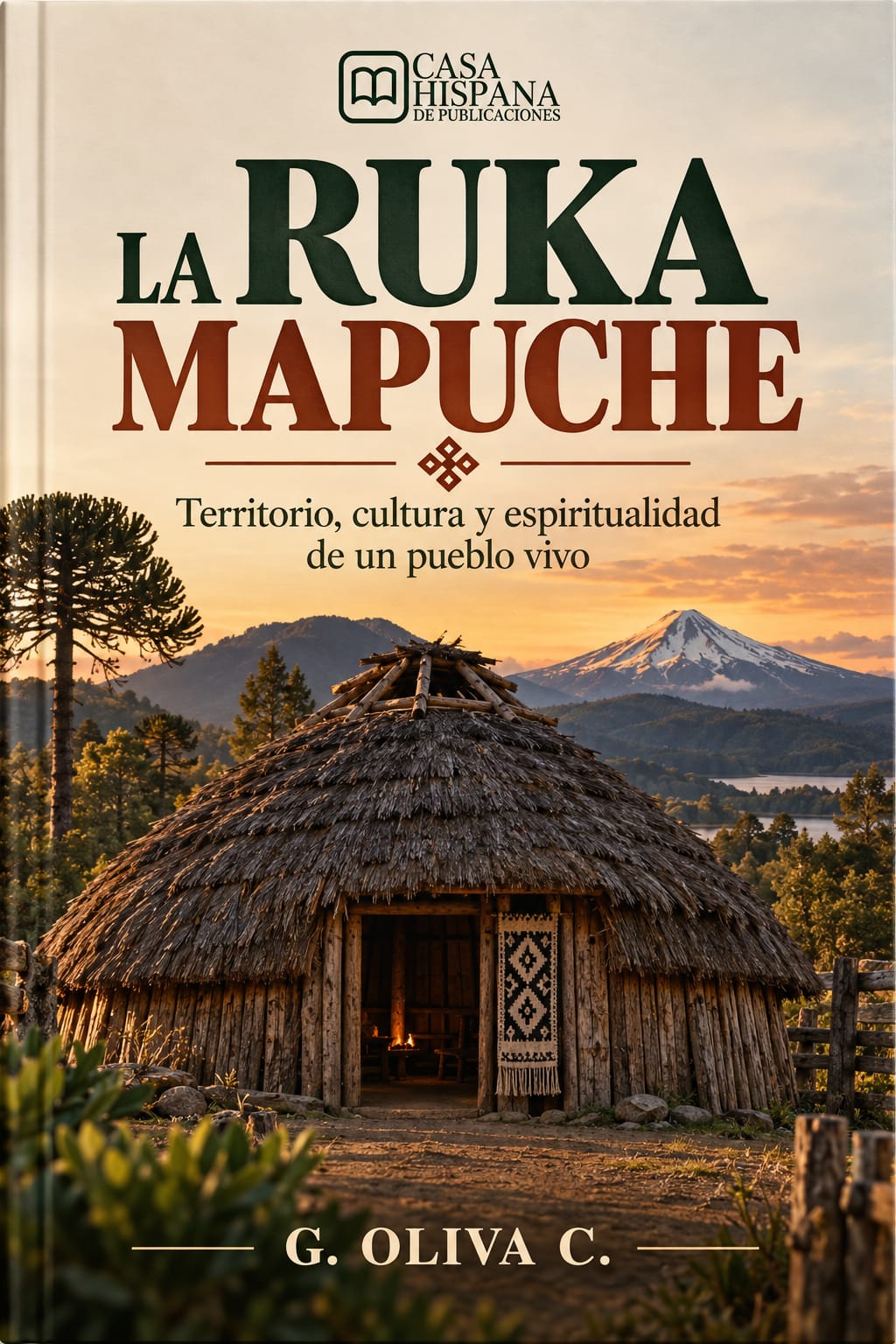
The Mapuche ruca constitutes much more than a construction intended to provide shelter, because historically it has represented a fundamental space for the organisation of family life, the transmission of knowledge, community coexistence and the daily relationship with the territory, and from the author's perspective, truly understanding its meaning requires going beyond an exclusively architectural reading in order to recognise it as a material expression of a particular cultural experience in which dwelling, family, memory, nature, work, food, conversation, education and belonging are closely related; the ruca may be observed from outside as a structure built mainly with materials available in the surroundings, but from within it represents an inhabited space where generations have carried out daily activities, shared food, transmitted stories, educated children and young people and built social bonds that form part of the historical continuity of the Mapuche people. Speaking of the ruca as a traditional dwelling requires at the same time recognising historical and territorial diversity, because not all Mapuche constructions have had exactly the same dimensions, shapes, materials, orientations or techniques, and their characteristics may vary according to territory, availability of resources, environmental conditions, family needs, historical periods and cultural transformations; for this reason it is methodologically more appropriate to speak of Mapuche building traditions than of an absolutely uniform and unchanging model; this precision is important because living cultures develop adaptations, and dwellings are precisely one of the spaces where these transformations can be observed most clearly. The construction of a ruca expresses practical knowledge accumulated across generations; selecting materials, recognising their properties, preparing structures, organising spaces and maintaining a dwelling require experience and territorial knowledge; traditional architecture should not be interpreted as rudimentary architecture simply because it uses natural materials; on the contrary, it responds to technologies developed within concrete historical conditions in which communities used available resources through knowledge transmitted mainly through observation, participation and practice. Wood, plant fibres, straw and other locally available materials could form part of these constructions depending on the territory and the period, and their use shows how the architecture was directly linked to the surrounding ecosystems; the forest, the fields, the wetlands and other spaces provided materials whose selection required knowledge about strength, flexibility, insulation, availability and behaviour under climatic conditions; in this way, building a dwelling also meant knowing the territory. From this perspective the ruca can be studied as an expression of vernacular architecture, that is, an architecture developed through local knowledge, available materials, accumulated experience and adaptation to the environment; this concept makes it possible to recognise that communities produced building solutions long before the existence of professional schools of architecture, and that these solutions contain knowledge worthy of historical, anthropological and environmental research. However, the contemporary appreciation of these building systems should not lead to idealisations; to claim that every traditional construction is automatically sustainable or perfectly adapted can be as simplistic as considering it primitive; sustainability depends on availability of materials, scale of extraction, capacity for regeneration, sanitary conditions, durability, maintenance and demographic context; what matters is to study concretely which traditional principles can contribute today to building models with lower environmental impact. One of those principles corresponds to the use of local resources; using materials available near the building site can reduce certain transport needs and strengthen knowledge about territorial resources, although today any recovery of traditional techniques must also consider environmental regulations, availability of species, structural safety and contemporary sanitary conditions; tradition can dialogue with innovation without needing to reproduce exactly all the conditions of the past. The most immediate function of the ruca is naturally to provide home and shelter, but the concept of home has a depth that goes beyond the existence of a roof and walls; a home is a space where relationships are established, where responsibilities are distributed, where food is prepared, where people rest, where they converse and where children learn by observing adults; for this reason the dwelling can become a true cultural institution. Many forms of knowledge have historically needed no classroom to be transmitted; a person learns by listening to conversations, taking part in tasks, observing techniques, asking the elders and accompanying family activities; from this perspective the ruca can be understood as an everyday pedagogical space where education takes place integrated into life. Within this understanding the hearth acquires particular importance as a place associated with the preparation of food, warmth, conversation and family gathering; around the fire stories, advice, memories, histories and teachings can circulate; the fire thus transforms the domestic space into a meeting place, although once again the specific functions and configurations need to be studied according to each territorial and historical context. Food likewise constitutes an important cultural dimension; preparing, sharing and consuming food within the home strengthens bonds and makes it possible to transmit knowledge about products, seasons, preparation techniques and forms of hospitality; food practices are part of cultural heritage, and the dwelling is one of their main settings. Conversation around the domestic space also has importance for the transmission of Mapudungun; a language stays alive fundamentally when it is used within everyday relationships, and the home has historically been one of the main places of linguistic transmission; children learn a language not only through vocabularies but by hearing how adults name people, objects, foods, animals, plants, emotions, actions and events…
Category
- MAPUCHE RUCA
- MAPUCHE ARCHITECTURE
- TRADITIONAL DWELLING
- MAPUCHE CULTURE
- MAPUCHE PEOPLE
- CULTURAL IDENTITY
- CULTURAL HERITAGE
- ARCHITECTURAL HERITAGE
- INDIGENOUS ARCHITECTURE
- VERNACULAR ARCHITECTURE
- MAPUCHE TERRITORY
- HISTORICAL MEMORY
- COMMUNITY LIFE
- INTERGENERATIONAL TRANSMISSION
- ANCESTRAL KNOWLEDGE
- MAPUCHE WORLDVIEW
- MAPUCHE SPIRITUALITY
- SUSTAINABLE BUILDING
- INTERCULTURALITY
- CULTURAL PRESERVATION
Rights for this book
We turn publishing rights into international growth, connecting authors and publishers with new markets, new readers and new partners around the world.
Technical details
- Title
- La ruka Mapuche
- Author
- G. Oliva C.
- Imprint
- Grupo Editorial casa Hispana
- Size
- 15x23cms
- Edition
- 1st edition, 2024
- Published in
- Chile
- Year of publication
- 2025
- Available languages
- Spanish, English, German, Portuguese
- Binding
- Paperback with flaps
- Pages
- 425