Description
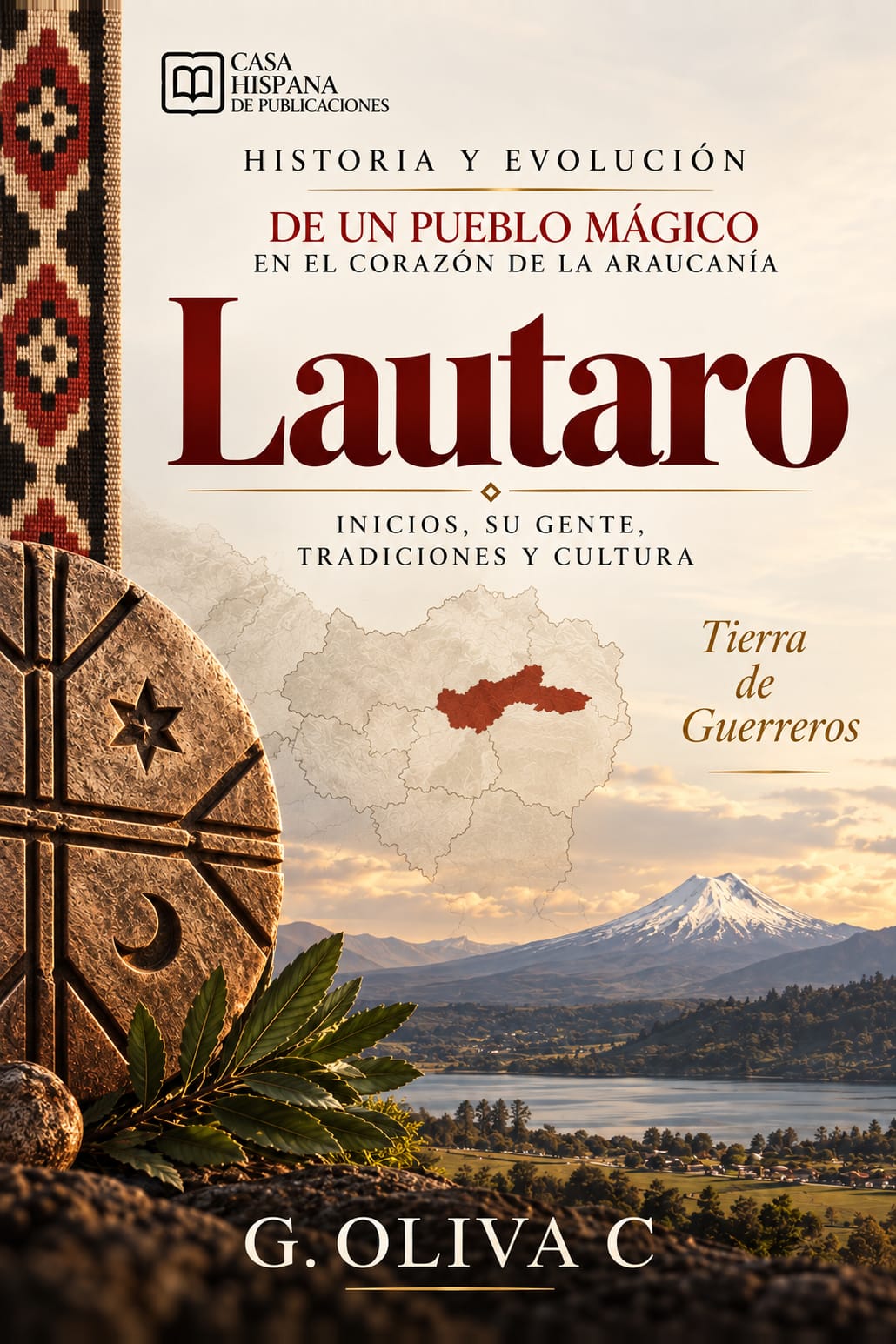
To speak of Lautaro is to speak of a territory whose history began long before there were streets, stations, industries, public buildings or administrative boundaries. Before becoming a city, this space formed part of a Mapuche territory crossed by family relationships, movements, exchanges, productive practices, knowledge of nature and its own forms of social and cultural organisation. For this reason, a history of Lautaro should not begin solely with a founding date. It must begin with the land, with the Cautín river, with the ancient roads, with the forests, with the communities and with the generations that inhabited these spaces before the definitive expansion of the Chilean State into the Araucanía. The deep history of Lautaro belongs, in the first place, to that Mapuche territorial memory and, later, to the multiple encounters, conflicts and transformations that gradually shaped local society. During the second half of the nineteenth century, the Araucanía underwent a decisive transformation. The Chilean State carried out a process of military occupation that culminated in territorial annexation and colonisation, the settlement and reduction of Mapuche communities and profound sociocultural changes. From the 1860s forts were raised, new towns were laid out and a region that until then had maintained a complex frontier relationship with the State was territorially reorganised. (Memoria Chilena) In that scenario lies the urban origin of Lautaro. On 18 February 1881, Manuel Recabarren Rencoret, Minister of the Interior under President Aníbal Pinto, established beside the Cautín river the fort called Aníbal Pinto, the direct antecedent of the settlement that would later become Lautaro. The fort arose within the State strategy of consolidating the Cautín line during the campaigns of occupation of the Araucanía. Around that military installation dwellings gradually appeared, initially linked to the families of soldiers and later to merchants and new inhabitants. (Municipalidad de Lautaro) This circumstance obliges us to narrate the origins of the city with a broad historical gaze: for the Chilean State it was a matter of territorial incorporation, institutional establishment and the expansion of communications; for the Mapuche communities, that same process meant war, territorial loss, reduction and profound alterations of their ways of life. Local history becomes more comprehensible when both dimensions are recognised and not when one of them is removed from the account. (Memoria Chilena) With the passage of time, the name of Lautaro ended up linking the nascent town with one of the most emblematic figures of Mapuche resistance in the sixteenth century: the toqui Leftraru or Lautaro, Reche-Mapuche leader of the Arauco War, whose memory reached a legendary dimension both in Mapuche history and in the history of Chile. (Memoria Chilena) In this way, the name of the city contains a powerful historical paradox: a town that arose in the context of the State occupation of the Araucanía ended up bearing the name of one of the most recognisable symbols of indigenous resistance to conquest. That tension forms part of the symbolic depth of Lautaro and helps to understand why its history cannot be narrated only as a succession of administrative dates. It is territory, memory and a meeting of histories that did not always move in the same direction. Towards the end of the nineteenth century a new stage began. From 1886 foreign immigrants arrived, promoted through colonisation policies and agencies, among them Swiss, Germans, French and Spaniards, joining a territorial society where Mapuche population, soldiers, Chilean families, merchants and workers already coexisted. In 1891 the Municipality of Lautaro was formally established and, later, the locality acquired new administrative functions: in 1907 it was the capital of the Department of Llaima and from 1928 of the new Department of Lautaro. (Municipalidad de Lautaro) Thus a society took shape marked by cultural encounters, but also by inequalities, territorial disputes and processes of adaptation. Mapuche, peasants, immigrants, workers, merchants and urban families gradually built a local identity that cannot be reduced to a single origin. Lautaro became a place where different memories began to share the same space. The growth of the city was closely related to another great protagonist of the history of southern Chile: the railway. Railway expansion into the Araucanía was part both of the territorial incorporation promoted by the State and of the economic development of the cities and towns of the south. The tracks facilitated the movement of people and products, especially agricultural, livestock and forestry goods, and the stations became commercial and social hubs. (Memoria Chilena) For localities such as Lautaro, the train represented much more than transport. The station was meeting and farewell, the arrival of goods and news, the circulation of workers and travellers, connection with other cities and an opening towards a country that seemed to draw closer as the rails advanced. The railway stations of the Chile of that era were true stages of social life, places where different classes converged and where travel began to change the perception of distances. (Memoria Chilena) One can imagine that Lautaro of the early twentieth century waking to the movement of its streets, the carts, the warehouses, commerce and the sound of the train announcing a new arrival. Around agricultural activity services, small businesses, workshops and later industries began to develop. Countryside and city needed each other. From the rural areas came products, workers and families; from the urban centre goods, tools and services were distributed. Fairs and commercial spaces became points where cultural differences could meet daily. There history ceased to be solely institutional and acquired a human face: women selling produce, farmers negotiating, workers starting their day, children on their way to school, merchants opening their doors, families travelling from rural sectors and conversations in which different ways of speaking, remembering and understanding the territory could cross. Lautaro became a town precisely through that daily life. One of its most significant stages unfolded between approximately 1921 and 1960, a period remembered for its industrial and cultural activity. Taking advantage of local raw materials and existing connectivity, establishments operated such as the Rudloff tannery, the Francisco Faesch spinning mill, the Carlos Wilken soap factory, the Dickinson foundry and the Cervecera Alemana brewery. Municipal documentation characterises this period as an era of economic boom and notes that this cycle lost strength towards the middle of the twentieth century, when technological and productive transformations contributed to the closure of several of those industries. (Municipalidad de Lautaro) The factories were not only buildings and machines: they organised family schedules, generated trades, produced labour relations and left memories that passed from one generation to another. Many inhabitants began to recognise the city through their workplaces. The industrial sound, the shifts, the workers' conversations and commercial movement became part of the human landscape of Lautaro. When those industries declined or disappeared, not only were sources of employment lost; a particular way of experiencing the city also came to an end. Economic transformation obliged Lautaro to seek new forms of development and left in its collective memory the image of an industrial past that still deserves to be researched, documented and passed on. But the history of Lautaro cannot be written solely from the economy. There is another dimension that gives it a singular depth: its cultural life. In this city, on 24 June 1935, the poet Jorge Teillier Sandoval was born, one of the most recognised figures of the so-called Chilean lárica poetry. Local cultural memory itself recognises him as one of its great references. (Municipalidad de Lautaro) In Teillier, the town, childhood, the province, trains, houses, landscapes and memory acquired a particular poetic density. His presence in the cultural history of Lautaro makes it possible to understand that towns do not only produce agriculture, commerce or industry: they also produce imagination, literature and ways of remembering. There is a material Lautaro made up of streets and buildings, but also a symbolic Lautaro made up of memories, stories, family photographs, sounds, aromas and places that remain in those who once inhabited them. It is there that the expression "magical town" acquires a meaning that can go beyond a tourist designation: Lautaro has an emotional geography built by generations. The Cautín river, the train, the old neighbourhoods, the schools, the squares, the nearby fields, the winters, the rain, the trees and the distant mountains form part of a memory that transforms physical territory into affective territory. However, at the centre of this history the Mapuche people remain. Their presence is not an ancient chapter that ends when the modern city begins. Mapuche communities form part of the past and present of Lautaro and of the Araucanía. Their knowledge, territorial relationships, cultural practices, oral memory and Mapudungun constitute essential dimensions for understanding the deep identity of the territory. Narrating the history of Lautaro without them would produce an incomplete history. But recognising them also requires avoiding romanticisation. Mapuche culture is not a museum piece nor an image frozen in the past. It is a contemporary reality that has undergone transformations, conflicts, adaptations and processes of revitalisation. Likewise, the presence of descendants of European settlers and of Chilean families who arrived during different stages forms part of local memory. Lautaro is the result of these overlapping trajectories. Its identity does not need to erase one memory in order to recognise another. It can learn to remember critically how the territory was formed and, at the same time, value what its different generations built. Mature history does not need to choose between memory and encounter. It needs truth so that encounter may be possible. From the author's perspective, that is one of Lautaro's greatest riches: to observe it means contemplating, on a local scale, a good part of the history of the Araucanía. In its origins appear Mapuche territory and military occupation; in its growth, colonisation, migration and the railway; in its consolidation, agriculture, commerce and industrialisation; in its culture, poetry, traditions, education and memory; and in its present, the need to relate heritage, development and identity. Each generation has received a different city and has left another to those who came after. For this reason the evolution of Lautaro should not be understood solely as urban growth. To evolve also means reinterpreting one's own history, recovering heritage, preserving archives and photographs, listening to the elders, documenting testimonies, protecting significant places and teaching new generations that behind every street there may be a history worth knowing. Tradition lives precisely through that transmission. It is in family stories, in memories of the railway, in the memory of workers, in rural life, in Mapuche communities, in celebrations, trades, cuisines, schools and organisations. Not all these traditions have the same origin, and precisely there lies one of the cultural particularities of Lautaro. It is an identity built through historical layers. Territory - Mapuche Memory - Frontier - Settlement - Railway - Agriculture - Industry - Poetry - Tradition - Community. Each represents a door to understanding the town. Contemporary Lautaro bears all those traces even if some are no longer visible at first sight. The industries may have disappeared, but they remain in the memory of their workers. The train may have changed its prominence, but the rails continue to evoke times of meetings and farewells. The old buildings may be transformed, but photographs preserve their shapes. The older generations are passing away, but their stories can remain when someone decides to listen to them and write them down. Languages may lose speakers, but they can also undergo processes of revitalisation when new generations recognise their value. There lies the responsibility of the present: not to turn heritage into motionless nostalgia, but to transform it into living knowledge. A town knows its future better when it understands the multiple histories that made it possible. Lautaro has privileged conditions for building that memory because its trajectory brings together central events of regional history and, at the same time, an enormous wealth of small stories: families, workers, merchants, peasants, teachers, railway workers, women, children, Mapuche communities, immigrants and poets. The great history and everyday history meet in the same territory. Hence writing about Lautaro is also listening. Listening to what the documents say and to what families still tell. Listening to Mapuche memory and to the memory of those who arrived later. Listening to the old train whistle in the imagination of those who remember it. Listening to the noise of the factories that once marked the working day. Listening to the poetry that turned the town into an inner landscape. And listening, above all, to the new generations asking what it means to belong to this place. Lautaro is not only the result of what happened; it is also what its inhabitants decide to preserve, reinterpret and build. Its true magic does not need to be invented, because it lies in the extraordinary concentration of memory this territory in the heart of the Araucanía possesses. A memory made of lights and conflicts, encounters and losses, work and poetry, Mapuche roots and new populations, countryside and city, tradition and transformation. That is why Lautaro can be narrated as a town that was historically born between frontiers and ended up becoming a place of encounter; a territory that knew the fort, the train, industry and crisis, but that continued to reinvent itself; a community where the traces of the past remain beneath the present and where each generation asks again what to preserve and what to transform. Lautaro is territory, memory and people. It is river and countryside, culture and work, Mapuche history and urban transformation, railway and poetry. It is a town that cannot be understood from a single history, because its identity was born from the encounter — and also from the tensions — between many memories. To know it is to return to those traces and discover that the heart of the Araucanía does not only keep its past: it still tells it…
Category
- LAUTARO
- ARAUCANÍA
- LOCAL HISTORY
- REGIONAL HISTORY
- HISTORICAL MEMORY
- MAPUCHE PEOPLE
- MAPUCHE CULTURE
- MAPUCHE TERRITORY
- LOCAL IDENTITY
- CULTURAL HERITAGE
- INTERCULTURALITY
- COLONISATION
- SETTLEMENT
- RAILWAY
- INDUSTRIALISATION
- INDUSTRIAL HERITAGE
- RURALITY
- ORAL TRADITION
- COLLECTIVE MEMORY
- HISTORY OF THE ARAUCANÍA
Rights for this book
We turn publishing rights into international growth, connecting authors and publishers with new markets, new readers and new partners around the world.
Technical details
- Title
- Lautaro, tierra de guerreros
- Author
- G. Oliva C.
- Imprint
- Grupo Editorial casa Hispana
- Size
- 15x23cms
- Edition
- 1st edition, 2023
- Published in
- Chile
- Year of publication
- 2025
- Available languages
- Spanish, English, German, Portuguese
- Binding
- Paperback with flaps
- Pages
- 507