Description
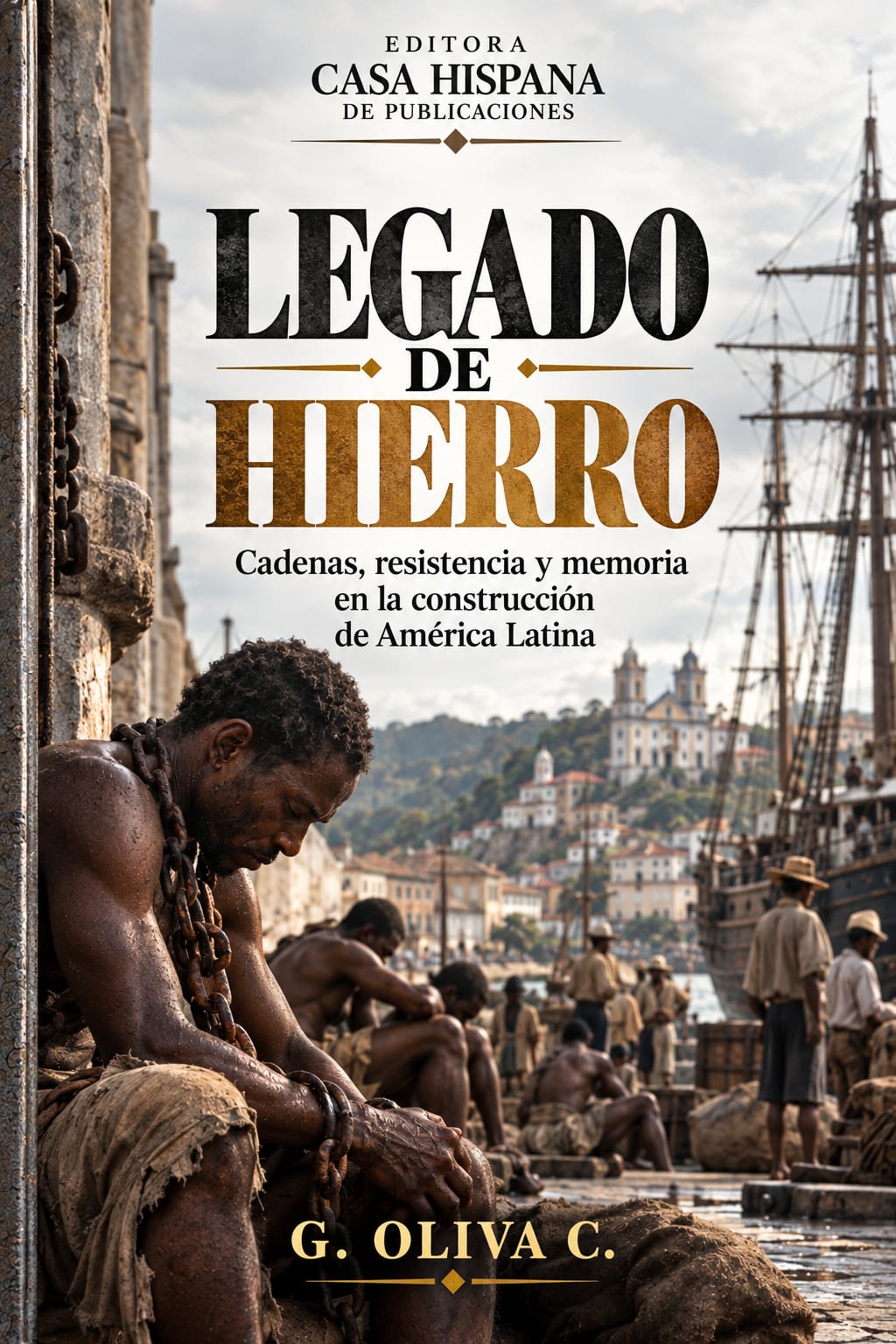
Legado de hierro: Cadenas, resistencia y memoria en la construcción de América Latina offers a historical, social and cultural approach to one of the deepest and most painful processes in the formation of Latin America: the enslavement of millions of African and Afro-descendant people and the consequences that this system left in the societies of the continent. The work uses the image of iron as a powerful historical metaphor. Iron evokes the chains, shackles and material mechanisms through which domination was exercised over enslaved bodies, but it also represents the economic, legal, social and racial structures that made slavery possible and that, in transformed guises, projected some of its consequences beyond abolition. The book starts from an indispensable consideration: the history of African people in Latin America does not begin with slavery. Before the forced displacement to the Americas there existed peoples, societies, political structures, commercial systems, spiritual traditions, languages, bodies of knowledge, family relationships and diverse cultural expressions on the African continent. To reduce millions of human beings exclusively to their condition as enslaved people is to accept, even unintentionally, one of the fundamental operations of the slave system itself: erasing their earlier histories and turning persons into merchandise. Before the chain there was a person. Before the enslaved there was a history. Before the uprooting there were a family, a community, a language and a memory. From this perspective, Legado de hierro places slavery within the broader process of colonial expansion and the formation of the Atlantic economies. The transatlantic trade forcibly transported millions of Africans to different regions of the Americas over several centuries. This displacement cannot be understood solely as a demographic movement. It meant family separation, territorial uprooting, physical violence, the rupture of community and the subjection of human beings to systems that sought to turn their capacity for work into economic property. The Atlantic crossing is one of the most dramatic moments of this history. The slave ships were spaces of extreme confinement, disease, violence and death. But the work avoids turning that experience into a spectacle of suffering. The purpose is not to accumulate images of pain, but to understand the historical mechanism that made it possible for human beings to be captured, traded, transported and exploited within an international economy. Africa – Capture – Trade – Atlantic – Enslavement – Labour – Resistance – Memory form a historical sequence that makes it possible to grasp the magnitude of the phenomenon without reducing its protagonists to a passive category. Once in the Americas, enslaved people were incorporated into different economic activities. Agricultural plantations, sugar mills, mining operations, landed estates, ports, craft workshops, domestic work, urban activities and numerous productive circuits depended, in different periods and regions, on enslaved labour. Brazil occupies a particularly significant place within this history, although African slavery was present in numerous Latin American and Caribbean territories. For that reason, the book proposes examining a question that for a long time received insufficient attention within certain national narratives: the material construction of Latin America also drew on the labour of African and Afro-descendant men and women subjected to slavery. Colonial cities, economies, agricultural holdings and commercial networks cannot be adequately understood without recognising that participation. However, recognising it does not mean attributing the whole of Latin America's economic formation exclusively to enslaved labour. Colonial societies were complex and combined different forms of labour, relations of power and social actors. Historical rigour demands that both invisibility and excessive generalisation be avoided. One of the central axes of Legado de hierro is the relationship between slavery and power. Slavery was not only a private relationship between master and enslaved person. It needed institutions, norms, commercial practices, mechanisms of surveillance and discourses capable of legitimising inequality. Turning a person into property required building a system that made legally possible what morally amounted to a profound denial of their humanity. Racialisation acquired a decisive historical importance in this process. Differences of origin and appearance were progressively incorporated into systems of social classification and hierarchy. The work distinguishes carefully between slavery and racism: they are not identical concepts, nor did they necessarily arise in the same way in every context. However, the expansion of Atlantic slavery contributed powerfully to consolidating racialised representations used to justify inequalities. The iron of the chains was therefore accompanied by another, less visible iron: that of the social categories through which certain groups were systematically placed in subordinate positions. But Legado de hierro does not construct a history told exclusively from the power of those who enslaved. Its second great axis is resistance. Enslaved people were not motionless actors within the system. They resisted through multiple strategies. Some were open and collective: escapes, uprisings, rebellions, marronage, the formation of quilombos and palenques. Others were everyday and less visible: preserving family ties, passing on knowledge, rebuilding communities, negotiating spaces of autonomy, keeping cultural expressions alive and using different mechanisms to widen the margins of freedom. Where there was domination, there was also resistance. Where an attempt was made to impose silence, there were ways of preserving memory. This statement profoundly alters the traditional narrative. Enslaved people cease to appear solely as objects upon which history acted and are recognised also as subjects capable of making decisions within extraordinarily restrictive circumstances. Resistance should not be romanticised. There were real limits, violence, defeats, reprisals and enormous asymmetries of power. But recognising those conditions does not require denying historical agency. Indeed, one of the work's aims is to hold both dimensions together: oppression and agency – violence and resistance – dispossession and reconstruction. The quilombos, palenques and other communities formed by people who escaped from slavery acquire, within this perspective, a particular significance. They represented diverse experiences of the search for autonomy and survival. They were not identical realities, nor can they be interpreted through a single model, but they are evidence that the enslaved population developed collective strategies in the face of the established order. The participation of women calls for equally specific attention. African and Afro-descendant women experienced particular forms of exploitation linked simultaneously to labour, legal status, gender and, in numerous cases, sexual and reproductive violence. But neither should they be presented solely through suffering. They took an active part in urban economies, family networks, cultural transmission, religious practices, strategies of freedom and the formation of communities. The work thus incorporates a perspective that makes it possible to observe how race, social condition, gender and power could intersect in different ways within slave societies. Another of the major fields addressed is culture. Forced displacement did not completely eliminate African memories. Languages, rhythms, culinary practices, knowledge, forms of religious life, techniques, bodily expressions and forms of sociability took part in processes of cultural transformation and re-creation within the Americas. However, the author takes care to avoid a simplistic reading of the African inheritance. Not every Afro-Latin American manifestation can be described as an intact reproduction of an original African practice. Cultures change through contact, adaptation, resistance, exchange and creation…
Category
- AFRO-LATIN AMERICAN HISTORY
- SLAVERY
- AFRICAN DIASPORA
- BLACK RESISTANCE
- AFRO-DESCENDANT MEMORY
Rights for this book
We turn publishing rights into international growth, connecting authors and publishers with new markets, new readers and new partners around the world.
Technical details
- Title
- Legado de hierro
- Author
- G. Oliva C.
- Imprint
- Grupo Editorial casa Hispana
- Size
- 15x23cms
- Edition
- 1st edition, 2025
- Published in
- Chile
- Year of publication
- 2025
- Available languages
- Spanish, English, German, Portuguese
- Binding
- Paperback with flaps
- Pages
- 467