Description
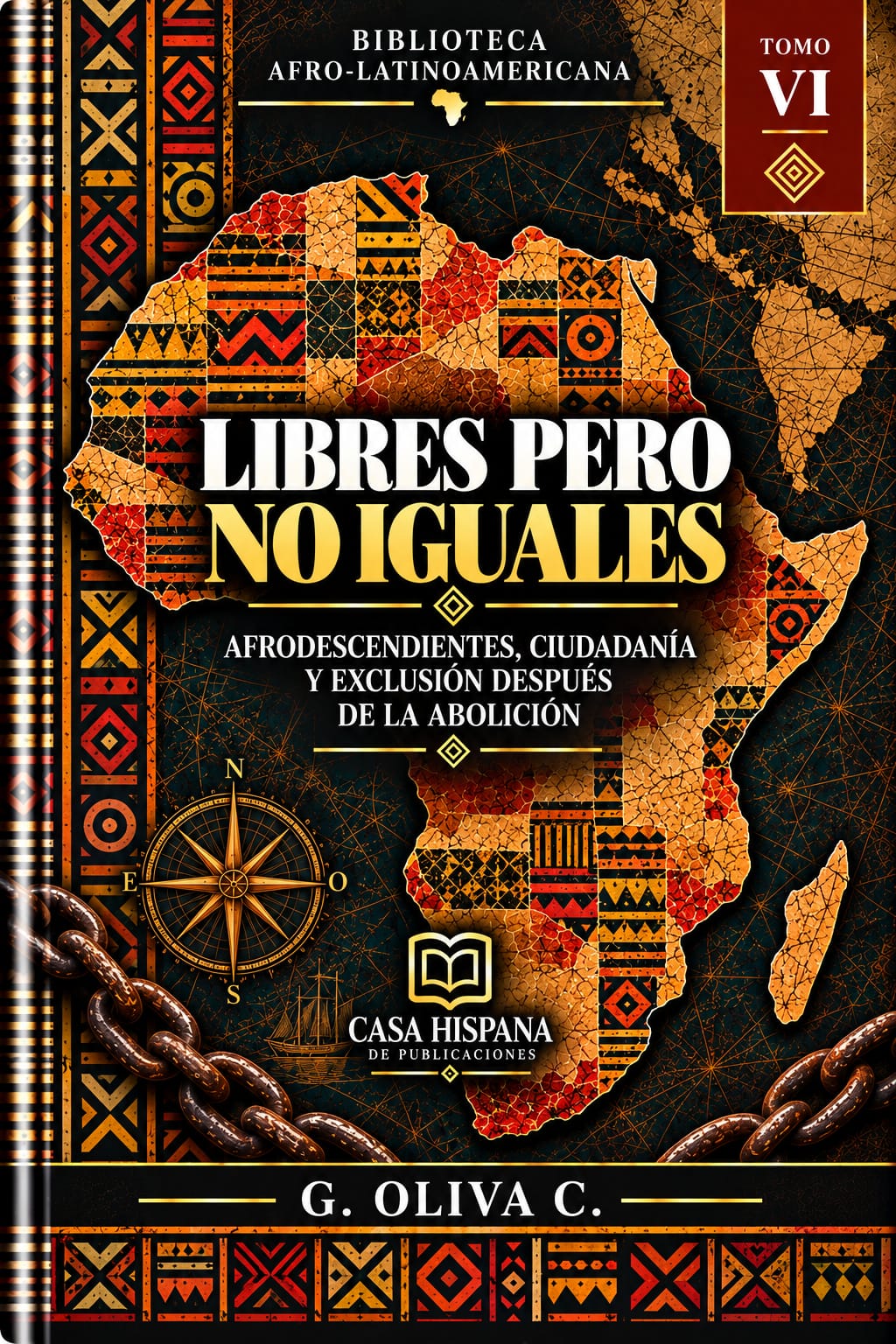
The abolition of slavery represented one of the deepest legal transformations in Latin American history, because it put an end to the legal recognition of one person's ownership of another and opened for millions of Africans and Afro-descendants a formal horizon of freedom that had been denied for generations; but the legal disappearance of slavery did not automatically produce an egalitarian society nor eliminate the economic, social, cultural and racial structures built over centuries, and precisely in this distance between freedom and equality lies one of the fundamental keys to understanding the Afro-descendant experience after abolition, because to be free meant ceasing to be legally property, while to be equal demanded something much broader, such as recognition, citizenship, effective access to rights, opportunities, education, work, land, housing, justice, political participation, social representation and respect for human dignity; and for this reason post-abolition history should not be narrated as a simple continuation of slavery, nor as the complete triumph of emancipation, but as a new historical stage in which old hierarchies were transformed, some disappeared, others remained and others acquired different mechanisms of reproduction within societies that were beginning to proclaim themselves formally free. The expression Free, but not Equal sums up this contradiction. Freedom had been legally won. Equality remained incomplete. This difference is fundamental because it avoids two equally problematic interpretations. The first consists in affirming that nothing changed with abolition because inequalities continued to exist. This would be historically incorrect. The end of human property radically transformed the legal status of millions of people. The second consists in affirming that abolition solved the racial problem because all people were left formally free. This would also be incorrect. The elimination of an institution does not automatically eliminate the social relations, prejudices, distributions of wealth, cultural representations and mechanisms of exclusion developed around it. Abolition was a fundamental rupture, but it took place within societies that had been organised for generations through deep inequalities. The former enslaved person and the former owner could legally become free persons under the new order and yet begin that freedom from radically different material positions. One could keep land, capital, education, property, trade networks, political influence and social recognition, while the other could begin free life without wealth, without land of their own, with limited education and within a society where African ancestry continued to be associated in certain contexts with subordinate positions. This initial inequality does not automatically determine every later trajectory, but it constitutes a historical condition that must be taken into account. Legal freedom changes the rules. It does not automatically redistribute the resources accumulated under the previous rules. There begins one of the great problems of post-abolition. How is citizenship built among formally equal people when their starting points have been historically unequal? This question runs through Afro-Latin American history after the end of slavery. From the perspective developed by the author it is indispensable to understand that citizenship should not be reduced solely to the absence of slavery, because a citizen needs to be recognised as a subject within a political community and to have effective possibilities of exercising rights. Personal freedom, citizenship and equality are related but different concepts. FREEDOM means that no one can legitimately own the person. CITIZENSHIP means recognised belonging to a political community with rights and duties defined by the legal order. EQUALITY means that characteristics such as origin, ancestry or colour should not turn certain citizens into persons of lesser legal or social worth. Abolition advanced decisively on the first dimension. The other two continued to develop through later historical processes. This sequence explains why Afro-descendant history does not end with emancipation. In a certain sense a new stage begins there. The question ceases to be exclusively how to attain freedom and becomes how to exercise it. It is no longer only a matter of escaping human property but of building an autonomous existence within societies that preserved deep hierarchies. The freed person needed work, housing, family, community, recognition, education, security and possibilities for the future. Freedom had to be transformed into life. This transition between legal freedom and social freedom is one of the most important spaces for historical research. The day after abolition a person was legally free but needed to eat. They needed to find work. They needed to decide where to live. They needed to protect their children. They needed to rebuild family relationships that had perhaps been affected by decades of slavery. They needed to learn to relate to institutions that for generations had been organised mainly to control their condition. Freedom did not eliminate these needs. It made them visible from a new perspective. Now the person could negotiate, but their bargaining power could be reduced. They could move, but they needed resources to do so. They could seek education, but they could encounter economic, social or institutional barriers. They could go to court, but effective access to justice also depended on information, resources, representation and institutional practices. They could take part in the economy, but they began without the wealth accumulated by other groups. This difference between formal right and effective capacity is one of the central tensions of post-abolition societies. It does not mean that formal rights are unimportant. On the contrary. Without them the person remains legally subordinate. It means that legal recognition needs institutions and conditions that allow it to be exercised. Equality before the law is a foundation. Social equality requires additional processes. Afro-descendant history after abolition can be understood precisely as a long search aimed at reducing that distance. Work, education, property, community organisation, political participation, cultural production, social movements, anti-discrimination legislation, identity recognition and human rights would progressively form part of this trajectory. However, these dimensions did not advance at the same pace or in the same way in every country. Latin America does not have a single post-abolition experience. Brazil, Cuba, Puerto Rico, Colombia, Venezuela, Peru, Ecuador, Argentina, Uruguay, Chile, Mexico, Central America and the Caribbean present different histories related to abolitionist chronologies, demographic structures, economic models, migration policies, processes of urbanisation and nation-building. For this reason any continental interpretation needs to recognise diversity. The concept of post-abolition is useful as a comparative category, but it must not become a uniform template. The Brazilian abolition of 1888 produced conditions different from those generated by emancipation processes that had taken place decades earlier in other territories. A numerically significant Afro-descendant population within certain regions could develop institutions and strategies different from those existing where the population was smaller or had been statistically rendered invisible. Plantation economies produced trajectories different from more urbanised societies or from regions where enslaved labour had coexisted with multiple labour regimes. Comparative history therefore always needs to ask where, when, who and through which institutions. This precision avoids generalisations. There is no single Latin American post-abolition. There are multiple societies facing a common question. What happens when slavery legally ends, but inequalities built during its existence remain? Work is one of the first spaces where this question took concrete shape. Abolition transformed the legal relationship between worker and former owner. The person could no longer be forced to work because they belonged to another. In principle they could negotiate, offer their labour, change employer, move or seek other forms of subsistence within the available possibilities. This transformation represents a fundamental achievement. But the transition towards free labour was marked by deep tensions, because propertied sectors needed to guarantee productive continuity while freed people sought to broaden their autonomy. These priorities did not always coincide. The owner could want to keep a stable workforce. The free worker could consider precisely that their new freedom consisted in deciding when, where and for whom to work. What to one could look like labour indiscipline could to another constitute the elementary exercise of autonomy. This difference of perspective needs to be considered when reading documents produced by post-abolition elites. Statements about a supposed lack of willingness to work among freed populations may contain prejudices derived from an earlier expectation in which the worker could not freely leave their post. Freedom changes the meaning of work. The former enslaved person ceases to owe labour by legal condition…
Category
- POST-ABOLITION
- AFRO-DESCENDANTS
- AFRO-DESCENDANT CITIZENSHIP
- LEGAL FREEDOM
- LEGAL EQUALITY
- RACIAL INEQUALITY
- SOCIAL EXCLUSION
- RACIAL EXCLUSION
- RACISM
- RACIALISATION
- STRUCTURAL RACISM
- RACIAL DISCRIMINATION
- RACIAL JUSTICE
- SOCIAL JUSTICE
- HUMAN RIGHTS
- CIVIL RIGHTS
- POLITICAL PARTICIPATION
- AFRO-DESCENDANT IDENTITY
- HISTORICAL MEMORY
- AFRO-LATIN AMERICAN HISTORY
Rights for this book
We turn publishing rights into international growth, connecting authors and publishers with new markets, new readers and new partners around the world.
Technical details
- Title
- Libres, pero no iguales
- Author
- G. Oliva C.
- Imprint
- Grupo Editorial casa Hispana
- Size
- 15x23cms
- Edition
- 1st edition, 2026
- Published in
- Chile
- Year of publication
- 2026
- Available languages
- Spanish, English, German, Portuguese
- Binding
- Paperback with flaps
- Pages
- 485