Description
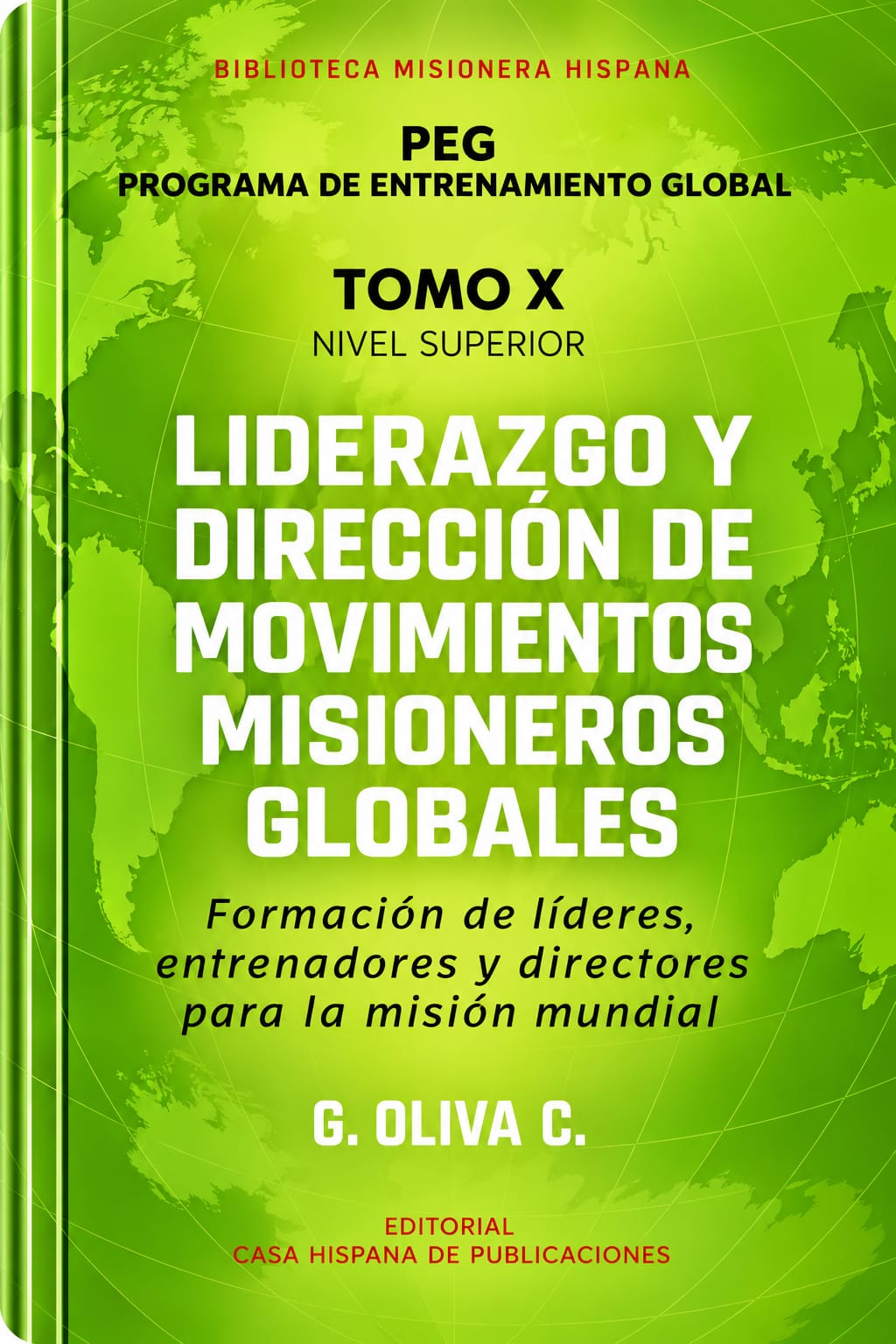
The leadership and direction of global missionary movements are among the most complex and decisive dimensions of contemporary Christian mission, particularly in an international setting marked by profound cultural, social, religious, economic and technological change. The expansion of world mission demands a new generation of leaders able to combine sound biblical and theological formation with strategic, administrative, intercultural and human competences that enable them to guide organisations, build teams, develop international partnerships and accompany processes of community transformation. It is from this perspective that liderazgo y dirección de movimientos misioneros globales: formación de líderes, entrenadores y directores para la misión mundial, by G. Oliva C., is presented: an advanced academic and missiological proposal aimed at examining the foundations, responsibilities and competences required to lead missionary initiatives in national, regional and international contexts. The central argument of this proposal recognises that missionary leadership cannot be reduced to the exercise of institutional authority, the administration of economic resources or the ability to organise evangelistic activities, but is a spiritual, ethical and strategic responsibility bound up with the formation of people, the strengthening of Christian communities and the responsible participation of the church in the mission of God. Directing global missionary movements requires understanding the nature of Christian mission from its biblical foundations, recognising the diversity of church traditions that exist around the world and developing the capacity to build relationships of cooperation that transcend cultural and denominational boundaries. The theological foundation of missionary leadership finds an essential point of reference in the ministry of Jesus Christ, whose teaching and practice present service, humility and self-giving as fundamental characteristics of Christian authority. In Mark 10:42-45, Jesus draws a significant distinction between models of domination and leadership understood as service, providing a guiding principle for the exercise of ministerial responsibilities. Likewise, the Great Commission of Matthew 28:18-20 links the mission of the church with the making of disciples, while Acts 1:8 projects Christian witness towards different peoples and territories. The experience of the early church, especially in Acts 13 and 15, offers precedents for reflecting on communal discernment, missionary sending, cooperation between churches and the resolution of controversies through processes of collective deliberation. The Pauline letters include guidance on the formation of co-workers, the organisation of communities and the responsible handing on of ministerial responsibilities. Second Timothy 2:2 is of particular relevance in setting out a principle of multiplying formation, by which the teachings received are passed on to people capable of forming others. This perspective makes it possible to understand that missionary leadership does not reach maturity through the permanent concentration of responsibilities in a single person, but through the formation of new generations of leaders prepared to take on functions of direction, teaching and accompaniment. From the understanding of the Missio Dei, mission originates in the divine initiative and calls the church to take part in its reconciling purpose. Consequently, missionary movements should not be organised solely around charismatic personalities, institutional interests or expectations of numerical growth, but should rest on clear theological convictions and a responsible understanding of their vocation. The formation of the missionary leader requires developing a ministerial identity characterised by integrity, spiritual maturity, discernment, responsibility and the capacity to serve people from different cultural backgrounds. Christian leadership cannot be separated from the character of the one who exercises it, since strategic decisions, institutional relationships and the accompaniment of teams are profoundly shaped by personal values and practices. Spiritual preparation is therefore an essential dimension of leadership formation. Prayer, Bible study, theological reflection, participation in community life and pastoral accompaniment all help to strengthen a spirituality that recognises both the responsibilities of leadership and its human limits. Ministerial authority needs to be exercised through practices that are transparent, respectful and subject to mechanisms of accountability, avoiding interpretations that present leaders as exempt from evaluation or questioning. One of the most significant challenges of contemporary missionary leadership lies in understanding the difference between personal leadership, organisational leadership and the leadership of movements. Personal leadership concerns the ability to direct one's own conduct, develop responsible habits and sustain coherent commitments. Organisational leadership involves directing teams, administering resources, setting priorities and building institutional structures capable of achieving shared objectives. The leadership of movements, for its part, demands an understanding of processes of cooperation, mobilisation and multiplication that may unfold across various organisations without depending on a single central authority. This last dimension requires particular skills in coordination, negotiation and communication, together with respect for the autonomy of participants. Global missionary movements tend to bring together churches, sending agencies, training centres, Christian humanitarian organisations and cooperation networks with different identities, structures and traditions. Responsible leadership needs to promote agreement on purposes, ethical principles, responsibilities and mechanisms of coordination, without confusing cooperation with institutional subordination. Strategic planning is another fundamental competence for those who hold leadership positions. Contemporary world mission requires analysing international scenarios, identifying needs, understanding demographic change and setting priorities grounded in verifiable information. Planning must incorporate sociocultural research, territorial studies, religious analysis, the assessment of resources and the recognition of local actors. These tools make it possible to develop realistic projects and to reduce the risks that arise from improvisation. Missionary strategy, however, should not be understood as a rigid procedure or as a system that automatically guarantees particular spiritual outcomes. Human, cultural and community processes present levels of complexity that demand flexibility, learning and the capacity to adapt. The direction of missionary movements needs to combine a long-term vision with mechanisms of periodic evaluation that make it possible to review decisions and change practices when circumstances so require. Organisational management is an indispensable component of this advanced formation. Mission directors need to understand the principles of institutional administration, the development of operational structures, the coordination of human resources, financial planning and the management of international projects. A clear definition of roles, the distribution of responsibilities and the establishment of transparent procedures help to strengthen the sustainability of organisations. Likewise, governance processes must include mechanisms of oversight, the prevention of conflicts of interest and the responsible participation of governing bodies. Institutional authority needs to be distinguished from personal ownership of resources or the individual appropriation of collective projects. A healthy missionary organisation requires structures capable of ensuring its continuity beyond its founders and first leaders. The formation of trainers and educators is an especially important dimension. The development of sustainable missionary movements depends on the existence of people equipped to prepare new workers, accompany learning processes and pass on theological, intercultural and ministerial knowledge. Training the trainers needs to integrate pedagogy, curriculum design, competence assessment, participatory methodologies and individual accompaniment. Trainers must understand that missionary training does not consist solely in transmitting information, but in facilitating learning processes that enable the development of knowledge, skills, attitudes and criteria for discernment. Training programmes require defined objectives, relevant content, practical activities and assessment mechanisms that take account of the real needs of participants. Missionary education must also recognise the diversity of prior experience, academic level and cultural background among students. The use of flexible methodologies, digital resources and collaborative learning strategies can help to widen access to specialised formation. Educational quality, however, demands accompaniment, feedback and rigorous assessment, so that ministerial preparation is not reduced to the accumulation of certificates or attendance at short activities. The formation of mission directors also requires the development of advanced intercultural competences. Leading international teams involves relating to people who have different languages, communication styles, institutional expectations and conceptions of authority. These differences can generate tensions when there are no adequate tools for dialogue and mediation. Cultural anthropology, intercultural communication and the analysis of power relations provide fundamental resources for understanding such situations. Responsible intercultural leadership needs to recognise that its own organisational practices are culturally conditioned and that administrative models developed in one society are not always appropriate in others. International cooperation requires sensitivity in adapting procedures, distributing responsibilities and recognising the capacities of local teams. The formation of locally rooted leadership is a strategic and ethical priority, since the sustainability of Christian communities depends on their capacity to develop their own leaders and to take an active part in the decisions that affect their future. Missionary movements should not reproduce permanent relationships of dependence between funding institutions and receiving communities. On the contrary, they need to foster processes of autonomy, co-responsibility and the progressive transfer of capacities. This orientation is especially important in contexts historically marked by colonialism, economic inequality and asymmetrical power relations. Latin American missiological reflection offers valuable perspectives for critically examining traditional forms of leadership, recognising cultural diversity and promoting more equitable institutional relationships. Work with Indigenous peoples, Afro-descendant communities, migrant populations and other culturally distinct groups requires respect for their identities, collective rights and forms of organisation. Missionary leadership must not use religious authority to impose processes of cultural assimilation or to make access to social services conditional on the acceptance of beliefs. Religious freedom, freedom of conscience and human dignity are fundamental principles of responsible missionary practice. The direction of global movements also needs to grasp the importance of inter-institutional cooperation. Partnerships between churches, training centres, mission agencies and international networks make it possible to share resources, develop joint programmes and strengthen the capacity to respond to complex challenges. These relationships must rest on transparent agreements that set out objectives, responsibilities, financial procedures and mechanisms for resolving disputes. International cooperation requires a distinction between strategic collaboration and the concentration of power, ensuring that participating organisations retain their identity and their capacity to make decisions. The formation of missionary networks can foster the flow of knowledge and experience between different regions of the world, especially when reciprocal relationships are promoted between churches of the North and of the Global South. Contemporary mission can no longer be understood solely through one-directional schemes in which certain countries send resources and personnel to other territories regarded as recipients. The growth and diversification of world Christianity have strengthened the participation of Latin American, African and Asian churches in international initiatives, opening up new possibilities for multidirectional cooperation. This transformation demands leaders capable of recognising different centres of missionary initiative and of building relationships based on mutual learning. Another essential component is the responsible mobilisation of economic resources. Directing international organisations requires knowledge of budgeting, financial sustainability, fund management, internal control and accountability. Resources allocated to mission must be used in accordance with previously established objectives and through verifiable procedures. Transparency is a concrete expression of institutional integrity and helps to strengthen the trust of communities, co-workers and partner organisations. Financial planning also needs to take into account risks relating to economic fluctuations, operating costs, international transfers and changes in funding conditions. The responsible diversification of sources of support and the building of contingency reserves can help to improve the continuity of projects. Financial sustainability, however, should not become a criterion that subordinates the dignity of people to the needs of institutional growth. The management of human talent is another leadership responsibility. Missionary movements require appropriate systems for the selection, training, accompaniment and evaluation of co-workers. The allocation of roles must take into account competence, experience, personal maturity and conditions of well-being. The holistic care of teams is an institutional obligation that includes the prevention of burnout, pastoral support, emotional accompaniment, the protection of vulnerable people and protocols for responding to situations of abuse or conflict. Responsible leadership needs to promote safe organisational environments in which there are reliable mechanisms for raising difficulties and reporting inappropriate conduct without fear of reprisal. Spiritual authority must not be used to justify coercive practices, labour exploitation or demands that unjustifiably compromise the health of co-workers. Conflict-resolution processes require impartiality, documentation and respect for the rights of the people involved. International leadership likewise needs to incorporate risk-assessment and security procedures that take into account the political, legal, health and social conditions of the territories in which activities are carried out. Contingency planning, compliance with applicable laws and the protection of information are responsibilities that must be taken on rigorously. In contexts of conflict or religious restriction, strategic decisions need to give priority to the safety of people and avoid actions that needlessly expose local communities. Digital technologies are important tools for the formation and coordination of global movements. Educational platforms, international communication systems and collaborative management tools make it possible to connect teams located in different regions, share materials and organise training programmes. Contemporary mission leadership needs to develop digital literacy, criteria for information security and the competence to evaluate the usefulness of new technologies. Artificial intelligence and other automation tools can support tasks of organisation, translation, document analysis and educational design, provided that their use is accompanied by human oversight, data protection and critical evaluation of their results. Technological innovation does not replace pastoral responsibility or the need to build personal relationships of trust. Another fundamental challenge is the evaluation of missionary movements. Monitoring systems must consider the achievement of objectives, the quality of formative processes, the development of local leadership, the sustainability of initiatives and the participation of communities. Quantitative indicators can help to identify trends and manage resources, but they are insufficient when used as the sole measure of the value of a ministerial activity. Qualitative evaluation makes it possible to examine dimensions relating to community maturity, cultural relevance, the quality of relationships and ethical responsibility. Leaders need to promote institutional cultures of learning that acknowledge mistakes, review procedures and favour continuous improvement. The capacity to correct decisions is a strength of leadership and not a sign of weakness. Succession planning is likewise an essential dimension for the continuity of global movements. Organisations that depend excessively on a central figure may face significant difficulties when changes of leadership occur. For this reason, the formation of new leaders, the documentation of processes and the progressive distribution of responsibilities must be built into institutional strategy. Mentoring, accompaniment and the transfer of knowledge make it possible to prepare leaders capable of taking on senior roles with integrity and competence. Succession needs to be carried out through transparent procedures and evaluation mechanisms that give priority to the suitability of candidates over personal relationships or private interests. The formation of trainers, coordinators and directors therefore represents a strategic investment in the sustainability of world mission. From an academic perspective, liderazgo y dirección de movimientos misioneros globales stands at the convergence of missiology, practical theology, ecclesiology, ministerial education, organisational leadership, strategic management and intercultural studies. Its thematic orientation makes it possible to examine the relationships between spiritual authority, institutional management, the formation of people and international cooperation. As the tenth volume of the Hispanic Missionary Library, part of the Global Missionary Training Programme, it represents the culmination of a formative journey that begins with the biblical foundations of evangelisation and advances progressively through the formation of the evangelist, personal and community evangelisation, discipleship, the mobilisation of the local church, evangelisation in a second culture, church planting, the preparation and sending of cross-cultural missionaries and the strategic planning of world missions. This final level widens the horizon of training towards the leadership of movements, the training of trainers and the direction of international organisations. Its relevance lies in recognising that the continuity and quality of missionary processes depend, to a great extent, on the preparation of people capable of exercising senior responsibilities without losing the sense of service that characterises the Christian vocation. Leadership formation needs to integrate theological knowledge, strategic thinking, administrative skills, emotional maturity and intercultural sensitivity. Global leadership demands the ability to understand complex scenarios, set responsible priorities and build agreements between diverse organisations, but it also requires recognising the limits of institutional power and promoting the participation of those who have historically remained on the margins of decision-making. In short, liderazgo y dirección de movimientos misioneros globales: formación de líderes, entrenadores y directores para la misión mundial, by G. Oliva C., stands as an academic and ministerial proposal intended for pastors, trainers, directors of mission agencies, international coordinators, heads of theological institutions, leaders of Christian networks and advanced students interested in the strategic leadership of world mission. Its approach stresses that the true significance of missionary leadership does not lie solely in the size of the organisations directed, the geographical reach of their programmes or the number of people mobilised, but in the capacity to form new leaders, strengthen autonomous communities, administer resources responsibly and develop relationships of cooperation grounded in integrity and respect. The direction of global missionary movements is a responsibility that demands vision, preparation, discernment and an abiding commitment to the well-being of people. A church committed to world mission needs leaders capable of understanding the complexity of the international scene and of guiding their initiatives by biblical principles, ethical responsibility and intercultural cooperation. In this way, the formation of leaders, trainers and directors is understood as a process of multiplying capacities that makes it possible to strengthen the continuity of Christian mission, promote the development of contextualised communities and contribute to a more responsible, collaborative and sustainable participation of the church in the contemporary world…
Category
- RELIGION AND SPIRITUALITY
- CHRISTIANITY
- THEOLOGY
- PRACTICAL THEOLOGY
- MISSIOLOGY
- MISSIONARY LEADERSHIP
- LEADERSHIP OF MISSION ORGANISATIONS
- TRAINING OF LEADERS AND TRAINERS
- INTERNATIONAL STRATEGIC MANAGEMENT
- GLOBAL MISSIONARY MOVEMENTS
Rights for this book
We turn publishing rights into international growth, connecting authors and publishers with new markets, new readers and new partners around the world.
Technical details
- Title
- Liderazgo y dirección de movimientos misioneros globales
- Author
- G. Oliva C.
- Imprint
- Grupo Editorial casa Hispana
- Size
- 15x23cms
- Edition
- 1st edition, 2026
- Published in
- Chile
- Year of publication
- 2026
- Available languages
- Spanish, English, German, Portuguese
- Binding
- Paperback with flaps
- Pages
- 475