Description
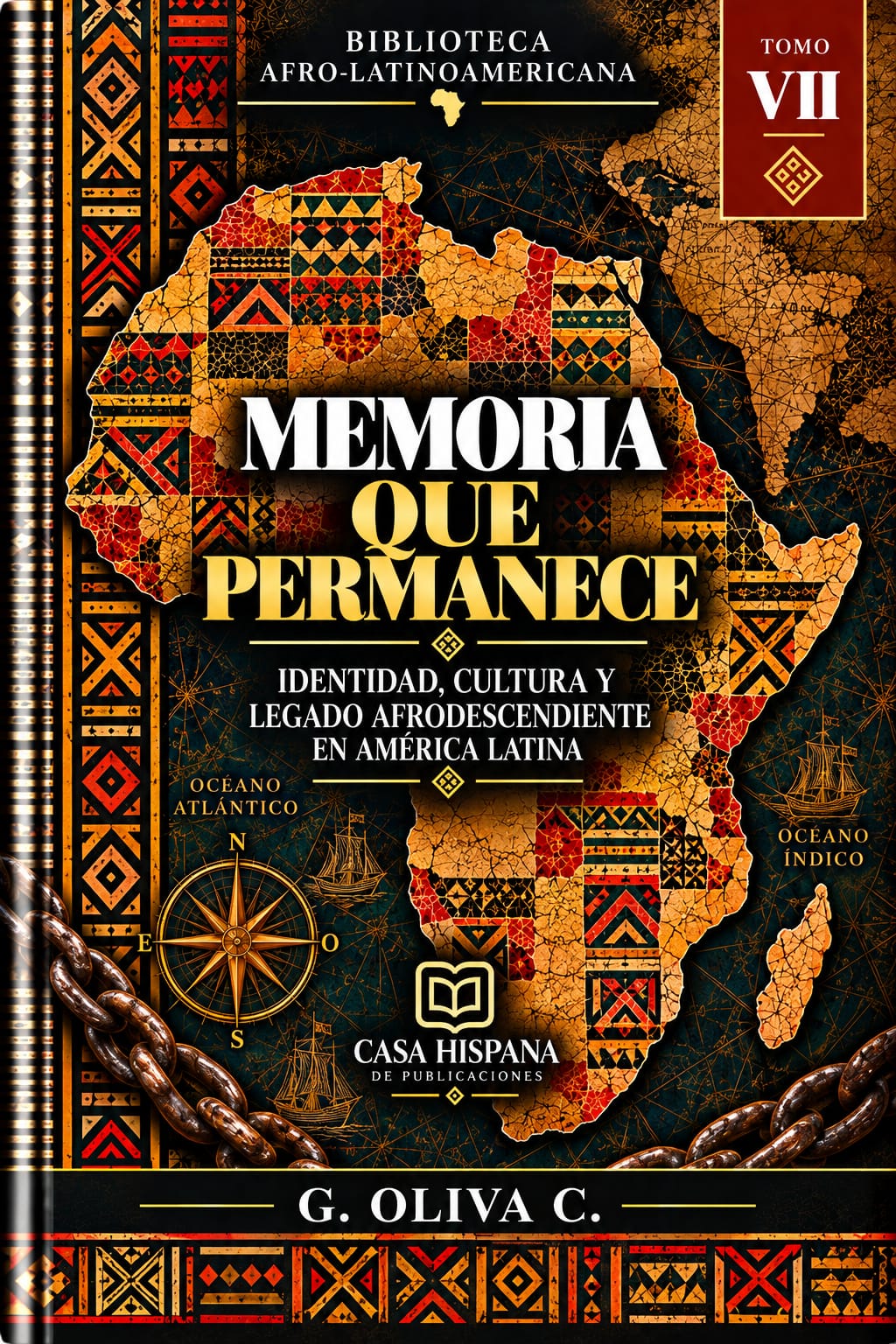
Afro-descendant memory in Latin America is a fundamental dimension for understanding the historical, cultural and social formation of the continent. To speak of memory that remains means recognising that the African and Afro-descendant presence does not belong only to the colonial past, nor can it be reduced to the experience of slavery. It is a living memory, passed on between generations, transformed by historical circumstances and expressed in languages, music, religiosities, cuisines, community practices, knowledge, forms of organisation, artistic expressions and multiple ways of understanding life. The history of Latin American Afro-descendant peoples begins long before their forced arrival in the Americas. The women, men and children transported from different African regions came from diverse societies with their own languages, political systems, religious traditions, agricultural knowledge, technologies, family structures, artistic expressions and collective memories. Africa was never a homogeneous cultural reality. For this reason, it is historically incorrect to speak of a single African culture transferred intact to the Americas. The processes that gave rise to Afro-Latin American cultures were complex and were marked simultaneously by rupture, continuity, adaptation, resistance and creation. The expansion of the transatlantic trade produced one of the largest forced displacements of population in modern history. Millions of Africans were uprooted from their communities and moved to different American territories. The violence of this process sought to transform people into merchandise and labour, but the legal condition imposed by slavery never exhausted the whole of their identities. Before being enslaved, those people had names, families, knowledge, beliefs, trades, languages and memories. Recognising this reality is a fundamental principle for historically reconstructing the Afro-descendant experience. The enslaved condition was imposed; human identity existed before the chain and survived it. During the colonial period, the African presence became deeply incorporated into the economic and social formation of Latin America. Enslaved people took part in agricultural, mining, port, domestic, craft, commercial and urban activities. Their labour contributed to the production of wealth and to the daily functioning of numerous colonial societies. However, limiting their history to labour would mean reproducing an incomplete view. African populations and their descendants also formed families, built communities, developed networks of solidarity, practised religions, preserved and transformed knowledge, organised mechanisms of resistance and took an active part in the creation of new societies. Resistance took diverse forms. There were open rebellions, escapes, marronage, quilombos, palenques and other autonomous communities, but also everyday strategies of survival, negotiation, family preservation and cultural continuity. To resist did not always mean confronting the system militarily. In certain circumstances, keeping a name, protecting one's children, maintaining a religious practice, passing on a song, preparing a traditional food or rebuilding community ties could represent a significant way of preserving humanity in the face of structures designed to fragment it. Memory - Resistance - Identity - Community - Transmission are, for this reason, inseparable dimensions of this history. Nor can the Afro-descendant identity that developed in Latin America be understood as an exact reproduction of African societies before the diaspora. Forced displacement produced encounters between people from different African peoples, indigenous populations, Europeans and other groups. Within those relationships, frequently deeply unequal, new cultural expressions arose. The African heritage remained, but it was also transformed. Heritage does not mean immobility; identity does not mean purity; culture is not a museum piece. A tradition remains precisely because communities can reinterpret it and pass it on within new historical circumstances. Music is one of the spaces where this memory achieved an extraordinary capacity for permanence. Rhythms, instruments, musical structures, bodily expressions and community forms of celebration linked to African matrices took part in the development of numerous Latin American musical expressions. Something similar happened with dance, orality, festivities, religious practices and certain culinary traditions. However, historical rigour requires avoiding the automatic assertion that every Latin American cultural manifestation with similar characteristics necessarily has an African origin. Responsible research must distinguish between documented influence, cultural convergence, historical reinterpretation and popular claims that require further evidence. To translate a memory into heritage requires researching it, contextualising it and recognising the communities that have passed it on. Religion represents another essential dimension of this continuity. Spiritual experiences originating in Africa went through processes of transformation, interaction and adaptation in the Americas. In different territories religious expressions linked to African matrices arose, which dialogued, coexisted or combined in diverse ways with Christian traditions and other local practices. These expressions cannot be adequately interpreted through simplifying categories. They are complex historical processes in which memory, identity, resistance, spirituality and community interact. The legal abolition of slavery during the nineteenth century and, in some territories, earlier, opened a new stage, but it did not mean the immediate disappearance of the inequalities accumulated over centuries. Legal Freedom Did Not Automatically Mean Social Equality. Afro-descendant populations entered post-abolition societies facing very different circumstances according to each country, region and historical period. In some places economic, educational, territorial and social barriers persisted; in others there were processes of mobility, integration, community organisation and growing participation. For this reason, Afro-descendant history after abolition should not be narrated exclusively from exclusion either. Doing so would produce a new form of invisibility, because it would turn millions of people solely into victims of social structures and would once again erase their historical capacity to act, decide, organise, create and transform. The Afro-descendant is not only someone upon whom history acts; they are also someone who acts within it. During the nineteenth and twentieth centuries, Afro-descendant populations took part in the construction of Latin American republican societies from multiple spheres. They worked, studied, organised associations, produced thought, developed artistic expressions, took part in social movements, progressively entered educational institutions, professions, universities, religious organisations, companies, public services and political spaces. These processes were uneven and did not follow an identical trajectory in every country. Brazil, Colombia, Venezuela, Ecuador, Peru, Cuba, the Dominican Republic, Panama, Uruguay, Argentina, Mexico, the Central American nations and other territories have particular Afro-descendant histories. Recognising a shared continental experience does not authorise erasing national, regional and community differences. For a long time, part of the construction of Latin American national identities tended to favour certain narratives over others. In some contexts, the Afro-descendant presence was recognised mainly as folklore, music, dance or cuisine, while its historical, intellectual, economic and political participation received less attention. This difference is fundamental. A culture can be celebrated and, at the same time, its protagonists can remain insufficiently recognised. Turning Afro-descendant heritage solely into cultural spectacle can also impoverish its meaning. Music matters, dance matters, cuisine matters and festivities matter, but so do archives, genealogies, community organisations, intellectuals, educators, women, workers, entrepreneurs, researchers and the new generations that continue to build identity. Historical memory then acquires a decisive function. To remember does not mean remaining trapped in the past. It means understanding how certain processes contributed to shaping the present and which elements of that past deserve to be known, preserved, discussed or transformed. Memory is not a prison; memory is knowledge of the road travelled. When a society knows its history it can better understand both its wounds and its capacities for creation and renewal. Afro-descendant memory must therefore include slavery and freedom, violence and resistance, exclusion and citizenship, uprooting and reconstruction, discrimination and mobility, tradition and innovation. Reducing it exclusively to suffering would be as incomplete as ignoring suffering and speaking only of cultural contributions. A mature memory needs to hold both dimensions without confusing them. In the twenty-first century, this memory faces new challenges. Globalisation, migrations, social media, urban transformation, cultural industries and digital technologies change the ways in which identities are built and passed on. New generations can access archives, photographs, research, genealogies and testimonies that were previously hard to find. At the same time, technologies can simplify complex histories, reproduce stereotypes or spread claims without sufficient documentary foundation…
Category
- AFRO-DESCENDANTS
- AFRO-DESCENDANT MEMORY
- AFRO-DESCENDANT IDENTITY
- AFRO-LATIN AMERICAN CULTURE
- AFRICAN LEGACY
- AFRICAN LEGACY
- AFRICAN DIASPORA
- HISTORICAL MEMORY
- SLAVERY IN LATIN AMERICA
- BLACK RESISTANCE
- POST-ABOLITION
- CITIZENSHIP
- HUMAN DIGNITY
- SOCIAL JUSTICE
- RACIAL JUSTICE
- CULTURAL HERITAGE
- AFRICAN ANCESTRY
- CULTURAL TRANSMISSION
- COLLECTIVE MEMORY
- AFRO-LATIN AMERICAN HISTORY
Rights for this book
We turn publishing rights into international growth, connecting authors and publishers with new markets, new readers and new partners around the world.
Technical details
- Title
- Memoria que permanece
- Author
- G. Oliva C.
- Imprint
- Grupo Editorial casa Hispana
- Size
- 15x23cms
- Edition
- 1st edition, 2026
- Published in
- Chile
- Year of publication
- 2026
- Available languages
- Spanish, English, German, Portuguese
- Binding
- Paperback with flaps
- Pages
- 475