
Description
To speak of memory, reparation and future in relation to the Afro-descendant peoples of Latin America requires beginning with a fundamental affirmation: no society can fully understand its present if it carefully selects what it wishes to remember and condemns to silence the experiences that prove uncomfortable for its national narrative. Historical memory does not consist only in preserving ancient events or accumulating documents in archives; it is a way through which societies interpret their trajectory, recognise those who took part in it, identify the consequences of certain decisions and pass on to future generations an understanding of what happened. In the case of the African and Afro-descendant populations of Latin America this task acquires a particular depth, because millions of people were displaced through the transatlantic trade, subjected to slave systems, separated from territories and families, coercively incorporated into colonial economies and later obliged to build their freedom within societies that did not immediately eliminate all the inequalities produced or consolidated over centuries. However, to begin this reflection from slavery does not mean affirming that African history began with the chains. The first volumes of this collection have insisted precisely on the contrary. Before the ship there was community. Before the plantation there was territory. Before racial classification there were peoples, languages, knowledge, religions, economies, institutions and memories. Before the enslaved person there was the person. And even during slavery the person never ceased to be a person. The system could legally turn human beings into property within certain historical legal orders, but it could never morally turn humanity into merchandise. This distinction is the foundation from which the historical debt must be approached. Slavery could deny freedom; it could not annul dignity. It could impose a price; it could not determine human worth. It could try to erase names; it could not completely erase memory. This conviction makes it possible to understand that reparation does not begin by granting dignity to those who supposedly lacked it. It begins by recognising that this dignity always existed and that it was certain institutions, practices and structures that refused to respect it. From the perspective developed by the author, this difference is decisive because it avoids building a paternalistic narrative in which contemporary societies appear to grant humanity to the descendants of those who were enslaved. No one grants humanity. No one grants fundamental dignity. Institutions can recognise rights, restore goods, correct narratives, repair damage, preserve memory and change practices, but they act before people whose dignity precedes any institutional decision. Dignity precedes reparation. Truth precedes reconciliation. Memory precedes a responsible future. These three affirmations offer an initial architecture for understanding the purpose of this volume. Memory asks what happened. Reparation asks what responsibilities can be identified and what responses are possible. The future asks what we will learn from what happened and what structures we wish to pass on to the next generations. The three dimensions need one another. Memory without horizon can turn into permanent contemplation of suffering. Reparation without investigation can become a symbolic response disconnected from concrete damage. Future without memory can silently repeat what it seeks to overcome. For this reason the challenge consists in building a responsible relationship between past - responsibility - transformation - future. The expression "historical debt" also needs to be used with precision. It can function as an ethical category to describe the accumulated consequences of historical injustices whose effects, memories or institutional responsibilities continue to be relevant, but it should not automatically become an individual financial debt biologically transmitted from one generation to another. Contemporary people are not morally guilty simply because of the ancestry of their forebears. Personal guilt is not inherited racially. This principle must be affirmed clearly, because any project of justice that turns ancestry into culpability would end up reproducing precisely the logic it seeks to overcome: judging people by origin. Historical responsibility does not mean hereditary racial guilt. Memory does not mean generational condemnation. Reparation does not mean revenge. Justice does not mean inverting hierarchies. The historical debt must be analysed by identifying actors, institutions, assets, decisions, continuities, obligations and documentable damage. There can be institutional responsibility without personal culpability on the part of all the current members of a society. A State can recognise that certain historical laws were unjust without declaring all its contemporary citizens guilty. A university can investigate historical links with slave systems without attributing moral guilt to its current students. A church can review the conduct of certain authorities or institutions of the past without affirming that every contemporary believer shares personal responsibility for those decisions. A company, archive, museum, municipality or institution can investigate its history and adopt measures of recognition where sufficient evidence exists. This distinction between personal guilt and institutional responsibility is essential for building a memory capable of producing justice without manufacturing new identities of hereditary culprits and victims. Mature memory individualises responsibility when the evidence allows it and recognises structures where appropriate, but it resists transforming entire racial categories into collective and immutable moral subjects. Racism did precisely that: it replaced the person with the category. A reparation consistent with human rights should not repeat that procedure. The future needs a different ethics: persons, not racial essences; responsibilities, not biological guilt; evidence, not assumptions; justice, not revenge. This methodology makes it possible to enter one of the most complex terrains of contemporary discussion: what it means to repair an injustice whose original events may have occurred generations ago. The answer cannot be reduced to a universal formula, because the historical damage was different, the responsible institutions were different, the legal orders changed and the Afro-descendant populations of Latin America have profoundly diverse trajectories. Reparation may be legal, patrimonial, territorial, educational, cultural, institutional, symbolic or economic according to the problem identified and the applicable framework. None of these dimensions should be assumed automatically. First it must be investigated. What happened? Who produced the damage? Who suffered it? Which institution was involved? What continuity can be demonstrated? What consequence persists? What response is proportionate? Who has the competence to adopt it? How will its result be evaluated? These questions turn a broad moral expression such as "historical reparation" into a researchable programme. Without them, reparation runs the risk of becoming a word capable of meaning everything and therefore of explaining little. The research developed by the author seeks to maintain precisely this discipline. A historical injustice deserves to be studied with the same rigour with which any other phenomenon is studied. The moral gravity of an event does not reduce the need for evidence. It increases it. When we speak of destroyed lives, separated families, appropriated labour, displacements, discrimination and exclusion, precision is a form of respect. We do not need to exaggerate slavery to show that it was unjust. We do not need to invent genealogies to recognise uprooting. We do not need to attribute every contemporary inequality directly to the slave period to understand that certain historical processes may have produced intergenerational consequences. Documented truth is powerful enough. This conviction should run through every page of the volume. Responsible memory differentiates fact - context - mechanism - consequence - interpretation. The fact establishes what the sources allow us to affirm. The context explains the conditions within which it occurred. The mechanism identifies how it produced certain consequences. The consequence shows observable effects. The interpretation connects evidence within a historical explanation. Confusing these levels can turn hypotheses into facts. For example, showing that an institution owned enslaved people is a fact if adequate documents exist. Determining how that wealth contributed to its later development requires additional research. Affirming that its entire contemporary situation derives from that wealth would be a much broader hypothesis that would need to demonstrate mechanisms of continuity. In the same way, documenting that an Afro-descendant community today has a lower average income than another population does not automatically show that the difference is a direct consequence of slavery. There may be a historical connection, but it must be reconstructed through intermediate variables: property, education, territory, discrimination, labour market, migration, public policies, social networks, family composition, regional development and other factors. Memory needs responsible causality. The past explains part of the present. Not every present is a copy of the past. This affirmation avoids determinism and also makes it possible to recognise the enormous transformations that took place after abolition. Afro-descendant populations did not remain motionless waiting for history to act upon them. They built families, neighbourhoods, communities, churches, associations, trade unions, companies, movements, universities, artistic expressions, political projects, intellectual networks and forms of citizenship. They migrated. They studied. They litigated. They produced knowledge. They created heritage. They organised resistance. They took part in national economies. They transformed cities. Memory that only records what was done against Afro-descendant people continues to grant excessive prominence to those who exercised domination. A complete memory also needs to narrate what Afro-descendant people did with the circumstances they encountered. This has been a transversal thesis of the Afro-Latin American Library: Afro-descendant history is never only what others did to Black people; it is also what Black people did with history. This affirmation acquires special force when speaking of the future. A population cannot be permanently defined by what it suffered. Suffering forms part of its memory, but it does not exhaust its identity. Slavery is part of Afro-descendant history. It does not constitute the whole of Afro-descendant history. Racism is part of certain Afro-descendant experiences. It does not constitute the essence of Afro-descendance. Discrimination may condition trajectories. It does not define capacity. Poverty may affect communities. It is not a racial attribute. The future demands breaking these associations. Black is not synonymous with enslaved. Afro-descendant is not synonymous with poor. Identity is not synonymous with victimisation. Memory is not synonymous with permanent trauma. This conceptual rupture is indispensable for building a reparation that does not end up freezing precisely the images it wishes to overcome. A policy of memory can produce recognition or it can produce pigeonholing. If every museum shows Afro-descendants only in chains, memory ends up reproducing a limited image. If school books mention Africa only when the trade begins, the student implicitly learns that African history began when Europe violently incorporated it into the Atlantic system. If rights campaigns show…
Category
- HISTORICAL MEMORY
- HISTORICAL REPARATION
- AFRO-DESCENDANTS
- HISTORICAL DEBT
- REPARATIVE JUSTICE
- SOCIAL JUSTICE
- RACIAL JUSTICE
- HUMAN RIGHTS
- LEGACY OF SLAVERY
- AFRICAN DIASPORA
- STRUCTURAL RACISM
- RACIAL DISCRIMINATION
- HUMAN DIGNITY
- HISTORICAL RECOGNITION
- AFRO-DESCENDANT MEMORY
- COLLECTIVE RIGHTS
- RECONCILIATION
- HISTORICAL RESPONSIBILITY
- AFRO-DESCENDANT HERITAGE
- AFRO-LATIN AMERICAN HISTORY
Rights for this book
We turn publishing rights into international growth, connecting authors and publishers with new markets, new readers and new partners around the world.
Technical details
- Title
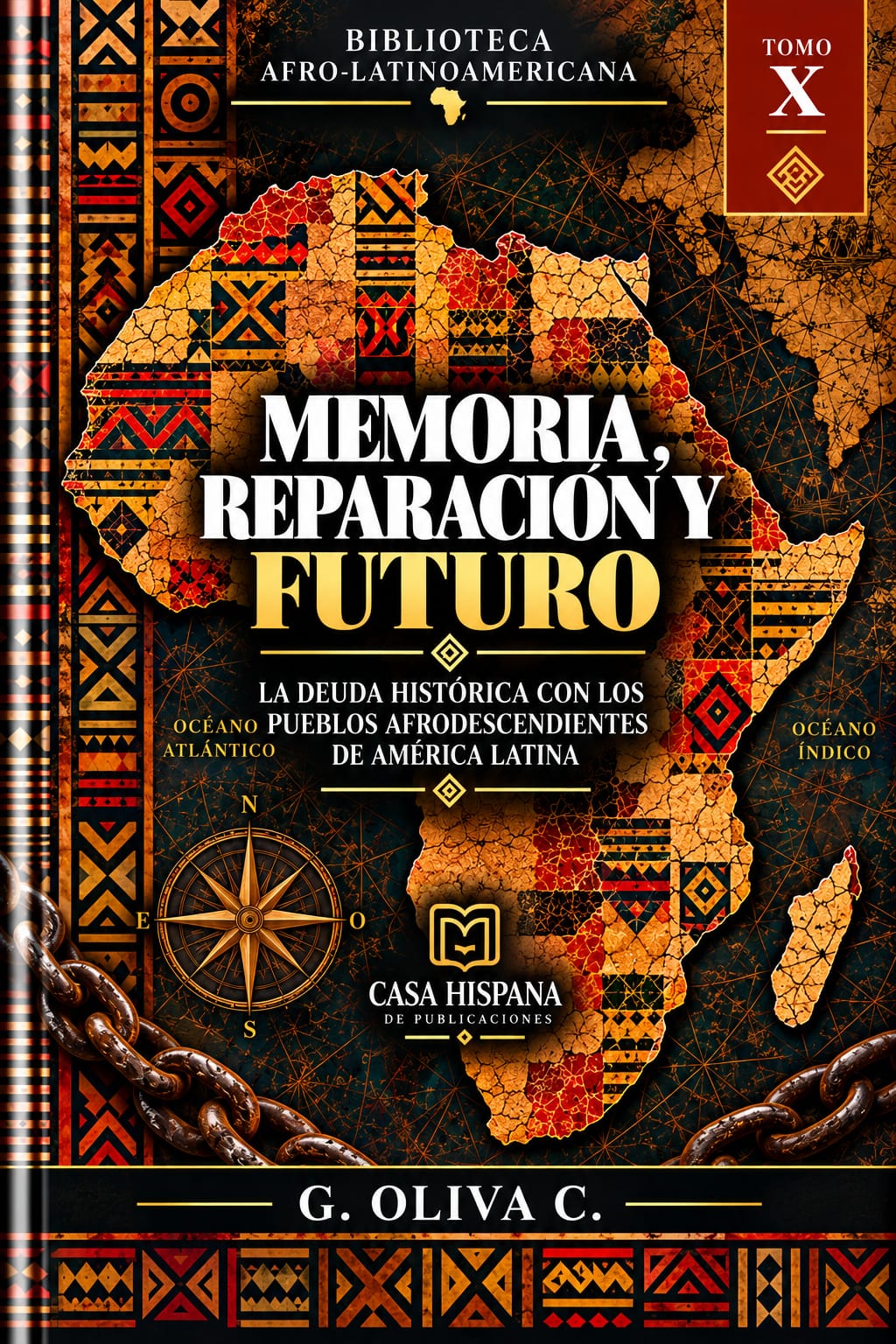
- Memoria, reparación y futuro
- Author
- G. Oliva C.
- Imprint
- Grupo Editorial casa Hispana
- Size
- 15x23cms
- Edition
- 1st edition, 2026
- Published in
- Chile
- Year of publication
- 2026
- Available languages
- Spanish, English, German, Portuguese
- Binding
- Paperback with flaps
- Pages
- 535