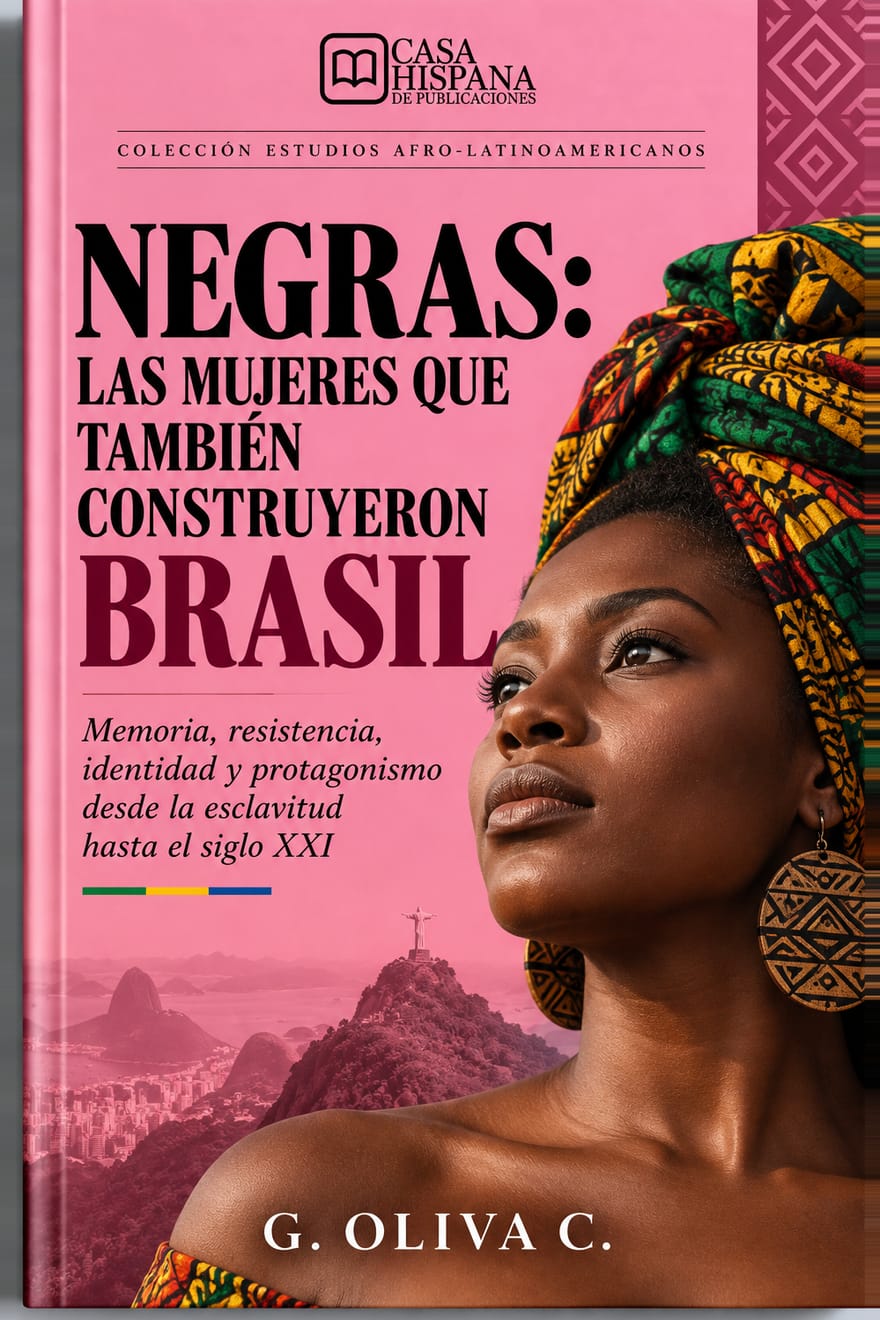
Description
The history of Brazil cannot be rigorously explained without recognising the decisive presence of Black women in its economic, social, family, cultural and religious formation. To say that they "also built Brazil" is not a merely vindicatory expression, but a historiographical proposition that obliges us to broaden the field from which the construction of Brazilian society is observed. For centuries, enslaved African women and their descendants worked in rural and urban spaces, sustained domestic and commercial activities, took part in economic networks, formed families and communities, passed on knowledge and developed different strategies of resistance, negotiation and survival. After abolition they continued to take an active part in the labour market, family organisation, religious life, culture, education and social movements, until reaching during the twentieth and twenty-first centuries a growing presence in universities, professions, the arts, companies, institutions and public spaces. However, this trajectory should not be written as a simple linear succession from oppression to emancipation. It is crossed by permanences, ruptures, contradictions, achievements and inequalities. Memory - Resistance - Identity - Protagonism therefore constitute four complementary dimensions for interpreting a history that begins long before abolition and remains open in the present. The starting point requires a fundamental precision: the women forcibly transported from Africa to Brazil did not arrive devoid of history. They came from diverse societies, spoke different languages and were bearers of knowledge, family experiences, productive practices, religious memories and ways of understanding the world. The general category "African woman" may be useful for certain analyses, but it must never hide this diversity. Africa was not a homogeneous cultural reality, and the African population transported to Brazil came from different regions and societies over several centuries. For this reason, studying Black women during slavery requires avoiding two equally problematic reductions: turning them solely into passive victims or romanticising their capacity for resistance to the point of minimising the violence of the slave system. The enslaved person was subjected to a legal and economic condition of domination; that condition, however, never exhausted the whole of her human identity. Enslaved women carried out diverse activities according to period, region and economic context. They were present on plantations, haciendas, in domestic spaces, markets, streets, selling activities, food production and numerous forms of urban work. In Brazilian cities, certain enslaved and freed women took an active part in small-scale trade circuits. Some worked as sellers and providers of services, while others developed economic strategies that could contribute to family maintenance and, in certain cases, to processes of manumission. But these possibilities should not be interpreted as evidence of the benignity of the regime. Capacity for action and domination could coexist. A woman could negotiate spaces within a structure that continued to deny her fundamental freedom. Precisely there lies one of the methodological keys of this work: recognising agency without denying oppression and recognising oppression without erasing agency. Nor did resistance take a single form. Not all resistance consisted in open rebellion or escape. There were flights, participation in autonomous communities, negotiation, lawsuits, preservation of ties, accumulation of resources, the search for freedom, the maintenance and recreation of cultural practices, family protection and multiple everyday strategies. Each modality must be studied within its documentary context and not automatically placed under a heroic category. To resist could mean to confront, but also to survive, preserve relationships, negotiate conditions or build possibilities within extremely restricted margins. Historical memory needs to recover these experiences without inventing what the archives do not allow us to affirm. Documentary silence does not authorise historical fiction. When the evidence is insufficient, rigour also consists in saying: we do not know. The family dimension is equally important. Slavery intervened violently in kinship relations through sales, displacements and legal subordination, but enslaved people developed family and community ties within those conditions. Women had important roles in the formation and continuity of those ties, although it would be incorrect to make them solely responsible for cultural or family preservation. Motherhood under slavery was crossed by a radical contradiction: creating and protecting life within an order that could turn offspring into property. Studying this experience requires sensitivity without sentimentality and precision without dehumanisation. Behind inventories, purchase records, notarial documents and statistics there were people. Name - Family - Body - Work - Memory - Dignity must remain present even when the historical documentation was produced by institutions that classified them mainly as labour or assets. The abolition of slavery in 1888 constituted a fundamental legal rupture: it legally ended the ownership of human beings in Brazil. However, abolition did not mean the automatic distribution of wealth, education, housing, stable employment or social equality. Legal freedom is not an automatic synonym of material equality. This distinction is essential for understanding the experience of Black women during post-abolition. Many continued to be inserted into low-paid activities, particularly in domestic work, services, informal trade and urban occupations. But once again it is necessary to avoid a single narrative. Black women also took part in associations, religious spaces, community organisations, economic activities and educational processes, and progressively broadened their presence in different professions. The history after 1888 must be written not only by asking what opportunities were denied to them, but also what spaces they built, what strategies they developed and how they intervened in Brazilian society. Domestic work occupies a particularly significant place because it makes it possible to observe historical continuities between race, gender and class. However, establishing continuity does not mean affirming absolute identity between slavery and later domestic work. A free labour relationship, even when it is unequal or precarious, is not legally equivalent to slavery. Historical rigour needs to distinguish categories in order to understand inequalities better. Slavery - Free Labour - Informality - Precariousness - Professionalisation represent different situations that can be historically related, but must not be confused. Identity constitutes another fundamental dimension. The Black Brazilian experience developed through complex processes of memory, adaptation, encounter and creation. Religiosity, music, orality, food, aesthetics, community forms and knowledge associated with different African traditions were preserved, reinterpreted and transformed within the Brazilian context. Not every Afro-Brazilian cultural practice can be linearly attributed to a single African origin, and not every Black woman necessarily maintains the same relationship with ancestry, religion or tradition. Heritage does not mean purity. Identity does not mean immobility. Culture is not a museum piece. Black women took part precisely in this dynamic production of culture, passing on and recreating knowledge while responding to new contexts. In this sense, their cultural protagonism consists not only in preserving the past, but also in producing the present. The twentieth century gradually broadened other spaces of participation. Urban transformations, educational expansion, industrialisation, legislative changes, social movements and new professional opportunities changed the conditions in which Brazilian women took part in society. Black women progressively entered new educational, cultural, professional and political spheres, although this process occurred unevenly. To understand it adequately, race and gender must also be related to class, education, territory and generation. Race - gender - class - education - territory - generation form a more rigorous analytical architecture than any monocausal explanation. A statistical difference between groups requires research into concrete mechanisms; it must not automatically become proof of a single cause. At the same time, causal complexity must not be used to deny discrimination when historical or empirical evidence demonstrates it. Rigour does not mean denying inequalities. It means explaining them with evidence. In recent decades, the presence of Black women in universities, intellectual production, literature, the arts, communication, professions, enterprises, social organisations and public institutions has helped to significantly change their social representation. This process introduces a decisive transformation: the Black woman progressively ceases to appear only as an object of research and also becomes researcher, author, teacher, professional, creator and producer of knowledge about Brazil and about herself. However, it would be incorrect to interpret this protagonism as a uniform experience. Black women hold different political, religious, economic and intellectual positions. They do not constitute an ideological bloc. Recognising collective identity does not authorise denying individuality. A truly plural society must allow a Black woman to speak about racism if she so decides, but also about science, business, literature, family, technology, theology, art or any other sphere without being permanently obliged to represent a racial category. There a higher dimension of protagonism appears: the right not to be reduced to a symbol. This perspective is especially relevant for new generations. Historical education about Black women needs to teach slavery, racism and inequality, but it cannot end there. If an Afro-Brazilian girl finds people like her only in chapters related to slavery, poverty or discrimination, education itself may reproduce an incomplete representation. It is also necessary to show writers, teachers, researchers, artists, entrepreneurs, workers, professionals, community leaders and ordinary women who took part in the daily construction of the country. The chain belongs to history. It cannot become the only symbol of the Black woman. Memory means remembering what happened; identity means understanding belongings without turning them into a prison; resistance means recognising the capacity for action in the face of adverse conditions; protagonism means taking part in the construction of the present and having the capacity to imagine the future. Memory without protagonism can imprison the person in the past. Protagonism without memory can ignore the paths that made the present possible. Both dimensions need to dialogue. From a human rights perspective, the horizon does not consist in inverting old racial hierarchies, but in preventing race or gender from arbitrarily determining a person's worth and possibilities. It is not a matter of changing who occupies the top and who remains at the bottom according to colour; it is a matter of rejecting that colour should determine who may be above or below. Human dignity precedes any social classification. This affirmation makes it possible to recognise the specific experiences of Black women without turning human differences into new hierarchies. Black Women: the women who also built Brazil therefore proposes to reconstruct a broader history of the country from the presence of women whose participation was often insufficiently recognised. It is not a matter of artificially incorporating them into a history already written, but of recognising that they were within it from the beginning. They were in the work that sustained economies, in the families that rebuilt ties, in the markets that fed cities, in the traditions that passed on memory, in the communities that generated solidarity, in the movements that demanded rights and in the contemporary institutions where they produce knowledge and future. The trajectory that leads from slavery to the twenty-first century is not simply the passage from victims to protagonists, because even under domination there was agency; nor is it a linear history from exclusion to equality, because advances and inequalities can coexist. It is a trajectory of Persons - Memory - Resistance - Freedom - Citizenship - Identity - Participation - Protagonism. Black women did not begin to build Brazil when they were recognised. They were building it long before history learned to name them as protagonists. To recognise them does not mean granting them a place in history; it means reconstructing history with the rigour needed to show the place they always occupied…
Category
- BLACK WOMEN
- AFRO-BRAZILIAN WOMEN
- AFRO-DESCENDANTS
- AFRO-BRAZILIAN HISTORY
- BRAZILIAN SOCIAL HISTORY
- WOMEN'S HISTORY
- SLAVERY IN BRAZIL
- POST-ABOLITION
- AFRICAN DIASPORA
- HISTORICAL MEMORY
- BLACK RESISTANCE
- AFRO-BRAZILIAN IDENTITY
- FEMALE PROTAGONISM
- HISTORICAL AGENCY
- RACE AND GENDER
- RACIAL INEQUALITY
- AFRO-BRAZILIAN CULTURE
- CITIZENSHIP
- SOCIAL JUSTICE
- HUMAN RIGHTS
Rights for this book
We turn publishing rights into international growth, connecting authors and publishers with new markets, new readers and new partners around the world.
Technical details
- Title
- Negras: las mujeres que también construyeron Brasil
- Author
- G. Oliva C.
- Imprint
- Grupo Editorial casa Hispana
- Size
- 15x23cms
- Edition
- 1st edition 2022
- Published in
- Chile
- Year of publication
- 2023
- Available languages
- Spanish, English, German, Portuguese
- Binding
- Paperback with flaps
- Pages
- 574