Description
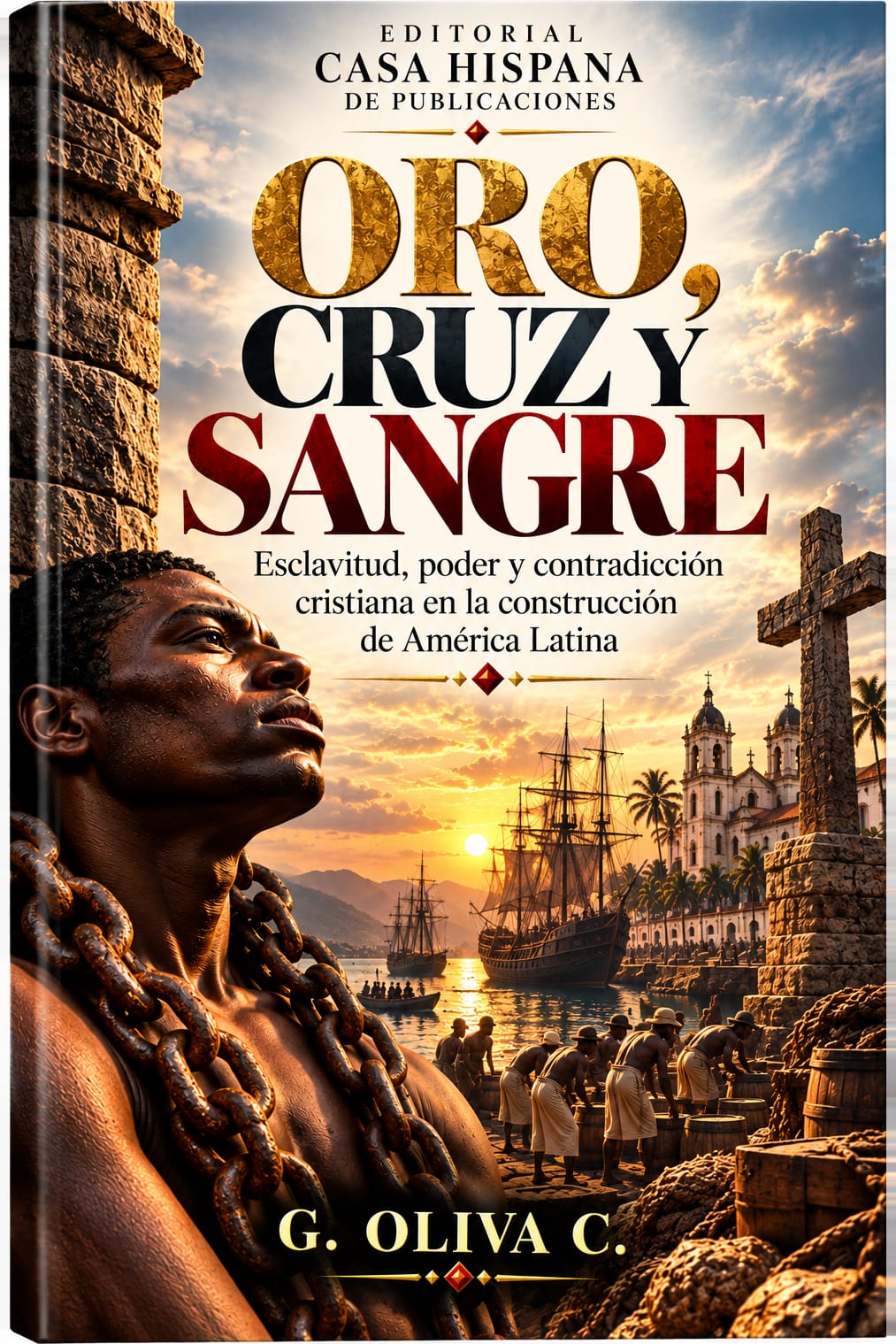
Oro, Cruz y Sangre: Esclavitud, poder y contradicción cristiana en la construcción de América Latina offers a historical, social and theological reading of the deep contradictions that accompanied the formation of the Latin American colonial world. Starting from three images of extraordinary symbolic force—gold, the cross and blood—the work examines the interaction between economic interests, structures of domination, colonial expansion, evangelisation, slavery and resistance, paying particular attention to the tension between the proclamation of the Christian message and certain historical practices carried on in societies that publicly identified themselves as Christian. The title sums up the book's conceptual architecture. Gold represents the pursuit of wealth, the appropriation of resources, trade and the economic interests that accompanied colonial expansion. The cross represents the presence of Christianity, evangelisation, religious institutions and the theological language used within that society. Blood, finally, recalls the human cost of an order built through conquest, exploitation, enslavement, displacement and many forms of violence. Gold – Cross – Blood. Economy – Religion – Power. Wealth – Evangelisation – Suffering. These dimensions cannot be treated as wholly independent realities. One of the work's central concerns is precisely to study their encounters, tensions and contradictions without reducing historical complexity to a monocausal explanation. The book begins by placing the European expansion towards the Americas within the profound political, commercial and religious transformations of the fifteenth and sixteenth centuries. The European arrival on the continent opened a process of conquest and territorial reorganisation that would radically transform the societies of the Americas. Territories, natural resources and populations were progressively incorporated into new political and economic systems. The search for precious metals acquired extraordinary significance within this expansion. Gold and silver were not merely objects of individual fascination: they formed part of international economic circuits, fiscal structures, commercial systems and imperial strategies. The wealth extracted from the Americas fed an economic transformation of transatlantic proportions. But behind the figures, trade routes and centres of production there were people. The fundamental question running through Oro, Cruz y Sangre is precisely this: what was the human cost of building colonial wealth? The answer leads necessarily to different systems of labour exploitation, coercion and enslavement. Indigenous populations experienced conquest, displacement, territorial reorganisation, disease and various forms of compulsory labour, depending on region and period. In parallel, the transatlantic trade progressively brought millions of enslaved Africans into the economies of the Americas. The author seeks to maintain a historically necessary distinction between the Indigenous and the African experiences. Both were subjected to severe forms of domination, but they should not be confused or described as identical processes. Their legal status, historical trajectories, mechanisms of exploitation and strategies of resistance differed in important ways. Precisely for that reason, the concept of power is one of the work's great analytical axes. Colonial power did not operate exclusively through military force. It needed institutions, legislation, economic structures, social classifications, mechanisms of property and discourses capable of lending legitimacy to the new order. To understand the colony therefore means studying how different forms of power could reinforce one another. Gold acquires a broader significance here. It does not represent merely a metal. It symbolises the transformation of territories, resources and human labour into wealth that can be accumulated. It represents the capacity of economic interest to organise social relations and establish hierarchies. However, the book avoids a purely economic interpretation of conquest and colonisation. The historical actors had multiple and, at times, contradictory motivations. Economic interests, political ambitions, religious convictions, the pursuit of prestige, imperial strategies and personal aspirations could coexist. This complexity is especially important when analysing the work's second great symbol: the cross. Colonial expansion was accompanied by processes of evangelisation. Missionaries, priests, religious orders and ecclesial institutions took part in different ways in the societies of the Americas. The history of this presence cannot responsibly be reduced to a single moral category. There was proximity between ecclesiastical structures and colonial powers, there were religious discourses used to legitimise particular social orders, and there were Christian actors who took part in or benefited from deeply unequal structures. But there were also Christian voices that denounced abuses, defended the humanity of subjugated populations and questioned practices of exploitation. History, therefore, demands that distinctions be drawn. The cross was preached in the midst of a society in which sword, chain and exploitation also existed. That historical proximity is one of the great contradictions that Latin American theology must examine. The work does not seek to judge Christianity indiscriminately on the basis of historical events, nor to absolve religious institutions by means of apologetic explanations. It seeks something more demanding: to confront certain historical practices with the central affirmations of the Christian faith itself. If every human being possesses dignity before God, how could their conversion into merchandise become normal? If Jesus Christ taught love of neighbour, how could Christians take part in structures of exploitation? If the Gospel proclaims freedom, reconciliation and dignity, how could its proclamation coexist with societies organised around profound inequalities? These questions are the theological heart of Oro, Cruz y Sangre. For the author, the contradiction does not necessarily lie in the Gospel itself, but in the distance that can exist between the Gospel proclaimed and the Gospel practised. This distinction is fundamental. The history of Christianity shows that a society can use Christian language without all its structures necessarily answering to the principles it claims to profess. Religion can become an element that legitimises power when it loses its prophetic capacity to confront it. Hence one of the work's central theses: when the cross is subordinated to power, it runs the risk of ceasing to confront what the Gospel ought to transform. The reflection becomes especially intense when it turns to African slavery. The transatlantic trade turned human beings into merchandise within an international commercial system. Men, women and children were forcibly displaced, separated from their communities and subjected to regimes of coerced labour in different regions of the Americas. The work insists, however, on an indispensable conceptual precision: those people were not naturally “slaves”. They were enslaved. The linguistic difference has historical and ethical importance. “Enslaved” makes it possible to remember that slavery was a condition imposed through human structures of power. Slavery was an imposed condition; the person's humanity existed before the chain. This perspective restores a leading role to those who frequently appear in the sources only as labour, merchandise or property. The third symbol of the title—blood—then acquires its full depth. It represents violence, suffering and death, but it also recalls that economic history has concrete bodies. Behind every productive system there were people who worked, suffered, resisted, formed families, preserved memories and sought spaces of freedom. However, Oro, Cruz y Sangre does not construct a history centred exclusively on victims. One of its aims is to recover the historical agency of Indigenous, African and Afro-descendant peoples. Where there was domination there were also negotiation, adaptation, flight, rebellion, community organisation, cultural preservation and resistance. Resistance took many forms. In Indigenous communities it could be expressed through territorial defence, rebellions, political negotiation, linguistic preservation, cultural continuity and community reorganisation. Among African and Afro-descendant populations it showed itself in escapes, marronage, quilombos, palenques, rebellions, legal strategies, family networks, cultural preservation and transformation, and different everyday mechanisms for seeking autonomy…
Category
- LATIN AMERICAN HISTORY
- SLAVERY
- COLONIAL CHRISTIANITY
- CHURCH AND POWER
- SOCIAL HISTORY
- HISTORICAL MEMORY
- RELIGION
Rights for this book
We turn publishing rights into international growth, connecting authors and publishers with new markets, new readers and new partners around the world.
Technical details
- Title
- Oro, cruz y sangre
- Author
- G. Oliva C.
- Imprint
- Grupo Editorial casa Hispana
- Size
- 15x23cms
- Edition
- 1st edition, 2025
- Published in
- Chile
- Year of publication
- 2025
- Available languages
- Spanish, English, German, Portuguese
- Binding
- Paperback with flaps
- Pages
- 497