Description
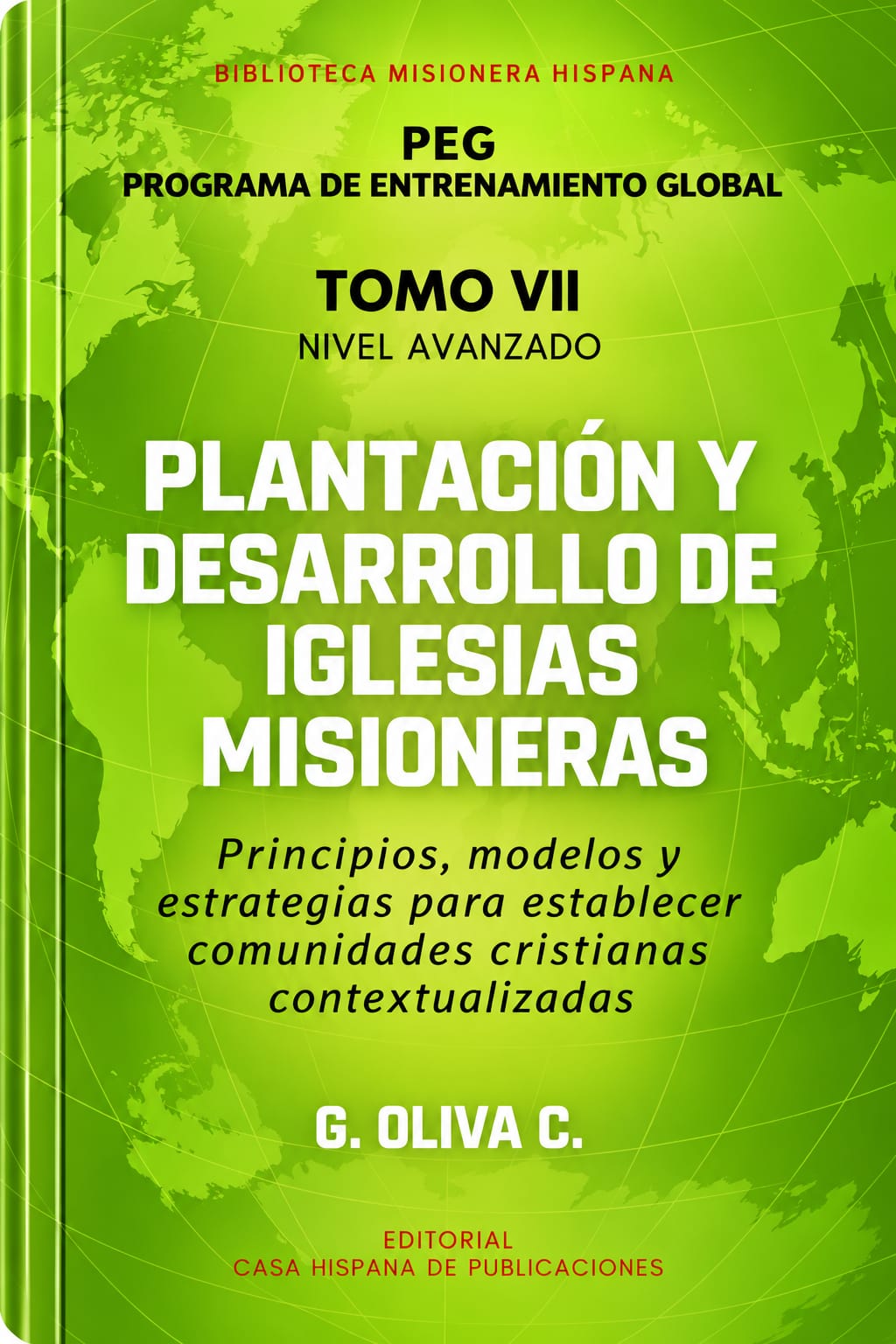
The planting and development of missional churches are fundamental dimensions of the historical expansion of Christianity and of the participation of Christian communities in the mission of God. From its origins, the church has carried out processes of forming, organising and multiplying communities of faith in diverse geographical, cultural and social contexts, seeking to communicate the gospel of Jesus Christ and to establish communal spaces devoted to biblical teaching, discipleship, worship and service. It is within this horizon that plantación y desarrollo de iglesias misionales: principios, modelos y estrategias para establecer comunidades cristianas contextualizadas, by G. Oliva C., is situated: an academic, theological and missiological proposal aimed at examining the foundations, methodologies and challenges involved in establishing new Christian communities. The work addresses a central question for contemporary missiology: how to develop churches that do not merely reproduce existing religious structures, but express an identity deeply bound up with Christian mission, with the cultural reality of their members and with the needs of the societies in which they are established. From this perspective, planting a church does not mean simply opening a place of worship, organising religious meetings or setting up a new ecclesiastical institution, but accompanying the emergence of a community of disciples capable of developing spiritual relationships, exercising shared responsibilities and taking an active part in the mission of God. The biblical foundation of church planting finds significant points of reference in the New Testament, especially in the Great Commission of Matthew 28:18-20, in the witness of the early church presented in the book of Acts and in the missionary activity of the apostle Paul. These accounts make it possible to recognise that the spread of Christianity was linked to the proclamation of the gospel, the making of disciples, the establishment of communities and the preparation of local leaders. The missionary experiences described in Acts 13 and 14 show processes of sending, preaching, accompaniment and community organisation that serve as relevant points of reference for missiological reflection. Likewise, the Pauline letters make it possible to examine the doctrinal, ethical, pastoral and organisational challenges faced by the first Christian congregations. From a theological perspective, church planting must be understood within the framework of the Missio Dei, recognising that mission originates in God and that Christian communities take part in it through their witness and service. This understanding makes it possible to move beyond purely institutional interpretations of church expansion and places the development of new congregations within a broader spiritual and communal responsibility. One of the fundamental pillars of the proposal is the missional identity of the church. A missional community is not defined solely by the existence of evangelistic programmes, but by the integration of mission into its spirituality, organisation, leadership and social relationships. The proclamation of the gospel, the making of disciples, fellowship and service to one's neighbour are complementary expressions of this identity. For this reason, church planting requires a theological vision capable of relating biblical faithfulness to cultural relevance and social responsibility. Establishing new Christian communities also demands rigorous processes of research and territorial assessment. Before undertaking a church-planting initiative, it is necessary to understand the demographic, economic, religious and cultural characteristics of the context. Knowledge of local history, family structures, community organisations, migration dynamics and social needs makes it possible to design more relevant strategies and to avoid interventions disconnected from reality. Missionary research must consider both quantitative data and qualitative approaches, including observation, interviews, community dialogue and sociocultural analysis. These tools make it possible to identify opportunities, recognise challenges and establish relationships of trust with the inhabitants of the territory. Contextualisation is another decisive dimension in the development of missional churches. Christian communities do not emerge in culturally neutral spaces, but in societies characterised by particular languages, traditions, worldviews and forms of organisation. For this reason, church models need to recognise cultural differences and avoid the mechanical reproduction of structures originating in other countries or historical contexts. Ecclesiological contextualisation seeks to develop forms of community capable of communicating and living out the gospel in an understandable and meaningful way, while maintaining a responsible relationship with biblical teaching. This process demands distinguishing between the central principles of the Christian faith and the cultural customs that have historically accompanied particular forms of religious organisation. In Latin America, this reflection takes on particular relevance given the diversity of Indigenous peoples, Afro-descendant communities, rural populations, urban sectors and migrant groups. Planting churches in these settings requires intercultural sensitivity, recognition of collective identities and respect for the historical experiences of communities. Christian mission must not become a mechanism of cultural imposition, nor disregard the rights, languages or traditions of peoples. On the contrary, it needs to promote relationships characterised by human dignity, freedom of conscience and respectful dialogue. Forming contextualised communities also means recognising the capacity of local believers to interpret the Scriptures, develop leadership and organise their congregational life in accordance with their circumstances. Another central aspect is the study of church-planting models. Over the course of Christian history, different strategies have been developed for establishing communities, including pioneering initiatives, projects launched by existing congregations, networks of house churches, communities linked to missionary movements and processes of congregational multiplication. Each model presents possibilities and limitations that must be weighed according to cultural conditions, available resources and the characteristics of the population. There is no universal methodology that guarantees equivalent results in every territory. For this reason, the choice of strategies requires theological discernment, contextual analysis and the capacity to adapt. Planning a new Christian community must set clear objectives, identify responsibilities, prepare teams and define mechanisms of accompaniment that make it possible to sustain the process of congregational formation. The preparation of church-planting teams is an important condition for the quality of these initiatives. Those who take part in such projects need to develop biblical, pastoral, communicative, administrative and intercultural competences. Doctrinal knowledge must be complemented by the ability to listen, build relationships, resolve conflicts and work collaboratively. Likewise, the spiritual and ethical formation of team members is fundamental for preventing authoritarian practices, leadership conflicts and relationships of dependence. Christian leadership is grounded in the model of service presented by Jesus Christ, whose teaching invites us to understand authority as a responsibility directed towards the well-being of the community. From this perspective, church-planting teams must promote the participation of their members, transparency in decision-making and the progressive preparation of new leaders. The formation of local leaders is one of the most important factors in the sustainability of an emerging church. A community that depends indefinitely on the direction, resources or presence of outside agents faces greater difficulties in developing institutional autonomy and ministerial continuity. For this reason, planting processes need to incorporate, from their earliest stages, mechanisms of training, mentoring and the responsible handing over of functions. The development of locally rooted leadership makes it possible to strengthen the cultural identity of the community, improve its capacity to respond to local challenges and encourage wider participation among its members. This orientation also helps to move beyond paternalistic models of mission in which fundamental decisions remain concentrated outside the community context. Discipleship is another essential component of church planting and congregational development. The establishment of a church cannot be assessed solely by the number of people attending its meetings, but also by the existence of formative processes that foster spiritual maturity and the responsible participation of believers. Biblical teaching, prayer, pastoral accompaniment, small groups and the formation of new leaders help to consolidate communities capable of sustaining their spiritual and ministerial life. The multiplication of disciples must be understood as a qualitative and relational process, avoiding the reduction of Christian formation to mechanisms of numerical expansion. A missional church needs to develop a culture of continuous learning in which its members can deepen their knowledge, recognise their abilities and take an active part in serving the community. Institutional organisation also plays a significant role. Although the early stages of a church plant may be characterised by simple structures and informal relationships, the growth of the community demands appropriate mechanisms of coordination, administration and responsibility. The definition of ministerial roles, the transparent management of resources, financial planning and accountability all help to strengthen trust within the community. Institutionalisation, however, must develop progressively and in proportion to the real needs of the congregation, so that administrative complexity does not displace spiritual and pastoral objectives. Economic sustainability is a particular challenge, especially in communities with limited resources or in contexts of social vulnerability. Financial strategies must be grounded in transparency, voluntary participation and the responsible use of resources, without resorting to mechanisms of religious pressure. Congregational development also demands consideration of the relationship between church and society. A missional community should not confine its presence to its own meetings, but should build meaningful ties with the territory in which it is located. Community service, hospitality, solidarity and participation in initiatives for the common good can give concrete expression to Christian witness. From the perspective of integral mission, the proclamation of the gospel and social responsibility are not necessarily opposing activities, but expressions that can complement one another within a broad understanding of the mission of the church. Social action, however, must respect people's freedom and avoid making material assistance in any way conditional on religious participation. Church planting also faces challenges relating to doctrinal diversity, community conflicts, the formation of institutional identity and relationships with other congregations. Inter-church cooperation can help to strengthen these processes through the exchange of experience, joint training and the accompaniment of emerging communities. Missionary networks and alliances between churches can provide teaching resources, pastoral support and training opportunities, provided that the relationships established are transparent and respectful of local autonomy. In today's world, technological change and new forms of social interaction also influence the establishment of Christian communities. Digital platforms make it possible to develop spaces for communication, teaching and accompaniment, especially among geographically dispersed populations. Virtual tools, however, must be integrated into strategies that recognise the importance of human relationships, community participation and pastoral responsibility. The evaluation of planting processes is a necessary tool for recognising progress, identifying difficulties and improving the strategies implemented. Indicators relating to attendance, participation, leadership formation, financial sustainability and ministerial continuity can provide useful information, but they need to be complemented by qualitative criteria concerning community maturity, cultural relevance, the quality of relationships and ethical responsibility. The multiplication of churches must be understood as a possible consequence of healthy communities committed to their mission, and not as an institutional demand detached from their real capacities. From an academic standpoint, plantación y desarrollo de iglesias misionales stands at the convergence of missiology, ecclesiology, practical theology, missionary anthropology, Christian leadership and strategic ministry planning. Its thematic proposal makes it possible to bring together the biblical foundations of mission and methodologies of research, organisation and community development. As the seventh volume of the Hispanic Missionary Library, part of the Global Missionary Training Programme, it represents an advanced stage of formation aimed at preparing believers, leaders and ministry teams for the responsible establishment of new Christian communities. Its relevance lies in recognising that church planting requires much more than evangelistic enthusiasm or organisational ability, since it involves theological preparation, cultural understanding, human formation and a commitment to sustainable processes of discipleship. The missional church must be understood as a community in constant relationship with its surroundings, capable of learning from social reality, communicating its faith and developing contextualised expressions of Christian life. In short, plantación y desarrollo de iglesias misionales: principios, modelos y estrategias para establecer comunidades cristianas contextualizadas, by G. Oliva C., stands as a proposal for academic and ministerial formation addressed to pastors, missionaries, church planters, theology students, congregational leaders and organisations committed to the responsible expansion of Christian mission. Its approach stresses that establishing a Christian community is not simply a matter of reproducing an institutional structure, but of accompanying the emergence of a church with a biblical identity, local leadership, spiritual maturity, intercultural sensitivity and a capacity for service. The true consolidation of a missional community is expressed in its capacity to make disciples, develop healthy relationships, take on shared responsibilities and participate meaningfully in the life of society. In this way, the planting and development of churches are understood as theological, human and communal processes that require discernment, planning, accompaniment and faithfulness to the mission of God…
Category
- RELIGION AND SPIRITUALITY
- CHRISTIANITY
- THEOLOGY
- PRACTICAL THEOLOGY
- MISSIOLOGY
- MISSIONAL ECCLESIOLOGY
- CHURCH PLANTING
- DEVELOPMENT OF MISSIONAL CHURCHES
- ECCLESIOLOGICAL CONTEXTUALISATION
- MULTIPLICATION OF CHRISTIAN COMMUNITIES
Rights for this book
We turn publishing rights into international growth, connecting authors and publishers with new markets, new readers and new partners around the world.
Technical details
- Title
- Plantación y desarrollo de iglesias misioneras
- Author
- G. Oliva C.
- Imprint
- Grupo Editorial casa Hispana
- Size
- 15x23cms
- Edition
- 1st edition, 2026
- Published in
- Chile
- Year of publication
- 2026
- Available languages
- Spanish, English, German, Portuguese
- Binding
- Paperback with flaps
- Pages
- 471