Description
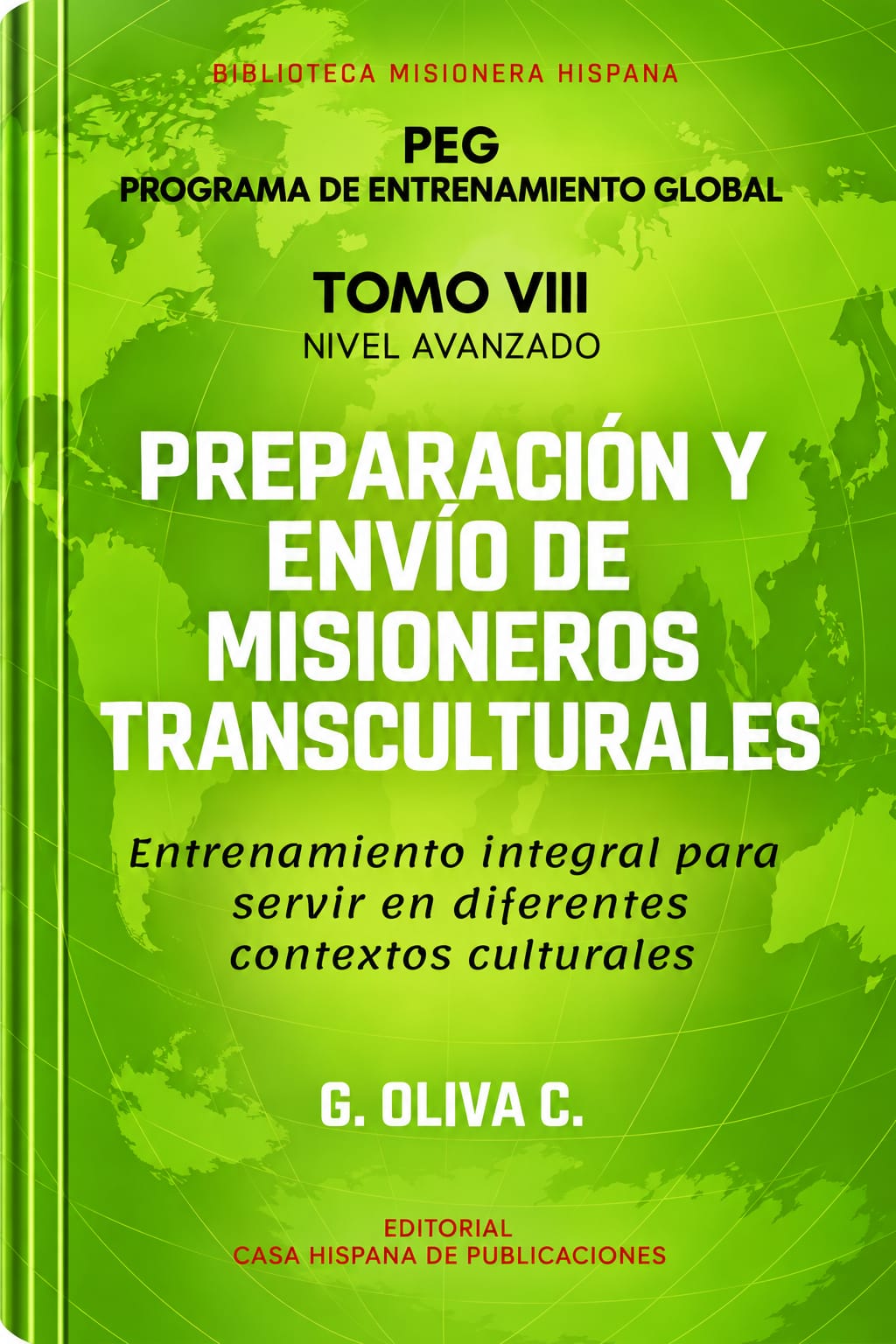
Cross-cultural Christian mission is one of the most complex, demanding and significant expressions of the Church's commitment to the mandate of Jesus Christ to proclaim the Gospel to all nations. The history of world missions shows, however, that goodwill, spiritual enthusiasm and personal readiness are not enough to build a ministry that is responsible, sustainable and culturally relevant. Mission requires preparation, discernment, knowledge, maturity, institutional support and a deep understanding of the human realities in which the missionary is called to serve. Preparación y envío de misioneros transculturales: Entrenamiento integral para servir en contextos culturales, sociales y religiosos diferentes is presented as a proposal for missiological formation designed to respond to a fundamental need of the contemporary Church: to prepare men and women capable of taking part in global Christian mission with biblical solidity, spiritual maturity, intercultural competence, ethical responsibility and practical tools for facing the challenges of service in societies other than those in which they were formed. This work, conceived as the eighth volume of the Hispanic Missionary Library, within the Global Missionary Training Programme (PEG), represents an advanced stage in the process of training evangelists, leaders, pastors, trainers and future cross-cultural missionaries. Its purpose is to bring together the theological foundations of mission and the concrete demands of intercultural relocation, integration into a community, personal adaptation, ministerial work and the holistic support of those who are sent. In the author's view, missionary preparation cannot be reduced to a set of courses, evangelistic techniques or administrative procedures. It is a process of human and spiritual formation that involves the whole person: their vocation, character, history, convictions, relationships, abilities, health, emotional balance, cultural understanding and responsibility towards the communities they wish to serve. Cross-cultural mission does not begin when the missionary arrives in another country; it begins when the Church takes on the responsibility of discerning, forming, accompanying and sending with wisdom. One of the central pillars of this editorial project is its understanding of the missionary vocation. The call to serve in a second culture requires a discernment that brings together personal spiritual experience, the recognition of gifts and abilities, the assessment of motives and the responsible involvement of the church community. Vocation must not be confused with a passing emotional impulse, with the desire to travel or with an individualistic interpretation of mission. On the contrary, it needs to be examined within the framework of Christian life, personal maturity, commitment to the community and the real needs of the mission fields. The preparation of missionaries therefore demands appropriate criteria for selection and assessment. A sending Church must ask not only whether a person wishes to serve, but also whether he or she has the spiritual, relational, psychological and practical qualities needed to do so responsibly. This calls for processes of accompaniment, interviews, progressive training, observation in ministry and assessment of competences, avoiding both improvisation and excessively bureaucratic models that end up weakening missionary participation. The work proposes understanding training as an integral journey in which biblical and theological formation holds an indispensable place. The missionary needs to know the Scriptures, understand the central message of the Gospel, interpret biblical texts responsibly and recognise the foundations of God's mission in history. He or she must also develop criteria for distinguishing between the essential content of the Christian faith and the particular cultural expressions through which that faith has been passed on. This distinction becomes especially important when service takes place in contexts dominated by worldviews, religious traditions, languages, family structures and forms of social organisation different from those familiar to the evangelist. In this sense, one of the principal challenges of cross-cultural mission lies in recognising that no culture can be regarded as an absolute expression of Christianity. The Gospel does not belong exclusively to any one nation, social tradition or civilisation. Communicating it demands faithfulness to the biblical message and, at the same time, sensitivity to the cultural particularities of peoples. The missiological research and reflection that guide this proposal pay particular attention to the risks of confusing evangelisation with cultural imposition. Throughout history, various missionary experiences were bound up with colonial processes, asymmetrical power relations and practices that devalued local knowledge, languages and traditions. A critical acknowledgement of this background is necessary in order to promote a contemporary mission grounded in human dignity, listening, reciprocity and respect. The missionary is not sent to reproduce his or her own culture in another territory, but to serve and to communicate the gospel with faithfulness, humility and an understanding of the other. The anthropological dimension consequently occupies an important place in cross-cultural training. Understanding a society requires knowing its values, symbols, narratives, forms of kinship, authorities, religious practices, economic relationships and the mechanisms by which identity is constructed. It is not simply a matter of gathering information about local customs, but of developing an investigative attitude that makes it possible to interpret human experiences within their own contexts. A missionary who is unaware of these dimensions runs the risk of misinterpreting behaviour, forming hasty judgements, reproducing prejudices or establishing relationships that breed dependence and mistrust. By contrast, those who learn to observe, listen and engage in dialogue can build stronger bonds and contribute to processes of respectful intercultural encounter. Language preparation is another indispensable component. Learning the language of a community is not merely a matter of acquiring a tool of communication; it means recognising the value of its thought, its memory and its particular ways of understanding the world. Language expresses relationships, cultural categories, historical experiences and meanings that can hardly be grasped through literal translation. From this perspective, language learning must be built into missionary formation as a sustained discipline that demands patience, humility and a readiness to learn from those who belong to the host culture. The book also addresses cultural adaptation as a fundamental dimension of its proposal. Moving to a different society can produce experiences of disorientation, frustration, loneliness, emotional exhaustion and difficulty in forming meaningful relationships. So-called culture shock should not automatically be interpreted as a spiritual failure or a lack of vocation, but as a process that may accompany the transition between different cultural systems. Preparing missionaries to recognise these experiences, to develop healthy strategies of adaptation and to seek support in good time is a responsibility shared between the person sent and the institution that stands behind them…
Category
- THEOLOGY
- MISSIOLOGY
- CHRISTIAN MISSIONS
- CROSS-CULTURAL MISSIONS
- MISSIONARY TRAINING
- MINISTRY TRAINING
- EVANGELISATION
- INTERCULTURALITY
- MISSIONARY ANTHROPOLOGY
- MISSIONARY SENDING
- MISSIONARY CARE
- WORLD MISSIONS
Rights for this book
We turn publishing rights into international growth, connecting authors and publishers with new markets, new readers and new partners around the world.
Technical details
- Title
- Preparación y envío de misioneros transculturales
- Author
- G. Oliva C.
- Imprint
- Grupo Editorial casa Hispana
- Size
- 15x23cms
- Edition
- 1st edition, 2026
- Published in
- Chile
- Year of publication
- 2026
- Available languages
- Spanish, English, German, Portuguese
- Binding
- Paperback with flaps
- Pages
- 452