Description
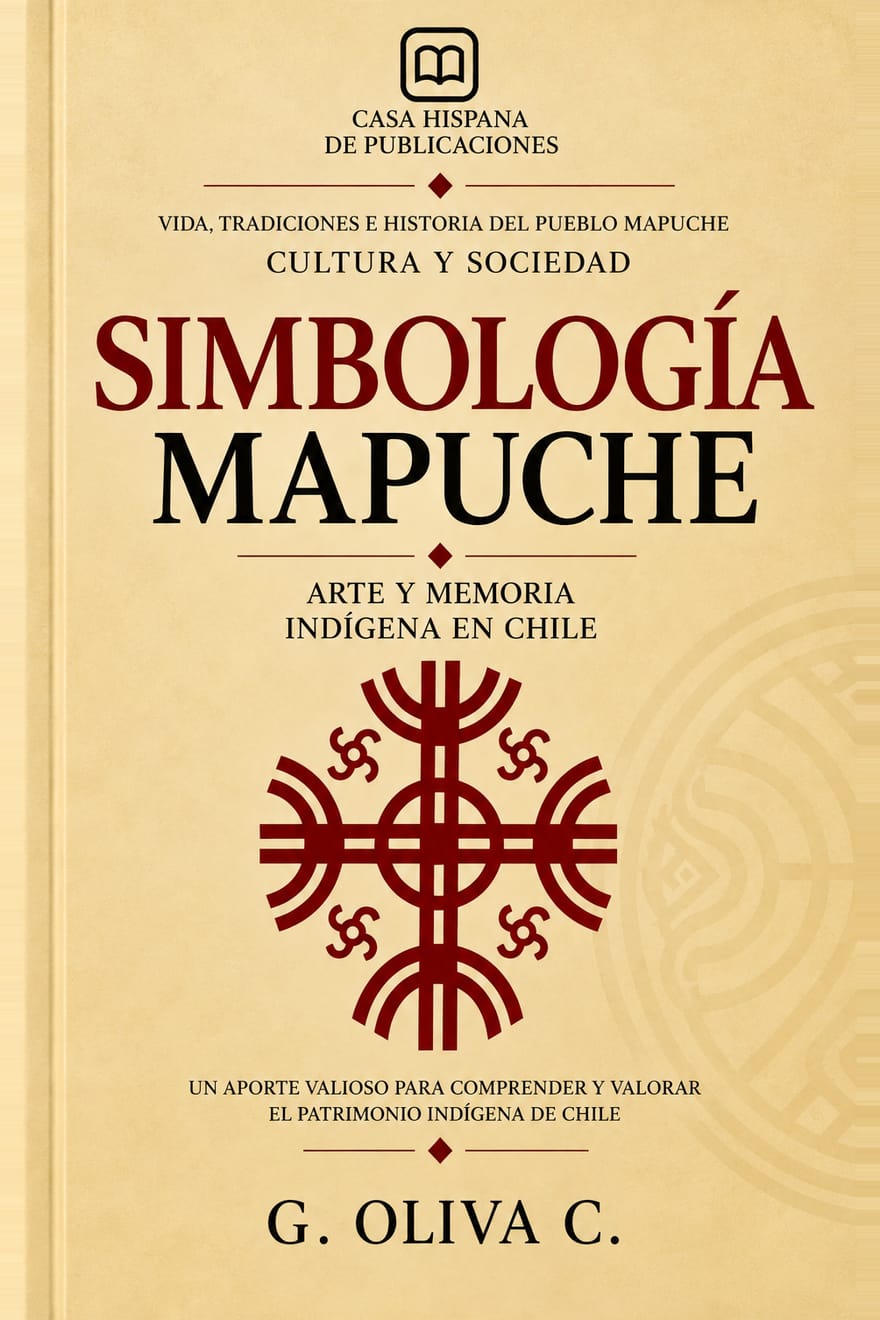
Mapuche symbolism constitutes a deeply meaningful dimension of the cultural heritage of the Mapuche people, because through shapes, colours, designs, objects, spatial arrangements, textile expressions, ceremonial elements and representations linked to nature, knowledge, memories, social relationships and ways of understanding the world that have been built and reinterpreted over generations are transmitted; to speak of Mapuche symbolism therefore does not mean referring simply to a collection of decorative figures or to a repertoire of signs that can easily be separated from the communities that produce and use them, but approaching a cultural universe in which meaning, context, territory, memory, spirituality, materiality and social practice are closely related; from the author's perspective, understanding this reality requires going beyond a superficial reading that reduces symbols to ornamental elements, because what from outside may be observed merely as design may be associated, within certain contexts, with family histories, territorial knowledge, craft practices, community relationships, spiritual conceptions or specific forms of cultural representation. A first fundamental consideration consists in recognising that there is not necessarily a universal and completely uniform dictionary in which every Mapuche symbol always has a single meaning independent of time, territory, medium and community; cultures are living realities, and their symbolic expressions may present local, family, historical and functional variations; a design used within a textile may acquire meaning through its relationship with other elements, while a similar shape used in silverwork, ceramics or architecture may fall within another interpretive context; for this reason the study of symbolism requires methodological prudence, documentation of sources, dialogue with knowledgeable people and attention to the concrete circumstances in which the symbols appear. This precision is especially important in the face of the growing circulation of Mapuche images on the internet, in commercial publications, fashion, tourism, crafts and social media, where explanations that are too simple are frequently offered, attributing absolute meanings to figures without indicating their provenance or evidence; academically responsible research needs to distinguish between documented interpretations, contemporary community interpretations, researchers' hypotheses and popular associations spread later; recognising this difference does not diminish the value of the symbolism but protects its complexity against simplifications. Cultural identity constitutes one of the spheres in which symbolism acquires particular relevance; visual and material expressions can function as forms of recognition, belonging and continuity; a textile piece, a piece of jewellery, a ceremonial instrument or certain designs can link a person to family, territorial or community histories and become vehicles through which culture is made visible; identity does not exist only within abstract ideas; it is also expressed through objects, colours, sounds, clothing, language, practices and shared spaces. This materiality of identity makes it possible to understand why certain objects acquire a value that far exceeds their commercial price; an inherited piece may contain family memory, a garment may be related to a ceremony, a piece of jewellery may transmit belonging or history, and an instrument may have functions inseparable from the context in which it is used; cultural meaning cannot be measured solely through economic value, because the object takes part in human and symbolic relationships accumulated over time. Intergenerational transmission holds a central place within this dynamic; symbols can act as doors to stories that the elders pass on to the young; explaining how a textile is made, why a certain design is used, when it is appropriate to use an object, who taught a technique or what family memory is linked to a piece turns material production into an educational process; transmission does not happen only through formal explanations but also by observing, working, listening, accompanying and taking part. The teaching of craft techniques represents precisely a form of cultural transmission; when one generation teaches another to spin, dye, weave, work metals, prepare materials or recognise designs, it does not transmit manual skills alone; it transmits vocabulary, discipline, memory, aesthetic criteria, territorial knowledge and social relationships; in this way material heritage and intangible heritage remain deeply connected. Mapuche textiles constitute one of the particularly relevant fields for understanding this relationship between technique, meaning and identity; their making may involve the selection and preparation of fibres, spinning, dyeing, setting up the loom, building designs and knowledge transmitted through experience; each stage contains knowledge that cannot be reduced to the finished product; contemplating only the final piece without understanding the process renders invisible a fundamental part of the knowledge that made it possible to produce it. Textile designs may present geometric shapes, colour compositions and structures that have different interpretations according to the pieces, the contexts and the traditions of those who make them; precisely for this reason the idea that every design necessarily constitutes a kind of coded writing with a single translation must be avoided; some shapes may have recognisable cultural associations, while others may also respond to aesthetic, technical, family or personal decisions; responsible interpretation needs to start from evidence and not from imagination. Mapuche silverwork constitutes another sphere of enormous cultural richness; objects used as personal adornments and elements associated with certain social or ceremonial contexts can express identity, status, family memory, aesthetics and belonging; the shapes of these pieces have also undergone historical transformations, showing that Mapuche material culture has not remained motionless but has dialogued with broader economic, technological and political processes. This dynamic character is essential for understanding symbolism; a living culture does not preserve every element in exactly the same way for centuries; communities select, reinterpret, adapt, create and transmit; cultural continuity does not mean immobility; it means the capacity to transform while maintaining recognisable links with a collective memory. Ceramics, basketry, carving and other material expressions can be studied from the same perspective; material forms speak of available resources, territorial techniques, everyday needs, exchange and creativity, and in certain cases may contain particular symbolic elements, but once again the meaning needs to be researched within the context of production and use. The spiritual dimension is probably one of the most delicate and profound aspects of Mapuche symbolism, because certain expressions are related to ceremonies, traditional authorities, conceptions of space, forces of nature and relationships between community, territory and spirituality; approaching these realities requires respect and a willingness to recognise that not all ceremonial knowledge must necessarily be turned into public information. From the author's perspective there is a fundamental difference between respectfully studying a spiritual tradition and turning it into a cultural spectacle; certain symbols, objects and practices may have meanings that depend precisely on their use within a community, and extracting them from that context to reproduce them commercially may modify or trivialise their meaning…
Category
- MAPUCHE SYMBOLISM
- MAPUCHE CULTURE
- MAPUCHE PEOPLE
- CULTURAL IDENTITY
- MAPUCHE WORLDVIEW
- MAPUCHE SPIRITUALITY
- CULTURAL HERITAGE
- INDIGENOUS HERITAGE
- MAPUCHE ART
- MAPUCHE ICONOGRAPHY
- MAPUCHE TEXTILES
- MAPUCHE SILVERWORK
- MAPUCHE RITUALITY
- MAPUCHE TERRITORY
- HISTORICAL MEMORY
- ORAL TRADITION
- ANCESTRAL KNOWLEDGE
- INTERCULTURALITY
- CULTURAL RIGHTS
- CULTURAL PRESERVATION
Rights for this book
We turn publishing rights into international growth, connecting authors and publishers with new markets, new readers and new partners around the world.
Technical details
- Title
- Simbología Mapuche
- Author
- G. Oliva C.
- Imprint
- Grupo Editorial casa Hispana
- Size
- 15x23cms
- Edition
- 1st edition, 2023
- Published in
- Chile
- Year of publication
- 2024
- Available languages
- Spanish, English, German, Portuguese
- Binding
- Paperback with flaps
- Pages
- 415