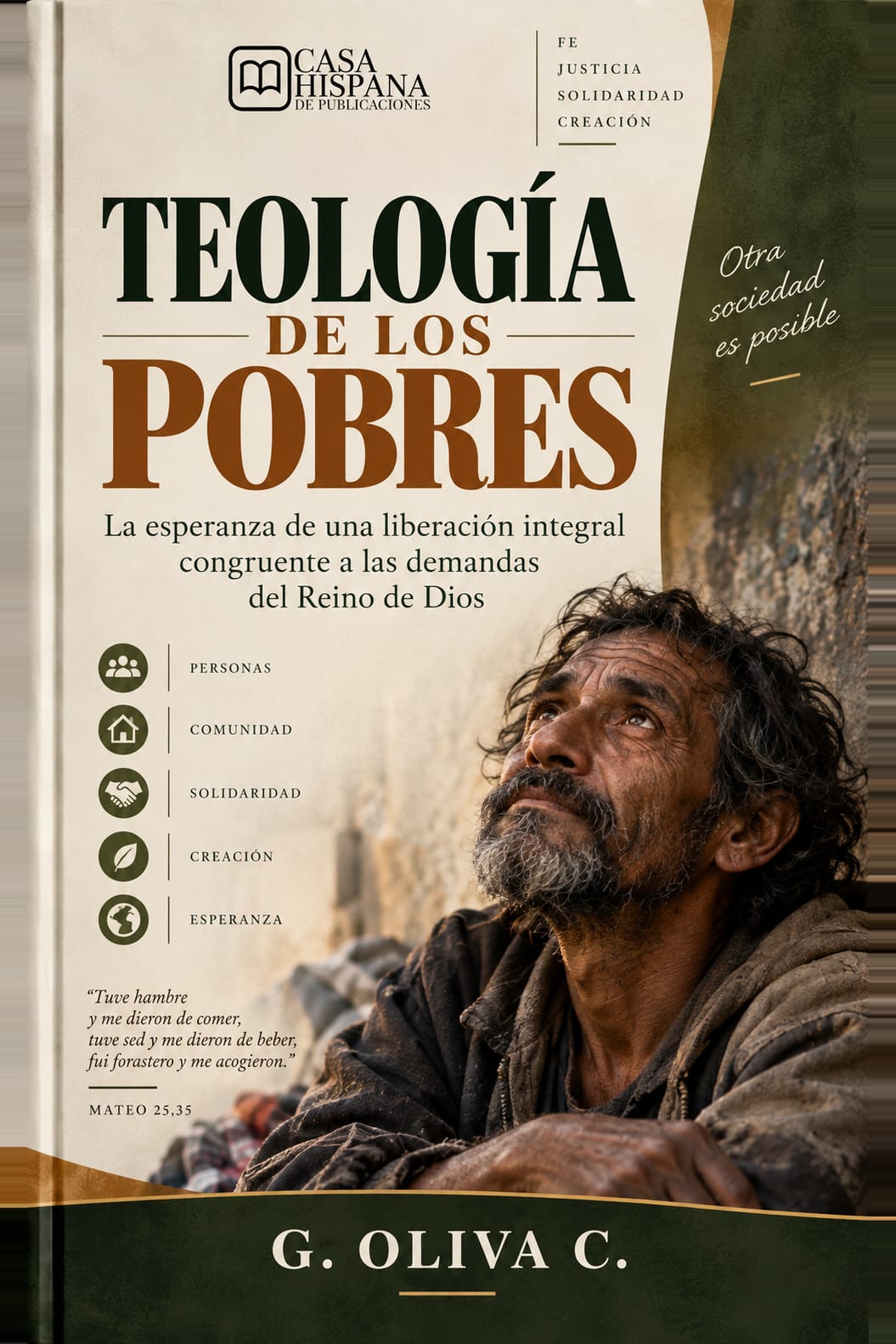
Description
The so-called theology of the poor is closely related to the theology of liberation that emerged in Latin America during the second half of the twentieth century, although the two expressions should not necessarily be regarded as identical in all their developments; the former makes it possible to place the emphasis specifically on the historical, social and human situation of those who experience poverty, exclusion, marginalisation and various forms of oppression, while the latter represents a broader theological current that sought to interpret the Christian faith from the concrete realities of injustice present on the Latin American continent; its fundamental concern consisted in asking what it means to proclaim the Gospel of Jesus Christ within societies that are deeply Christianised and at the same time marked by inequality, poverty, concentration of wealth, political violence, social exclusion and the violation of human dignity. This question profoundly transformed the way of understanding the theological task, because it was no longer enough to develop doctrinal concepts detached from the concrete conditions in which Christian communities lived; reflection on God had to dialogue with history, and particularly with the experience of those who suffered the consequences of unjust social structures; in this way poverty ceased to be regarded exclusively as an individual situation related to material deprivation and began to be analysed also as a historical, social, economic and structural reality that could be linked to unequal relations of power. The emergence of this current must be situated mainly in the 1960s and 1970s, when numerous Latin American countries were experiencing strong economic inequalities, accelerated processes of urbanisation, internal migrations, social conflicts, political instability, authoritarian regimes and deep differences between privileged sectors and large impoverished populations; within this scenario various theologians, pastors, priests, Christian communities and social agents began to ask about the responsibility of the Church in the face of these realities. Among the most influential figures is Gustavo Gutiérrez, whose work contributed decisively to systematising the theology of liberation from Latin America, together with other thinkers who later developed their own perspectives, such as Leonardo Boff and Jon Sobrino; their works were not completely identical and cannot be reduced to a single formulation, but they shared the concern to relate the Christian faith to the historical reality of the poor, justice, liberation and the transformation of conditions that degraded human life. The Second Vatican Council, held between 1962 and 1965, constituted an important antecedent because it promoted a more open understanding of the relationship between Church, world, history and human responsibility; later the Second General Conference of the Latin American Episcopate, held in Medellín in 1968, interpreted various conciliar impulses from the Latin American reality, paying particular attention to problems related to poverty, justice, peace, education and social structures; these processes provided an ecclesial framework within which a specifically Latin American theological reflection began to develop with greater force. One of the most important contributions of this current consisted precisely in maintaining that Latin America should not limit itself to receiving theological systems elaborated entirely from other cultural contexts, but could develop a historically situated Christian reflection capable of dialoguing with its own questions, conflicts, peoples, cultures and experiences; theology thus began to understand context not as a secondary element but as the space from which certain questions acquire urgency and meaning. This does not mean that context replaces the Scriptures, but that every reading of the Scriptures takes place from some historical reality; consciously recognising that context makes it possible to examine how certain human experiences influence the questions put to the biblical text; the concern of contextual theology consists precisely in establishing a responsible dialogue between text, tradition, community and historical reality, avoiding both a biblical interpretation completely disconnected from life and a reading in which social circumstances end up arbitrarily imposing themselves on the content of revelation. Within this horizon appears one of the best-known concepts of Latin American liberation theology: the preferential option for the poor; this expression should not be interpreted as an affirmation that God loves only poor people or that those who possess economic resources are automatically excluded from his grace; its theological meaning points to the particular attention that the Scriptures give to people whose dignity is threatened by poverty, oppression, exploitation, abandonment or marginalisation. The Bible contains numerous expressions of this concern, from the Old Testament legislation regarding foreigners, widows, orphans and the poor to the prophetic denunciation of exploitation and injustice; the prophets repeatedly confronted a religiosity that could maintain liturgical practices while ignoring deeply unjust social relations; this tradition provides a fundamental antecedent for understanding why justice cannot be regarded as a theme completely foreign to biblical spirituality. The proclamation of Jesus deepens this relationship; Luke 4:18-19 presents the programmatic beginning of his ministry through words related to good news for the poor, freedom for captives, recovery of sight and release for the oppressed, within the context of Isaiah; this passage has acquired special importance for liberation theologies because it makes it possible to observe that the announcement of the Kingdom of God has implications for concrete people who experience suffering, exclusion and the need for restoration. Matthew 25:31-46 constitutes another central text because it relates service to those who suffer hunger, thirst, foreignness, nakedness, sickness or imprisonment with the very encounter with Christ; this teaching prevents a complete separation between spirituality and responsibility towards one's neighbour; the relationship with God finds concrete expression in the way the believer responds to human vulnerability. The preferential option for the poor thus represents an ethical, pastoral and theological orientation that invites us to look at reality from those sectors where the consequences of injustice usually manifest themselves most intensely; to ask about the poor means asking who bears the cost of certain economic structures, who lacks sufficient access to education, health, housing, land, security, dignified work or social participation, and who remains without the effective capacity to make their voice heard. However, reducing poverty exclusively to economic deprivation would be insufficient; there are forms of poverty linked to cultural exclusion, displacement, territorial loss, racial discrimination, social invisibility, forced migration, environmental deterioration and the violation of rights; for this reason later expressions of Latin American contextual theology considerably broadened their field of reflection, incorporating the experiences of indigenous peoples, Afro-descendant communities, women, migrants, peasants, inhabitants of urban peripheries and populations affected by various processes of exclusion. This broadening makes it possible to understand that speaking theologically from the poor does not mean constructing a homogeneous human category; impoverished people have different cultures, histories, identities, spiritualities, experiences and aspirations; a responsible theology needs to avoid turning them simply into abstract objects of compassion and to recognise them also as subjects capable of interpreting their reality, organising their communities, expressing their faith and taking an active part in processes of transformation. At this point appears another characteristic contribution of liberation theology: the relationship between reflection and praxis; theology is not conceived solely as intellectual elaboration carried out from libraries, universities or seminaries, although academic study continues to be necessary, but as a reflection that dialogues with the historical practice of communities committed to faith and justice. Praxis can be understood as a permanent interaction between action, reflection, discernment and new action; the community observes a reality, acts within it, reflects theologically on its experience in the light of the Scriptures, critically evaluates its practices and acts again with greater discernment; in this way theology seeks to avoid two extremes: an abstract reflection incapable of relating to human suffering, and an activism that acts constantly without sufficient biblical, theological or spiritual foundation. The contextual reading of the Bible plays a fundamental role within this process, because it allows concrete communities to approach the text formulating questions born of their own reality; people who experience poverty, displacement, exploitation or discrimination may perceive with particular intensity certain biblical themes related to exodus, liberation, justice, land, dignity, community, hope and the Kingdom of God. The Exodus narrative therefore acquired special importance within liberation theology because it presents God hearing the cry of a subjugated people and acting within their history; however, a responsible hermeneutic needs to avoid mechanically transferring every element of Israel to any contemporary political conflict; the theological value of the narrative lies in revealing dimensions of the character and action of God, while its application requires historical and exegetical discernment. Theological research on the poor must maintain precisely this balance, because there is always the risk of using the Bible simply to confirm previously adopted positions; an authentic contextual theology needs to allow the Scriptures also to confront the political, cultural, economic and religious interpretations present within the context itself. Liberation constitutes another central category, but it needs to be understood integrally within Christian thought; biblical salvation cannot be reduced exclusively to political, economic or social transformation, but neither should it be presented in such a way that the concrete conditions of human existence become completely irrelevant; the human person has spiritual, bodily, relational, communal and social dimensions that are deeply connected. From this perspective integral liberation seeks to relate reconciliation with God, personal transformation, the restoration of human relationships and responsibility in the face of structures that produce suffering; individual conversion remains fundamental, but it also needs to produce consequences in the way power is used, resources are administered, workers are treated, other cultures are related to, creation is cared for and situations of injustice are answered. This understanding prevents reducing the Gospel to a political project, because Christian mission has a transcendent dimension linked to God, sin, grace, reconciliation, resurrection and eternal life, but it also prevents reducing it to an exclusively inner experience without historical consequences; the Kingdom of God transforms the way the believer understands both their relationship with God and their relationship with their neighbour. An important concern within the theology of the poor consists precisely in overcoming the false opposition between evangelism and social responsibility; proclaiming Jesus Christ and responding to human suffering should not necessarily become rival tasks; the ministry of Jesus shows proclamation, teaching, compassion, healing, welcome, prophetic denunciation and the formation of disciples integrated within a single mission. Integral mission has subsequently developed this relationship within various Latin American evangelical sectors, insisting that the verbal proclamation of the Gospel and the concrete demonstration of Christian love belong to the responsibility of the Church; this perspective makes it possible to establish important spaces for dialogue between certain intuitions of liberation theology and developments proper to Latin American evangelical theology without erasing their doctrinal differences…
Category
- THEOLOGY
- SYSTEMATIC THEOLOGY
- CHRISTOLOGY
- CONTEXTUAL THEOLOGY
- LATIN AMERICAN THEOLOGY
- CHRISTIAN EDUCATION
- SPIRITUALITY
- MISSION
- SOCIAL JUSTICE
- PASTORAL THEOLOGY
Rights for this book
We turn publishing rights into international growth, connecting authors and publishers with new markets, new readers and new partners around the world.
Technical details
- Title
- Teología de los pobres
- Author
- G. Oliva C.
- Imprint
- Grupo Editorial casa Hispana
- Size
- 15x23cms
- Edition
- 1st edition, 2025
- Published in
- Chile
- Year of publication
- 2026
- Available languages
- Spanish, English, German, Portuguese
- Binding
- Paperback with flaps
- Pages
- 435