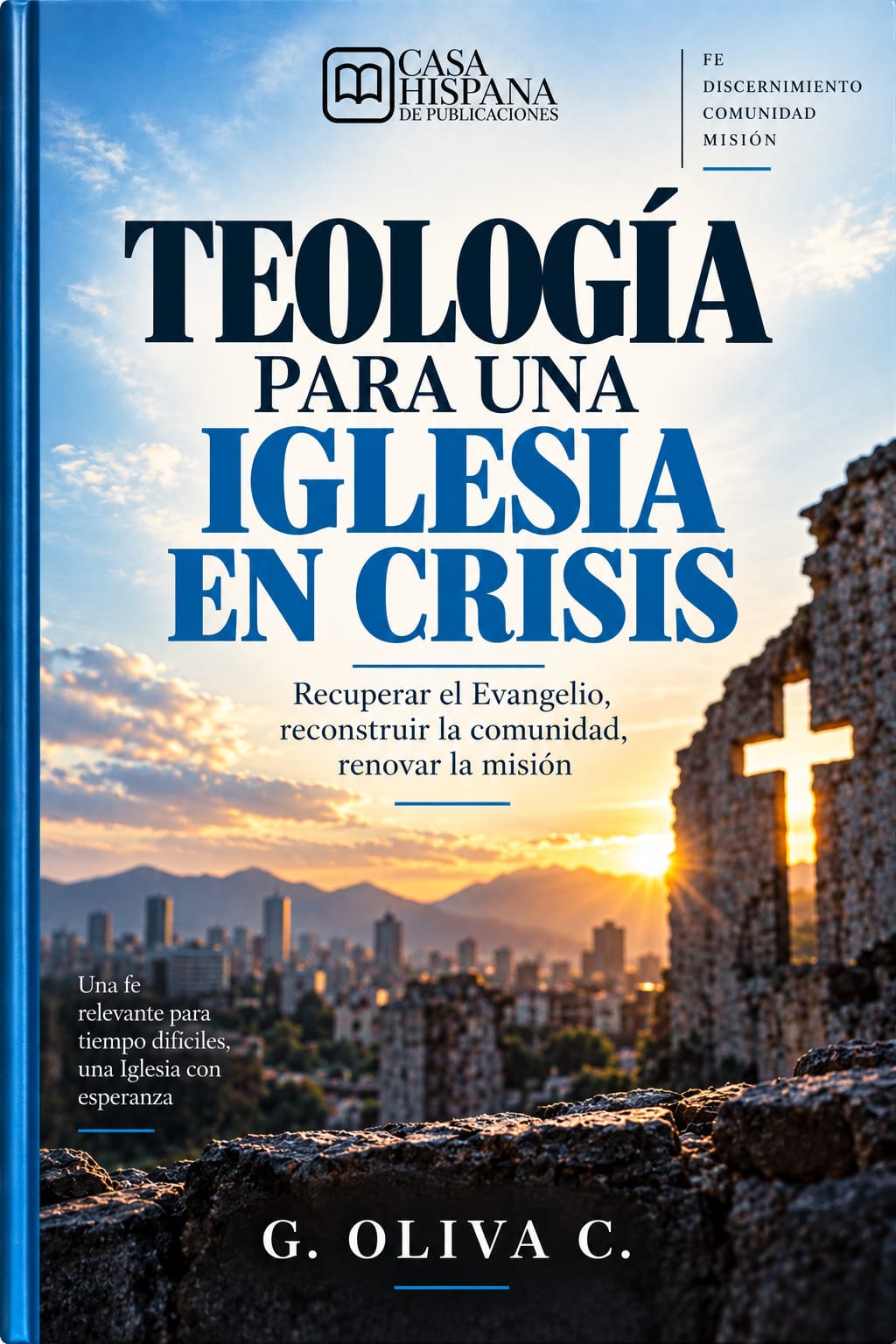
Description
Theology acquires an especially significant importance when the church goes through times of crisis, because difficulties test not only its structures, its leadership and its relationships but also the depth of its convictions, the understanding of its identity and the way it interprets the presence and action of God within adverse circumstances; a crisis may arise from internal conflicts, doctrinal divisions, leadership problems, loss of credibility, spiritual weakening, cultural transformations, persecution, economic difficulties, institutional scandals, generational changes or social situations that directly affect the Christian community; in the face of these realities theology provides biblical foundations, categories of discernment, spiritual guidance and ethical criteria that make it possible to understand the crisis without being completely determined by it. When a church faces a crisis there is the danger of reacting solely out of urgency, seeking immediate solutions that reduce the conflict but do not necessarily respond to its deep causes; theology introduces a different perspective, because it obliges us to formulate fundamental questions about God, Christ, the Holy Spirit, the Scriptures, the nature of the church, mission, sin, grace, repentance, reconciliation and Christian hope; these questions make it possible to understand that many church crises cannot be resolved solely through administrative techniques, communication strategies, organisational changes or institutional decisions, because they may reveal deeper problems related to the spiritual and theological identity of the community. The Scriptures constitute an indispensable foundation during these processes; Second Timothy 3:16-17 affirms that all Scripture is inspired by God and useful for teaching, rebuking, correcting and training in righteousness; this affirmation acquires special relevance in moments of confusion, because the community needs criteria that transcend personal opinions, particular interests and circumstantial disputes; a theology rooted in the Scriptures helps to examine the different interpretations present within a crisis and makes it possible to ask not only which solution is most convenient but which response expresses most faithfully the character of Christ and the principles of the Gospel. Doctrinal clarity then acquires a pastoral function, because a community that understands what it believes is better placed to interpret what it is living through; the doctrine of God reminds us that the church ultimately belongs to Him; Christology places Jesus Christ once again as head and foundation of the community; pneumatology recalls dependence on the Holy Spirit; ecclesiology makes it possible to review the nature and mission of the church; the doctrine of sin helps to recognise the reality of human frailty, while the doctrines of grace, forgiveness, sanctification and reconciliation provide categories for thinking through paths of restoration; theology thus ceases to be an abstract reflection and becomes a tool for understanding reality spiritually. Crises can also cause a loss of identity when the church begins to define itself mainly by its conflicts, its financial difficulties, its divisions or the figure of certain leaders; theological reflection makes it possible to recover a deeper identity; Ephesians 4:11-16 presents a community oriented towards edification, the unity of the faith, the knowledge of Christ and maturity; this perspective reminds us that the church does not exist fundamentally to preserve an organisation but to be a community of disciples gathered in Christ, formed by the Word, equipped for service and sent to take part in the mission of God. Recovering this identity is fundamental, because many crises worsen when the institution begins to defend its own survival as if this were its main purpose; a church may keep buildings, programmes, offices, structures and activities and at the same time experience a deep spiritual weakening; theology obliges us to distinguish between the church as the people of God and the historical structures through which it organises its community life; structures are necessary but must remain at the service of the mission and never become an absolute end. Spiritual discernment constitutes another fundamental contribution of theology in moments of crisis; John 16:13 presents the Holy Spirit as the one who guides towards the truth; however, to speak of the Spirit's direction requires discernment, because personal convictions can easily be confused with divine direction; a responsible theology relates the work of the Spirit to the Scriptures, the Christian community, wisdom, the character of Christ and the search for truth, avoiding the use of spiritual expressions to legitimise personal decisions or to prevent legitimate questions…
Category
- THEOLOGY
- CONTEXTUAL THEOLOGY
- LATIN AMERICAN THEOLOGY
- MISSIOLOGY
- SPIRITUALITY
- CHRISTIAN EDUCATION
- CHRISTOLOGY
Rights for this book
We turn publishing rights into international growth, connecting authors and publishers with new markets, new readers and new partners around the world.
Technical details
- Title
- Teología para una Iglesia en crisis
- Author
- G. Oliva C.
- Imprint
- Grupo Editorial casa Hispana
- Size
- 15x23cms
- Edition
- 1st edition, 2024
- Published in
- Chile
- Year of publication
- 2024
- Available languages
- Spanish, English, German, Portuguese
- Binding
- Paperback with flaps
- Pages
- 415