Description
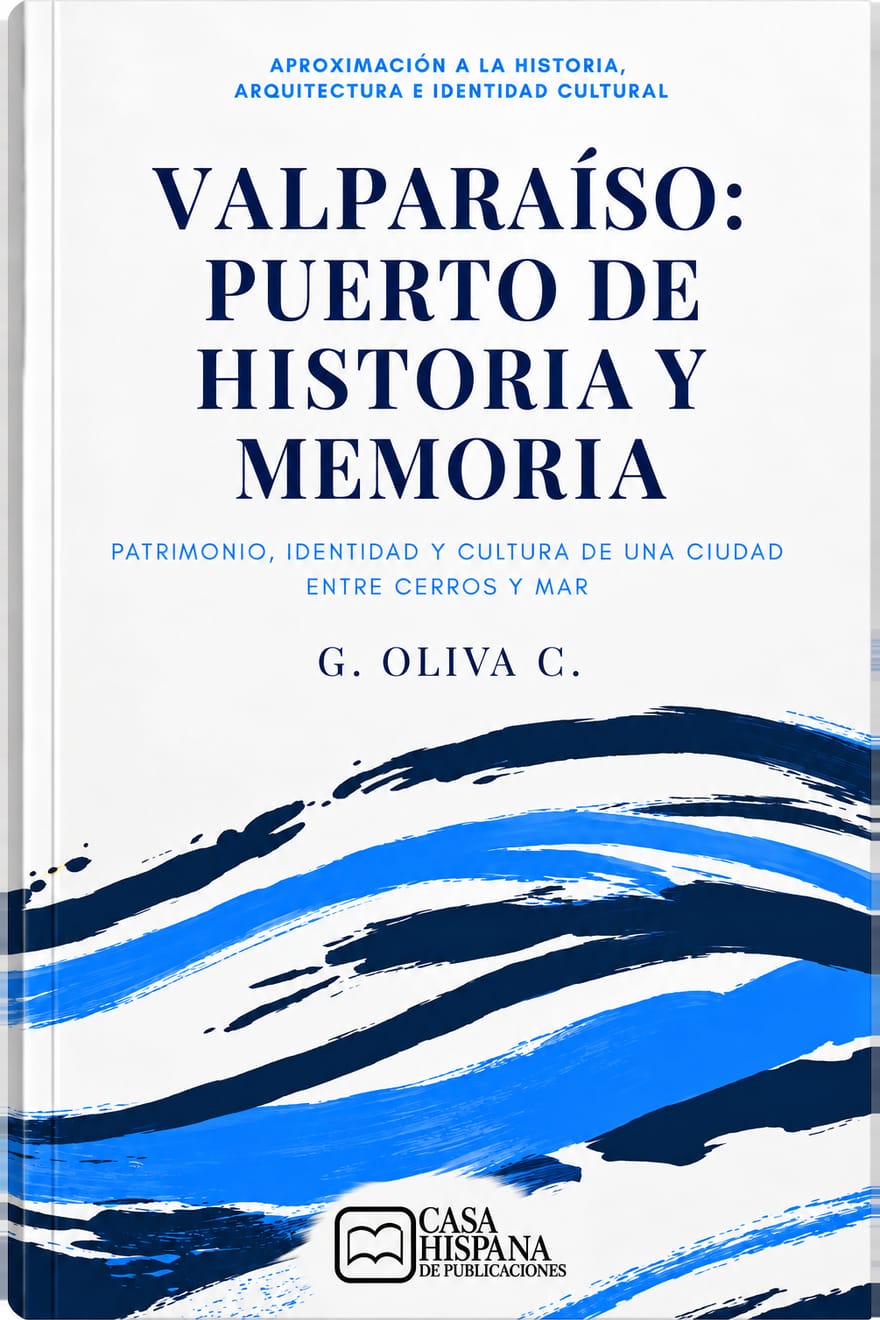
Valparaíso is not merely a city built facing the Pacific Ocean. It is a territory where geography, history, architecture and collective memory meet to shape one of the most distinctive urban identities in Chile and Latin America. Its hills, ravines, stairways, funiculars, squares, buildings, streets and port spaces are material expressions of a history closely bound up with maritime trade, migration, social change and the creativity of its inhabitants. To understand Valparaíso therefore requires looking beyond its landscapes and recognising that every corner of the city preserves the testimony of the generations who took part in building it. Valparaíso: Puerto de historias y memoria. Patrimonio, identidad y cultura de una ciudad entre cerros y mar offers a historical and cultural approach to the formation, evolution and heritage significance of this port city. From an interdisciplinary perspective, the work invites the reader to examine how territory, economic relations, migratory movements, cultural expressions and the everyday experiences of its inhabitants have helped to shape an urban identity that remains in constant transformation. The research guiding this proposal starts from a fundamental conviction: cities are not built only with buildings, streets and infrastructure; they are also built with human experiences, shared memories, social relations and particular ways of understanding territory. In Valparaíso, this reality takes on a special depth because of the historical relationship between the sea and the hills, two geographical elements that have conditioned its urban development and, at the same time, nourished its cultural imagination. Geography is one of the first keys to understanding what makes Valparaíso singular. Unlike cities that developed across large and relatively flat expanses, Valparaíso has a territorial layout defined by a narrow coastal strip and a series of hills and ravines rising before the ocean. This condition has decisively influenced its patterns of settlement, its systems of mobility, its architecture and the distribution of its social spaces. For the author, the geography of the port city should not be understood solely as a natural backdrop against which the city developed. On the contrary, it is an active part of its history. The slopes determined routes, the ravines conditioned settlements, the connections between the flat lower town and the hills called for particular transport solutions, and the views towards the ocean helped to form a visual and emotional relationship between the inhabitants and their surroundings. Valparaíso cannot be understood without its hills, but neither can it be understood without the sea that has guided its history. The history of the city is closely related to its condition as a port. During the colonial period, Valparaíso performed maritime functions linked to Santiago and to the commercial system of the South Pacific. Later, during the nineteenth century, it acquired growing significance as a centre of commercial exchange and international connection. The expansion of port activities, the circulation of goods, the presence of foreign merchants and the development of financial and commercial institutions helped to transform its urban landscape. This process turned Valparaíso into a meeting place for different cultural experiences, economic interests and projects of modernisation. The city received architectural, technological and commercial influences from various parts of the world, especially from Europe, which were gradually incorporated into its urban structures. However, the work proposes avoiding an interpretation that reduces the history of the port city to the foreign presence or to economic growth. Valparaíso was also built by dock workers, artisans, local traders, fishermen, clerks, women, working-class families and communities who took part day by day in the running of the city. From this perspective, it is essential to recognise that urban history does not belong exclusively to the great businessmen, the institutions or the monumental buildings. It also belongs to those who lived in modest dwellings, climbed steep stairways, worked on the quays, kept the markets going and developed networks of solidarity in the neighbourhoods. The history of Valparaíso is not found only in its heritage buildings; it also endures in the memory of its inhabitants. One of the main themes of the work is cultural heritage understood as a broad, dynamic and socially constructed reality. In this sense, heritage is not limited to monuments, churches, old buildings or spaces officially recognised for their architectural value. It also includes cultural practices, local knowledge, traditional trades, family stories, celebrations, artistic expressions and forms of coexistence that have given meaning to urban life. The recognition of part of the historic area of Valparaíso as a World Heritage Site by UNESCO in 2003 is a significant event for understanding the international reach of its urban heritage. Nevertheless, this recognition does not mean that the whole of the city is inscribed, nor that the conservation of its heritage is guaranteed. Rather, it raises permanent responsibilities relating to the protection, management and transmission of its historical values. The research developed from this perspective makes it possible to reflect on an essential question: conserving heritage does not consist solely in preserving façades or restoring architectural structures. It also involves understanding the social relations that gave rise to those spaces and recognising the communities that continue to inhabit them. A heritage city cannot simply become a stage set intended for tourist contemplation. Its authenticity also depends on the continuity of everyday life, on its inhabitants remaining there and on the capacity to integrate conservation with contemporary social needs. Consequently, the work proposes a view that links architectural heritage, collective memory and the right to the city. Historic buildings have value because of their material characteristics, but also because of the human experiences they represent. Streets and squares acquire meaning because they have been places of encounter, work, celebration, conflict and social transformation. To preserve heritage does not mean bringing history to a halt; it means allowing history to go on being understood by future generations. Architecture is another of the great protagonists of Valparaíso. Its dwellings adapted to the slopes, its constructions of timber and metal sheeting, its commercial buildings, its churches, its passageways and its solutions for vertical circulation reflect the interaction between cultural influences, the availability of materials, practical needs and geographical conditions. The architectural diversity of Valparaíso expresses historical processes of adaptation and transformation. European influences helped to introduce styles and building techniques, but these were reinterpreted in accordance with local characteristics. In this way, the city developed an architectural identity that cannot be explained as a simple reproduction of foreign models. The historic funiculars occupy a particularly significant place within this heritage. Beyond their technological and tourist value, they represent concrete responses to the difficulties of mobility imposed by the topography. Their presence shows how the city developed solutions of its own to connect urban spaces separated by steep differences in level. Likewise, the stairways, passageways, viewpoints and pedestrian routes are fundamental elements of the Valparaíso experience. They are everyday infrastructure, but also spaces of social interaction and essential components of territorial identity. For the author, these elements make it possible to understand that architecture should not be studied exclusively in terms of its formal styles. It is necessary to examine how buildings respond to people's needs, how they organise relations between neighbours and how they take part in the formation of a shared urban memory. Another fundamental aspect of the work is the cultural diversity that characterises Valparaíso. The city has been the setting for encounters between local populations, migrants from within the country and communities from different countries. These movements helped to enrich its commercial practices, educational institutions, religious expressions, cultural activities and forms of sociability. The influence of British, German, Italian and French communities, and of others of different origins, made itself felt at different moments in its development. However, the identity of the port city cannot be reduced to these contributions. The city is also deeply bound up with the trajectories of its working-class populations, with the internal movements of Chilean inhabitants and with the many cultural experiences that developed in its neighbourhoods. In this context, cultural memory makes it possible to recognise that Valparaíso is the result of a collective construction. Its identity does not belong to a single community, nor does it correspond to one particular period. It is the product of encounters, adaptations, tensions and transformations that continue to the present day. The identity of the port city is not a motionless inheritance; it is a historical construction that is renewed with each generation. The work also considers the social side of heritage and the inequalities that have accompanied urban development. The commercial growth and modernisation of Valparaíso did not produce equivalent benefits for all its inhabitants. The expansion of economic activity coexisted with differences in housing conditions, access to services and the availability of infrastructure. This reality invites us to study the city from a perspective that recognises both its historical achievements and its social contradictions. The heritage wealth of Valparaíso does not remove the difficulties faced by different sectors of its population. For this reason, a responsible interpretation must integrate the memory of urban progress with the experiences of vulnerability, precariousness and community organisation. Later economic transformations, changes in maritime trade, the modernisation of port infrastructure and shifts in productive activities also influenced the evolution of the city. Such processes make it possible to understand that Valparaíso is not a reality frozen in its commercial past, but a territory that has had to adapt to new economic and social circumstances. Within this reflection, the author seeks to emphasise that heritage protection must be related to the quality of life of communities. The recovery of historic buildings is important, but it must be coordinated with policies on housing, security, mobility, risk prevention, public spaces and cultural development. A city that conserves its monuments but progressively loses its inhabitants or weakens its communities faces a contradiction that demands attention. The memory of Valparaíso also includes the experiences of catastrophes and reconstructions. Its history has been marked by earthquakes, fires and other events that have affected its material and social fabric. These experiences reveal the vulnerability of a city whose topography, environmental conditions and building characteristics pose permanent challenges. However, they also make it possible to recognise its inhabitants' capacities for organisation and response. The experiences of reconstruction form part of collective memory and show how communities reinterpret their spaces after traumatic events. The research invites us to understand that heritage does not only record periods of prosperity or architectural beauty. It also preserves traces of losses, difficulties and collective efforts at recovery. A city is defined not only by what it has built, but also by what it has had to rebuild. Culture and the arts likewise occupy a central place in this approach. Valparaíso has been a source of inspiration for writers, poets, musicians, painters, photographers and creators who found in its urban landscape a space for aesthetic expression. Its colours, its irregular perspectives, its façades, its stairways and the constant presence of the ocean have helped to shape a recognisable cultural image. Literature and the arts have taken part in the construction of this identity, turning the city into a territory that can be travelled both physically and through its symbolic representations. Nevertheless, the author proposes distinguishing between the real city and the idealised city. The artistic image of Valparaíso is an important part of its cultural heritage, but it does not replace the concrete experiences of its inhabitants. The beauty of its landscapes must enter into dialogue with the realities of work, housing, economic transformations and social conditions. This distinction makes it possible to develop a deeper cultural view, capable of appreciating the aesthetic richness of Valparaíso without concealing the complexities of its history. The markets, the street fairs, the musical activities, the popular expressions and the gathering places also form part of the identity of the port city. Through these practices, communities produce and transmit forms of knowledge that are not always recorded in official documents. Oral tradition therefore acquires a particular relevance. The accounts of long-standing inhabitants, dock workers, families from the hills and neighbourhood communities offer perspectives that complement the historical archives. In heritage research, these voices make it possible to broaden knowledge of the city and to recognise experiences that may be left on the margins of institutional narratives. From the author's perspective, listening to the inhabitants is a methodological and ethical requirement. It is not enough to describe urban spaces from the outside; it is necessary to understand how those who inhabit them interpret their meaning. The hills hold stories, the streets preserve traces and the inhabitants transmit memories that no building can tell on its own. The relationship between Valparaíso and the ocean is another essential element of the work. The sea has historically been a route of communication, trade, work and cultural contact. At the same time, it is a permanent component of the landscape and of the collective imagination. Port activity has influenced the economic organisation of the city, its demographic movements and its relations with other territories. The quays, vessels, warehouses, commercial facilities and spaces linked to maritime work form part of a productive memory that deserves to be studied. However, the sea also has a symbolic side. For many generations, it has represented opportunities, journeys, farewells, encounters and uncertainties. Its presence in literature, music and cultural expressions confirms that the ocean belongs both to the material history and to the emotional identity of Valparaíso. The city can be understood, then, as a space of interaction between land territory and maritime horizon, between rootedness and movement, between permanence and transformation. This duality makes it possible to interpret Valparaíso as a city open to the world, yet deeply conditioned by its local geography. In the contemporary sphere, the work invites reflection on the challenges of heritage conservation. The protection of historic spaces requires resources, planning, citizen participation and effective coordination between public institutions, private actors and local communities. The tensions between property development, economic activity, tourism, conservation and housing needs make it necessary to adopt a perspective of integrated heritage management. Cultural tourism can contribute to making the history of the port city more widely known and can generate economic opportunities. However, when it is not adequately managed, it can also encourage processes of displacement, the transformation of the traditional uses of neighbourhoods or the reduction of heritage to a commodity intended for consumption. For this reason, the author argues for the importance of promoting a model of cultural development that recognises the inhabitants as protagonists of conservation and not simply as secondary elements of a tourist landscape. Heritage must help to strengthen community life, historical education and the sense of belonging. Heritage education is, in this context, an indispensable tool. Knowing the history of the neighbourhoods, understanding the value of the buildings, recovering family stories and studying the transformations of the territory makes it possible to develop a more conscious relationship with the city. Schools, universities, libraries, museums, cultural organisations and neighbourhood communities can take part in processes of transmitting historical memory. The research proposed by the author recognises that the preservation of heritage does not depend exclusively on specialists. It also requires citizens capable of identifying, valuing and defending the cultural elements that form part of their surroundings. A society that does not know its heritage faces greater difficulties in understanding the meaning of its urban transformations. Cultural heritage is not protected only through laws and restorations; it is also protected through knowledge, participation and memory. The work acquires a Latin American scope by placing Valparaíso within a wider history of port cities, commercial exchanges and urban transformations. Its experience has points of contact with other ports on the continent that underwent processes of commercial expansion, migration, modernisation and territorial reorganisation. However, the singularity of Valparaíso lies in the particular combination of its geography, its historical trajectories and its cultural expressions. Its hills and its relationship with the ocean produced forms of occupying space that helped to distinguish it from other urban centres. From this perspective, Valparaíso can be studied as a significant case for understanding the relations between heritage, modernisation, identity and memory in Latin America. The city makes it possible to examine how global processes acquire local expressions and how communities reinterpret external influences in accordance with their own territorial conditions. One of the concerns running through this proposal is the need to avoid fragmented interpretations of urban history. Architectural heritage cannot be completely separated from social history; port activity cannot be understood without human labour; migrations cannot be analysed without cultural transformations; and memory cannot be reduced to a collection of isolated events. A full understanding of Valparaíso requires bringing together these…
Category
- HISTORY OF CHILE
- VALPARAÍSO
- CULTURAL HERITAGE
- URBAN HISTORY
- HERITAGE ARCHITECTURE
- PORT-CITY IDENTITY
- HISTORICAL MEMORY
Rights for this book
We turn publishing rights into international growth, connecting authors and publishers with new markets, new readers and new partners around the world.
Technical details
- Title
- Valparaíso: puerto de historia y memoria
- Author
- G. Oliva C.
- Imprint
- Grupo Editorial casa Hispana
- Size
- 15x23cms
- Edition
- 1st edition, 2026
- Published in
- Chile
- Year of publication
- 2026
- Available languages
- Spanish, English, German, Portuguese
- Binding
- Paperback with flaps
- Pages
- 464