Description
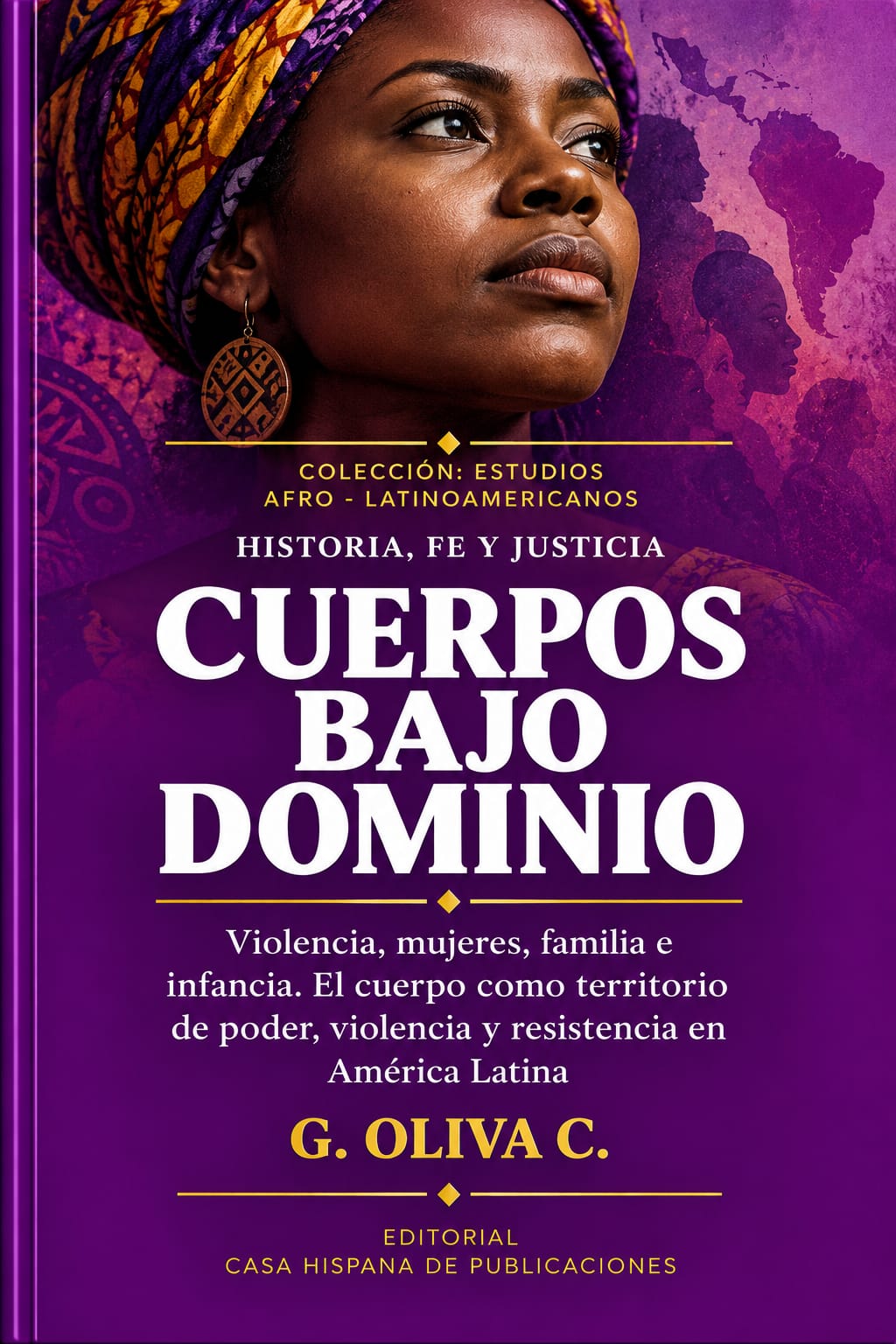
Cuerpos bajo dominio is a historical, social and critical approach to the systems through which colonial power turned the human body into a territory of appropriation, exploitation, discipline and control. The work places at the centre of its analysis the Indigenous, African and Afro-descendant people subjected to different forms of coercion in Latin America, examining in particular enslavement and its economic, legal, political, racial and cultural mechanisms. Its fundamental proposal is to understand that domination did not operate only on territories and resources: it also acted directly on bodies, regulating their mobility, their labour, their reproduction, their family relationships and, in certain circumstances, even the possibility of deciding about their own existence. The concept of the body under domination is thus the organising category of the work. The enslaved body was transformed legally into property, economically into labour power and socially into an object of classification. However, this reduction never succeeded in completely eliminating the human condition of those who were subjected to it. Behind inventories, commercial records, court documents and transactions there were people with names, family ties, memories, languages, knowledge, affections, beliefs and aspirations. This distinction is essential to the perspective developed in the book. Slavery is not a natural identity. To be enslaved was a historical condition imposed through asymmetrical relations of power. They were not born to be property. They were turned into property by systems built to dominate their bodies and appropriate their labour. From this premise, Cuerpos bajo dominio analyses slavery as a complex institution and not merely as a succession of individual acts of cruelty. Its persistence over centuries required economic structures, legislation, markets, mechanisms of surveillance, political institutions and discourses of legitimation. Physical violence was a fundamental part of it, but it was not the only one. There were also legal coercion, economic dependence, family separation, restrictions on mobility and social hierarchies intended to preserve the established order. The economy is one of the first fields of analysis. In different Latin American regions, enslaved labour was incorporated into plantations, haciendas, sugar mills, mining operations, port activities, domestic work, workshops, urban commerce and many productive spaces. The body thus acquired a calculable economic value: it could be bought, sold, inherited, moved and used as collateral. This process represents one of the deepest contradictions studied by the work: a person could possess human dignity and, simultaneously, be recorded by the system as an economic value. The commodification of the body is therefore much more than an economic category. It entails a radical transformation of the relationship between human beings. Where one person can legally own another, inequality ceases to be simply social difference and becomes an institutionalised structure of domination. The transatlantic slave trade represents an extreme expression of this process. Millions of Africans were forcibly displaced to America over several centuries. The Atlantic crossing transformed ships, ports and markets into spaces of an economy built around the trade in human beings. The body appears once again at the centre: captured, transported, examined, classified and sold. But the book insists on recovering what the mercantile categories tried to erase. Before being “labour” they were people. Before being recorded as property they had a history. Before the chain there were identity, community and memory. The work pays particular attention to bodily discipline. Slave systems needed to control the time, movement and productive capacity of the people subjected to them. Surveillance, punishment and threat could operate as instruments intended to produce obedience. In this sense, the body was not only labour power: it was also a space on which power sought to make itself visible. Physical punishment had a function that went beyond individual pain. It could communicate a collective warning. Public violence recalled the limits imposed by the system and sought to demonstrate the consequences of transgressing them. In this way, bodily domination also acquired a symbolic character. However, Cuerpos bajo dominio avoids turning violence into narrative spectacle. The description of suffering acquires historiographical meaning only when it makes it possible to understand the structures that produced it. To expose the violated body unnecessarily can reproduce, in another register, the dehumanisation that one sets out to denounce. The academically relevant question is not simply what violence occurred, but what structures allowed that violence to become normalised. This shift from the event to the structure is one of the main analytical contributions of the work. Gender introduces another indispensable perspective. Domination over bodies did not operate identically on men and women. Enslaved women were exposed to specific forms of labour, domestic, sexual and reproductive exploitation. Their experience requires that legal status, gender, social position and racialisation be considered simultaneously. The female body could be subjected to a double appropriation: as productive force and as a body over which certain agents exercised sexual and reproductive power. This reality makes it necessary to introduce a gender perspective into the study of slavery. But once again the work refuses to represent women exclusively in terms of victimisation. African and Afro-descendant women developed economic, family, religious and community strategies; they took part in networks of solidarity, sought legal mechanisms of freedom and contributed decisively to cultural transmission between generations. The subjected body was not necessarily a body without agency. Here the second great axis of the book appears: resistance. If power sought to control the body, resistance could begin precisely through the recovery of spaces of autonomy over it. Fleeing, refusing, negotiating, forming independent communities, preserving family ties, maintaining cultural practices or using legal mechanisms were some of the many historical strategies through which enslaved people confronted the restrictions imposed on them. Resistance took on different intensities. There were rebellions and uprisings, but also less visible everyday forms. To reduce resistance solely to armed insurrection would make it impossible to understand a large part of the capacity for action developed within slave societies. The quilombos, palenques, maroon communities and other spaces of autonomy acquire particular relevance. In them, flight could be transformed into a collective project. Escaping individual domination opened up the possibility of rebuilding community, even though these experiences were diverse, vulnerable and frequently subjected to new threats. The body that flees ceases to be solely an object of power and becomes the subject of a search for freedom. The family is another fundamental element. Enslavement could fragment families through sale, displacement and separation. Consequently, forming and preserving family ties could also acquire meaning as a practice of survival and continuity. Kinship, motherhood, fatherhood, community networks and relationships of solidarity made it possible to rebuild spaces of humanity within systems that sought to turn people fundamentally into units of production. The book likewise examines the process of the racialisation of the body. Certain physical characteristics were progressively interpreted through social categories that assigned differences of position, prestige and power. Skin colour ceased to function solely as a bodily characteristic and was incorporated into historical systems of classification. Race then appears not as a biological explanation of human capacities, but as a historical construction used to organise differences and, in certain contexts, to legitimise hierarchies. This process is decisive for understanding the transition between slavery and post-abolition societies. Legal abolition eliminated the lawful possibility of owning people, but it did not automatically make the social representations built up over centuries disappear. Legal freedom could be declared by law; social equality required much deeper transformations. This affirmation allows Cuerpos bajo dominio to move from the history of slavery towards the problem of its legacies. The author avoids establishing a mechanical continuity between past and present. Latin American societies have undergone enormous transformations since the abolitions. However, studying contemporary racism, inequality and exclusion also requires considering the historical processes that helped to shape certain hierarchies. Abolition therefore represents a fundamental rupture, but not necessarily a zero point. Slavery – Abolition – Post-abolition – Citizenship – Inequality – Memory are moments that must be studied both in their discontinuities and in their connections. The work also incorporates a particularly significant theological perspective. From the standpoint of a Christian anthropology, the body is neither a commodity nor a spiritually irrelevant reality. The biblical affirmation that the human being has been created in the image of God provides a radical foundation for human dignity. This perspective makes it necessary to confront a fundamental historical contradiction: Christianised societies were able to coexist for long periods with systems that allowed the appropriation of the human body. The question cannot be avoided: how could the spiritual dignity of a person be proclaimed while their body was treated as property? The research developed by the author finds here a space for dialogue between history and theology. It is not a matter of using religious categories to replace historical research, but of confronting the practices of Christian societies with Christianity's own anthropological affirmations. The incarnation has a particular relevance at this point. The Christian faith confesses that the Son of God assumed true humanity. The body, therefore, cannot be regarded as a reality devoid of dignity. Hunger, suffering, violence, illness and death affect whole persons and are relevant to a theology that confesses the Word made flesh. The resurrection deepens this valuation. Christian hope does not consist simply in abandoning bodily existence for good, but in the resurrection. In this way, creation, incarnation and resurrection converge in a profoundly positive understanding of bodily dignity. A human body is not a thing. It is not a commodity. It is not capital. It is not property. It is the body of a person whose dignity does not depend on the price that others may seek to assign to it. This affirmation connects the work with human rights. Although the contemporary categories of human rights belong to later historical developments and must not be projected anachronistically onto all periods, they provide a present-day framework for recognising the gravity of systems that denied freedom, integrity and autonomy to millions of people. The body thus appears as a space where history, economy, politics, race, gender, religion and law converge. Body – Power – Property – Labour – Violence – Race – Gender – Resistance – Freedom – Memory are the structuring concepts of the work. For the author, recovering the memory of these bodies also means changing the way history is written. For too long, many documents described enslaved people from the viewpoint of owners, administrators, merchants or authorities. Contemporary historiography faces the challenge of reading those sources critically and seeking, even within archives built by power, the traces of those who were subjected. A figure in an inventory was a person. A record of sale involved a life. An escape noted in a document expressed a decision. A punishment entered in a court record may reveal a conflict. A freedom suit may contain a strategy of resistance. To read the archive critically means restoring humanity to what administrative language transformed into an object. Memory, therefore, is not a sentimental complement to history. It is a critical part of its interpretation. Cuerpos bajo dominio also proposes widening the view to include the Indigenous peoples of Latin America, recognising that their historical experiences of forced labour, displacement and domination must be analysed according to their own legal and regional contexts. The work avoids automatically equating African enslavement with the different forms of coercion experienced by Indigenous populations. To compare requires recognising both similarities and differences. This precision is especially important for a truly plural Latin American history. The continent was built through complex relations between Indigenous peoples, Europeans, Africans and, later, many migratory currents. Within that process there were exchange, mestizaje and cultural creation, but also conquest, coercion, hierarchisation and resistance. History does not need to choose between complexity and denunciation. It can acknowledge both. The contribution that the author seeks to make with this work consists precisely in placing the human body as a historical category of analysis. The great economic structures take on another aspect when one observes how they affected particular bodies. Laws reveal their true reach when we ask what they allowed to be done to those bodies. Social hierarchies become visible when we examine who could move freely and who needed authorisation, who could own and who could be owned, who administered punishment and on whom it fell. In this way, the body functions as a cartography of power…
Category
- AFRO-LATIN AMERICAN HISTORY
- SLAVERY
- BODY AND POWER
- COLONIAL VIOLENCE
- BLACK RESISTANCE
Rights for this book
We turn publishing rights into international growth, connecting authors and publishers with new markets, new readers and new partners around the world.
Technical details
- Title
- Cuerpos bajo dominio
- Author
- G. Oliva C.
- Imprint
- Grupo Editorial casa Hispana
- Size
- 15x23cms
- Edition
- 1st edition, 2025
- Published in
- Chile
- Year of publication
- 2025
- Available languages
- Spanish, English, German, Portuguese
- Binding
- Paperback with flaps
- Pages
- 510