Description
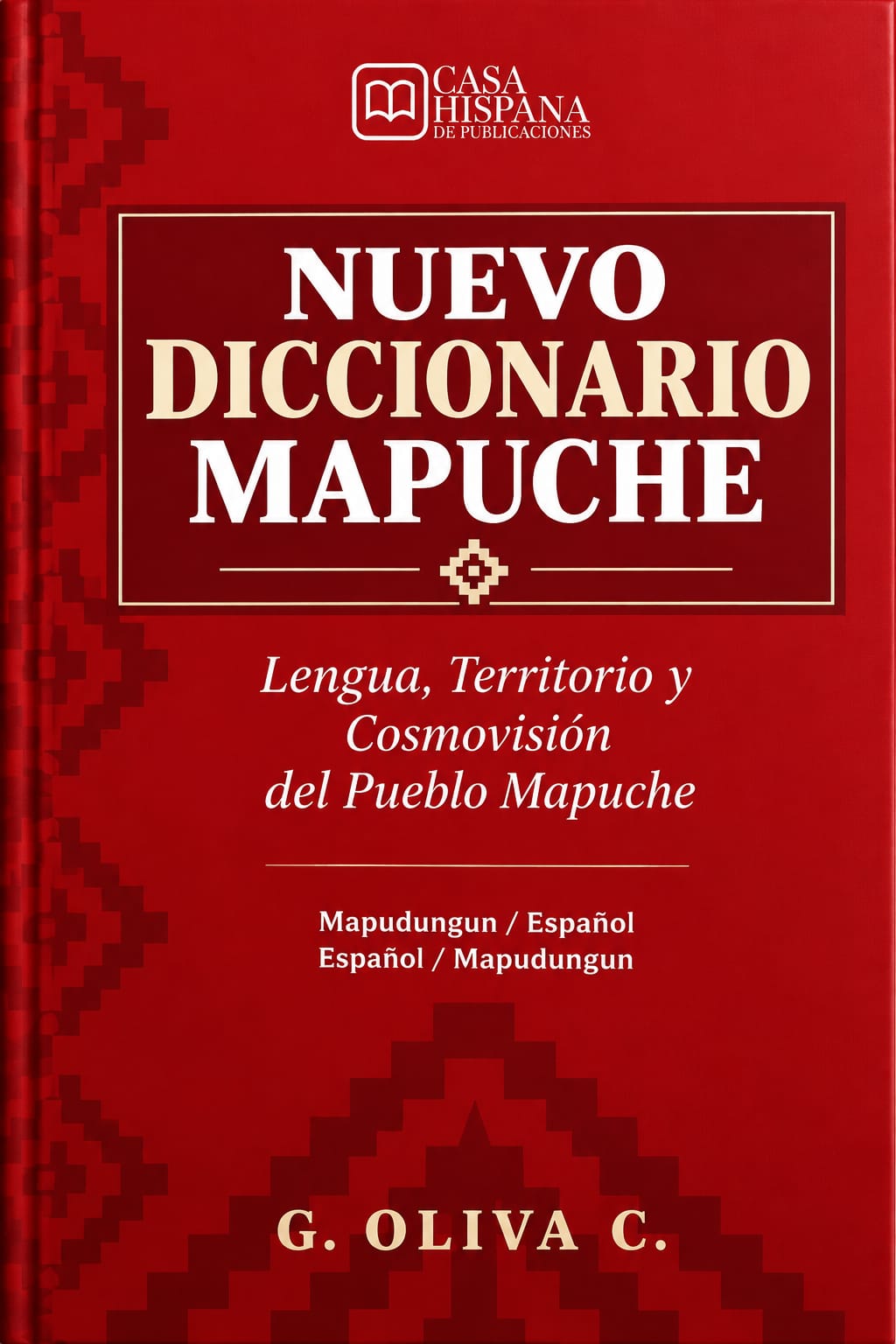
The New Mapuche Dictionary: Mapudungun, language, culture and living memory of the Mapuche people is born as a work of reference, learning and linguistic appreciation intended to bring Mapudungun closer both to those who belong to the Mapuche people and to students, teachers, researchers and readers interested in getting to know one of the indigenous languages of greatest historical and cultural relevance in southern America. Its fundamental proposal consists in establishing a practical bridge between Mapudungun - Spanish and Spanish - Mapudungun, facilitating the search for words, meanings and expressions from both languages and offering a tool that contributes to the knowledge, teaching and transmission of a linguistic heritage that remains alive in communities, families, territories and different contemporary spaces. The importance of a dictionary of this kind goes beyond the elementary function of gathering words and providing equivalents. A language is also a way of naming, organising and interpreting reality. Its lexicon holds historical experiences, territorial knowledge, family relationships, social categories, ways of observing nature and concepts that acquire meaning within specific cultural contexts. For this reason, approaching Mapudungun means encountering not only words different from Spanish, but also a linguistic memory built and passed on between generations. Each term can open a small window onto ways of understanding territory, community, nature, spirituality, kinship, work, food, human relationships and multiple dimensions of Mapuche experience. From this perspective, the dictionary seeks to avoid an understanding of Mapudungun as a language belonging exclusively to the past. Its value lies precisely in recognising it as living heritage and as a means of communication, identity and cultural transmission. A language remains alive when it can be spoken, taught, learned, written, researched and passed on. Hence gathering and organising its lexicon also has an educational and cultural dimension. To preserve a word is also to preserve a way of naming the world. When a language loses spaces of transmission, not only sounds or terms disappear: knowledge, stories, categories and memories associated with it may weaken. The bidirectional structure Mapudungun-Spanish / Spanish-Mapudungun considerably broadens the practical usefulness of the work. The first direction makes it possible to locate Mapuche words and approach their meanings in Spanish; the second allows a person to start from a word or concept in Spanish to look for its corresponding expression in Mapudungun. This double organisation makes the dictionary a particularly useful tool for learning processes, the preparation of educational materials, everyday consultation and an initial approach to the language. At the same time, it should be remembered that equivalences between two languages are not always absolutely symmetrical. There are terms whose semantic field may be broader or more specific than that of an apparently equivalent Spanish word. For this reason, where appropriate, meaning requires context and not only literal translation. This aspect is especially relevant because an intercultural dictionary needs to recognise that translating a word does not always mean translating its whole universe of meaning. Certain concepts may be closely linked to social practices, territoriality, kinship, nature or worldview. Reducing them mechanically to a single Spanish word can impoverish their meaning. The lexicographical value of a contemporary work lies, therefore, not only in presenting equivalents, but also in helping the reader to understand when a word needs additional explanation, an example of use or cultural contextualisation. The lexicon is the heart of the dictionary. Its organisation makes it possible to move through fields related to daily life, family, community, territory, nature, animals, plants, the human body, food, dwelling, traditional activities, social relationships, time, space, actions, qualities, emotions, spirituality and other spheres of human experience. This breadth makes it possible to understand that vocabulary does not exist in isolation from life. Words are born and acquire meaning within concrete relationships. Linguistic knowledge can therefore be enriched when each word is considered not only as an independent lexical unit, but as part of networks of meaning. The work also acquires special relevance within the educational sphere. It can serve as complementary material for students beginning their approach to Mapudungun, teachers who need organised vocabulary, families interested in strengthening processes of intergenerational transmission and readers seeking a first systematic reference tool. In intercultural contexts it can likewise favour a respectful approach to the Mapuche language and culture, helping to overcome ignorance and simplifications. Learning the name by which another people designates a reality is also a way of recognising its historical and cultural presence. The dictionary also has an important value for new generations. In an age marked by globalisation, mobility and the predominance of major international languages, the preservation and revitalisation of indigenous languages faces considerable challenges. Dictionaries, teaching materials, written records and digital resources can collaborate with these processes, although they never replace the speakers or the communities that transmit the language. The dictionary preserves and organises words; the community gives them voice, context and continuity. This distinction is essential. No lexicographical work can appropriate a language or present itself as absolute authority over the diversity of its speakers. Precisely for this reason, a new Mapuche dictionary needs to recognise the existence of linguistic and territorial variations. Mapudungun should not be presented as if every word necessarily had a single form used identically by all speakers. Differences in pronunciation, spelling, use and meaning are part of the reality of living languages. Where sufficiently documented variants exist, recognising them can enrich the work and prevent a given form from being automatically presented as the only legitimate one. Internal diversity does not diminish the value of the language; it shows its historical, territorial and community trajectory. From the cultural point of view, this dictionary also aspires to contribute to the recognition of Mapudungun as a fundamental part of Mapuche heritage. Words linked to territory, nature, community organisation, spirituality, kinship and memory contain knowledge that needs to be treated with rigour and respect. This requires avoiding both simplification and romanticisation. Mapuche culture is not a motionless reality, nor does it belong exclusively to the past. Its speakers and communities take part in the present, live through processes of change, develop new expressions and face the challenges proper to every contemporary society. A living language preserves memory and, at the same time, develops the capacity to name new realities. From the author's perspective, the contribution this work seeks to make can be summed up in four inseparable dimensions: Language - Memory - Identity - Transmission. Language, because it organises a lexical heritage that can be consulted and learned. Memory, because many words carry historically accumulated experiences and knowledge. Identity, because speaking and recognising a language can constitute a significant dimension of cultural belonging, without reducing Mapuche identity solely to linguistic command. Transmission, because every documentation effort acquires greater meaning when it helps new generations to approach, learn and continue developing what they received. The New Mapuche Dictionary thus seeks to be more than an alphabetical succession of terms. It aims to become a gateway to knowledge of Mapudungun and an instrument that facilitates dialogue between two languages without erasing their differences. Its Mapudungun - Spanish / Spanish - Mapudungun organisation responds to a practical, educational and intercultural purpose: to make it possible to search, understand, compare and learn. Its value lies not only in how many words it can gather, but in the care with which these are recorded, explained and contextualised. Because behind every word there is a history of use; behind every language there is a community of speakers; and behind Mapudungun there is a cultural memory that continues to dialogue with the present. To preserve the lexicon is to preserve memory. To teach the language is to open paths for its continuity. And to approach Mapudungun with respect is to recognise that the words of a people are also part of its heritage, its history and its projection towards the future…
Category
- MAPUDUNGUN
- MAPUCHE LANGUAGE
- MAPUCHE DICTIONARY
- LEXICOGRAPHY
- MAPUCHE LEXICON
- MAPUCHE VOCABULARY
- INDIGENOUS LINGUISTICS
- MAPUCHE PEOPLE
- MAPUCHE CULTURE
- MAPUCHE IDENTITY
- LINGUISTIC HERITAGE
- CULTURAL HERITAGE
- LANGUAGE REVITALISATION
- INTERCULTURAL EDUCATION
- INTERCULTURALITY
- ORAL TRADITION
- CULTURAL MEMORY
- MAPUCHE WORLDVIEW
- LINGUISTIC DIVERSITY
- INTERGENERATIONAL TRANSMISSION
Rights for this book
We turn publishing rights into international growth, connecting authors and publishers with new markets, new readers and new partners around the world.
Technical details
- Title
- Nuevo Diccionario Mapuche
- Author
- G. Oliva C.
- Imprint
- Grupo Editorial casa Hispana
- Size
- 15x23cms
- Edition
- 1st edition, 2024
- Published in
- Chile
- Year of publication
- 2025
- Available languages
- Spanish, English, German, Portuguese
- Binding
- Paperback with flaps
- Pages
- 497