Description
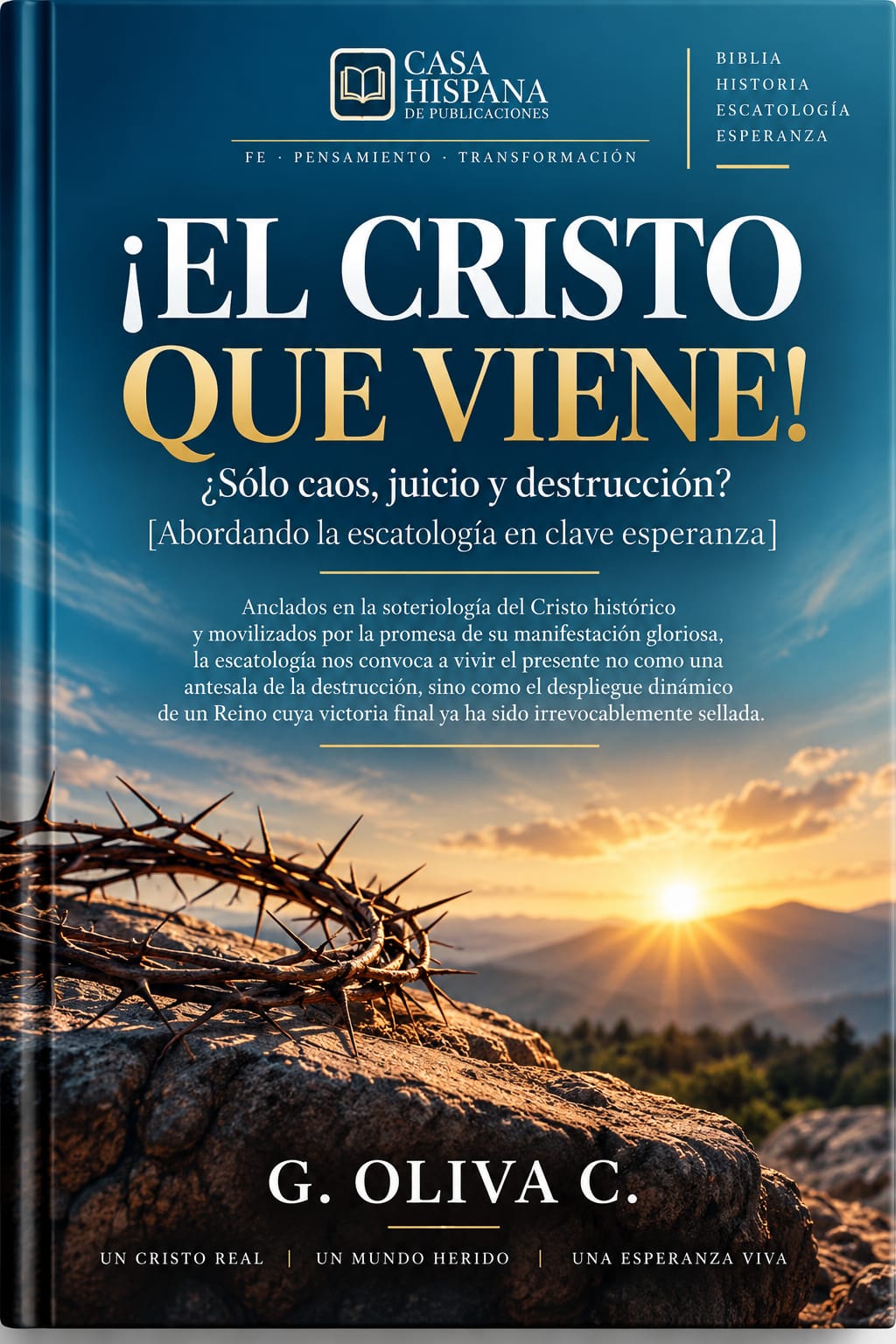
To speak of the Christ who is coming is to speak of one of the deepest confessions of the Christian faith: history does not walk towards emptiness, but towards the fulfilment of God's redemptive purpose. Biblical eschatology was not given to the Church mainly to feed speculation about dates, build endless chronologies or provoke fear of future events, but to sustain hope, strengthen perseverance and remind us that Jesus Christ, crucified and risen, will bring history to its consummation. The Christian announcement of the future begins precisely in what God has already accomplished in Christ. The resurrection is the great eschatological anticipation: the one who conquered death is also the one whose coming the Church awaits. For this reason Christian hope does not rest simply on the expectation that human circumstances will improve, but on a person: Jesus Christ. Christ Came - Christ Died - Christ Rose - Christ Reigns - Christ Will Return. This sequence makes it possible to understand that the second coming is not a marginal element of Christian doctrine, but the culmination of a history of redemption that runs through the whole of Scripture. In John 14:1-3, Jesus comforts his disciples by announcing that he will return; in Acts 1:11, after the ascension, the disciples receive the affirmation that this same Jesus will come again; Paul presents the coming of the Lord as a source of comfort for a community facing death and grief (1 Thess 4:13-18); and Revelation concludes with the prayer of the Church: "Come, Lord Jesus" (Rev 22:20). There is, therefore, a deeply Christological orientation to eschatology: the centre of the Christian future is not the antichrist, catastrophe, war or fear; the centre is Christ. When this centrality is lost, eschatology can turn into religious anxiety. When Christ recovers the centre, the doctrine of the last things once again becomes hope. From the author's perspective, one of the necessary tasks of the contemporary Church consists precisely in rescuing eschatology from two extremes: speculative obsession and practical indifference. The first tries to turn every war, earthquake, technology, economic crisis or political event into a definitive key for deciphering God's calendar; the second lives as if the promise of Christ's coming had no consequence for the present. Both perspectives impoverish biblical teaching. Jesus affirmed that no one knows the day or the hour (Matt 24:36), while the New Testament repeatedly insists on watchfulness, faithfulness and preparation. The biblically decisive question is not only when Christ will come, but how the church should live while it waits for Christ. Eschatological expectation thus becomes an ethics of the present. To wait means to live responsibly. Future hope produces present faithfulness. This relationship appears clearly in 1 John 3:2-3, where the hope of seeing Christ is linked to a life oriented towards purity. Likewise, Jesus's eschatological parables show servants managing what they received while they await their master's return. To keep watch does not mean abandoning the world to look at the sky; it means living in the world aware that our life answers to God. For this reason biblical eschatology has consequences for holiness, service, mission, justice, the management of resources and human relationships. Hope is not escape. It is a way of inhabiting the present responsibly in the light of the future promised by God. In this sense, the expression "last things" can prove insufficient when it suggests that eschatology deals only with events located at the end of a timeline. The New Testament shows that, with Christ, God's future has already begun to break into history. The Kingdom has been inaugurated, although we still await its consummation. This tension between the "already" and the "not yet" is one of the fundamental keys to understanding Christian hope. We have already received salvation, but we await its fullness; we already know eternal life, but we still face death; we have already received the Spirit, but we await full redemption; Christ already reigns, but we still wait for all opposition to be definitively overcome. Already - Not Yet. Promise - Fulfilment. Present - Consummation. The Church lives precisely within this tension. It cannot behave as if the Kingdom had not yet begun, but neither as if it had already reached its full plenitude. This protects both from absolute pessimism and from religious triumphalism. The Christian does not affirm that all is lost, because Christ rose; nor does the Christian affirm that all is fully restored, because suffering, injustice, sin and death still exist. Biblical hope looks at both realities and confesses that neither of them has the last word over creation. One of the great events associated with this hope is the resurrection of the dead. The Christian faith does not simply propose the abstract survival of the soul, but God's victory over death. First Corinthians 15 places the resurrection at the very heart of the gospel. The risen Christ is the firstfruits of those who have died, and the future resurrection expresses the continuity of God's creative and redemptive purpose. Christian salvation, therefore, does not despise the body. We await integral redemption. Death is not the final destiny; resurrection is promise. This hope also transforms the Christian way of facing grief. Paul does not teach that believers will never experience sorrow; he teaches that they should not grieve "like the others who have no hope" (1 Thess 4:13). The pain remains real, but it ceases to be definitive. The tomb continues to be painful, but it is no longer the last frontier. Eschatological hope makes it possible to weep without despairing. Alongside the resurrection appears the biblical teaching about judgement. To speak of hope does not mean eliminating this dimension. The Christ who is coming is Saviour and Judge. Scripture affirms moral responsibility and accountability before God. However, judgement must not be used as an instrument of psychological manipulation nor become a fascination with the condemnation of others. Its meaning includes the affirmation that evil will not be eternally a matter of indifference, that human actions carry moral weight and that God will establish justice. For those who have suffered violence, persecution or oppression, the promise of justice can also be a dimension of hope. Evil is not eternal. Injustice will not have the last word. Death will not be sovereign. Christ is the Lord of history. This conviction allows the Church to seek justice without making vengeance its mission, because definitive judgement belongs to God. Biblical eschatology also leads towards a cosmic understanding of redemption. Romans 8 describes a creation groaning as it awaits liberation, while Revelation 21 presents new heavens and a new earth and proclaims God's dwelling with humanity. Christian hope does not end simply with individuals escaping from creation, but with God bringing his redemptive work to a renewed reality where death, weeping and pain no longer hold dominion. This dimension is especially significant for a theology of creation. If God does not abandon what he created, future hope does not authorise the Church to despise the present world. Stewardship, the responsible care of the earth and the protection of life can be understood as coherent expressions of a faith that recognises God as Creator and Redeemer. We do not save the planet by our own strength nor confuse ecological responsibility with eschatological consummation; we simply recognise that what belongs to God deserves to be treated responsibly. Eschatological hope also drives mission. Matthew 28:19-20 links the sending of the disciples to the promise of Christ's presence "to the end of the age". The Church proclaims the gospel because it lives between the resurrection and the consummation. Each generation receives anew the responsibility to bear witness. However, mission and eschatology must be related without manipulation. We do not evangelise in order to manufacture prophetic events or to control God's calendar. We evangelise because Christ commanded it, because the gospel is good news and because people of every people, language and nation are called to take part in the redeemed community. To wait for Christ is also to bear witness to Christ. This gives mission an extraordinary intercultural perspective. Revelation presents a multitude from peoples, tribes, languages and nations. Diversity does not appear simply as an obstacle that must disappear, but within the universal horizon of redemption. Pentecost had already anticipated this principle: the same gospel communicated among many languages. Christian mission can then proclaim Christ without confusing evangelism with cultural uniformity. The future belongs to God, not to a particular culture. Eschatological hope also relativises human powers. Empires, governments, economies, ideologies and institutions appear and disappear within history; none can claim absolute character. To confess that Jesus Christ is Lord means recognising that no human structure deserves ultimate obedience. However, this affirmation does not turn eschatology into a partisan programme either. The Kingdom of God cannot be fully identified with any political project, nation, economic system or historical movement. The Church can seek justice, defend dignity, serve the needy and work for peace, but it must not confuse its temporal preferences with the consummation of the Kingdom. Christ is coming; no human power takes his place. This conviction offers freedom from fear. Every Christian generation has faced events capable of seeming definitive: wars, epidemics, persecutions, political collapses, revolutions, disasters and technological transformations. Interpreting them responsibly requires prudence. The Church must avoid turning newspaper headlines into automatically fulfilled prophecies. Scripture deserves a more serious hermeneutic than the hasty search for correspondences between biblical symbols and contemporary figures. Date - Speculation - Sensationalism - Fear do not constitute the path of a healthy eschatology. Christ - Promise - Watchfulness - Faithfulness - Hope do provide a more solid biblical axis. The different Christian traditions have interpreted in diverse ways matters such as the millennium, the tribulation, the rapture and the sequence of certain eschatological events. These differences deserve serious and respectful study. However, what is debated should not hide what historically constitutes the shared core of Christian hope: Jesus Christ will return, the dead will rise, there will be judgement, evil will be definitively overcome and God will bring his redemptive purpose to its consummation. Chronologies can be debated; Christ remains at the centre. From the author's perspective, this distinction is pastorally necessary because a doctrine meant to produce hope should not become a permanent source of anxiety among believers. Eschatology needs to return to the language of apostolic comfort. "Encourage one another with these words", Paul writes after teaching about the coming of the Lord (1 Thess 4:18). Encourage, not terrify. Prepare, not speculate. Persevere, not flee from responsibilities. Bear witness, not calculate dates. The true eschatological question then reaches our daily life: if Christ is coming, how do we treat our neighbour? How do we manage our gifts? How do we use our resources? How do we face suffering? How do we serve? How do we forgive? How do we proclaim the gospel? How do we live when no one is watching us? An eschatology that knows every prophetic scheme but does not transform character has lost part of its biblical purpose. The future promised by God must produce faithfulness in the present. In this way, THE CHRIST WHO IS COMING! proposes approaching eschatology in the key of hope, recovering its Christological, pastoral and missionary centre. It is not a matter of ignoring the biblical warnings, but of placing them within the greater horizon of redemption. Christian history does not end with a beast, a war, a crisis or a tomb. It ends — and at the same time definitively begins — under the lordship of the Lamb. Coming Of Christ - Resurrection - Judgement - Restoration - New Creation are dimensions of a hope that calls the Church to remain awake and active. That is why waiting for the Lord should never mean abandoning the earth, despising history or being paralysed before the future. It means working while we wait, serving while we wait, loving while we wait, proclaiming while we wait and remaining faithful while we wait. Christian eschatology is not the art of guessing when the world will end; it is the conviction that the world and history have a destiny in God. The church does not simply wait for something that will happen: it waits for someone who is coming. And that someone is Jesus Christ. That is why our last word is not fear, but hope; not defeat, but resurrection; not abandonment, but presence; not darkness, but the promise of the Christ who is coming…
Category
- ESCHATOLOGY
- THE SECOND COMING OF CHRIST
- PAROUSIA
- THE COMING CHRIST
- CHRISTIAN HOPE
- ESCHATOLOGICAL HOPE
- RESURRECTION
- RESURRECTION OF THE DEAD
- THE KINGDOM OF GOD
- CONSUMMATION OF THE KINGDOM
- FINAL JUDGEMENT
- NEW CREATION
- ETERNAL LIFE
- REDEMPTION
- THEOLOGY OF HOPE
- CHRISTOLOGY
- CHRISTIAN WATCHFULNESS
- MISSION OF THE CHURCH
- BIBLICAL PROPHECY
- ESCHATOLOGICAL THEOLOGY
Rights for this book
We turn publishing rights into international growth, connecting authors and publishers with new markets, new readers and new partners around the world.
Technical details
- Title
- ¡El Cristo que viene!
- Author
- G. Oliva C.
- Imprint
- Grupo Editorial casa Hispana
- Size
- 15x23cms
- Edition
- 1st edition 2022
- Published in
- Chile
- Year of publication
- 2023
- Available languages
- Spanish, English, German, Portuguese
- Binding
- Paperback with flaps
- Pages
- 514