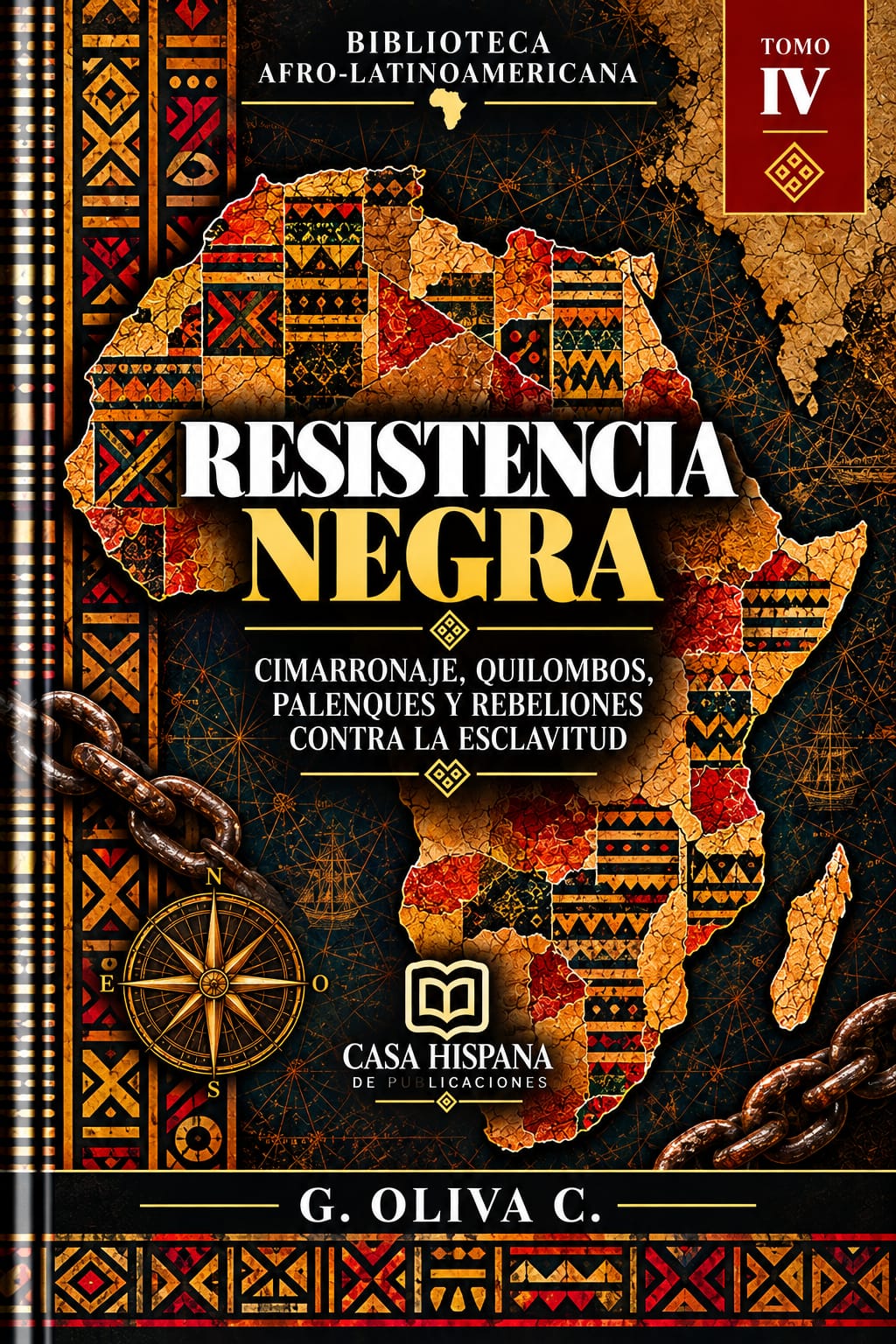
Description
The history of slavery in Latin America cannot be fully understood if African and Afro-descendant people appear only as victims of a system imposed upon them, because from the first moments of capture in Africa to the last decades of the legal existence of slavery there was opposition, negotiation, escape, community organisation, cultural preservation, litigation, sabotage, rebellion and multiple strategies aimed at recovering spaces of autonomy and freedom, and precisely for this reason Black resistance constitutes a structural dimension of Afro-Latin American history and not a marginal episode later added to the history of slavery, because where there was domination there were also responses to it, although these responses took very different forms depending on the territory, the period, economic conditions, possibilities of mobility, family networks, geography, relations with other groups and the degree of control exercised by owners and authorities. To speak of Black resistance requires beginning by recognising a fundamental distinction between slavery and passivity, because having been subjected does not mean having inwardly accepted the imposed condition, and a person could be legally enslaved while developing concrete strategies to protect their family, preserve elements of their identity, improve their conditions, negotiate spaces of autonomy, escape, acquire their freedom or take a direct part in collective actions against the system. Slavery sought to appropriate labour and limit freedom, but it never managed to control the human will completely, and this tension between domination and autonomy is one of the great interpretive axes of the Afro-descendant experience in Latin America. From the perspective developed by the author it is necessary to understand that resistance began even before arrival in the Americas, because captured people could try to escape during the African interior transfers, resist during coastal confinement or take part in acts of opposition during the Atlantic crossing, and once disembarked the possibilities of resistance changed but did not disappear, so that the ocean does not separate two completely different histories but different stages of a single human search for freedom. However, resistance must not become a category so broad that it ends up losing meaning, because not every daily action carried out by an enslaved person necessarily constituted a conscious rebellion against the institution, and for this reason it is worth distinguishing between survival, agency, negotiation, cultural resistance, everyday resistance, organised escape and open rebellion. These forms could be related and overlap, but they were not identical. Surviving could constitute a victory over a deeply destructive system, but survival did not always imply an explicit political intention. Negotiating better conditions could broaden autonomy without immediately questioning the whole institution. Buying freedom could use mechanisms recognised by the system itself in order to leave it. Escaping constituted a direct break with the owner's dominion. Organising a rebellion involved an even more open collective confrontation. This diversity shows that enslaved people acted within different margins of possibility and that their decisions must be studied from the concrete circumstances in which they were taken. It is not appropriate to demand retrospectively a single form of heroism. The one who stayed beside their children to protect them could be making a decision as deeply human as the one who escaped to a palenque. The one who negotiated could do so because a rebellion meant the risk of death for their family. The one who bought their freedom could later use their resources to free other people. History needs to understand these strategies before judging them. Black resistance was therefore plural. It was individual and collective. Rural and urban. Open and silent. Legal and extralegal. Cultural and political. Spiritual and material. Family-based and communal. Organised and spontaneous. This plurality is precisely one of its fundamental characteristics. Marronage represents one of the most visible expressions of this search for freedom and is generally related to the escape of enslaved people who left the control of owners, haciendas, mines, plantations, cities or other spaces of exploitation seeking to recover autonomy. But escaping did not automatically mean attaining permanent freedom, because the fugitive could face persecution, capture, hunger, illness, isolation, unfamiliarity with the territory or violence, and the authorities could develop mechanisms aimed at recovering fugitives. Escape was therefore a decision laden with risk. This reality makes it possible to understand its historical meaning better. Escaping meant rejecting in practice the property right that another person claimed to exercise over the fugitive. The owner said "they belong to me". The escape answered through a concrete action: "my life belongs to me". This dimension turns marronage into a practical negation of one of the legal foundations of slavery. The maroon did not need to write a treatise on freedom to affirm their right to it. Their movement could constitute a political declaration made with the body. Walking towards a forest, a mountain, a border or a distant territory could mean leaving the geography of domination and attempting to build a geography of autonomy. Territory thus acquired decisive importance within different experiences of resistance. Jungles, mountains, swamps, border regions and areas of difficult access could offer possibilities for establishing refuges and communities. Geography did not automatically determine resistance, but it could create favourable conditions for it. Knowing paths, rivers, forests, agricultural cycles and natural resources could become strategic knowledge. Freedom needed space. This relationship between territory and resistance is one of the most significant aspects of the history of marronage, because it shows that recovering autonomy consisted not only in breaking a labour relationship but also in recovering the capacity to decide where to live, with whom to relate, how to organise work and which rules to follow. When fugitives began to establish relatively stable settlements, communities arose known by different names according to regions and historiographical traditions, and among the best known are the quilombos and mocambos in Brazil and the palenques in different territories of Spanish America, although the words, contexts and characteristics of these communities should not automatically be regarded as equivalent. Each experience needs to be studied within its concrete history. Some communities were small and temporary. Others survived for prolonged periods. Some remained relatively isolated. Others maintained economic, political or military relations with neighbouring populations. Some gathered mainly African and Afro-descendant fugitives, while others could interact with indigenous people, free mestizos, the poor, merchants and different sectors of colonial society. This diversity prevents the construction of a single image of the quilombo or the palenque. They were not necessarily communities completely isolated from the colonial world. They could trade, negotiate, exchange products, receive information, establish alliances or enter into conflict with nearby populations. The border between slaveholding society and fugitive community could be more permeable than certain heroic representations suggest. This complexity does not diminish their significance. It strengthens it, because it shows the capacity to build real alternatives within extremely adverse historical conditions. The Brazilian quilombos constitute one of the fundamental examples of…
Category
- BLACK RESISTANCE
- AFRO-DESCENDANT RESISTANCE
- MARRONAGE
- MAROONS
- QUILOMBOS
- PALENQUES
- ANTI-SLAVERY REBELLIONS
- SLAVE RESISTANCE
- COLONIAL SLAVERY
- AFRO-DESCENDANTS
- AFRICAN DIASPORA
- MAROON COMMUNITIES
- AUTONOMOUS COMMUNITIES
- CULTURAL RESISTANCE
- COMMUNITY RESISTANCE
- STRUGGLE FOR FREEDOM
- EMANCIPATION
- ABOLITION OF SLAVERY
- HISTORICAL MEMORY
- AFRO-LATIN AMERICAN HISTORY
Rights for this book
We turn publishing rights into international growth, connecting authors and publishers with new markets, new readers and new partners around the world.
Technical details
- Title
- Resistencia negra
- Author
- G. Oliva C.
- Imprint
- Grupo Editorial casa Hispana
- Size
- 15x23cms
- Edition
- 1st edition, 2026
- Published in
- Chile
- Year of publication
- 2026
- Available languages
- Spanish, English, German, Portuguese
- Binding
- Paperback with flaps
- Pages
- 498