Description
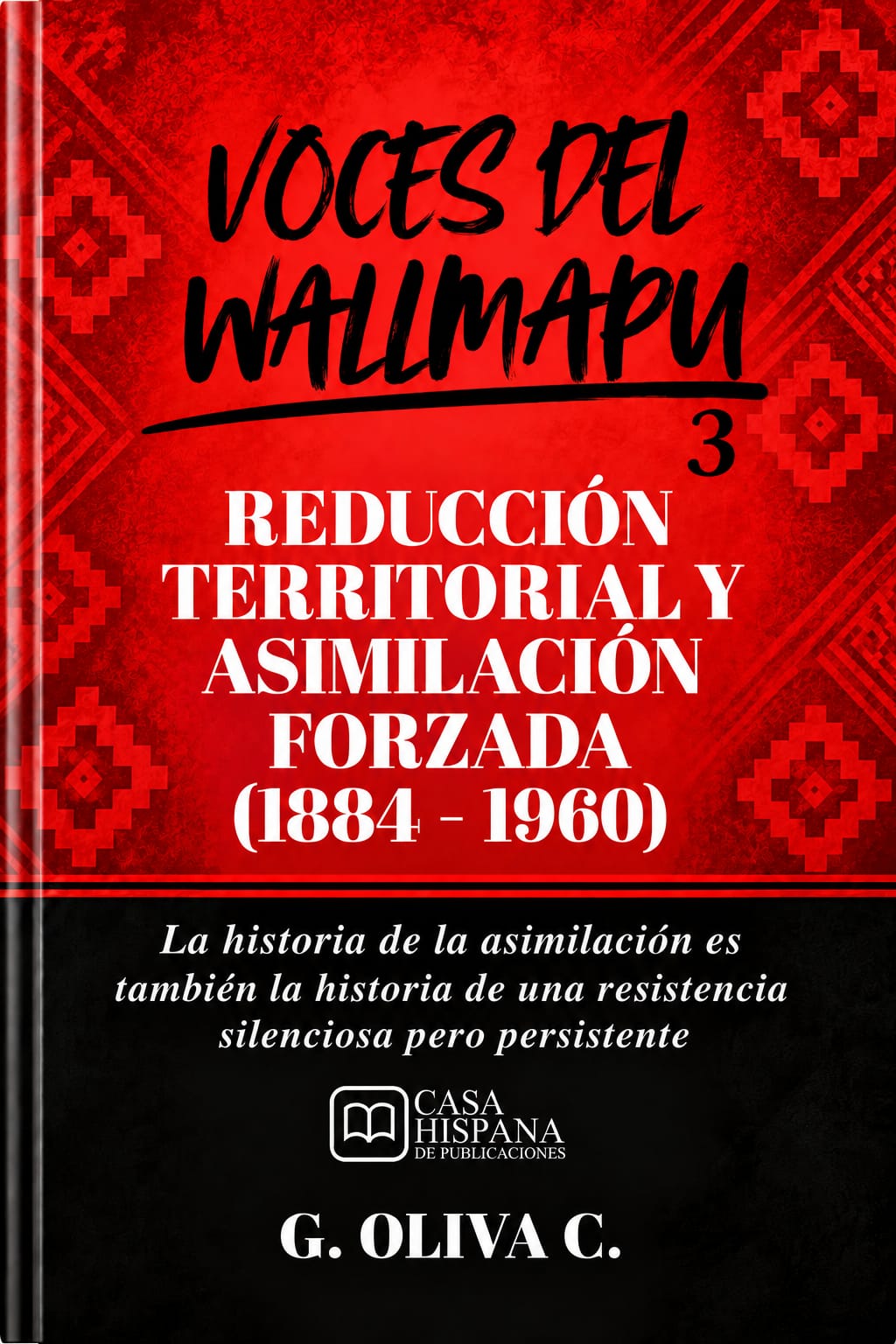
Territorial Reduction and Forced Assimilation (1884–1960) is the third volume of a study devoted to understanding the historical transformation of relations between the Mapuche people and the Chilean State. If the preceding period was marked by the military occupation of the Araucanía and the loss of territorial autonomy, this new cycle raises a different but closely related question: what became of the Mapuche people once the State had consolidated political and military control over their territory? The answer leads towards a stage less defined by open military campaigns, yet no less profound in its consequences. From the end of the nineteenth century there began a process of land allotment, territorial reduction, colonisation, legal transformation of property and the subordinate incorporation of Mapuche communities into the national order. The State no longer needed merely to control the territory; it had to administer it, distribute it, draw it into the economy and define the place its original inhabitants would occupy within Chilean society. This volume examines precisely that passage: from military occupation to the administration of a population and a territory. Reduction did not mean simply having less land. It altered systems of production, family relations, authorities, patterns of mobility and the possibilities of economic and cultural reproduction. At the same time, educational, legal, religious and social policies were fostering varying degrees of incorporation into a national society that tended to regard cultural homogenisation as part of progress. To speak of assimilation, therefore, means studying something deeper than the loss of territory. It means examining the pressures brought to bear on language, identity, customs, communal institutions and a people's own ways of understanding the world. After the occupation. The consolidation of State control during the 1880s produced a radical transformation. The old frontier gradually ceased to work as a political space of negotiation between State and Mapuche authorities. The territory was absorbed into Chilean administrative structures and subjected to new rules governing property, colonisation and economic exploitation. In 1883 the Comisión Radicadora de Indígenas began its work, an institution essential to any understanding of the period that followed. Through the process of land allotment (radicación), Títulos de Merced were granted to Mapuche communities and families over demarcated areas. According to Memoria Chilena, the allotment process carried out between 1884 and 1929 ended by conceding some 3.000 Títulos de Merced over approximately 500.000 hectares, leaving the communities with a fraction of the territory they had previously occupied. This new geography had enormous consequences. The territory began to be divided in law between Indigenous lands recognised by the State, fiscal land, private property and areas set aside for colonisation. Land ceased to be organised primarily through Mapuche territorial relations and became subordinate to survey, titles, registers, boundaries and the legal categories of the State. The change was political, economic and cultural. Reduction as social transformation The word reducción, which names a territorial reality, also describes a social process. The reducciones (the reservation-like land settlements imposed by the Chilean State) concentrated communities into considerably smaller spaces. This altered farming, stock-rearing, mobility and the use of natural resources. Activities that had formerly required extensive territories now had to be carried on within ever narrower limits. The consequences accumulated steadily. Less land meant less productive capacity. The growth of families increased the pressure on limited areas. The fragmentation of holdings weakened the possibility of sustaining certain traditional forms of production. The poverty that later affected many communities cannot therefore be understood solely as the result of individual decisions or of a failure to adapt to modernisation. Structural historical conditions were at work. When a society loses much of its territorial base and must rapidly reorganise its economic life within reduced spaces, the consequences can extend across generations. This relationship between territory, poverty and inequality is one of the central sociological axes of the work. Land turned into property. There is, moreover, a conceptual transformation that deserves particular attention. For the modern State, land had to have defined boundaries, identifiable owners and legally recognised titles. For Mapuche communities, territory had historically been bound up with family, communal and territorial structures that did not always coincide with those categories. The imposition of a new regime of property therefore produced an unequal encounter between two ways of understanding and organising space. This helps to explain why many later conflicts cannot be reduced simply to determining who currently holds legal title. Positive law answers one fundamental question: who is the owner in law. History asks another: how did that territory come to acquire the structure of ownership it now has? The two questions are different and, at the same time, both necessary. The book tries to keep them in dialogue. Colonisation and a new regional society. While Mapuche communities were being allotted their land, the territory was simultaneously undergoing processes of Chilean and foreign colonisation. Families, farmers, traders and workers arrived. Towns, roads, schools, productive activities and later new transport infrastructure were developed. The Araucanía was drawn ever more closely into the national economy. This process produced a new regional society. Mapuche and non-Mapuche began to live alongside one another within a profoundly transformed space. Yet that coexistence was born marked by an unequal distribution of resources and power. Contemporary regional society was built precisely upon this complex overlaying of histories. To acknowledge the historical dispossession of the Mapuche does not mean denying that later generations of non-Indigenous families also developed a sense of belonging and rootedness in the region. The historical difficulty is that different memories of belonging can coexist over one and the same territory. That overlaying is one of the antecedents which help to explain the present-day complexity of the territorial question. From reduction to assimilation. The second great axis of the volume is cultural assimilation. Once the Mapuche people had been territorially incorporated into the Chilean State, a political question characteristic of the nation states of that era arose: what was to be done with a population that retained its own language, identity, authorities, customs and cultural forms? For much of the period under study, the prevailing answer was shaped by an ideal of a culturally homogeneous nation. The Indigenous person was progressively to become a Chilean citizen in accordance with the institutions, language and values held to be national. The problem did not necessarily lie in acquiring citizenship, education or a share in national society. It arose when that incorporation entailed renouncing cultural difference. Here lies the core of the concept of assimilation. Integration means taking part in a common society while legitimately retaining an identity of one's own. Assimilation means that such participation is conditional, explicitly or implicitly, on the progressive abandonment of that identity. School, language and identity Education played a central part. The school could be an extraordinary instrument of literacy and social mobility. But it could also become a space in which one culture was held to be legitimate and another had to remain outside. Castilian Spanish occupied the centre of the education system. Mapudungun, by contrast, was frequently relegated to the family and the community. This linguistic inequality had profound consequences. A language is not merely an instrument for conveying information. It carries categories, memories, ways of naming nature, kinship, spiritualities and knowledge. When a language loses the social spaces in which it is passed on, part of a cultural heritage also begins to weaken. Mapudungun survived nonetheless. And that survival is an important expression of cultural resistance. The weight of discrimination. Assimilation did not operate through institutions alone. It also worked socially. To be Mapuche came to be frequently associated with negative categories constructed by the dominant society: backwardness, poverty, rurality or a lack of education. Such representations produced discrimination. Faced with them, some people began to conceal surnames, to stop using Mapudungun in public or to play down certain elements of their identity in order to avoid stigma. This phenomenon is sociologically significant. Assimilation can be produced by law, but also by something more everyday: making a person feel that in order to be accepted they must stop resembling themselves. Cultural discrimination has precisely that capacity. It does not need formally to prohibit an identity. It can turn it into a source of shame. Resistance, adaptation and reorganisation, Yet to read the period 1884–1960 solely through assimilation would give an incomplete picture. The Mapuche people did not disappear. Nor did they stand still. Communities developed multiple strategies of resistance, adaptation, negotiation and reorganisation. Legal mechanisms were used to defend land. New organisational forms emerged. Traditional authorities continued to perform communal functions, while new leaders learned to deal with State institutions and political parties. During the first decades of the twentieth century, Mapuche organisations began to emerge that sought to represent collective interests within the new national setting. The Sociedad Caupolicán Defensora de la Araucanía, founded in 1910, and the Araucanian Federation, later linked to Manuel Aburto Panguilef, expressed different forms of organisation and claim-making. This process is fundamental. Mapuche resistance ceased to be expressed chiefly through military confrontation and began to take new forms: social organisation, petition, education, legal defence, political leadership and cultural claim-making. Mapuche society was being transformed. The urban Mapuche. Another phenomenon gradually gained importance: migration to the cities. Land scarcity, rural poverty and the search for educational and employment opportunities drove movement towards urban centres. This process would intensify over the following decades, but its roots already lie within the period under study. Migration produced new experiences of identity. To be Mapuche no longer meant exclusively living within a rural community. There came to be an urban Mapuche experience as well. In the cities, people might face discrimination and the loss of communal networks, but also gain access to education, work and new forms of organisation. Mapuche identity thus began to be rebuilt in different spaces. The Church and cultural transformation. The Church also occupies a significant place within this process. Catholic missions and later various Protestant expressions took part in education, evangelisation, social assistance and community formation. The history of the missions holds important contributions that must be acknowledged. Missionaries studied languages, recorded customs, founded schools and accompanied communities. But a critical study must also ask another question: to what extent did certain forms of evangelisation contribute, consciously or unconsciously, to processes of cultural assimilation? The question does not seek to disqualify the Christian mission. It seeks to distinguish the Gospel from Western culture. When abandoning legitimate cultural practices was presented as a necessary condition for conversion to Christianity, evangelisation and assimilation could become confused. This problem is of enormous significance for contemporary missiology. A person can be converted to Jesus Christ without necessarily ceasing to be culturally Mapuche. The Church needs to learn from this history. A mature cross-cultural mission does not seek to reproduce the missionary culturally, but to communicate the Gospel with biblical fidelity and with respect for the identity of peoples. Taking stock of seventy-six years. The idea of taking stock is once again useful for understanding this third volume. What was left after the military occupation? There remained a people territorially reduced. There remained communities subjected to new rules of property. There remained an Indigenous economy forced to reorganise itself. There remained territorial disputes. There remained processes of colonisation. There remained a language that began to lose its public spaces. There remained experiences of discrimination. But there also remained resistance, memory, community, organisation and identity. The historical stocktaking cannot record losses alone. It must also record what survived. Despite the enormous transformations brought about between 1884 and 1960, the Mapuche people preserved fundamental elements of their identity. Communities continued. Mapudungun continued. Authorities and territorial memories continued. Cultural practices continued. And new forms of political and social organisation began. The history of this period is therefore at once a history of dispossession and a history of persistence. The inheritance towards 1960. By the middle of the twentieth century, the Mapuche question had changed profoundly from what it had been in 1884. The old frontier no longer existed. The territory was fully incorporated, administratively, into the State. But formal integration had not resolved the inequalities. Rural poverty, territorial fragmentation, land conflicts, discrimination and difficulty of access to opportunity all persisted. At the same time, new national debates were beginning on agrarian reform, the peasantry, property and social justice. These processes would open a different stage. During the 1960s and the early 1970s, the Mapuche territorial question would come to be linked increasingly with peasant movements, structural reforms and new Indigenous organisations. For this reason 1960 is a fitting analytical boundary. It closes a long period dominated by reduction, land allotment and assimilationist incorporation, and opens another marked by social mobilisation, agrarian reform and territorial recovery. A final consideration. Territorial Reduction and Forced Assimilation (1884–1960) studies a period less visible than the military campaigns of the nineteenth century, but possibly more decisive for understanding the contemporary social configuration of the Araucanía. Military occupation altered sovereignty. Reduction altered the land. Colonisation altered the regional structure. The school altered linguistic relations. Discrimination pressed upon identity. The economy altered forms of subsistence. And Mapuche organisation answered by building new ways of resisting and taking part. This is precisely one of the central theses of the volume: the end of the war did not mean the end of the historical conflict. It simply changed its nature. Military confrontation gave way to territorial, legal, economic, cultural and political disputes whose effects ran through much of the twentieth century.. The period 1884–1960 also shows that a society can formally incorporate a people within its borders without yet having resolved how to live with their cultural difference. The great challenge was not merely to turn the Mapuche into a Chilean citizen. It was to learn to understand that he could be at once a Chilean citizen and Mapuche. That apparently simple distinction contains one of the great historical problems examined by this work. This third volume is therefore not only a history of lands lost. It is also a history of identity, memory and cultural survival. After the occupation, the Mapuche people had to learn to live within a State that had profoundly transformed their territory. The State, for its part, still had to learn something it would take many decades to begin to acknowledge fully: to integrate should not mean to erase; sharing a State does not necessarily require sharing a single cultural identity. Between 1884 and 1960 much of that tension was built. Understanding it is indispensable for understanding the territorial, cultural and political demands that would reappear with renewed force during the second half of the twentieth century. And it also makes it possible to grasp a fundamental historical reality: despite territorial reduction, assimilationist pressure and the profound transformations undergone, the Mapuche people remained. Their memory remained. Their identity. Their language. Their relationship with the territory. And there remained a question that would run through the generations to come: how are dignity, territory and recognition to be rebuilt after being incorporated into a State that for decades sought to integrate the Mapuche people without fully understanding their right to go on being culturally different?…
Category
- SOCIAL SCIENCES
- HISTORY
- HISTORY OF CHILE
- LATIN AMERICAN HISTORY
- MAPUCHE HISTORY
- INDIGENOUS STUDIES
- HISTORICAL SOCIOLOGY
- CULTURAL ANTHROPOLOGY
- TERRITORIALITY
- INDIGENOUS PEOPLES
- STATE AND INDIGENOUS PEOPLES
- CULTURAL IDENTITY
- INTER-ETHNIC RELATIONS
Rights for this book
We turn publishing rights into international growth, connecting authors and publishers with new markets, new readers and new partners around the world.
Technical details
- Title
- Reducción Territorial y Asimilación Forzada (1884–1960)
- Author
- G. Oliva C.
- Imprint
- Grupo Editorial Casa Hispana de Publicaciones
- Size
- 15x23cms
- Edition
- 1st edition, 2024
- Published in
- Chile
- Year of publication
- 2025
- Available languages
- Spanish, English, German, Portuguese
- Binding
- Paperback with flaps
- Pages
- 558
- Format
- Print book
- Language
- Spanish