Description
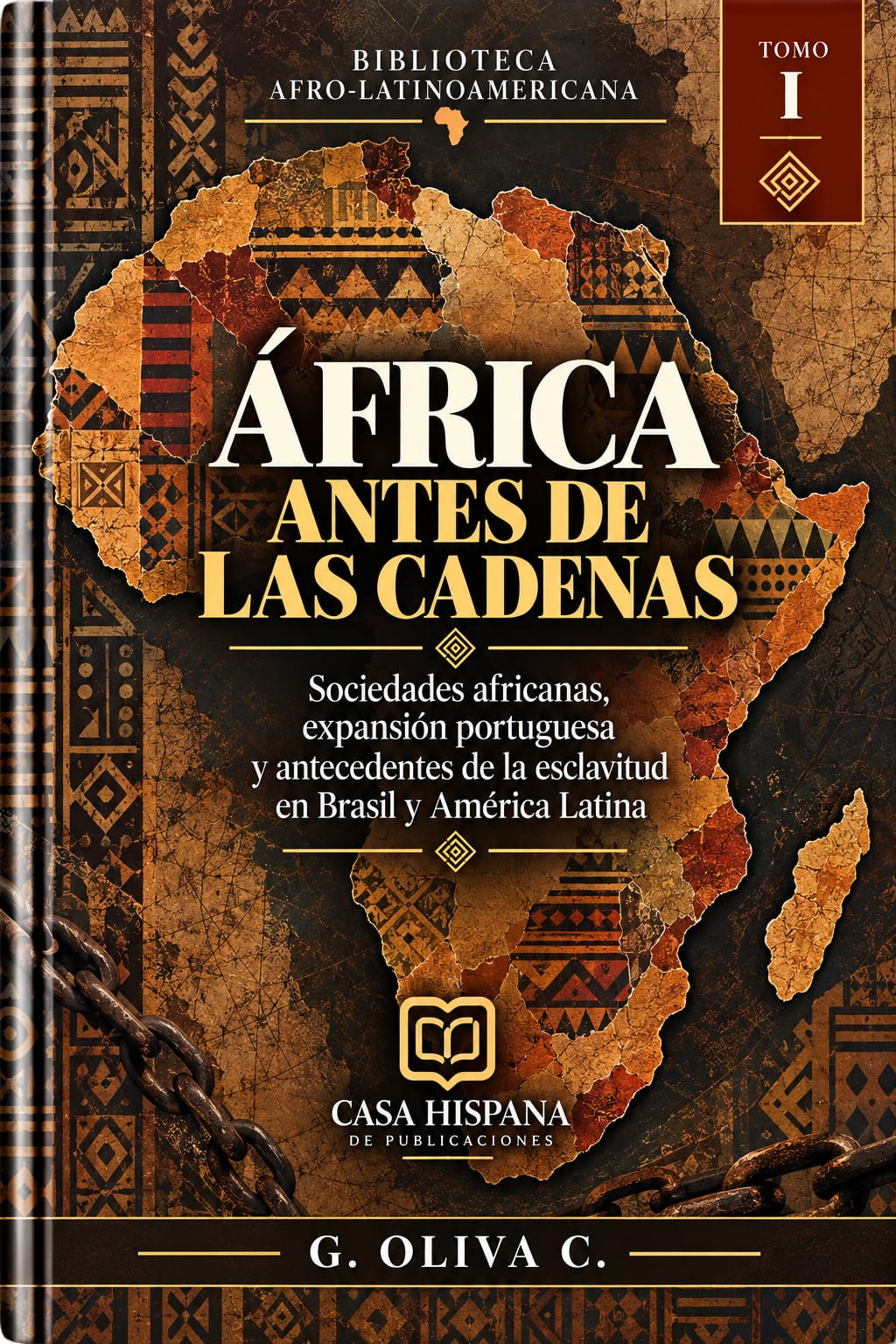
Africa Before the Chains is an invitation to recover a history that for centuries was narrated from the moment of enslavement, as if the historical existence of millions of Africans had begun when they were captured, transported and sold on the other side of the Atlantic; yet long before the slave ships crossed the African coasts, the continent was home to complex societies, rural communities, cities, trading centres, kingdoms, empires, religious traditions, political systems, metallurgical knowledge, exchange networks, artistic expressions, family institutions, languages, memories and diverse forms of social organisation, and precisely for this reason understanding the African diaspora requires beginning before the chains, because those who were enslaved were not human beings without history or identity but people belonging to concrete peoples, bearers of knowledge, languages, family relationships, spiritualities, techniques, memories and experiences accumulated over generations. One of the author's central concerns is to question that historical representation which turns Africa solely into a stage of slavery, poverty, colonialism, conflict or dependence, because this image, besides being incomplete, reproduces a view built largely from later experiences of domination and ends up concealing centuries of African history prior to the Atlantic trade; studying Africa before the diaspora therefore means recovering the temporal depth of the continent and recognising that its history is not an appendix to European history and does not begin with the arrival of the Portuguese, Spanish, British, French, Dutch or other powers, but has historical processes of its own whose understanding requires attention to the extraordinary geographical, linguistic, political, economic and cultural diversity of the continent. Speaking of "Africa" demands from the outset a fundamental methodological precaution, because the term designates a continent of enormous extent and diversity and not a single culture; the societies of the Nile valley cannot be confused with those of the Sahel; the communities of West Africa present trajectories different from those in Central, East or Southern Africa or the Horn of Africa, and within each of these great regions there also existed multiple peoples, languages, political structures, economies and traditions; for this reason general expressions such as "African culture" or "African religion" must be used with extreme caution, since they can produce exactly what a rigorous history seeks to avoid: the reduction of millions of people and hundreds of societies to a homogeneous identity. Africa is plural. Its histories are plural. Its peoples are plural. So are its memories. This diversity is the necessary starting point for reconstructing its past. Long before European expansion there existed in different African regions societies organised through political structures ranging from relatively decentralised communities to monarchies, kingdoms and great empires; some developed complex administrations, tribute systems, armies, diplomatic networks, regional markets, urban centres and long-distance trade relations; others organised their life through less centralised political structures that should not automatically be interpreted as inferior, because the absence of a territorial State similar to the European one is not the same as the absence of political organisation. This precision is fundamental. For a long time certain historiographies used European categories to measure the development of other societies: City, State, Writing, Monarchy, Monumental architecture. These were turned into almost universal indicators of civilisation. Societies that did not respond exactly to these categories could be labelled primitive. But contemporary research makes it possible to understand that human communities develop multiple forms of complexity. A society may possess sophisticated systems of kinship, oral law, distribution of resources, authority, ecological knowledge, trade and conflict resolution without building monumental palaces. African history needs to be interpreted from this institutional plurality…
Category
- PRECOLONIAL AFRICA
- HISTORY OF AFRICA
- AFRICAN PEOPLES
- AFRICAN KINGDOMS
- AFRICAN EMPIRES
- AFRICAN CIVILISATIONS
- AFRICAN CULTURES
- AFRICAN MEMORY
- AFRICAN IDENTITY
- AFRICAN HERITAGE
- AFRICAN DIASPORA
- ATLANTIC DIASPORA
- ATLANTIC SLAVERY
- TRANSATLANTIC SLAVE TRADE
- AFRICAN ANCESTRY
- ORAL TRADITION
- CULTURAL DIVERSITY
- AFRICAN LEGACY
- AFRO-LATIN AMERICAN HISTORY
- HISTORICAL MEMORY
Rights for this book
We turn publishing rights into international growth, connecting authors and publishers with new markets, new readers and new partners around the world.
Technical details
- Title
- África antes de las cadenas
- Author
- G. Oliva C.
- Imprint
- Grupo Editorial casa Hispana
- Size
- 15x23cms
- Edition
- 1st edition, 2026
- Published in
- Chile
- Year of publication
- 2026
- Available languages
- Spanish, English, German, Portuguese
- Binding
- Paperback with flaps
- Pages
- 458