Description
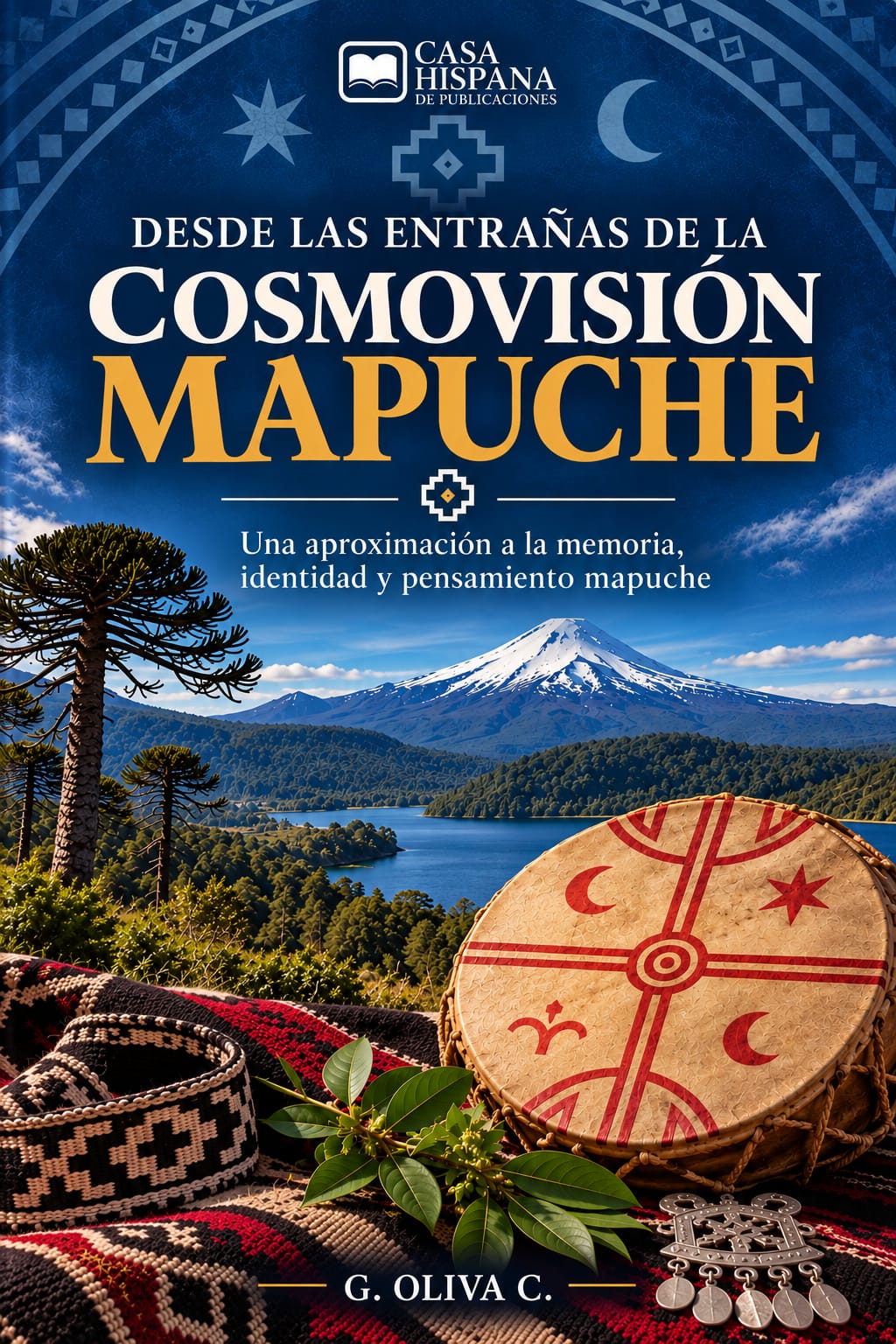
The Mapuche worldview constitutes an integral way of understanding existence through which the Mapuche people have historically interpreted their relationship with territory, nature, community, ancestors, spirituality, time, health and the different dimensions of life, and for this reason it should not be reduced simply to an isolated set of religious beliefs, myths or ceremonies, because it constitutes a much broader cultural structure from which human relationships, community practices, territorial knowledge, traditional medicine, language, social organisation, the transmission of memory and certain ways of relating to the environment acquire meaning; from the author's perspective, approaching this worldview requires recognising that we stand before a living cultural tradition that possesses historical depth but that at the same time has undergone internal transformations, intercultural contacts, processes of adaptation and new interpretations, and therefore any rigorous research must avoid presenting the Mapuche people as a homogeneous society all of whose members share exactly the same beliefs, practices or explanations of the world. One of the fundamental principles for approaching the Mapuche worldview is the relational understanding of existence, because within numerous Mapuche cultural expressions the person does not appear completely separated from family, community, territory and the other forms of life, but set within a network of relationships that help to shape identity, belonging, responsibility and memory; this perspective makes it possible to understand why concepts related to territory, nature, health, spirituality and community tend to appear deeply linked, and why it is insufficient to study them as completely independent categories; land, for example, does not represent only productive surface, water is not merely an economic resource, plants do not constitute exclusively material available for human use, and territorial spaces may also contain stories, names, memories, knowledge, family relationships and cultural meanings. This relational understanding does not mean affirming that all elements of nature are conceived in an identical way or that there is a single Mapuche doctrine about each phenomenon, but recognising that the relationships between people, territory and the natural world hold a particularly significant place within traditional forms of cultural understanding; territory is thus transformed into lived space and not merely geographical delimitation; it contains paths, watercourses, mountains, forests, meeting places, ceremonial spaces, cemeteries, productive zones, plants, animals and names transmitted across generations, and each of these elements may be related to memory and knowledge. Mapudungun is indispensable for understanding this depth, because every worldview is expressed through linguistic categories, and words are not simple labels placed over realities previously defined by other cultures; a language organises meanings, establishes relationships, distinguishes concepts and transmits particular ways of naming experience; for this reason, studying the Mapuche worldview solely through Spanish translations can lead to overly hasty equivalences in which complex concepts end up reduced to Western words that are apparently similar but semantically different. From this perspective, the research developed by the author considers it fundamental to avoid automatic translations, especially within the spiritual sphere; Mapuche terms related to authorities, practices, ceremonies, forces, territorial relationships or spiritual dimensions need to be studied within their own historical, linguistic and community contexts, because immediately translating a word as "god", "spirit", "demon", "shaman" or "religion" may introduce categories from other traditions that do not necessarily correspond precisely to what the Mapuche word expresses. This problem appears particularly clearly around the concept of Ngünechen, frequently translated in a simplified way as "Creator God" in popular materials, although the historical, linguistic, religious and community interpretations associated with the term are more complex and have also been the subject of discussion and transformation through the influence of intercultural and Christian contact; for this reason serious research should present the different documented interpretations and avoid constructing an absolute equivalence between Christian theological categories and Mapuche spiritual categories. Something similar occurs with wekufe or weküfü, which is usually translated simply as "evil spirit" and placed in direct opposition to Ngünechen in order to build a dual structure similar to Western categories of good and evil; this explanation may be pedagogically attractive, but it runs the risk of oversimplifying concepts whose meaning needs to be understood within specific cultural systems; the Mapuche worldview should not be artificially reconstructed as if it corresponded exactly to a universal dualist theology in which two equivalent forces govern the universe…
Category
- MAPUCHE WORLDVIEW
- MAPUCHE CULTURE
- MAPUCHE PEOPLE
- MAPUCHE SPIRITUALITY
- CULTURAL IDENTITY
- MAPUCHE TERRITORY
- MAPUDUNGUN
- KÜME MONGEN
- ANCESTRAL KNOWLEDGE
- INDIGENOUS KNOWLEDGE
- ORAL TRADITION
- COLLECTIVE MEMORY
- NATURE
- MAPUCHE RITUALITY
- MAPUCHE MEDICINE
- CULTURAL HERITAGE
- INTERGENERATIONAL TRANSMISSION
- INTERCULTURALITY
- INTERCULTURAL EDUCATION
- CULTURAL PRESERVATION
Rights for this book
We turn publishing rights into international growth, connecting authors and publishers with new markets, new readers and new partners around the world.
Technical details
- Title
- Desde las entrañas de la cosmovisión mapuche
- Author
- G. Oliva C.
- Imprint
- Grupo Editorial casa Hispana
- Size
- 15x23cms
- Edition
- 1st edition, 2024
- Published in
- Chile
- Year of publication
- 2025
- Available languages
- Spanish, English, German, Portuguese
- Binding
- Paperback with flaps
- Pages
- 458