Description
The importance of the human rights of indigenous peoples lies in the recognition that their individual and collective dignity is not a concession granted by States nor a privilege derived from their ethnic belonging, but an expression of rights inherent to the human condition that acquire certain specific dimensions because of their identities, cultures, languages, territories, institutions and historical experiences; indigenous peoples have formed part of the history of humanity long before the constitution of numerous contemporary States, and their forms of organisation, knowledge, memories, cultural systems and relationships with territory represent living heritage whose continuity depends to a large extent on their being able to exercise their rights effectively, without discrimination, forced assimilation, displacement or loss of identity. To speak of indigenous human rights requires understanding that there is an inseparable relationship between individual rights and collective rights; an indigenous person has the same fundamental human rights as any other person, but in addition forms part of a people whose cultural existence may depend on the recognition of collective elements such as language, territory, traditional institutions, participation, social organisation, cultural heritage and intergenerational transmission; this collective dimension constitutes a fundamental characteristic of contemporary international law relating to indigenous peoples. The development of instruments such as Convention 169 of the International Labour Organization and the United Nations Declaration on the Rights of Indigenous Peoples consolidated internationally principles related to non-discrimination, participation, consultation, lands, resources, culture, education, own institutions and the determination of development priorities; Convention 169 is based precisely on respect for the cultures and ways of life of indigenous and tribal peoples and recognises their participation in decisions that affect their lives, as well as rights linked to lands and natural resources. (Normlex). One of the essential foundations of these rights is found in human dignity; recognising the dignity of indigenous peoples means abandoning those historical conceptions that presented them as inferior, backward, incapable societies or ones inevitably destined to disappear within dominant cultures; during different historical periods these conceptions served to justify policies of assimilation, displacement, territorial appropriation, linguistic prohibition, educational discrimination and intervention in their institutions. The contemporary paradigm of indigenous rights represents precisely a departure from those assimilationist conceptions; the very evolution of international norms shows this change; Convention 169 replaced the earlier approach of ILO Convention 107, whose integrationist orientation belonged to another era, and established a framework based on respect for cultures, ways of life, participation and the capacity of peoples to define priorities related to their own development. (International Labour Organization). Within this framework equality acquires a meaning that goes beyond the simple declaration that all people are equal before the law; treating culturally and historically different realities justly may require recognising specific conditions, because a purely formal equality can coexist with deep material inequalities; a people whose language cannot be used within the education system, whose traditional land lacks protection or whose institutions are not considered in decisions that directly affect their territory may formally hold the same individual rights as other citizens while facing specific obstacles to exercising them. The struggle against racial, ethnic and cultural discrimination therefore constitutes an essential dimension of indigenous rights; discrimination may manifest itself through open aggression but also through prejudice, stereotypes, invisibility, institutional exclusion, linguistic barriers, unequal treatment and distorted representation of indigenous cultures; combating these forms of discrimination requires legislation, institutions, education and cultural changes capable of recognising indigenous peoples as legitimate participants in diverse societies. This transformation also begins in education, because prejudices do not appear spontaneously but can be reproduced through incomplete historical accounts, family stereotypes, public discourse or educational materials; Convention 169 expressly provides for educational measures aimed at eliminating prejudice and points to the importance of teaching materials offering a fair, accurate and informative description of indigenous societies and cultures. (International Labour Organization). Culture constitutes another central dimension of these rights, because a people does not exist only through isolated individuals; its continuity also depends on memory, language, practices, knowledge, symbols, community relationships, forms of cultural transmission and historical ties; protecting cultural rights means allowing communities to maintain, develop, transmit and renew those elements without being forced to abandon their identity in order to take part in national society. Language has an especially profound importance, because through it particular ways of understanding history, territory, nature, family relationships, spirituality and collective memory are transmitted; when an indigenous language disappears, not only a system of words is lost; a singular way of organising knowledge and expressing a historical experience also disappears. For this reason intercultural and linguistically relevant education represents much more than a pedagogical policy; it can become an instrument of cultural continuity; Convention 169 establishes that education programmes for indigenous peoples must be developed in cooperation with them and incorporate their histories, knowledge, techniques, value systems and aspirations, and provides for measures to preserve and promote their languages. (International Labour Organization). This perspective does not mean isolating indigenous children from national societies; a solid intercultural education should provide them with tools to function fully both within their communities and within broader societies; learning the national language and taking part in general education systems need not imply abandoning the original language, identity or family memory. Self-determination constitutes another fundamental principle, although it needs to be understood with legal and political precision; in general terms it recognises indigenous peoples as subjects capable of taking part in determining their priorities and of maintaining their own institutions within the applicable legal frameworks; it does not simply mean that any community may act without legal limits, but that decisions that deeply affect their existence should not systematically be adopted without their participation. Convention 169 recognises the right of the peoples concerned to decide their own priorities regarding the process of development when it affects their lives, beliefs, institutions, spiritual wellbeing and lands, and establishes their participation in the formulation, implementation and evaluation of plans and programmes that may affect them directly. (International Labour Organization). This recognition profoundly changes the traditional relationship between the State and indigenous peoples, because it progressively replaces a paternalistic model in which others decide what is convenient for communities with one based on participation, dialogue, representation and shared responsibility; the community ceases to be merely the recipient of public policies and begins to be recognised as a subject that takes part in defining them. Territory is probably one of the deepest dimensions of this relationship; for many indigenous peoples land does not represent exclusively an economic property susceptible to monetary valuation; it constitutes a space of memory, kinship, subsistence, culture, spirituality, cemeteries, traditional routes, ecological knowledge and historical continuity; completely separating territory and identity may be impossible within certain worldviews. This understanding makes it possible to grasp why territorial conflicts have a depth that frequently exceeds discussions about individual property; a hectare of land may have a certain commercial value within the market, but for a community it may contain ceremonial sites, water sources, family cemeteries, medicinal plants, productive spaces and memories transmitted over generations. The protection of traditionally occupied lands therefore holds a central place in Convention 169, which requires identifying those lands and guaranteeing effective protection of rights of ownership and possession, and also provides for adequate procedures to resolve land claims. (Normlex). However, territory and natural resources generate some of the most complex legal, political and economic debates, because over the same space there may be indigenous, State, private, productive, environmental, energy or mining interests; a human rights-based approach does not automatically eliminate those conflicts, but it requires that the affected peoples not be treated as invisible obstacles to projects defined entirely by third parties. Natural resources have a direct relationship with this question; water, forests, minerals, biodiversity, soils, fisheries and other goods can sustain both national economies and community ways of life; Convention 169 provides that the rights of the peoples concerned to the natural resources pertaining to their lands must receive special protection and includes their participation in the use, management and conservation of those resources under the terms established by the…
Category
- THEOLOGY
- SYSTEMATIC THEOLOGY
- CHRISTOLOGY
- CONTEXTUAL THEOLOGY
- LATIN AMERICAN THEOLOGY
- CHRISTIAN EDUCATION
- SPIRITUALITY
- MISSION
- SOCIAL JUSTICE
- PASTORAL THEOLOGY
Rights for this book
We turn publishing rights into international growth, connecting authors and publishers with new markets, new readers and new partners around the world.
Technical details
- Title
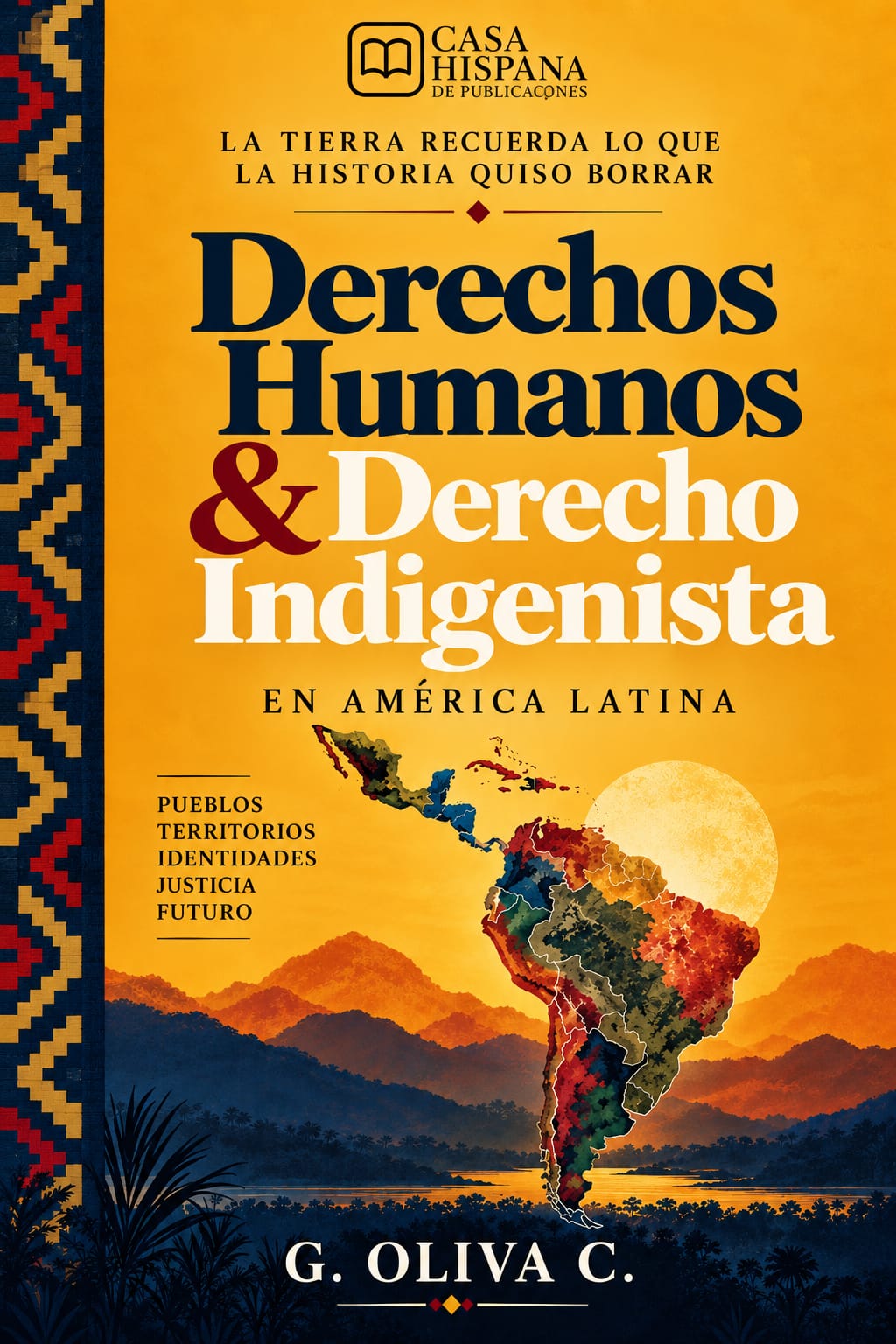
- Derechos humanos & derecho indigenista en América Latina
- Author
- G. Oliva C.
- Imprint
- Grupo Editorial casa Hispana
- Size
- 15x23cms
- Edition
- 1st edition, 2023
- Published in
- Chile
- Year of publication
- 2025
- Available languages
- Spanish, English, German, Portuguese
- Binding
- Paperback with flaps
- Pages
- 472