Description
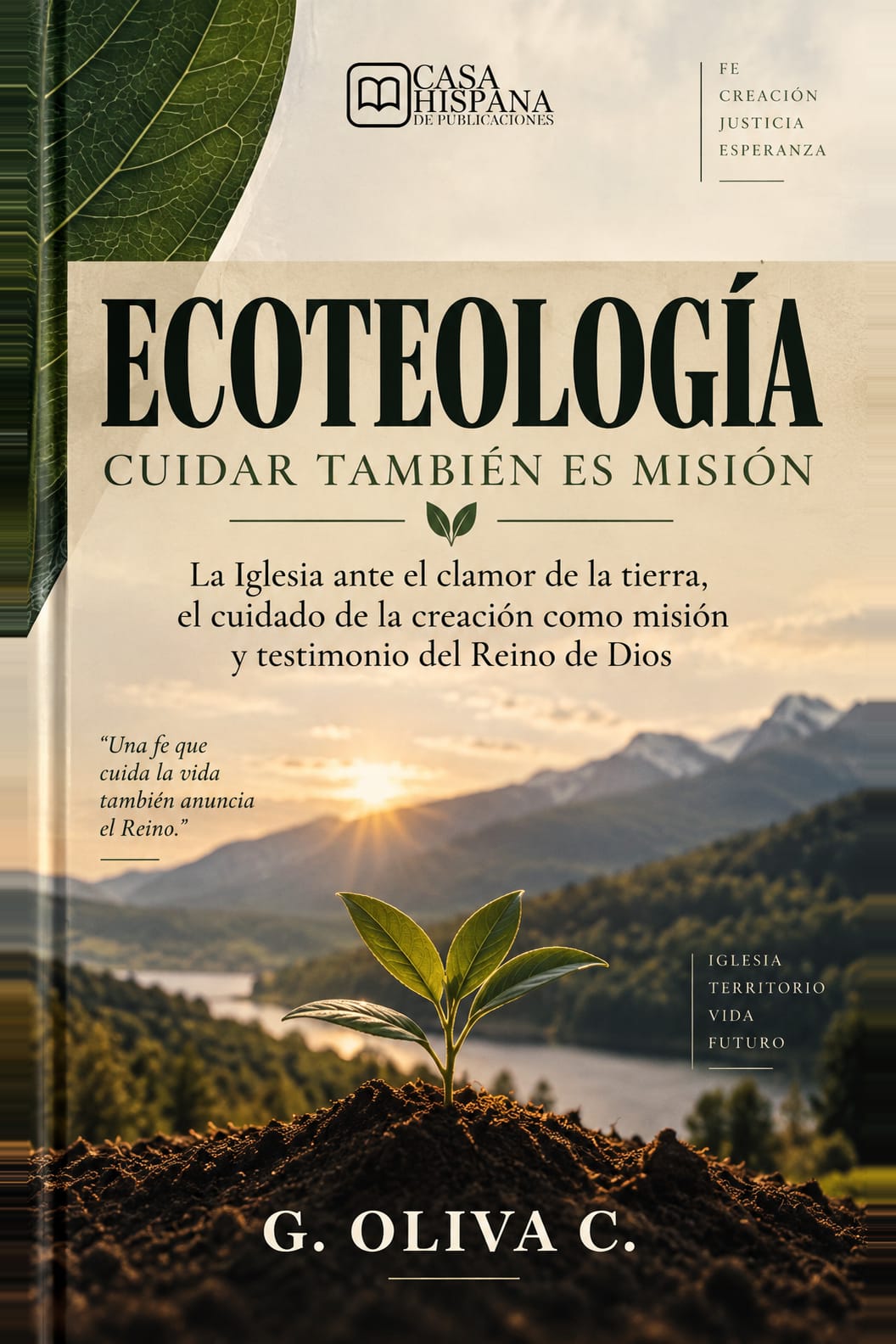
Christian ecotheology constitutes a theological reflection on the relationship between God, humanity and the whole of creation, and seeks to recover a dimension of the faith that during certain periods of Christian history received less attention than other doctrinal and pastoral themes; its starting point does not consist simply in incorporating contemporary environmental concerns into the discourse of the Church, but in returning to the Scriptures to ask what it means to confess God as Creator, what responsibility belongs to the human being within creation, and how the Christian doctrines of creation, sin, redemption, Kingdom of God, hope and mission can illuminate our relationship with the Earth; from this perspective care for the environment ceases to be regarded as a peripheral matter reserved exclusively for scientists, environmental organisations or government policies and begins to be recognised as a question that also has spiritual, ethical, social, pastoral and missiological dimensions, because the way a society uses water, manages soils, protects forests, treats animals, produces food, consumes energy, generates waste and distributes the costs of environmental degradation inevitably expresses certain values about life, one's neighbour and future generations. One of the concerns running through this work consists precisely in recovering a theology of creation solid enough to avoid two extremes: on the one hand, a spirituality that concentrates the whole of Christian experience exclusively on individual salvation and ends up regarding the material world as something theologically secondary, and on the other, an interpretation that divinises nature or dilutes the biblical difference between the Creator and what has been created; Christian ecotheology needs to hold both affirmations: God transcends creation, and creation has value because it comes from God; nature is not God, but neither is it a reality devoid of meaning, simply available for any form of human appropriation; this distinction makes it possible to develop a specifically Christian environmental ethic in which respect for nature is born not from its divinisation but from recognising it as a work belonging to the Creator. The Genesis account begins precisely by placing creation before the appearance of the human being; light, the heavens, the waters, the earth, vegetation, the heavenly bodies, aquatic animals, birds and land animals receive recognition within the creative order before humanity can attribute usefulness to them; this sequence has a profound theological importance, because it reminds us that the value of creation does not depend exclusively on the economic or material benefit it provides to our species; when Genesis repeatedly affirms that what was created is good, it establishes a valuation that precedes its human use; biodiversity, forests, rivers, oceans and the other components of the natural world do not begin to have meaning only when they are turned into resources; they possess a creational dignity derived from their relationship with God. The human being nevertheless holds a particular position within the biblical account, being presented as the image and likeness of God; this singularity has sometimes been interpreted as authorisation for a practically unlimited dominion over nature, but from the perspective developed by the author this reading needs to be examined in the light of the whole of the biblical witness; exercising dominion as bearers of the divine image should reflect the character of the God whose image we represent, and the biblical God does not appear simply as a distant owner but as the one who sustains, feeds, preserves and cares for his creatures; for this reason human authority over creation must be understood as delegated responsibility and not as absolute sovereignty. Genesis 2:15 offers a particularly significant formulation when it presents the human being placed in the garden to till it and keep it; these two movements make it possible to build a balanced theology of stewardship; to till means working, transforming, producing and obtaining from the land what is needed to sustain human life, while to keep means protecting, conserving, watching over and preserving; biblical responsibility does not demand a completely untouchable nature, because the human being also needs to use it, but neither does it authorise an exploitation that systematically destroys its capacity for regeneration; the tension between tilling and keeping is perhaps one of the most pertinent images for thinking about sustainable development from a Christian perspective. Stewardship arises precisely from this understanding; the steward manages what belongs to another, and therefore their authority is accompanied by responsibility; Psalm 24 declares that the earth is the Lord's and the fullness thereof, an affirmation that relativises any human claim to absolute ownership; we may legally own land, companies, resources or goods, but theologically we remain temporary administrators within a creation we did not originate and that will remain after us; this awareness transforms the environmental question: it is no longer only a matter of determining how much we may legally extract, but how much we ought responsibly to use, what we need to conserve, what consequences our decisions produce and what kind of world we will hand over to those who come after. Christian stewardship therefore embraces much more than money or church administration, although for a long time the term has been used predominantly in those spheres; we are also stewards of water, soil, energy, food, materials, biodiversity and the technological possibilities we have received; a coherent theology of stewardship cannot teach financial responsibility while ignoring the systematic waste of natural resources, because both behaviours ultimately belong to the same question about how we manage what lies under our responsibility. Psalm 104 broadens this vision by presenting a deeply interrelated creation in which springs, mountains, trees, animals, seas and human beings form part of an order sustained by God; the text does not seek to offer a modern scientific description of ecosystems, but it expresses a theological intuition extraordinarily compatible with what contemporary ecology allows us to understand: no creature exists completely in isolation; water connects soils, plants, animals and human communities; forests influence multiple ecological processes; oceans sustain food webs and regulate fundamental aspects of the climate system; wetlands connect terrestrial and aquatic environments; and the loss of certain components can have repercussions on others. This interdependence obliges us to revise an excessively individualistic Christian anthropology; the human being not only maintains relationships with God and with other human beings; they also exist bodily within ecological systems; we breathe air, drink water, depend on productive soils, consume living organisms and need climatic conditions compatible with our existence; recognising this dependence does not diminish human dignity; on the contrary, it places us correctly within the created order: we are responsible creatures within a broader community of life. The research developed by the author considers that this awareness can correct one of the deepest cultural problems of modernity: the illusion of independence from nature; contemporary cities can partially hide our ecological dependence; water appears from a tap, food arrives packaged, electricity through cables and waste disappears in lorries; this necessary infrastructure can produce the impression that resources simply exist, when in reality each one has a territorial history; water comes from basins, rivers, aquifers, lakes or reservoirs; food depends on soils, water, climate, biodiversity, energy and labour; materials come from ecosystems and industrial processes; and what we discard must inevitably end up somewhere; recovering this awareness is part of a spirituality of creation. Gratitude can acquire here a deep ecological dimension; giving thanks for food should also lead to valuing the soils, the water, the seeds, the farmers and the ecosystems that make its production possible; giving thanks for water can awaken responsibility towards the basins that provide it; recognising creation as gift changes our relationship with it, because what is received as a gift should hardly be treated with contempt; Christian spirituality can thus contribute to forming habits of moderation, gratitude and responsibility in the face of a culture in which consumption frequently tends to identify wellbeing with the growing accumulation of goods. This does not mean that ecotheology should become an indiscriminate condemnation of economic development, industry, technology or consumption; the author considers it necessary to avoid that simplification; human development has made it possible to reduce numerous forms of suffering, extend life expectancy, improve nutrition, build infrastructure, develop medicine and connect societies; the theological question does not consist in determining whether humanity should transform nature, because every civilisation necessarily does so, but under what limits, criteria and responsibilities it should do so; the problem appears when transformation compromises the ecological conditions needed to sustain life or when its costs are systematically transferred to vulnerable communities or future generations. Here environmental justice enters directly into the field of ecotheology; environmental degradation does not affect all people in the same way; a high-income community may have insurance, infrastructure, climate control, transport and the capacity to relocate, while populations with fewer resources may depend directly on agriculture, fishing, forests or local water sources and have less capacity to adapt to droughts, floods, pollution, soil loss or ecosystem degradation; for this reason the same environmental event can generate profoundly different social consequences. Environmental justice asks who receives the benefits of an economic activity, who bears its impacts, who takes part in decisions, who has access to information and who has the capacity to defend their rights; this perspective is compatible with the biblical prophetic tradition, which constantly relates worship to social justice; the prophets questioned a religiosity capable of maintaining ceremonies while ignoring the oppression, exploitation and suffering of one's neighbour; a coherent Christian ecotheology needs to continue that logic: when the degradation of a territory affects water, food, health, livelihoods or cultural identity, the environmental problem also becomes a question of justice. Climate justice constitutes a contemporary extension of this concern; climate change is a global phenomenon, but its impacts and response capacities are unequally distributed; certain communities contribute relatively little to global emissions and yet may experience significant consequences because of their geographical location, economic dependence or social vulnerability; this asymmetry raises ethical questions about responsibility, solidarity, adaptation, financing and international cooperation…
Category
- CHRISTIAN ECOTHEOLOGY
- CHRISTIAN STEWARDSHIP
- THEOLOGY OF CREATION
- CARE OF CREATION
- GOD'S CREATION
- INTEGRAL ECOLOGY
- ECOLOGICAL SPIRITUALITY
- ENVIRONMENTAL RESPONSIBILITY
- ENVIRONMENTAL JUSTICE
- CLIMATE JUSTICE
- ENVIRONMENTAL ETHICS
- ENVIRONMENT
- BIODIVERSITY
- ENVIRONMENTAL CONSERVATION
- ECOLOGICAL RESTORATION
- SUSTAINABLE DEVELOPMENT
- SUSTAINABILITY
- INTEGRAL MISSION
- CHURCH AND THE ENVIRONMENT
- INTERGENERATIONAL RESPONSIBILITY
Rights for this book
We turn publishing rights into international growth, connecting authors and publishers with new markets, new readers and new partners around the world.
Technical details
- Title
- Ecoteología
- Author
- G. Oliva C.
- Imprint
- Grupo Editorial casa Hispana
- Size
- 15x23cms
- Edition
- 1st edition 2022
- Published in
- Chile
- Year of publication
- 2025
- Available languages
- Spanish, English, German, Portuguese
- Binding
- Paperback with flaps
- Pages
- 425