Description
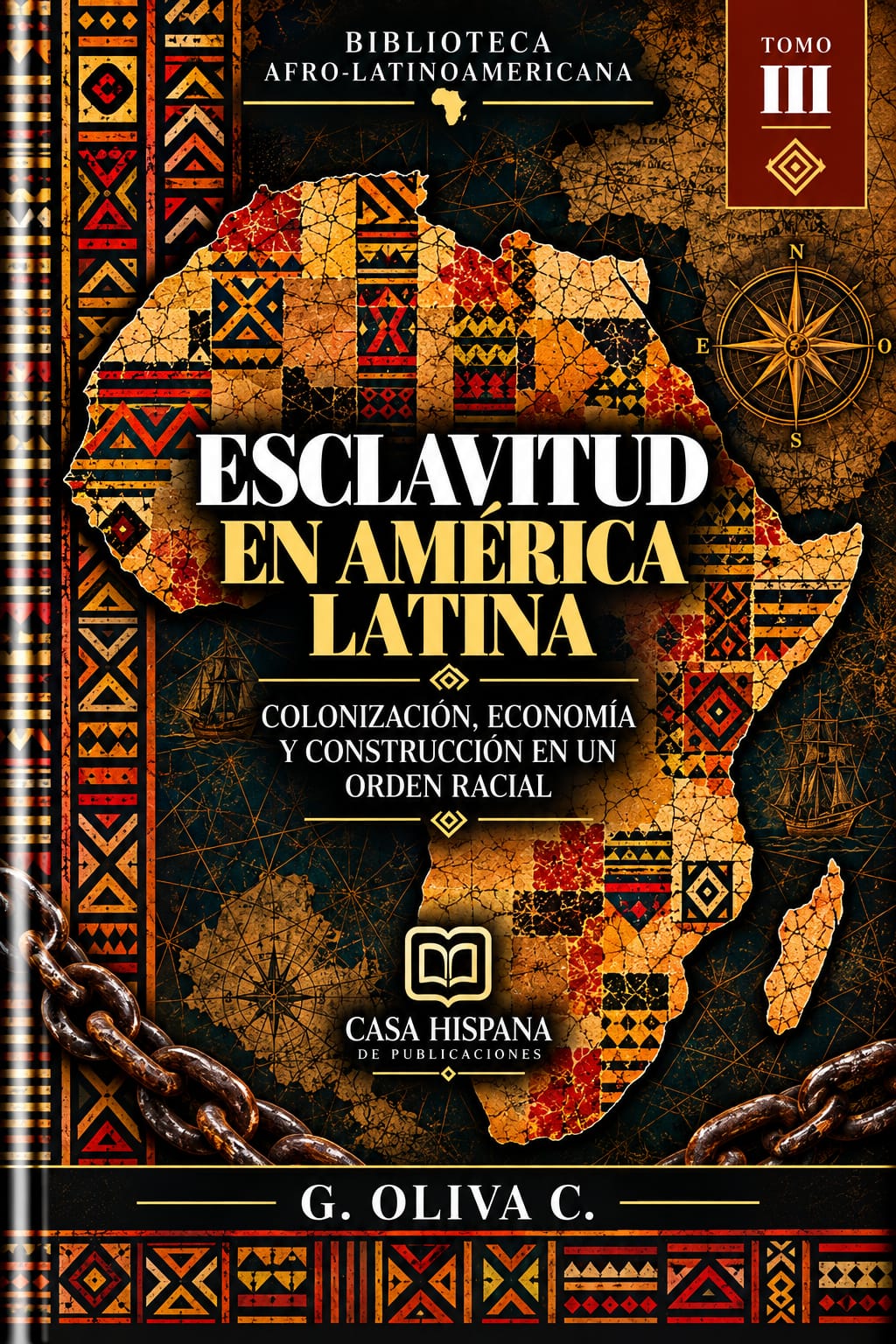
Slavery in Latin America constitutes one of the fundamental historical processes for understanding the economic, social, political, cultural and racial formation of the continent, because for several centuries millions of African people and their descendants were subjected to systems of coerced labour that took a direct part in the building of colonial economies, cities, trade circuits, agricultural estates, mining centres, haciendas, ports, fortifications, dwellings, infrastructure and domestic and craft activities; and yet for a long time an important part of Latin American national narratives presented this presence as secondary or peripheral, when in numerous territories the African and Afro-descendant population constituted a structural component of colonial and later republican society; for this reason studying Latin American slavery does not mean adding a further chapter to a previously complete history but revising the very way in which we have understood the formation of Latin America. The passage from The Atlantic of the Enslaved to Slavery in Latin America represents a change of scene but not an interruption of the process, because disembarkation in American ports did not end the forced displacement begun in Africa but opened a new stage marked by sale, redistribution, exploitation, adaptation, resistance and community reconstruction; those who survived capture, the African interior transfers, coastal confinement and the Atlantic crossing could be moved again after disembarking and sold to regions far from the ports of arrival, so that the complete process of uprooting could extend over months and cross several spaces before a person was definitively incorporated into a hacienda, plantation, mine, city, workshop, private house or other productive unit. From the perspective developed by the author it is fundamental to begin by recognising that there was no single Latin American slavery but multiple slave systems related to one another yet differentiated according to period, territory, legislation, economic activity, demographic composition, relations of power, availability of labour and regional dynamics; the experience of a person enslaved on a Brazilian sugar plantation was not identical to that of one who worked in a mine in the Andean region, nor to that of an enslaved woman engaged in urban trade, nor to that of a craftsman in a colonial city, nor to that of domestic or port workers, and this diversity obliges us to abandon excessively uniform representations. Brazil, the Caribbean, New Granada, Venezuela, Mexico, Peru, the Río de la Plata, Central America and other Latin American spaces developed different trajectories. Even within the same territory the forms of slavery changed over time. This plurality does not diminish the existence of a common element. The coercive appropriation of the freedom and labour of human beings. The slave institution legally transformed persons into property or subjected them to regimes that allowed others to dispose of fundamental aspects of their existence, labour, mobility, family relationships and capacity to decide, and precisely there lies one of its essential contradictions, because the law could classify a person as property while that person continued to be fully human. The European colonisation of the Americas produced precisely the conditions within which different forms of coerced labour were incorporated into imperial economies oriented both to local supply and to regional and transatlantic trade circuits; the conquest had deeply affected numerous indigenous peoples through wars, diseases, displacements, territorial exploitation, community disruption and coercive labour systems, while at the same time the expansion of certain economic activities increased the demand for workers…
Category
- SLAVERY IN LATIN AMERICA
- COLONIAL SLAVERY
- COLONISATION
- COLONIALISM
- COLONIAL ECONOMY
- RACIAL ORDER
- RACIALISATION
- COLONIAL RACISM
- AFRO-DESCENDANTS
- ENSLAVED PEOPLE
- ENSLAVED LABOUR
- LABOUR EXPLOITATION
- AFRICAN DIASPORA
- AFRO-DESCENDANT RESISTANCE
- MARRONAGE
- QUILOMBOS
- PALENQUES
- ABOLITION OF SLAVERY
- HISTORICAL MEMORY
- AFRO-LATIN AMERICAN HISTORY
Rights for this book
We turn publishing rights into international growth, connecting authors and publishers with new markets, new readers and new partners around the world.
Technical details
- Title
- Esclavitud en América Latina
- Author
- G. Oliva C.
- Imprint
- Grupo Editorial casa Hispana
- Size
- 15x23cms
- Edition
- 1st edition, 2026
- Published in
- Chile
- Year of publication
- 2026
- Available languages
- Spanish, English, German, Portuguese
- Binding
- Paperback with flaps
- Pages
- 459