Description
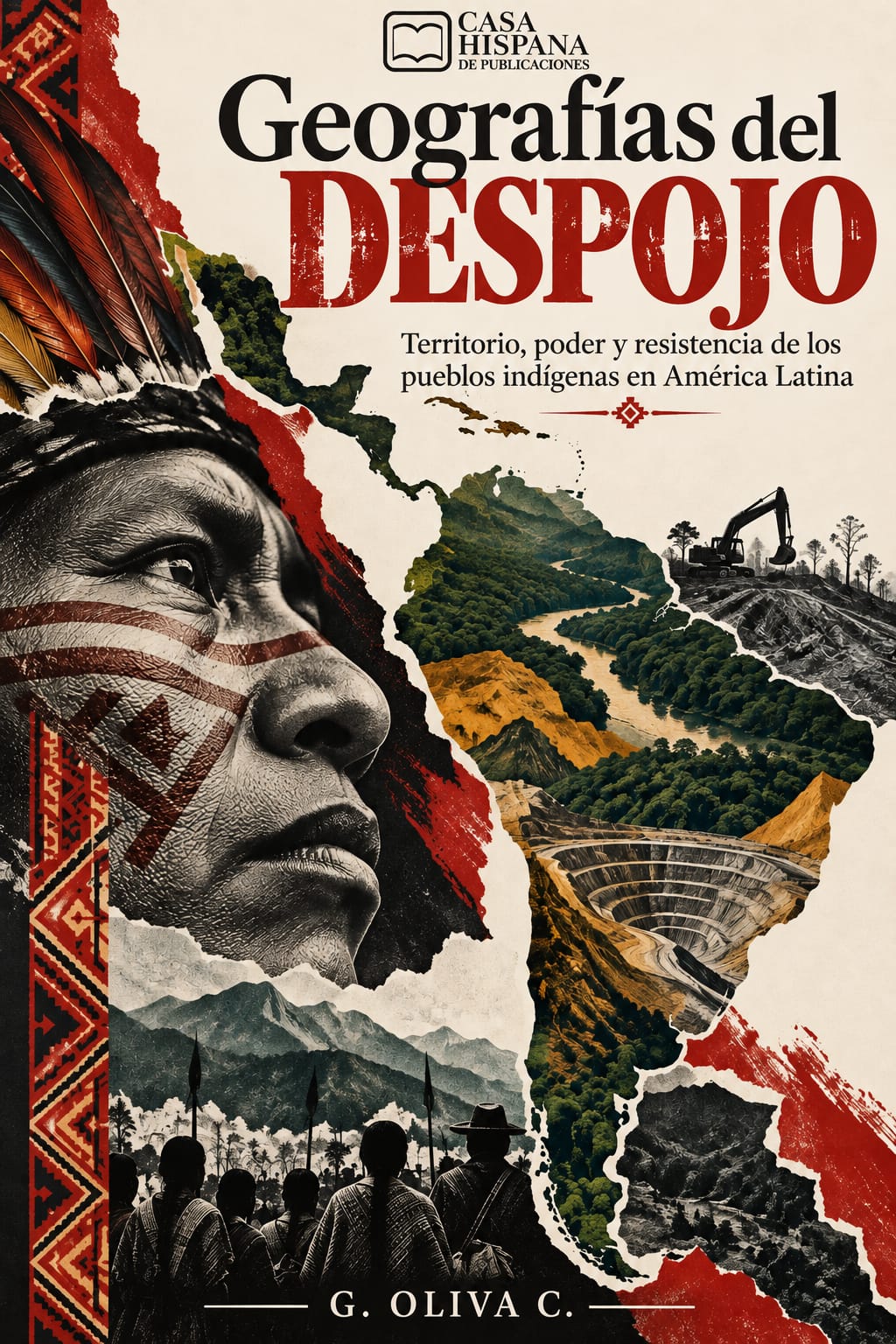
Geografías del despojo offers a critical reading of the historical relationship between territory, power and Indigenous peoples in Latin America. The work starts from a fundamental premise: territorial dispossession is not solely an event of the colonial past, but a long-term historical process that has taken different political, legal, economic and cultural forms. From this perspective, geography ceases to be understood simply as the physical description of space and becomes a decisive aspect of relations of power. Territory appears, then, as inhabited space, collective memory, source of subsistence, sphere of social organisation and permanent arena of dispute. The book examines the territorial construction of Latin America in the light of the profound changes produced since the European conquest and colonisation. The occupation of Indigenous territories, the transformation of systems of property, the reorganisation of populations, the exploitation of natural resources and the later consolidation of the nation states significantly altered the pre-existing geographies. Political borders, private properties, concessions, agricultural, mining and forestry operations and infrastructure projects gradually shaped new maps of power over territories that had histories, meanings and forms of organisation predating the formation of the contemporary states. In this sense, Geografías del despojo argues that maps are never completely neutral. To delimit, name, register, parcel out and administer a territory are operations that can acquire a deep political significance. Cartography can represent a territorial reality, but it can also take part in the institutional construction of that reality. What appears in law as property, concession, administrative boundary or area of exploitation may coincide with territories that Indigenous communities understand in terms of much wider historical, family, spiritual, economic and cultural relationships. Territory – Power – Memory – Dispossession – Resistance are therefore the great interpretative axes of the work. Territory is not approached exclusively as a surface open to economic appropriation. For many Indigenous peoples it represents a web of relationships in which community, ancestral belonging, water, forest, mountain, ceremonial places, cemeteries, paths, traditional knowledge and their own mechanisms of social reproduction converge. To lose territory can consequently mean much more than losing a given extent of land: it can affect the material and cultural conditions that allow a community to continue. From a historical perspective, the book pays special attention to the continuity and transformation of the mechanisms of dispossession. The independence of the Latin American countries did not necessarily mean the disappearance of territorial pressures on Indigenous peoples. During the nineteenth and twentieth centuries, different processes of state expansion, internal colonisation, privatisation, territorial reduction, incorporation of lands into national markets and intensive exploitation of resources produced new territorial configurations. The experiences differed according to each country and people, which is why the work avoids turning Latin American Indigenous diversity into a single historical experience. This aspect is fundamental. Latin America is not a homogeneous Indigenous reality. The Mapuche, Quechua, Aymara, Maya and Guaraní peoples, and many Amazonian, Andean and Mesoamerican peoples and peoples of other regions, have distinct historical trajectories, social systems, languages and territorial relationships. Consequently, the concept of dispossession must be used with historical precision. Not every territorial transformation responds to the same mechanism, nor can every relationship between State, companies and Indigenous communities be interpreted through a single explanation. The economy likewise occupies a central place. The expansion of extractive and productive activities has turned many Indigenous territories into strategic spaces for national and global economies. Mining, hydrocarbons, forestry, monocultures, energy infrastructure, roads, dams and other territorial interventions raise questions about who decides over the territory, who receives the benefits, who bears the socio-environmental costs and what mechanisms are available for communities to take part in decisions that affect their living conditions. Thus, the concept of geographies of dispossession makes it possible to understand that inequality also has a spatial expression. There are centres and peripheries, territories highly integrated into economic circuits and territories historically marginalised from services and infrastructure; spaces valued for their resources and communities that, paradoxically, may remain in situations of vulnerability within them. Territory thus reveals the contradictions between natural wealth, economic concentration, social inequality and the recognition of rights. But this work does not set out to build a history in which Indigenous peoples appear solely as passive victims. Over against the geographies of dispossession there are also geographies of resistance. Communities have developed many strategies of historical continuity: territorial defence, cultural recovery, linguistic strengthening, community organisation, political mobilisation, legal action, intercultural education, Indigenous intellectual production and coordination with national and international organisations. Resistance must not be reduced exclusively to open conflict. It is also expressed in the everyday persistence of a language, a ceremony, a family memory, a community practice or a particular way of understanding territory. From this perspective…
Category
- SOCIAL SCIENCES
- LATIN AMERICAN STUDIES
- INDIGENOUS STUDIES
- SOCIAL AND POLITICAL ANTHROPOLOGY
- HUMAN AND POLITICAL GEOGRAPHY
- INDIGENOUS TERRITORIALITY
- TERRITORIAL DISPOSSESSION
- COLONIALISM AND POWER RELATIONS
- COLLECTIVE RIGHTS
- INDIGENOUS RESISTANCE
- TERRITORIAL JUSTICE AND SELF-DETERMINATION
Rights for this book
We turn publishing rights into international growth, connecting authors and publishers with new markets, new readers and new partners around the world.
Technical details
- Title
- Geografías del despojo
- Author
- G. Oliva C.
- Imprint
- Grupo Editorial casa Hispana
- Size
- 15x23cms
- Edition
- 1st edition, 2026
- Published in
- Chile
- Year of publication
- 2026
- Available languages
- Spanish, English, German, Portuguese
- Binding
- Paperback with flaps
- Pages
- 481