
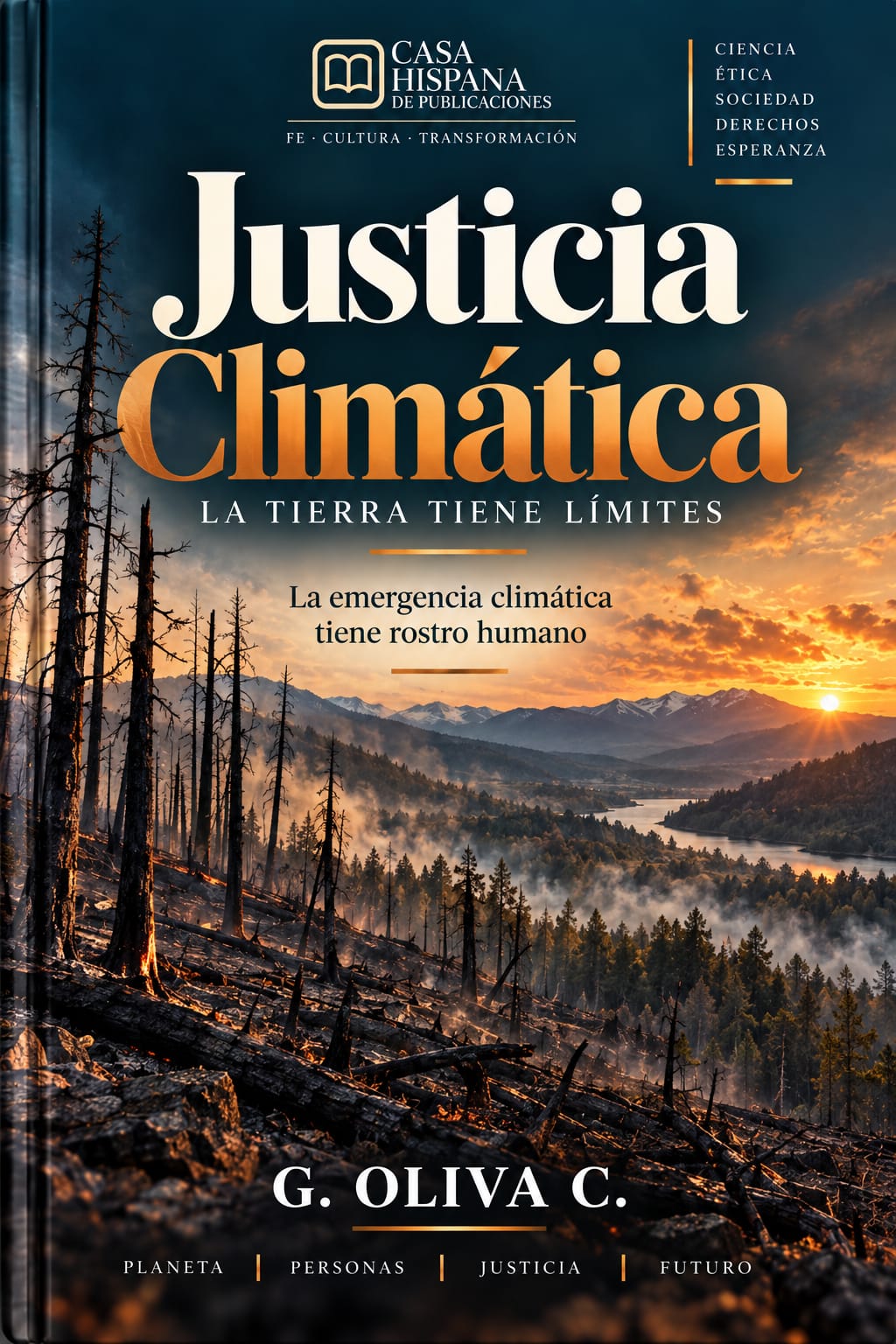
Description
Climate justice constitutes one of the fundamental concepts for understanding the human, social, economic, territorial and ethical dimension of climate change, because it makes it possible to recognise that the climate crisis cannot be analysed solely as a physical alteration of the planet's temperature, nor exclusively as a problem related to greenhouse gas emissions, but also as a question deeply linked to the unequal distribution of risks, responsibilities, resources and adaptive capacities among different societies, communities and generations; to speak of climate justice means asking who has historically contributed most to the accumulation of emissions, who receives the benefits associated with certain models of production and consumption, who currently bears the most serious impacts, who possesses greater resources to protect themselves and who faces floods, droughts, fires, heatwaves, food insecurity, deterioration of ecosystems or displacement while having considerably smaller economic and institutional capacities to respond. From the perspective developed by the author, climate justice represents a necessary broadening of the environmental discussion, because it places the person and communities within the climate analysis without separating the protection of nature from human dignity; climate change affects ecosystems, but its consequences are transmitted to agriculture, water availability, food production, health, infrastructure, energy, economy, housing, work, migration and the security of communities; for this reason behind every climate indicator there are concrete human realities, and behind every environmental transformation there may be families, workers, farmers, fishers, indigenous peoples, rural communities, coastal populations and urban inhabitants whose possibilities of adaptation are profoundly different. This inequality constitutes one of the starting points of climate justice; a flood may affect two communities with the same physical intensity and produce completely different social consequences; a population with resilient infrastructure, drainage systems, early warning systems, financial insurance, health services, evacuation capacity and sufficient public resources may recover relatively quickly, while an impoverished community with precarious housing, insufficient infrastructure, scarce access to credit and limited social protection may take years to rebuild its living conditions; the climate phenomenon may be similar, but social vulnerability determines a fundamental part of the damage finally experienced. For this reason climate justice studies not only threats but also vulnerabilities and response capacities; exposure to an environmental hazard does not by itself determine the final level of risk; it is necessary to consider the social, economic, territorial and institutional conditions that allow a population to anticipate, resist, adapt and recover. One of the central concerns running through this work consists precisely in preventing the climate crisis from being presented as if all of humanity faced exactly the same problem under the same conditions; the expression global climate change correctly describes the planetary scale of the phenomenon, but global does not mean uniform; its manifestations vary territorially, and human capacities to face them also vary profoundly. Lower-income communities usually have fewer resources to finance adaptation systems, modify housing, take out insurance, change productive activities, access new technologies or relocate when certain environmental conditions become dangerous; this reality turns economic inequality into a relevant factor of climate vulnerability. Climate justice therefore has a close relationship with human rights, because certain impacts can affect conditions necessary for the effective exercise of rights linked to water, food, health, housing, livelihoods, culture and an adequate environment; when a prolonged drought reduces water availability, when a flood destroys homes, when the loss of agricultural productivity compromises family income or when sea-level rise threatens coastal settlements, the climate crisis ceases to be an abstract environmental question and begins to directly affect fundamental conditions of existence. The protection of human dignity therefore needs to be incorporated into climate mitigation and adaptation strategies; it is not enough to reduce emissions if certain policies generate new forms of exclusion, nor is it sufficient to build adaptation infrastructure if only the sectors with greater resources can access it. Climate justice thus introduces a fundamental distributive question: how should the costs and benefits of climate action be distributed? This question acquires special importance when considering historical responsibilities, because the accumulation of greenhouse gases in the atmosphere is related to processes of industrialisation developed over long periods, and historical and current contributions have not been equal among countries, economic sectors, companies and populations. However, this question needs to be analysed with precision; the distribution of climate responsibilities may vary depending on whether one looks at accumulated historical emissions, total current emissions, emissions per inhabitant, economic capacities or consumption patterns; for this reason a rigorous understanding of climate justice avoids excessively simplified explanations and recognises that there are different legitimate criteria for examining responsibilities. The principle of common but differentiated responsibilities expresses precisely the idea that facing climate change constitutes a shared responsibility, but the obligations and response capacities are not necessarily identical; everyone needs to contribute, but historical, economic, technological and social conditions must be considered when designing cooperation mechanisms. This differentiation is particularly relevant for developing countries that need simultaneously to reduce poverty, expand infrastructure, improve public services, generate employment and progressively transform their energy systems; demanding exactly the same pace and cost of transition from economies with profoundly different financial capacities can produce new inequalities. Climate justice therefore seeks to articulate environmental responsibility with economic capacity and development needs. Mitigation constitutes a fundamental dimension of this response, because reducing emissions and strengthening carbon sinks is necessary to limit the future magnitude of climate change, but the way that transition is carried out also has distributive consequences. Transforming energy systems, transport, industry, construction, agriculture and consumption patterns requires considerable investment and may change labour markets, territories and production chains; some activities will decline while others grow, some jobs will disappear and others will be created, certain regions may benefit from new investment while others could experience economic losses. Here the concept of a just transition arises, which seeks to ensure that the transformation towards lower-emission economies does not abandon workers, families and communities whose livelihoods currently depend on carbon-intensive activities. An energy transition may be environmentally necessary but socially conflictive when a community abruptly loses its main source of employment without productive alternatives, training, social protection or territorial investment; climate justice requires anticipating these effects and developing policies capable of accompanying those who will face the greatest costs of transformation…
Category
- CLIMATE JUSTICE
- CLIMATE CHANGE
- ENVIRONMENT
- SUSTAINABLE DEVELOPMENT
- SUSTAINABILITY
- ENVIRONMENTAL JUSTICE
- SOCIAL JUSTICE
- CLIMATE EQUITY
- HUMAN RIGHTS
- ENVIRONMENTAL RIGHTS
- HUMAN DIGNITY
- SOCIO-ENVIRONMENTAL INEQUALITY
- CLIMATE VULNERABILITY
- VULNERABLE COMMUNITIES
- CLIMATE RESPONSIBILITY
- HISTORICAL RESPONSIBILITY
- CLIMATE MITIGATION
- CLIMATE ADAPTATION
- CLIMATE RESILIENCE
- JUST TRANSITION
- ENERGY TRANSITION
- CLIMATE GOVERNANCE
- CLIMATE POLICIES
- CLIMATE ACTION
- CLIMATE FINANCE
- INTERNATIONAL COOPERATION
- GLOBAL SOLIDARITY
- LOSS AND DAMAGE
- INTERGENERATIONAL JUSTICE
- INTERGENERATIONAL RESPONSIBILITY
- FUTURE GENERATIONS
- WATER SECURITY
- FOOD SECURITY
- BIODIVERSITY
- ENVIRONMENTAL CONSERVATION
- PROTECTION OF ECOSYSTEMS
- ECOLOGICAL RESTORATION
- NATURAL RESOURCES
- TERRITORY
- TERRITORIAL JUSTICE
- TERRITORIAL DEVELOPMENT
- INDIGENOUS PEOPLES
- INDIGENOUS RIGHTS
- RURAL COMMUNITIES
- COASTAL COMMUNITIES
- CITIZEN PARTICIPATION
- COMMUNITY PARTICIPATION
- CLIMATE EDUCATION
- ENVIRONMENTAL HEALTH
- RENEWABLE ENERGY
- LOW-CARBON ECONOMY
- ENVIRONMENTAL INNOVATION
- INTEGRAL ECOLOGY
- ECOTHEOLOGY
- THEOLOGY OF CREATION
- CARE OF CREATION
- ENVIRONMENTAL ETHICS
- SOCIAL RESPONSIBILITY
- COMMUNITY RESILIENCE
Rights for this book
We turn publishing rights into international growth, connecting authors and publishers with new markets, new readers and new partners around the world.
Technical details
- Title
- Justicia climática
- Author
- G. Oliva C.
- Imprint
- Grupo Editorial casa Hispana
- Size
- 15x23cms
- Edition
- 1st edition, 2023
- Published in
- Chile
- Year of publication
- 2024
- Available languages
- Spanish, English, German, Portuguese
- Binding
- Paperback with flaps
- Pages
- 485