Description
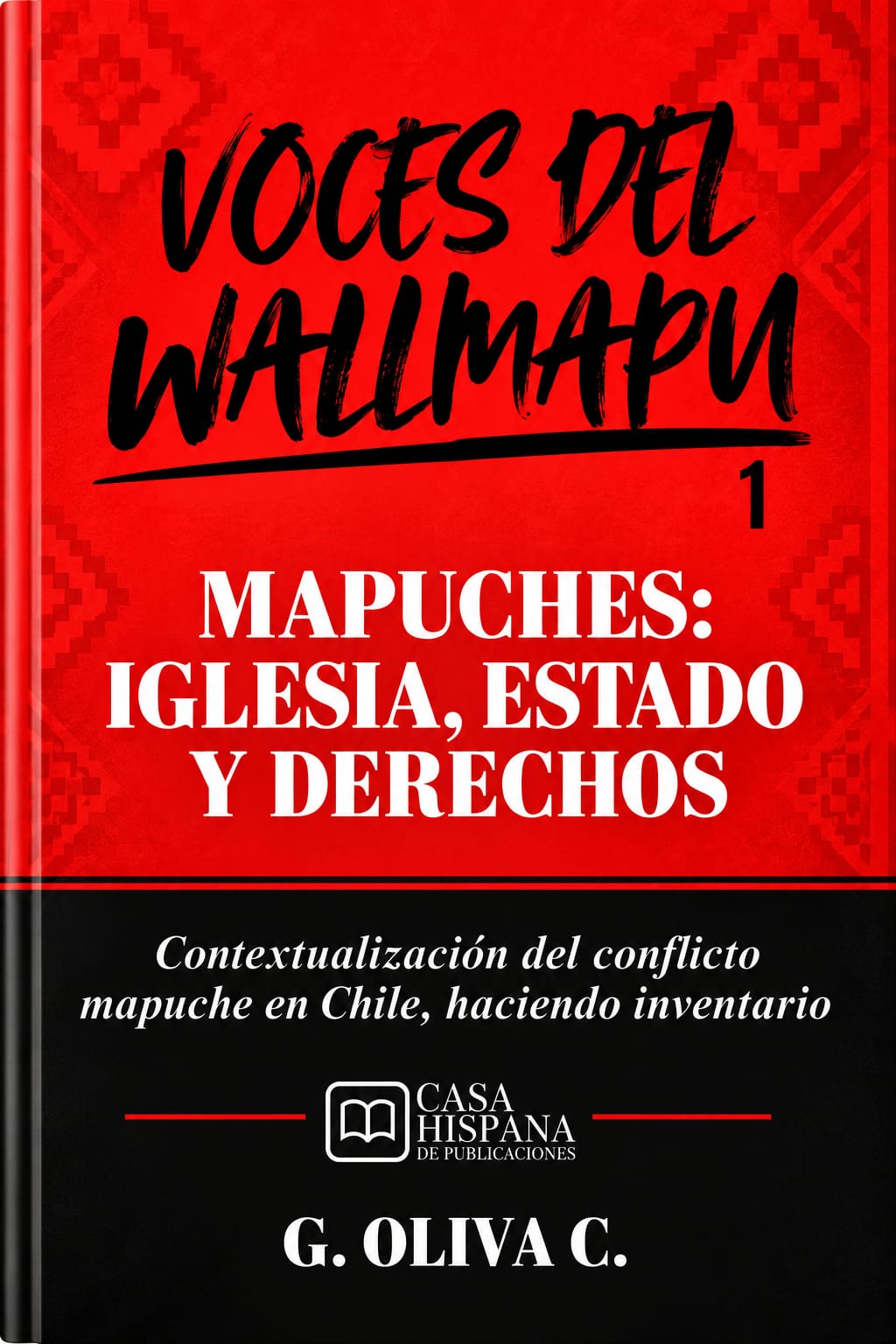
The Mapuche: Church, State and Rights is a historical, sociological and interdisciplinary work that examines the complex relationship between the Mapuche people, the State and the Church, placing at the centre of its analysis such fundamental questions as territory, identity, historical memory, collective rights, interculturality and recognition. The book proposes that the so-called Mapuche question be understood not as an isolated or exclusively contemporary phenomenon, but as the outcome of long-run historical processes whose consequences continue to shape social and institutional relations in the present. From a historical standpoint, the work traces the decisive moments in the relationship between the Mapuche people and the structures of power. The processes of conquest and colonisation, the frontier parliaments and treaties, the expansion of the nation states over Indigenous territories during the nineteenth century, the confinement of Mapuche territory to the reducciones (the reservation-like land settlements imposed by the Chilean State) and the later policies of integration and assimilation are all indispensable background if present-day Mapuche demands are to be understood. The author is careful to avoid simplifying readings: the contemporary conflict cannot be explained by recent events alone, because behind them lies an accumulation of memories, territorial losses, cultural transformations, experiences of subordination and historical demands for recognition. Sociologically, the work makes it possible to analyse how these processes have shaped the construction of Mapuche identity and its relations with the majority society. Territory appears here as a reality that reaches well beyond the economic. For the Mapuche people it also stands for belonging, memory, community, culture and historical continuity. Understanding that relationship is essential if concepts such as autonomy, territoriality, recognition and collective rights are to be interpreted properly. The book also attends to the processes of migration, urbanisation, discrimination, political organisation and cultural revitalisation that have profoundly transformed contemporary Mapuche society. One especially significant component of the work is its analysis of the State and its historical responsibility. The author examines critically the policies through which the States of Chile and Argentina dealt with Mapuche territories and communities, along with the later tensions between state sovereignty, property, public security and Indigenous rights. From this standpoint the work takes in the contemporary development of international law on Indigenous peoples and such fundamental concepts as self-determination, participation, consultation, cultural identity and territorial protection. The Church is the third major actor examined. Its historical presence among Indigenous communities is a complex reality that calls for a critical and balanced reading. Missionary activity contributed at various points to educational, linguistic, pastoral and community work; certain forms of evangelisation, however, were also bound up with cultural models that did not always give sufficient recognition to the autonomy and the worldview of Indigenous peoples. The book therefore raises a question of particular relevance for contemporary Christianity: how is the Gospel to be proclaimed while showing deep respect for the cultural identity of the other? That question leads towards an intercultural understanding of mission, one capable of distinguishing evangelisation from cultural assimilation. One of the study's distinctive contributions lies in the author's attempt to approach Mapuche reality not only through historical documents and academic categories, but also through observation and fieldwork among Mapuche communities. That contact makes it possible to recognise that behind concepts such as conflict, territory or rights there are particular people, families, communities and memories. The experience does not, however, claim to replace documentary rigour; it works as a space of contrast and understanding that humanises the research and encourages a dialogue between history, sociology and territorial reality. The Mapuche: Church, State and Rights does not set out to romanticise the Mapuche people or to construct a one-sided reading of the conflict. Its purpose is to contribute to a more rigorous understanding of a reality shot through with historical responsibilities, legitimate demands, legal controversies and competing political interpretations. It is precisely for that reason that the work proposes moving on from simplified confrontation towards historical knowledge, intercultural dialogue, justice, recognition and the building of more respectful relations between the State, the churches and Indigenous peoples. In short, the book is an invitation to look at the Mapuche question from a profoundly human standpoint. Understanding the present requires listening to the memories of the past, but also building the conditions for a future shared life grounded in dignity and respect. In that meeting of memory, territory, Church, State and rights lies the core of a work that seeks to contribute to the academic and public debate on one of the historical challenges still outstanding in the south of Latin America. Taking stock of a historical relationship that remains unfinished: One of the concepts that carries particular weight in The Mapuche: Church, State and Rights is the idea of “taking stock”. The author uses it as an intellectual, historical and human exercise: to pause before the relationship between the Mapuche people and the States of Chile and Argentina in order to identify which events, conflicts, demands, responsibilities and unresolved matters have accumulated over time. The point is not to take stock in order to remain anchored in the past, but to understand which elements of the past are still at work on the present. Taking stock means, in this sense, recognising before proposing solutions. It involves identifying what has been resolved, what remains outstanding and what, as a result of new social and political transformations, has taken on contemporary forms. The Mapuche question cannot be reduced to the land problem alone, even though territory occupies a central place. It is a multidimensional relationship in which history, property, identity, culture, recognition, security, economic development, collective rights, political participation, the environment and memory all converge. Territory: the historical core of the conflict. The first item in this stocktaking is inevitably the territorial question. In Chile, the State itself has institutionally acknowledged that there is a historical land claim which the system now in force has failed to resolve satisfactorily. The Presidential Commission for Peace and Understanding, whose final report was delivered in May 2025, recommended establishing a new land system and bringing Indigenous legislation into line with ILO Convention 169. (Government of Chile) This shows that land does not belong to the past alone. It remains one of the principal matters of contemporary dispute. For a substantial part of the Mapuche world, moreover, territory cannot be understood solely through the Western category of individual property. It is bound up as well with community, ancestry, memory, identity, spirituality and cultural continuity. Conflict arises precisely when different legal, economic and cultural conceptions of territory meet within one and the same space. Chile: security, violence and territorial claims. A second item concerns the contemporary cycle of violence and state response. In certain areas of southern Chile, territorial claims coexist with rural violence, arson attacks, the destruction of infrastructure, confrontations and police operations. From the State's standpoint there is an obligation to guarantee security, protect people and prosecute crime; from the communities and Indigenous organisations come objections concerning criminalisation, the use of force and the political and policing treatment of a problem with historical roots. Academically it is essential to avoid one confusion: Mapuche claims and violence are not equivalent categories. The Mapuche people are a diverse social reality, and responsibility for acts carried out by particular organisations or individuals cannot be attributed collectively to their communities. That very diversity is another item in the stocktaking: there is no single Mapuche voice. There are communities, traditional authorities, territorial organisations, urban associations, intellectuals, leaders and movements holding different positions on autonomy, the restitution of territory, negotiation with the State and political strategy. Recognition and participation. A third item concerns institutional recognition. The relationship between the State and Indigenous peoples has moved from predominantly assimilationist models towards paradigms of cultural recognition and collective rights. The gap between legal recognition and practical application, however, continues to generate controversy. ILO Convention 169 introduced particularly important principles concerning consultation, participation and the rights of Indigenous peoples. In Chile, Indigenous consultation is in law a right of those peoples and a duty of the State in respect of certain measures liable to affect them directly. (Indigenous Consultation) The contemporary difficulty lies in determining how that participation is turned into effective influence, legitimate dialogue and the building of agreements. Recent experience demonstrates exactly that complexity. The Chilean consultation process on a new land system, planned in the wake of the recommendations of the Commission for Peace and Understanding, ran into difficulties over participation and was suspended once again in February 2026, as the official record shows. (Official Gazette). Sociologically this is telling: it shows that the challenge is not merely to create mechanisms for dialogue, but to build the conditions of trust that make dialogue possible. Argentina: territory, communal property and legal certainty Across the Andes the stocktaking takes on different features, though important historical continuities remain. In Argentina the Mapuche question is especially present in Neuquén, Río Negro and Chubut, as well as in other provinces. There too, territorial demands, the recognition of communities, private property, natural resources, tourism, protected areas and the competing powers of national and provincial authorities all converge. Law 26.160 had declared an emergency in respect of the possession and ownership of lands traditionally occupied by Indigenous communities and established technical, legal and cadastral surveys. The Argentine State itself describes these surveys as instruments for identifying current, traditional and public occupation and for moving towards the regularisation of territory. (Argentina.gob.ar). The picture changed significantly, however, when Decree 1083/2024 declared that emergency, and the suspension of evictions that accompanied it, at an end. (Argentina.gob.ar). This change brings into view one of the central tensions of the Argentine case: how to reconcile constitutional recognition of Indigenous rights, communal property, the rights of registered owners, provincial powers and legal certainty. Natural resources and development. Another indispensable component of the stocktaking is natural resources. Land, water, forests, mining, hydrocarbons, energy, infrastructure and protected areas turn certain Indigenous territories into spaces where community, state and corporate interests converge. The contemporary problem can no longer be framed simply as “the State versus the Mapuche people”. Many of these conflicts also involve companies, private owners, regional or provincial governments, municipalities, environmental organisations and non-Indigenous local communities. This turns the Mapuche question into a problem of territorial governance. The question is no longer only who owns a given space; it now includes who takes part in the decisions, how the benefits of development are distributed, which environmental impacts are acceptable and how legitimate rights that may stand in tension with one another are to be protected. Identity and cultural revitalisation. The stocktaking must also take in elements that do not belong to the conflict alone. There is a significant process of Mapuche cultural and identity revitalisation under way. Language, names, symbols, ceremonies, traditional knowledge, community organisations and the recovery of historical memory are all part of contemporary processes through which new generations are rebuilding their relationship with Mapuche identity. This is happening in rural communities and in urban settings alike. Present-day Mapuche people cannot be reduced to a historical image of the Indigenous person living exclusively in rural communities. There are Mapuche professionals, academics, students, workers, leaders, artists and families integrated into a range of social settings. This reality compels us to move beyond static representations of Indigenous identity. The Church: it too must take its own stock. The idea of taking stock reaches the Church as well. The Church needs to review critically its historical presence among the Mapuche people. It must acknowledge the contributions made by missionaries, educators, translators and Christian communities, but it must also ask at what points evangelisation, Westernisation and cultural assimilation were confused with one another. That review should not lead to a denial of the Christian mission. It should lead towards a more mature mission. The contemporary Church needs to ask whether it is ready to proclaim the Gospel from a genuinely intercultural standpoint, one in which conversion to Jesus Christ is not presented as the compulsory abandonment of cultural identity. A contemporary stocktaking. In this way the book makes it possible to set out systematically the principal components of the contemporary question: territory and restitution; communal property and private property; constitutional recognition; autonomy and self-determination; consultation and participation; public security and violence; criminalisation; economic development; natural resources; the environment; cultural revitalisation; language and identity; Indigenous urbanisation; historical memory; cross-border relations; Church and evangelisation; interculturality; reparation and reconciliation. This stocktaking shows that there is no single solution. A problem built up over generations can hardly be resolved by one law, one transfer of land, one police operation or one round table. Chile and Argentina: a history divided by a border. There is, finally, a particularly important matter: the Mapuche people have a history that predates the present-day borders between Chile and Argentina. The nation states later drew a political frontier across spaces in which Indigenous territorial, economic, family and cultural relations already existed. This does not cancel the contemporary sovereignty of either State, but it is indispensable background if one is to understand why certain Mapuche territorial categories do not necessarily coincide with today's political and administrative divisions. Studying the Mapuche question exclusively from Santiago or Buenos Aires is therefore insufficient. The territory and the communities must also be understood from within. A final consideration. The Mapuche: Church, State and Rights thus proposes a stocktaking that does not set out to apportion blame mechanically between the good and the bad. It seeks something academically more demanding: to reconstruct responsibilities, identify the actors, recognise rights, distinguish legitimate claims from violence, and understand the historical complexity before formulating contemporary answers. Taking stock means asking ourselves what we have inherited. What remains outstanding. Which mistakes have been repeated. Which rights need to be made effective. Which responsibilities fall to the State. Which responsibilities fall to the organisations and social actors themselves. What part falls to the Church. And, above all, what conditions must be built so that Mapuche and non-Mapuche can share one political territory without that requiring their historical and cultural differences to be erased. In this sense, the Mapuche question should not be understood solely as an Indigenous problem. It is also a question put to Chile and Argentina about the kind of intercultural societies they wish to build. Taking stock of the past is indispensable, but it is not the final destination. Its real purpose is to provide the materials for moving towards historical truth, recognition, justice, security, dialogue, reparation and shared life. Because a society does not overcome its historical conflicts simply by ceasing to speak of them. It begins to overcome them when it manages to understand them with enough rigour not to go on reproducing them…
Category
- CULTURAL ANTHROPOLOGY
- ARGENTINA
- SELF-DETERMINATION
- CHILE
- SOCIAL SCIENCES
- COLONIALISM
- SOCIAL CONFLICT
- INDIGENOUS CONSULTATION AND PARTICIPATION
- ILO CONVENTION 169
- LAW
- HUMAN RIGHTS
- COLLECTIVE RIGHTS
- RIGHTS OF INDIGENOUS PEOPLES
- TERRITORIAL RIGHTS
- STATE AND FIRST PEOPLES
- ETHNIC STUDIES
- INDIGENOUS STUDIES
- CROSS-CULTURAL EVANGELISATION
- TERRITORIAL GOVERNANCE
- HISTORY OF CHILE AND ARGENTINA
- LATIN AMERICAN HISTORY
- MAPUCHE HISTORY
- CONTEMPORARY CONFLICTS
- HUMANITIES
- MAPUCHE IDENTITY
- IDENTITY AND TERRITORY
- CHURCH AND INDIGENOUS PEOPLES
- CHURCH AND SOCIETY
- INTERCULTURALITY
- JUSTICE AND REPARATION
- HISTORICAL MEMORY
- MISSIOLOGY
- COMMUNAL PROPERTY
- MAPUCHE PEOPLE
- INDIGENOUS PEOPLES
- CONSTITUTIONAL RECOGNITION
- STATE RELATIONS
- INTERCULTURAL RELATIONS
- INTER-ETHNIC RELATIONS
- TERRITORIAL RESTITUTION
- CULTURAL REVITALISATION
- SOCIOLOGY
- CONTEXTUAL THEOLOGY
- INDIGENOUS THEOLOGY
- TERRITORIALITY
- TERRITORY AND HISTORICAL MEMORY
- WALLMAPU
Rights for this book
We turn publishing rights into international growth, connecting authors and publishers with new markets, new readers and new partners around the world.
Technical details
- Title
- Mapuches: Iglesia, Estado y Derechos
- Author
- G. Oliva C.
- Imprint
- Grupo Editorial Casa Hispana de Publicaciones
- Size
- 15x23cms
- Edition
- 1st edition, 2024
- Published in
- Chile
- Year of publication
- 2025
- Available languages
- Spanish, English, German, Portuguese
- Binding
- Paperback with flaps
- Pages
- 597
- Format
- Print book
- Language
- Spanish