Description
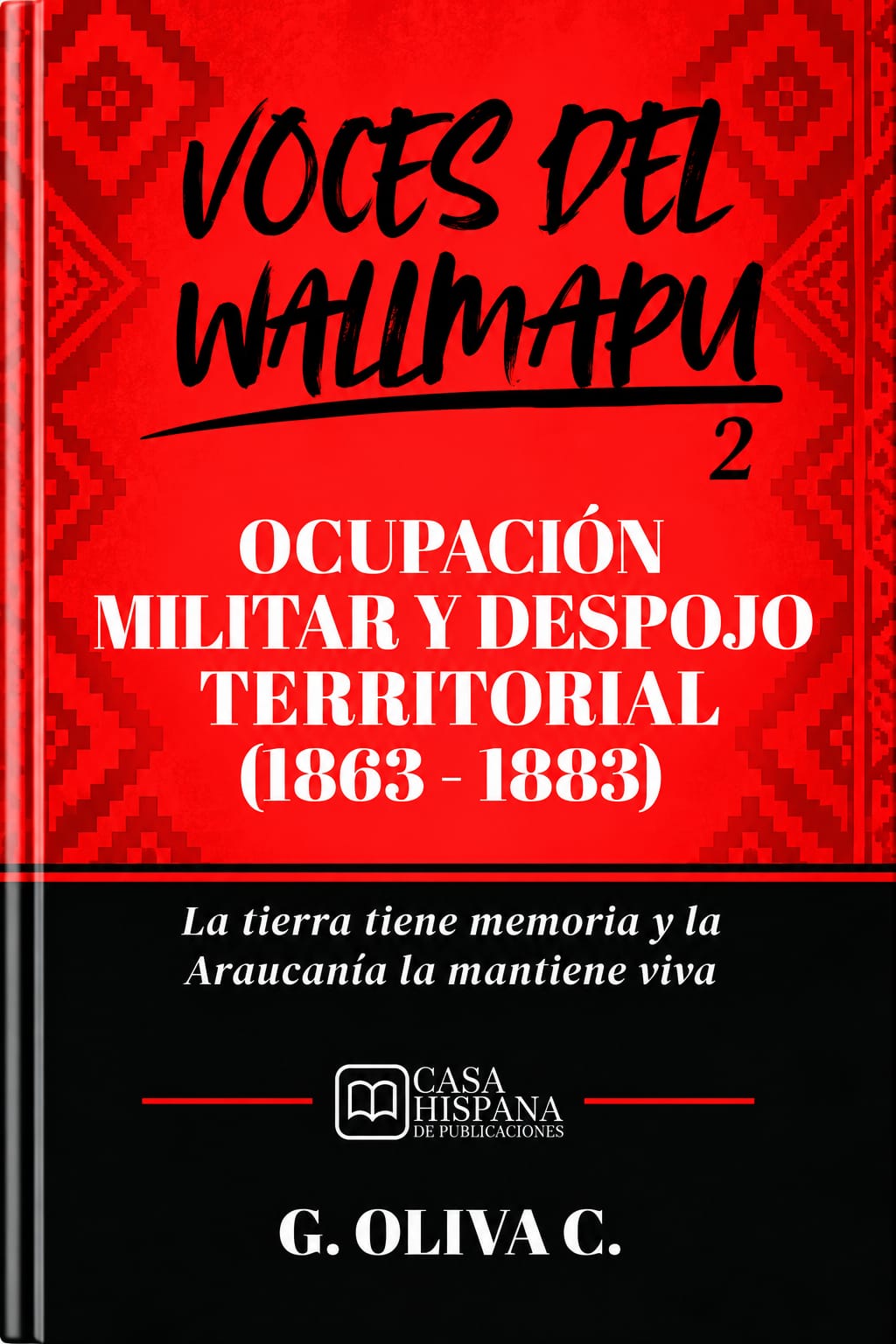
Military Occupation and Territorial Dispossession (1863–1883) addresses one of the most decisive and painful periods in the history of relations between the Chilean State and the Mapuche people. This second volume examines critically the process traditionally called the “Pacification of the Araucanía”, an expression that for decades formed part of official Chilean historiography but that today is inadequate to describe the political, military, territorial and human complexity of what took place. The National Library of Chile itself now characterises this period as a process of military occupation and colonisation whose outcome included territorial annexation, the resettlement of communities into reducciones (the reservation-like land settlements imposed by the Chilean State) and subsequent processes of sociocultural assimilation. (Memoria Chilena). The book begins from a fundamental question: what did the incorporation of the Araucanía into the territory controlled by the Chilean State actually mean? Answering it requires looking beyond the military campaigns. The occupation did not consist solely of clashes between the Army and Mapuche groups; it also involved moving the frontier, building forts, founding towns, installing new authorities, opening roads, colonisation and the progressive reorganisation of landholding. It was, in consequence, a structural transformation of the relations between territory, power and society. The work situates the process within the building of the Chilean nation state during the nineteenth century. After independence, the republican authorities faced the problem of territorially consolidating a country whose effective sovereignty was not exercised in the same way over all the spaces it claimed as its own. South of the Biobío there remained a Mapuche political and territorial reality with its own authorities, community structures, economic relations and mechanisms of negotiation. For the State, the existence of this frontier represented a problem of territorial continuity, particularly because Valdivia and Chiloé lay further south. (Memoria Chilena). From this perspective, the book analyses the occupation as part of a broader project of state building and consolidation. For the Chilean authorities of the period, advancing into the Araucanía was bound up with sovereignty, frontier security, agriculture, colonisation, communications and economic expansion. Acknowledging these historical motives, however, does not mean accepting their consequences uncritically. One of the academic purposes of the work is precisely to set the state rationality of the nineteenth century face to face with the experience of the communities that inhabited those territories. The advance of the frontier. The 1860s represent a decisive moment. Cornelio Saavedra proposed a system of progressive occupation based, among other elements, on the establishment of fortified lines. The advance of the frontier was subsequently accompanied by forts, villages, towns and military campaigns. Historians have distinguished several phases between 1862 and 1883: first territorial advances and fortifications; then the implementation of the Malleco line and further incursions; and finally a stage marked by more intense confrontations that led to the general uprising of 1881 and to the military consolidation of the following years. (Memoria Chilena). This progression shows that the so-called “Pacification” was neither a single event nor a linear campaign. It was a prolonged process, run through simultaneously by war, negotiations, treaty assemblies (parlamentos), truces, resistance and alliances. This point is fundamental to the historical interpretation the book proposes. Neither the Chilean State nor the Mapuche world should be presented as wholly homogeneous blocs. Among the Mapuche there were different territories, forms of leadership and strategies in the face of the state advance. Some sectors negotiated, others reached circumstantial agreements and others mounted armed resistance. State strategies likewise changed according to period, authorities and political circumstances. Recognising this diversity makes it possible to write a considerably more human history. Mapuche resistance. The work gives a central place to Mapuche historical agency. The communities do not appear simply as passive victims of an external force. There was resistance, there was negotiation, there were displacements, alliances and political strategies. The figure of Külapang (Quilapán) and the wenteche resistance takes on particular importance within this period. The historical record documents sustained confrontations with the advancing Army and a complex web of relations among Mapuche authorities, soldiers, settlers and state representatives. (Memoria Chilena) This perspective makes it possible to recover the Mapuche people as the subject of their own history. Nevertheless, the disparity in military resources and the institutional capacity of the State progressively altered the existing balance. The campaigns advanced through new military positions and territorial control. Building forts was not merely defensive: it concretely reshaped the geography of power. Each new line made it possible to establish a state presence, to facilitate new settlements and to prepare the administrative incorporation of the surrounding space. Violence and human experience. Nor can a rigorous historical account reduce this process to movements on a map. Behind every shift of the frontier there were people. The war affected communities, families, dwellings, animals, harvests and forms of subsistence. Historical sources compiled by the National Library record episodes of crops destroyed, of territories and dwellings burned, of livestock seized and of grave abuses committed in the frontier context. There were also Mapuche attacks on forts, settlements and property. (Memoria Chilena). This is fundamental to humanising the research. When history speaks simply of “campaigns”, “advance” or “pacification”, there is a risk of concealing the human cost contained within those categories. The author therefore proposes approaching this period not only through military history but also through a social history of the conflict: how the communities lived through the war, what became of their productive systems, how their territorial relations changed and how the consequences were later transmitted through family and community memory. 1881: a turning point. The events of 1881 are one of the central moments of the study. That year saw a general Mapuche uprising against the state advance, with attacks at various points in the Araucanía. The military response progressively consolidated Chilean control. Operations and the building of positions continued through 1882, while the campaign towards Villarrica and its refounding at the beginning of 1883 symbolised the consolidation of a new territorial reality. (Memoria Chilena). The historical significance of this transformation is profound. For centuries, the relationship between the Mapuche and the colonial and republican authorities had been marked by a frontier, by negotiations and by parlamentos. After the occupation the relationship changed radically: the Mapuche people moved progressively from relating to the State from a distinct territorial position to being incorporated within the administrative, legal and economic structures of that same State. That change is one of the great historical ruptures the book examines. From military control to territorial dispossession. The second major strand of the work is territorial dispossession. Military occupation is only the first part of the transformation. Once state control had been consolidated, a process of territorial reorganisation began through colonisation, auctions, occupations, the demarcation of plots and the subsequent resettlement of communities. In 1883 the Comisión Radicadora de Indígenas (the commission charged with settling Indigenous communities on assigned plots) was created, and a stage began in which territorial reducción became one of the principal instruments by which the Mapuche presence was reorganised within the new state order. (Memoria Chilena) This point is essential for understanding the thesis of the volume. Military defeat had territorial consequences. And territorial consequences had social effects. Mapuche territory was not merely an economic resource. Historically it was the space in which family relations, production, mobility, exchange, authority, spirituality, memory and belonging were articulated. Reducing the territory therefore also meant transforming the society. Land as social structure. Drawing on sociology and anthropology, the work proposes understanding land through a broader category: territoriality. Modern property tends to imagine land as a bounded surface open to purchase, sale, registration and economic exploitation. For Indigenous societies, however, territory may hold productive, communal, spiritual, familial and historical meanings at the same time. The clash between these different ways of understanding land is one of the interpretative keys to the period. The State progressively introduced administrative, legal and cartographic systems designed to measure, delimit and distribute territory. The maps drawn up during the process recorded forts, military routes, villages and land earmarked for colonisation, showing that mapping the territory was itself part of its effective incorporation into the State. (Memoria Chilena) The map, in this sense, was not simply a representation. It was also an instrument of power. Reducción and the transformation of Mapuche society. Resettlement profoundly altered the social and economic structures of the communities. Confined to smaller territories, many families had to change their systems of production and mobility. The loss of territory also weakened certain traditional forms of authority. The National Library notes that the process of resettlement and reducción diminished the political and military power of the longko (the heads of a lof or community), intervened in social structures and contributed to the impoverishment of many communities. (Memoria Chilena). Here one of the principal sociological contributions of the book appears: territorial dispossession does not end when legal ownership of the land changes. Its effects can extend across generations. Less territory means changes in production. Changes in production can generate impoverishment. Impoverishment can produce migration. Migration transforms family structures. And all these experiences can remain within collective memory. The territorial history of the nineteenth century is therefore an indispensable background for understanding certain social conditions of the Mapuche people during the twentieth century and the territorial claims that continue to be voiced in the present. The construction of a new regional society. The occupation transformed not only the Mapuche people. It transformed the whole region. The arrival of settlers and the establishment of towns, roads, public institutions, agricultural activity and later railways progressively integrated the Araucanía into national economic and administrative circuits. (Memoria Chilena) A new regional order thus emerged in which Mapuche communities, Chilean settlers, European immigrants, traders, officials, soldiers and missionaries lived alongside one another — not always peacefully. The contemporary Araucanía began to take shape upon this complex superimposition of populations, memories and rights. This obliges us to avoid overly simple readings. Understanding historical Mapuche dispossession does not mean denying that later generations of non-Mapuche families have also developed legitimate bonds of belonging to the territory. It is precisely this historical layering that explains part of the present difficulty: different memories and legitimate experiences of belonging, built at different historical moments, can exist over one and the same territory. From autonomy to assimilation. One of the deepest consequences of the occupation was the change it brought about in the relationship between the State and Mapuche identity. Once the State had consolidated its territory, a long process aimed at incorporating the communities into national society began. Education, legislation, property, religious missions, the market and administration progressively penetrated spaces where greater degrees of autonomy had previously existed. The sociological problem is not simply to describe this phenomenon as integration. One must ask under what conditions that integration occurred and how much room it left for Mapuche cultural continuity. Here the tension between integration and assimilation appears. Joining a common State should not necessarily mean abandoning language, memory, identity and culture. Historically, however, the two have frequently been confused. Historical memory and contemporary conflict. The great contribution of the book lies in connecting this period with historical memory while avoiding the use of the past as an automatic explanation for every present-day conflict. Not every contemporary problem can be attributed directly to the events of 1863–1883. But nor is it possible to understand current territorial demands fully without taking into account what happened during this period. Mapuche collective memory preserves the occupation as a rupture. Traditional Chilean historiography, for its part, tended for decades to interpret the process through categories of pacification, progress, colonisation and territorial incorporation. These two memories can come into conflict. The academic task is precisely to submit both narratives to historical scrutiny, distinguishing memory, documentation, interpretation and the political use of the past. Revisiting the concept of “Pacification” The subtitle of the volume —The so-called “Pacification of the Araucanía”— therefore carries a particular methodological significance. Words are never entirely neutral. To call a military campaign a pacification is to adopt a particular perspective on what happened. Seen from the State, it may represent the definitive establishment of authority and order. For those who experienced the loss of autonomy, violence and territorial reducción, the same process may be remembered as occupation. Contemporary historiography has a responsibility to acknowledge this terminological tension. It is not simply a matter of replacing one word with another. It is a matter of asking what historical reality each concept renders visible and what it conceals. The academic and human contribution of the author. Military Occupation and Territorial Dispossession (1863–1883) seeks to contribute to this revision from an interdisciplinary perspective, bringing history, sociology, anthropology, Indigenous studies, territoriality and collective memory into dialogue. The author strives to maintain a stance particularly necessary in studies of this kind: to acknowledge historical suffering without turning the analysis into propaganda; to understand the reasons of the State without turning that understanding into automatic justification; to recognise Mapuche resistance without idealising all of its actors; and to study violence while distinguishing concrete responsibilities. Rigour demands precisely that complexity. But academic rigour should not dehumanise what it studies either. Behind concepts such as occupation, reducción, resettlement and colonisation there were real families. People who lost land, others who arrived to settle, communities that resisted, authorities that negotiated, soldiers who fought and later generations who inherited the consequences of decisions taken in those years. The book also aims to recover that human side. A final consideration. This second volume argues, in short, that the period between 1863 and 1883 is one of the great historical fractures for understanding the relationship between the Mapuche people and the Chilean State. Before the occupation there was a frontier relationship marked by autonomy, negotiation, conflict and exchange. After it another stage began: territorial reducción, colonisation, administrative incorporation and sociocultural transformation. The so-called “Pacification of the Araucanía” cannot therefore be studied only as a military victory, nor exclusively as an episode of violence. It must be understood as a structural transformation of the territory and of the relations of power. And that is where the contemporary relevance of the work lies. When people speak today of land, restitution, recognition, interculturality or Indigenous rights, the questions of the present have a history. Knowing that history does not oblige anyone to accept a single political reading of the present. But it does oblige us to recognise that the present did not begin yesterday. Military Occupation and Territorial Dispossession (1863–1883) invites the reader to return to that moment of rupture, to reconstruct it with documentary rigour and to listen to the different memories it produced. For only by understanding how the territory, the communities and the relations of power were transformed can we understand why, more than a century later, land remains memory, identity and one of the central issues in the relationship between the Chilean State and the Mapuche people. (Memoria Chilena)…
Category
- SOCIAL SCIENCES
- HISTORY
- HISTORY OF CHILE
- LATIN AMERICAN HISTORY
- MAPUCHE HISTORY
- INDIGENOUS STUDIES
- HISTORICAL SOCIOLOGY
- HISTORICAL ANTHROPOLOGY
- TERRITORIALITY
- INDIGENOUS PEOPLES
- STATE AND INDIGENOUS PEOPLES
- TERRITORIAL CONFLICTS
- HISTORICAL MEMORY
Rights for this book
We turn publishing rights into international growth, connecting authors and publishers with new markets, new readers and new partners around the world.
Technical details
- Title
- Ocupación Militar y Despojo Territorial (1863 – 1883)
- Author
- G. Oliva C.
- Imprint
- Grupo Editorial Casa Hispana de Publicaciones
- Size
- 15x23cms
- Edition
- 1st edition, 2024
- Published in
- Chile
- Year of publication
- 2025
- Available languages
- Spanish, English, German, Portuguese
- Binding
- Paperback with flaps
- Pages
- 547
- Format
- Print book
- Language
- Spanish